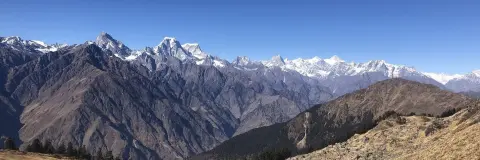
Quick answer: Nanda Devi peak is a two-summit massif in Uttarakhand. Nanda Devi West, the higher summit, is 7,817 m and Nanda Devi East is 7,434 m. Trekkers see it from Kuari Pass (3,815 m) on Day 4 of the Kuari Pass trek and from Chandrashila (3,962 m). Trekkaro's Kuari Pass batches include Free Trekking Gear.
What and where is Nanda Devi peak?
Nanda Devi is not one summit but a massif with two. The Uttarakhand Forest Department describes it as a two-peaked massif that forms a high ridge about 2 km long, running east to west. The western summit is the higher one. The eastern summit, Nanda Devi East, is lower and is known locally as Sunanda Devi.
The summits stand above a ring of mountains. The Forest Department's Nanda Devi peak page says the inside of that ring is known as the Nanda Devi Sanctuary and is protected as the Nanda Devi National Park, and that Nanda Devi East lies on the eastern edge of the ring, at the border of Chamoli, Pithoragarh and Bageshwar districts.
| Summit | Height | Where it stands |
|---|---|---|
| Nanda Devi West (the main summit) | 7,817 m | Inside the Nanda Devi National Park |
| Nanda Devi East (Sunanda Devi) | 7,434 m | On the eastern edge of the ring, where Chamoli, Pithoragarh and Bageshwar districts meet |
The two heights come from the Wildlife Institute of India, quoted in the next section.
Which protected area is Nanda Devi part of?
Nanda Devi gives its name to a whole protected landscape. The Wildlife Institute of India describes the Nanda Devi Biosphere Reserve as the second biosphere reserve of the country, spread across Chamoli, Pithoragarh and Bageshwar districts. It has two core zones, the Nanda Devi National Park and the Valley of Flowers National Park, and both are UNESCO World Heritage Sites.
The same page places Nanda Devi West (7,817 m) inside the national park and lists Nanda Devi East (7,434 m) and Trishul (7,120 m) among the peaks that line the northern boundary of the core zone. Trishul is one of the peaks you see beside Nanda Devi from Kuari Pass; our guide to Trishul peak covers it on its own.
Can you trek to Nanda Devi?
No trek goes to the top of Nanda Devi. Both summits are above 7,400 m, while the viewpoints on the treks below are Kuari Pass at 3,815 m and Chandrashila at 3,962 m. Trekkers see Nanda Devi from a distance, from a pass or a summit, across the valleys of Uttarakhand.
Where can you see Nanda Devi on a winter trek?
Among Trekkaro's winter treks, Kuari Pass and Chopta Chandrashila both name Nanda Devi in their summit view. On both, the view comes on Day 4, from the high point of the trek.
| Trek | Viewpoint and day | Height of the viewpoint | What is on the skyline |
|---|---|---|---|
| Kuari Pass | Kuari Pass, Day 4, a 13 km round trip from Khullara | 3,815 m (12,516 ft) | A 180° view of 14 peaks, among them Nanda Devi, Kamet, Chaukhamba, Kedarnath, Dronagiri, Trishul and Hathi Ghodi Parvat |
| Chopta Chandrashila | Chandrashila summit, Day 4, via Tungnath | 3,962 m (13,000 ft) | A 360° view of Chaukhamba, Kedarnath, Trishul, Bandarpoonch and Nanda Devi |
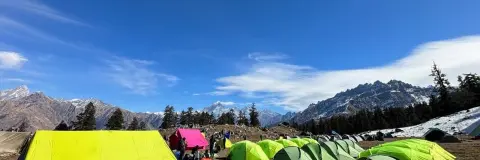
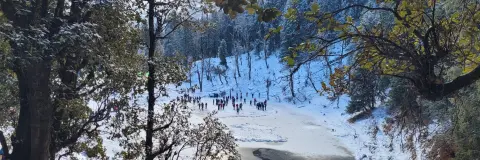
On the Kuari Pass trek, summit day starts early from Khullara, the meadow camp at 3,350 m. The trail crosses a stream and a broken bridge, then climbs the ridge, under snow in winter, and you walk back to the same tents the same day. Our Khullara camp guide describes the camp. On the Chopta Chandrashila trek, Day 4 goes from Chopta (2,679 m) past Tungnath (3,680 m) to Chandrashila, the highest point of the trek.
Which trek should you choose for a Nanda Devi view?
These two treks both give you the peak; they differ in how you get there.
| What differs | Kuari Pass | Chopta Chandrashila |
|---|---|---|
| Days and grade | 6 days, Easy–Moderate | 5 days, Moderate |
| Start and end | Pipalkoti, about 215 km from Rishikesh | Starts at Sari, about 185 km from Rishikesh; ends at Baniyakund |
| Summit day | 13 km round trip from Khullara, 8 to 9 hours | 11 km from Chopta via Tungnath and back |
| Longest walking day | Summit day, 13 km, moderate to strenuous on snow | Day 3, about 16 km from Deoriatal to Baniyakund |
| Snow on the trail | December to March | On the higher sections and the summit from December to April |
| Winter nights (December to February) | -14°C to -8°C | -10°C to -6°C |
| Season | October to April | October to June |
| Minimum age | 8 | 8 |
Pick Kuari Pass if you want the longer list of named peaks and two nights at the same high camp. Pick Chopta Chandrashila if you also want Deoriatal, Rohini Bugyal and the Tungnath temple on the way; our guide to where Chandrashila is explains how Chopta, Tungnath and the summit fit together.
How do you give yourself the clearest view of Nanda Devi?
Mountain weather decides the view, so check the Chamoli or Rudraprayag district forecast in the days before you travel. On the trek, be ready the night before summit day, because the start is early, and keep your cap and gloves on at the top, even for photos.
On Chopta Chandrashila, October and November bring clear trails and open views, with nights around 0°C. From December to February both treks are colder, with winter nights of -14°C to -8°C on Kuari Pass and -10°C to -6°C on Chopta Chandrashila, so walk at the pace your trek leader sets.
What should you check before you book a trek for the Nanda Devi view?
A summit view depends on reaching the top safely and with time to spare. Ask any company these questions before you pay; the last column gives Trekkaro's answers for the Kuari Pass trek.
| What to check | Why it matters | With Trekkaro |
|---|---|---|
| Does the itinerary give a full summit day from a high camp, back to the same tents? | Without it, the view is squeezed into a day that also has to move camp. | Yes. Day 4 goes from Khullara (3,350 m) to the pass and back to Khullara, the second night in the same camp. |
| Is the trailhead cab in the fee? | Without it you arrange and pay for the road to the trail yourself, on the way in and out. | Yes. The 15 km cab between Pipalkoti and Dhak on Days 2 and 5 is included. |
| Are snow shoes, a jacket, poles, gaiters and microspikes in the fee? | Without them you rent or buy a snow kit for a ridge that is under snow from December to March. | Yes, Free Trekking Gear: Decathlon trekking shoes, a jacket rated to -10°C, poles, gaiters and microspikes. A ₹3,000 refundable deposit and a ₹200 washing charge; buying the kit costs about ₹13,395. |
| Is SpO2 checked before the summit climb? | Without readings at the high camp, a trekker who is not coping with the height can set off anyway. | SpO2 and pulse are checked twice a day at every campsite, and a falling reading is acted on early. |
| How many trekkers per trek leader or guide? | With too few leaders, a slow walker on a 13 km snow day has nobody beside them. | Up to 20 trekkers per batch, one trek leader or guide for every 8. Leaders are trained in wilderness first aid and lead with local guides. |
| What are the cancellation terms? | Without them, a change of plan can cost you the whole fee. | 70% back at 30 or more days, 50% at 15 to 29 days, no cash refund from 14 days; up to 8 days before, a 100% TrekCash voucher (valid 1 year), a free reschedule or a transfer instead. |
| Can you pay in EMI? | Without EMI the full fee is due when you book. | EMI starts at ₹484 a month. |
| Where do extra bags stay? | Without a store, your travel bag comes up the mountain with you. | Free of charge in Trekkaro's store in Pipalkoti; valuables stay with you. |
What does the Kuari Pass trek cost?
The Kuari Pass trek fee is ₹9,400 per person plus 5% GST (₹9,870 with GST). It covers a guesthouse or homestay in Pipalkoti on Days 1 and 5, 3-person tents at Gulling and Khullara on Days 2 to 4 (shared by three, with men and women in separate tents), pure vegetarian meals from Day 1 dinner to Day 5 dinner, all trekking permits and forest camping fees, the Pipalkoti to Dhak cab and the Free Trekking Gear.
The drive between Rishikesh and Pipalkoti is not included. We help the group book shared cabs at ₹6,500 one way per 5 to 6 seat vehicle, paid directly to the driver and split among the trekkers in it, which is ₹1,083 each when six share. Each trekker brings a medical certificate signed by a doctor (the form is in My Bookings), and travel insurance that covers high-altitude trekking and emergency evacuation is mandatory and not included. Live batch dates and fees are on the Kuari Pass trek page.
See Kuari Pass Trek dates and book | Where is Kuari Pass | Chaukhamba peak
Frequently asked questions
How high is Nanda Devi peak?
Nanda Devi West, the main summit, is 7,817 m, and Nanda Devi East is 7,434 m, according to the Wildlife Institute of India. The two summits are joined by a ridge about 2 km long.
Can you see Nanda Devi from Kuari Pass?
Yes. From Kuari Pass, at 3,815 m, the view runs through 180° and takes in 14 peaks, Nanda Devi among them. You reach the pass on Day 4 of the Kuari Pass trek.
Can you climb Nanda Devi on a trek?
No. Both summits are above 7,400 m, and no trek goes to the top. Trekkers see Nanda Devi from viewpoints such as Kuari Pass and Chandrashila.
Which districts is Nanda Devi in?
Nanda Devi East stands where Chamoli, Pithoragarh and Bageshwar districts meet. The Nanda Devi Biosphere Reserve around it is spread across the same three districts of Uttarakhand.
What should I look for when choosing a company for a trek with a Nanda Devi view?
Check that the itinerary gives a full summit day from a high camp, that the trailhead cab and Free Trekking Gear are in the fee, and that SpO2 is checked at camp. Then compare the 1:8 ratio, refunds, EMI and the luggage store.