
Kedarkantha Trek
Inclusion:
Accommodation
Meals
All Permits
Expert Trek Leader & Guide
Kedarkantha Trek — Guide, Dates & Cost
Region: UttarakhandDistrict: Uttarkashi
Duration: 5 Days
Difficulty Level: Easy–Moderate
Highest Altitude: 3,810 m / 12,500 ft.
Trekking Distance: 20 Kilometers
Temperature: Summer (April–June): Daytime: 8°C to 15°C, Night: 0°C to 7°C, Winter (Dec–Jan): Daytime: -2°C to 5°C, Night: -12°C to -5°C
Kedarkantha is India's most celebrated winter trek, and for good reason. It rewards first-time trekkers with a dramatic summit climb, snow-buried pine forests, a frozen lake campsite, and jaw-dropping 360-degree Himalayan views that few peaks in the world can match, all without requiring prior mountaineering experience.
Kedarkantha (3,810 m / 12,500 ft) rises from the Govind Pashu Vihar National Park in the Uttarkashi district of Uttarakhand, deep in the western Garhwal Himalayas. It is a relatively accessible summit by Himalayan standards, reachable without technical climbing gear or prior mountaineering experience, yet it rewards every trekker with a summit view that rivals peaks three times its height. The trail begins at Sankri village (1,950 m), winds through ancient cedar and pine forests, passes the frozen high-altitude lake of Juda Ka Talab, crosses sweeping snow-blanketed meadows called bugyals, and culminates in a pre-dawn summit push that delivers one of the finest sunrises in the Indian Himalayas. For five days, the Kedarkantha trek is your entire world.
Why Winter? The Case for December to February
Kedarkantha runs in every month except July and August, with the season reopening on 15 September, but winter is when it becomes something extraordinary. Between December and February, heavy snowfall transforms the entire trail into a white wilderness. The pine forests carry several feet of snow on their branches. The meadows above the treeline are buried under deep, untracked powder. Juda Ka Talab freezes solid. And the summit, stripped of summer haze, offers crystalline 360-degree panoramas of Himalayan giants including Swargarohini, Bandarpunch, Black Peak, Kalanag, and the distant Kedarnath range. Winter also thins the crowds significantly. On a December or January batch with Trekkaro, you experience a trail that feels genuinely untouched, a rarity in popular Indian trekking.
Who Is This Trek For?
Kedarkantha is rated Easy-Moderate and is one of the best-suited winter treks in India for first-time trekkers. The daily distances are manageable (4–6 km), the altitude gain is gradual enough to allow natural acclimatisation, and the summit push, while demanding, does not require any technical skills beyond physical fitness and determination. The trek is equally compelling for seasoned trekkers chasing a winter summit and Himalayan views without the multi-week commitment of a technical expedition. The minimum recommended age is 8 years, and trekkers above 60 can join depending on their fitness and cardiovascular health. If you can walk briskly for 4–5 hours and handle cold-weather camping, Kedarkantha is within your reach.
What Makes Kedarkantha Stand Apart
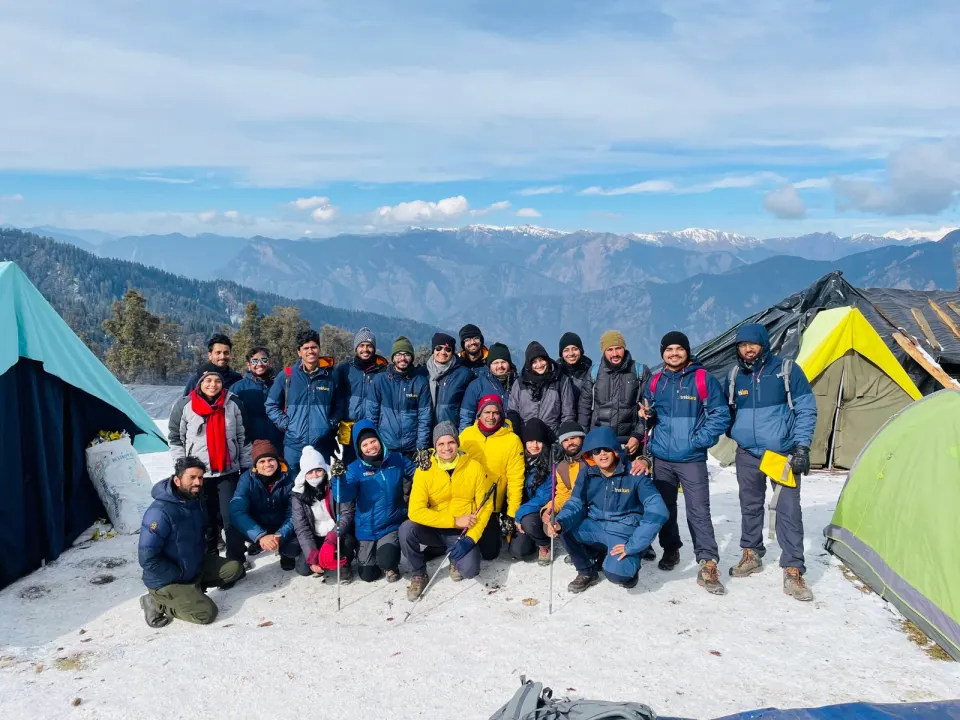
Many Himalayan treks offer stunning views. Fewer offer a genuine summit experience. And almost none combine a true winter summit with trail variety, cultural immersion, and beginner accessibility the way Kedarkantha does. In five days, you move through four distinct landscapes: a winding river-road drive through Garhwal gorges, dense snow-draped forest trails, open alpine meadows with unobstructed Himalayan panoramas, and a pre-dawn summit climb that ends in a sunrise you will describe for years. The trek also passes through Sankri, a living Jaunsari tribal village where traditional wooden architecture, local cuisine, and mountain hospitality offer a grounding cultural counterpoint to the wilderness above. This is not a single-note adventure. It is a complete Himalayan experience compressed into five unforgettable days.
Key Highlights of the Kedarkantha Trek
- Summit at 12,500 ft with a 360-degree winter panorama of the Garhwal Himalayas
- Camping beside the frozen Juda Ka Talab under a star-filled mountain sky
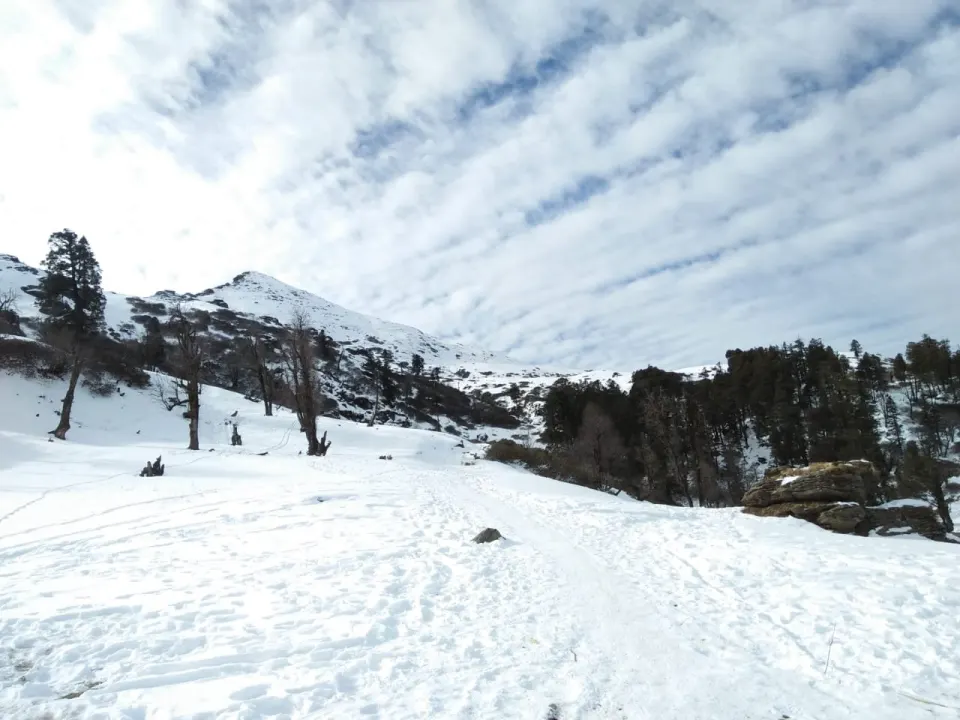
- Dense pine forest trails blanketed in deep winter snow
- Open alpine meadows (bugyals) with unobstructed views of Swargarohini and Bandarpunch
- Cultural immersion in Sankri’s Jaunsari village community
- Scenic 200 km drive along the Tons River gorge through the Garhwal Himalayas
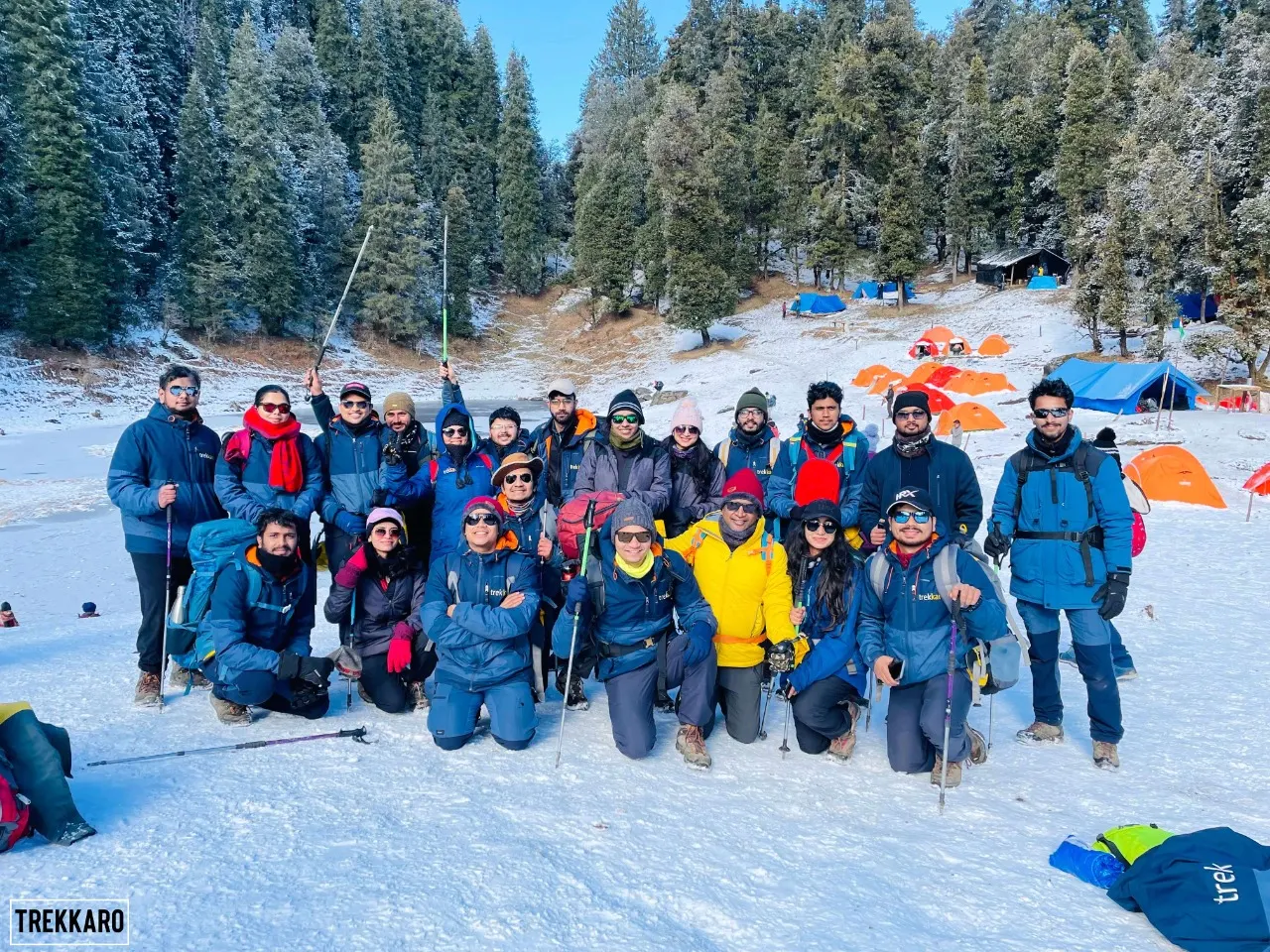
- Guided by NIM-certified Trekkaro professionals with full safety and eco-trek protocols
Best Time to Visit Kedarkantha
Kedarkantha runs in every month except July and August – the trail closes for the monsoon and reopens on 15 September – and each season offers a dramatically different experience. The month you choose shapes everything: the trail conditions underfoot, the views from the summit, the temperature at camp, and the crowd levels on the mountain. Here is a season-by-season breakdown to help you pick the window that matches what you are looking for.
December to February - Peak Season (Highly Recommended)
This is the window Trekkaro recommends above all others, and the reason is simple: Kedarkantha in winter is a completely different mountain. The entire trail disappears under several feet of snow, turning the pine forest into a white tunnel and the high-altitude meadows into an unbroken snowfield. Juda Ka Talab freezes solid. The summit air is clear of summer haze, delivering the sharpest, most expansive panoramas of the season. Night temperatures at base camp drop to -10°C to -15°C, so proper layering and quality sleeping bags are non-negotiable, but the Trekkaro team handles all cold-weather gear. January and early February typically see the heaviest snowfall and the most dramatic conditions on the trail. December offers slightly milder temperatures with reliable snow coverage and fewer crowds. If a winter wonderland summit is what you are after, this is your season.
- Temperatures: Day: -2°C to 8°C | Night at camp: -10°C to -15°C
- Trail conditions: Deep snow throughout. Crampons and microspikes provided on summit day.
- Best for: Snow trekking, summit views, winter photography, and the full Kedarkantha experience.
March to April — Spring Season (Good for Beginners)
As winter loosens its grip, the Kedarkantha trail transitions into something softer and more colourful. Snowmelt reveals patches of green meadow beneath, and rhododendrons begin to bloom in vivid crimson and pink along the lower forest sections. Residual snow still covers the upper trail and summit, making this an excellent window for trekkers who want some snow experience without the extreme cold of January. Daytime temperatures are comfortable, and the longer daylight hours make for relaxed pacing on the trail. Skies are generally clear in March, though April can bring occasional afternoon cloud build-up. This is a particularly good season for first-time trekkers who prefer milder camping temperatures while still enjoying a snow-dusted summit.
- Temperatures: Day: 5°C to 15°C | Night at camp: -2°C to -6°C
- Trail conditions: Partial snow on upper sections. Clear path on lower forest trail. Rhododendron blooms.
- Best for: First-time trekkers, wildflower photography, and mild-weather summit attempts.
May to June — Pre-Monsoon Season (Clear Skies, No Snow)
The pre-monsoon window offers the warmest trekking conditions on Kedarkantha, with snow largely absent from all but the very upper trail. The meadows are fully green, carpeted in alpine grasses and wildflowers, and the forest is lush. Daytime temperatures on the trail are pleasant and camping is considerably more comfortable than in winter. The Himalayan panoramas remain exceptional, though the occasional afternoon haze can soften views compared to the crystal clarity of December or January. If you are travelling with children, trekkers with lower cold tolerance, or a group with mixed fitness levels, the May-June window offers the most forgiving conditions. Trails close in July with the onset of the monsoon and reopen on 15 September.
- Temperatures: Day: 10°C to 20°C | Night at camp: 2°C to 5°C
- Trail conditions: Snow-free. Green meadows and wildflowers. Well-defined trail throughout.
- Best for: Families, wildflower lovers, and trekkers who prefer warm-weather camping.
July to August — Monsoon Season (Trek Closed)
The monsoon brings heavy rainfall to the Garhwal Himalayas, making the Kedarkantha trail unsafe due to landslide risk, slippery terrain, and poor visibility. Trekkaro does not operate Kedarkantha batches during the monsoon months. If your travel window falls in July or August, we recommend exploring monsoon-safe alternatives in the rain shadow regions of Spiti Valley or Ladakh instead.
Mid-September to November — Autumn Season (Excellent Visibility)
Post-monsoon autumn is arguably the most underrated season on Kedarkantha. The rains wash the atmosphere clean, leaving behind some of the sharpest mountain visibility of the entire year. The meadows are a vivid green, the sky is a deep, unobstructed blue, and the first dustings of early snow appear on the higher Himalayan peaks by October and November, creating a striking contrast against the golden and amber tones of the forest below. Temperatures are moderate and pleasant during the day, dropping to cold but manageable levels at night. Trail conditions are excellent. Crowds are lighter than winter peak season. November in particular sits in a sweet spot: early snowfall on the upper trail can make for a partial snow experience without the full cold exposure of mid-winter. For trekkers who want stellar views, comfortable temperatures, and quiet trails, Mid-September to November is a compelling alternative to the December-February window.
- Temperatures: Day: 5°C to 18°C | Night at camp: -2°C to -8°C
- Trail conditions: Clear and well-defined. First snow on peaks from October. Green meadows below.
- Best for: Landscape photography, clear summit views, and quieter trails with comfortable daytime temperatures.
Trekkaro Recommendation
For the full Kedarkantha experience, book a December, January, or February batch. If you want milder temperatures with residual snow, March is ideal. For green meadows, wildflowers, and comfortable camping, go with May or June. For crystal-clear autumn panoramas and a quieter trail, November is our top off-season pick.
| Season | Months | Temperature (Night) | Trail Condition |
| Winter (Peak) | Dec - Feb | -10°C to -15°C | Deep Snow, Frozen Lakes |
| Spring | Mar - Apr | -2°C to -6°C | Residual Snow, Rhododendrons |
| Summer | May - Jun | 2°C to 5°C | Lush Green Meadows |
| Autumn | Sep - Nov | -2°C to -8°C | Crystal Clear Skies |
🏃 Am I ready for the Kedarkantha Trek? Take the free 2-minute fitness test and get your readiness score and a personal training plan.
Take the test →Trek Itinerary
A cab can be arranged at an additional cost from Dehradun Railway Station at 06:30 AM to Sankri Village. The cost is approximately ₹6,500 one way per 5–6 seat vehicle, which should be shared among the trekkers.
A cab can be arranged at an additional cost from Sankri Village at 06:30 AM to Dehradun Railway Station, with an expected arrival by 06:00 PM. The cost is approximately ₹6,500 one way per 5–6 seat vehicle and should be shared among the trekkers.
Day 1: Dehradun to Sankri
Route Details:
Dehradun → Sankri | Distance: ~200 km | Drive Duration: ~7–8 hours | Altitude Gain: 1,900 ft to 6,400 ft
Your Kedarkantha winter trek begins not on a trail, but on a winding mountain road that feels like a curtain slowly rising on a grand stage. Depart Dehradun in the early morning in a shared 4x4, and within two hours, the city dissolves into dense oak and rhododendron forests. The NH-707 hugs the emerald-green Tons River through the Garhwal Himalayas, a road so scenic that seasoned trekkers photograph it obsessively. Watch for waterfalls crashing down limestone cliffs, remote villages perched impossibly on ridges, and the first distant white crowns of snow-capped peaks appearing above the treeline.
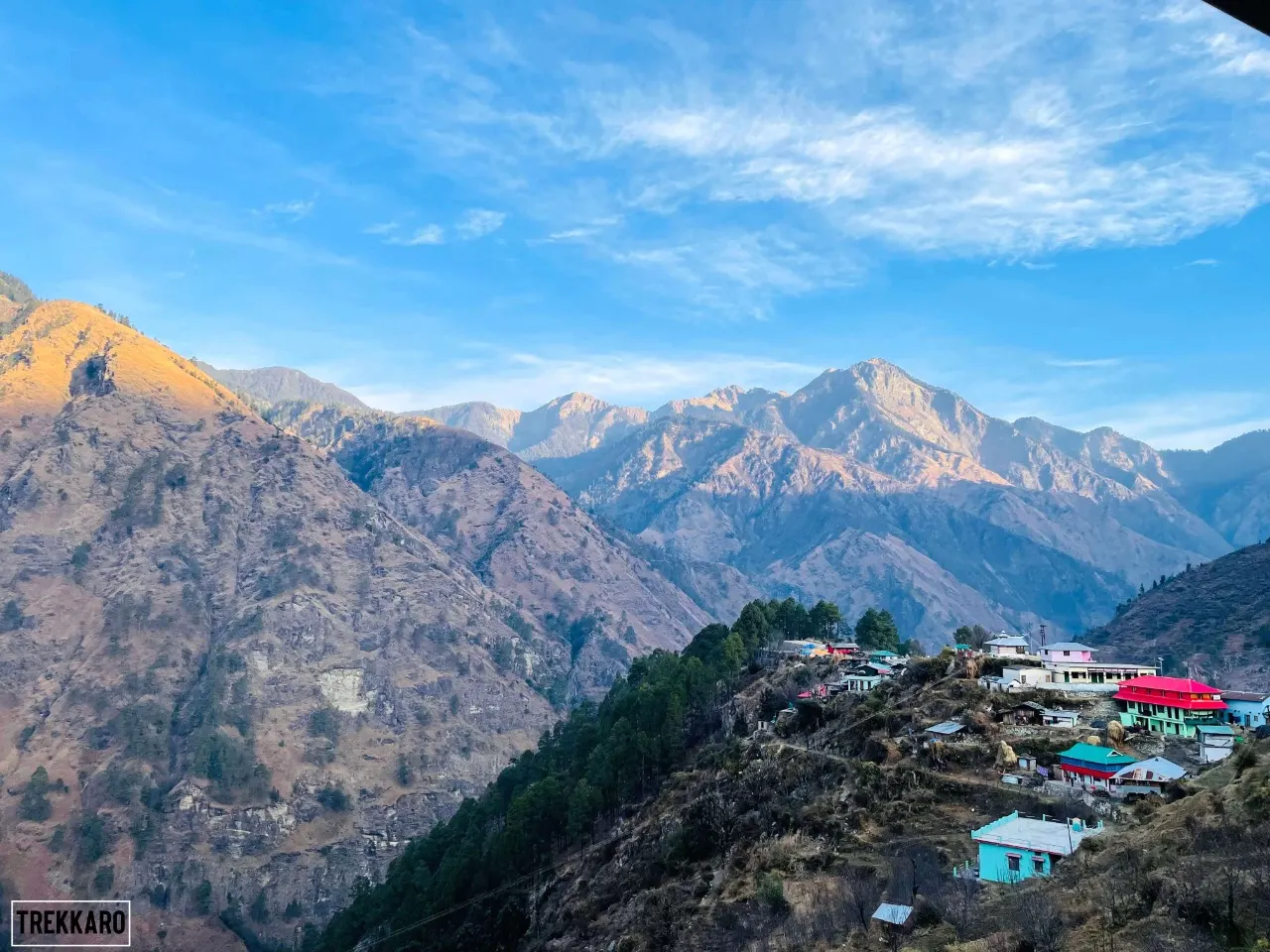
As you ascend past Purola and Mori, the temperature drops noticeably and the landscape shifts from green to a quieter, more austere beauty. Snow may dust the roadside even here, hinting at what awaits higher up. Pull-over chai stops at roadside dhabas are a small but essential ritual on this drive. By late afternoon, the road delivers you to Sankri, a compact Himalayan village that serves as the base camp for the Kedarkantha trek and the jumping-off point for several other celebrated Uttarakhand trails.
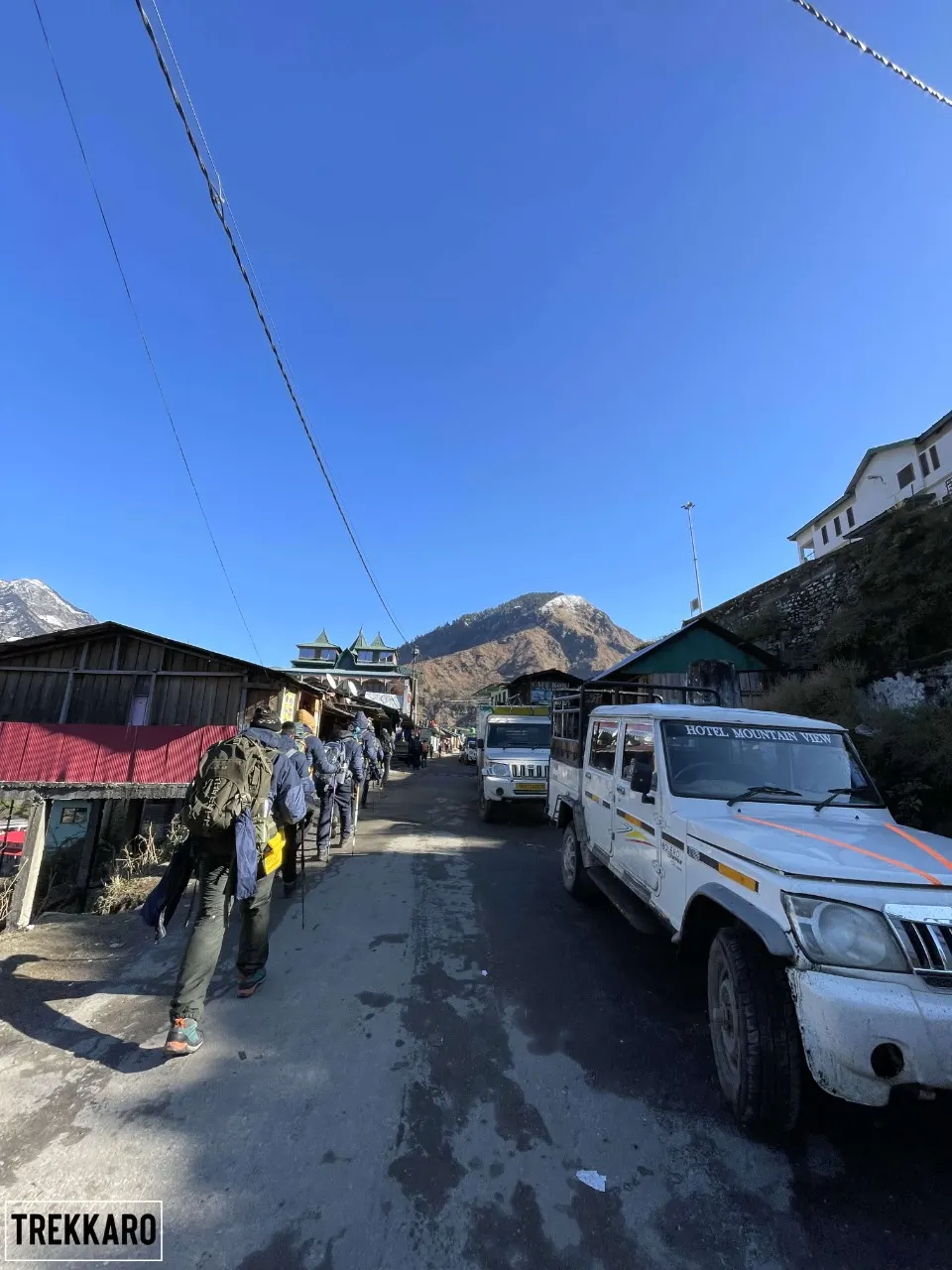
Sankri itself is a place worth pausing to absorb. Local guesthouses and teahouses cluster around a central area where mules carry supplies, children shout greetings from rooftops, and the air smells of pine smoke and altitude. Your Trekkaro guide will brief you on the days ahead, run a gear check, and introduce you to your trek crew. Eat a warm, hearty dinner, hydrate well, and sleep early. The mountains operate on their own schedule, and tomorrow, you follow theirs.
What to Expect:
- A scenic 7–8 hour drive along the Tons River gorge
- First glimpses of snow-capped peaks from the road
- Arrival and acclimatization at Sankri base camp (6,400 ft)
- Gear check and trek briefing with your Trekkaro guide
- Accommodation in Sankri guesthouse
Day 2: Sankri to Juda Ka Talab
Route Details:
Altitude: 6,400 ft → 9,100 ft | Trek Distance: ~4 km | Duration: 4–5 hours | Terrain: Dense pine & oak forest
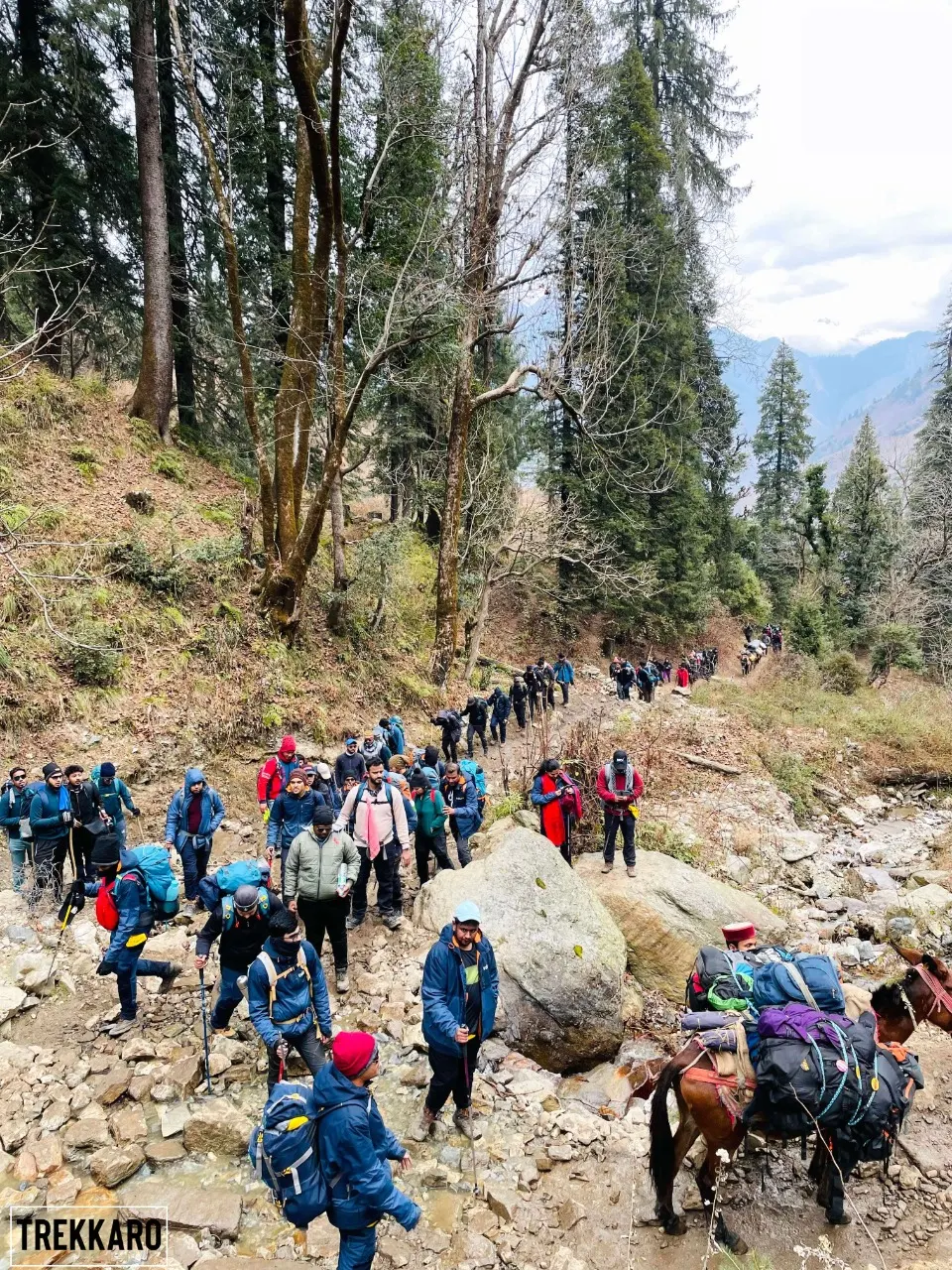
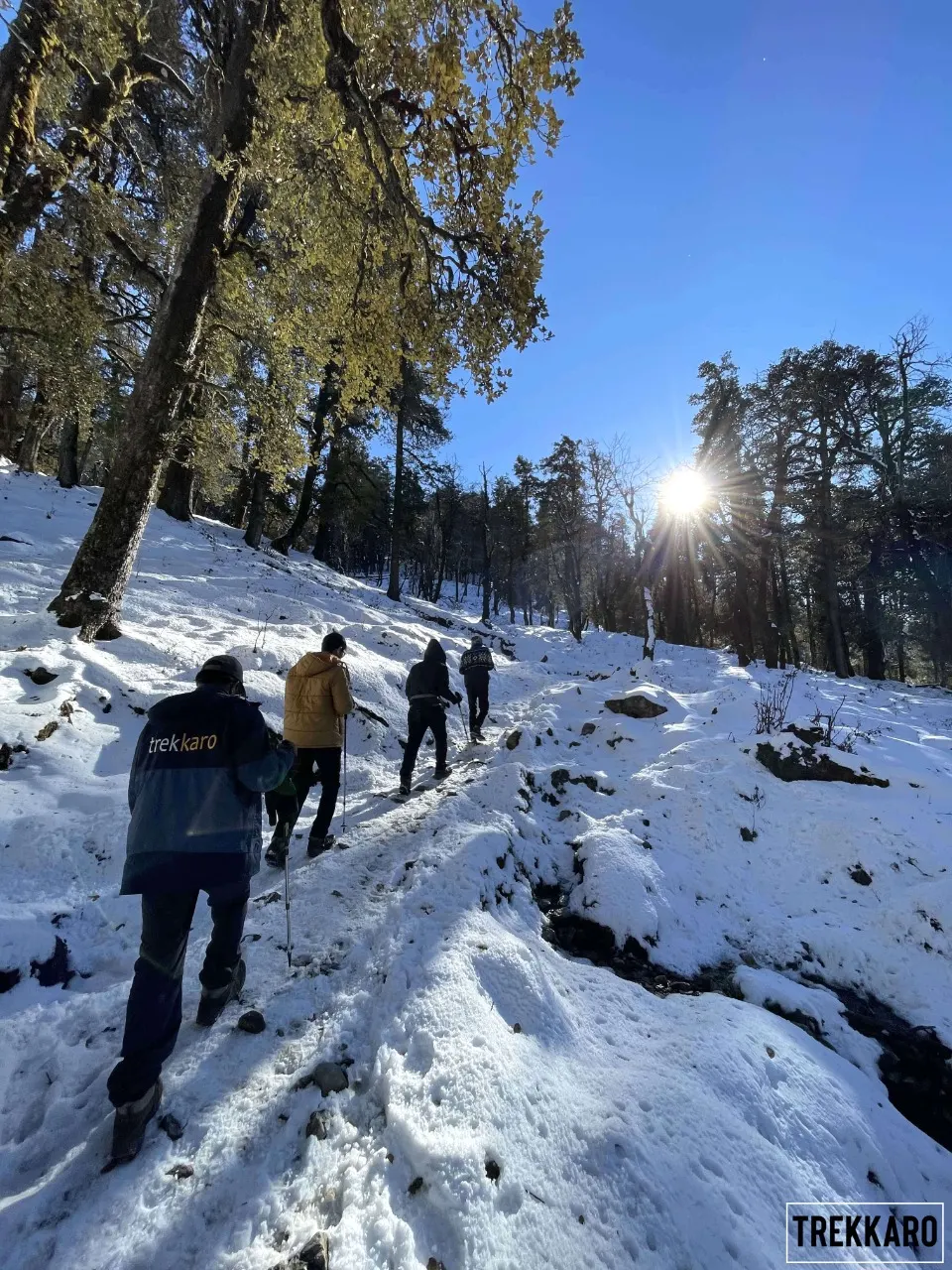
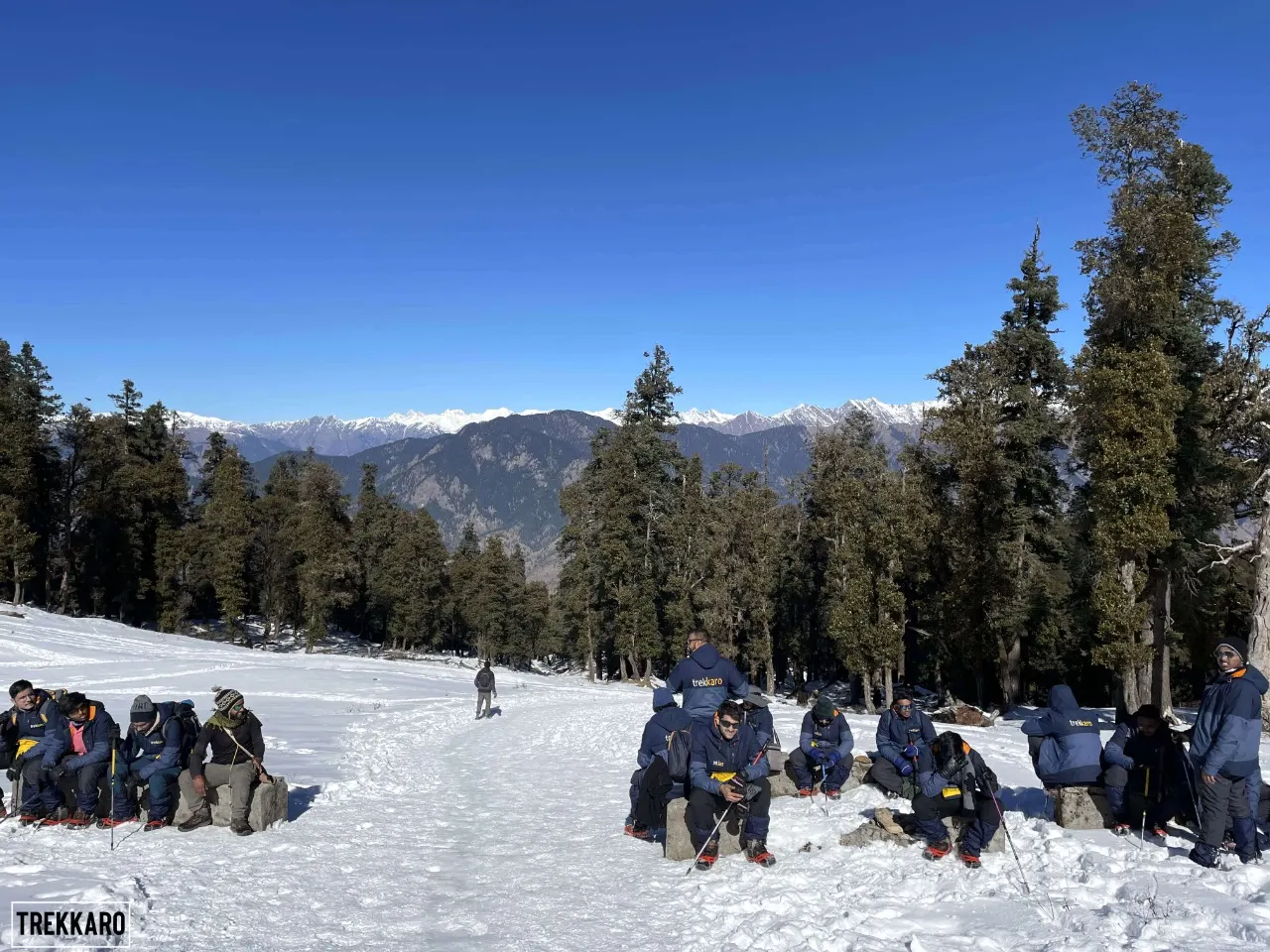
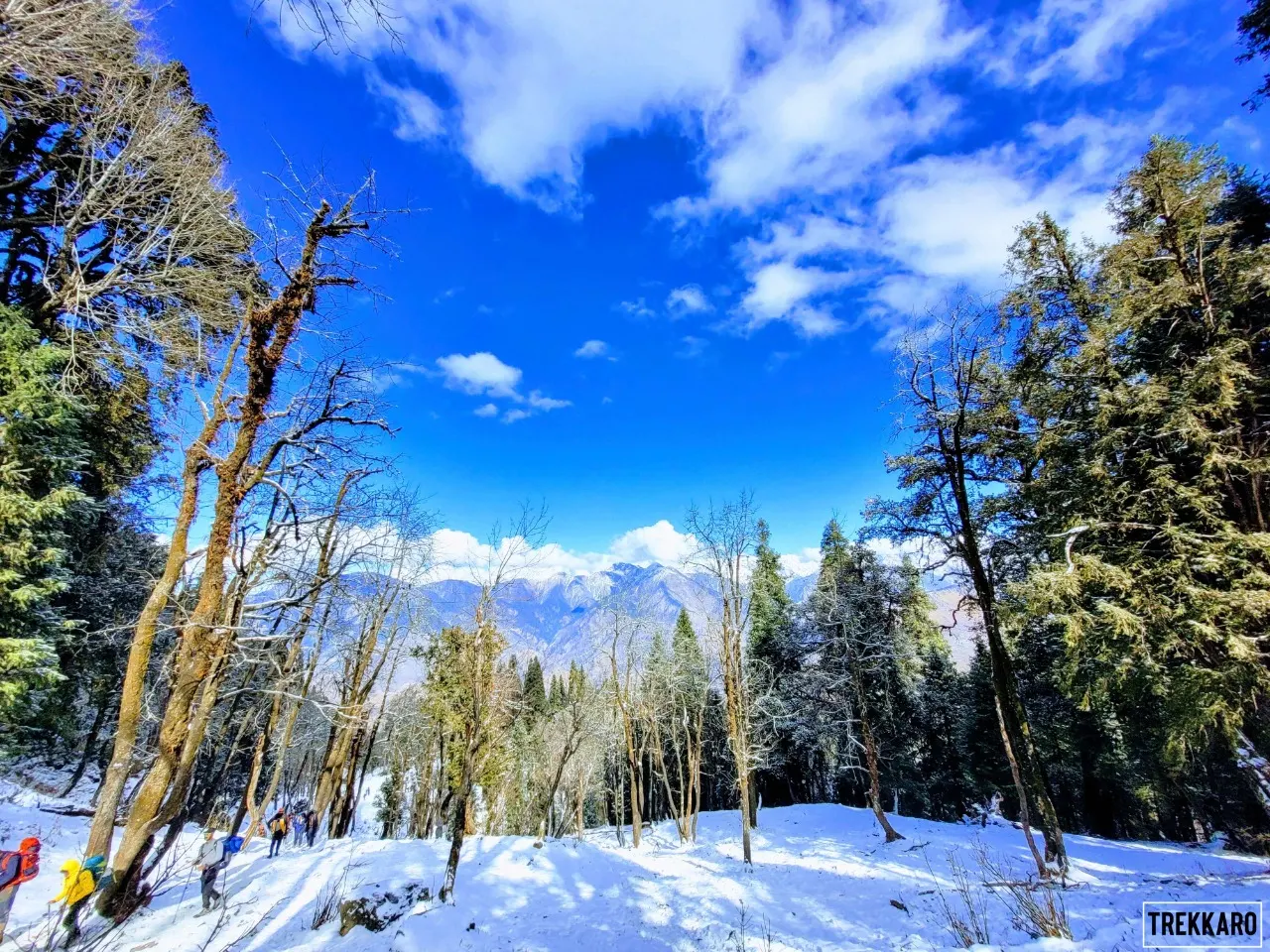
The moment your boots hit the Kedarkantha trail, the world goes quiet in the most absolute way. From Sankri, the path climbs steadily through a cathedral of towering pine trees whose branches bow under the weight of winter snow. Sunlight filters through in slanted golden columns, and the only sounds are the crunch of snow underfoot and the occasional whistle of a Himalayan bird. This 4-kilometre stretch through dense forest is not just a warm-up. It is the trek's opening movement, and it sets the mood for everything that follows.
The gradient is consistent and manageable, making it an ideal first trekking day even for beginners. Your guide will point out medicinal plants used by local Jaunsari tribes, animal tracks pressed into the snow, and occasional clearings that reveal early glimpses of the Himalayan peaks beyond. The forest feels primeval and unmarked, the kind of wilderness that recalibrates your sense of scale and silence. Stop frequently to drink water, adjust your pace to your breathing, and photograph the pine groves encrusted with frost.
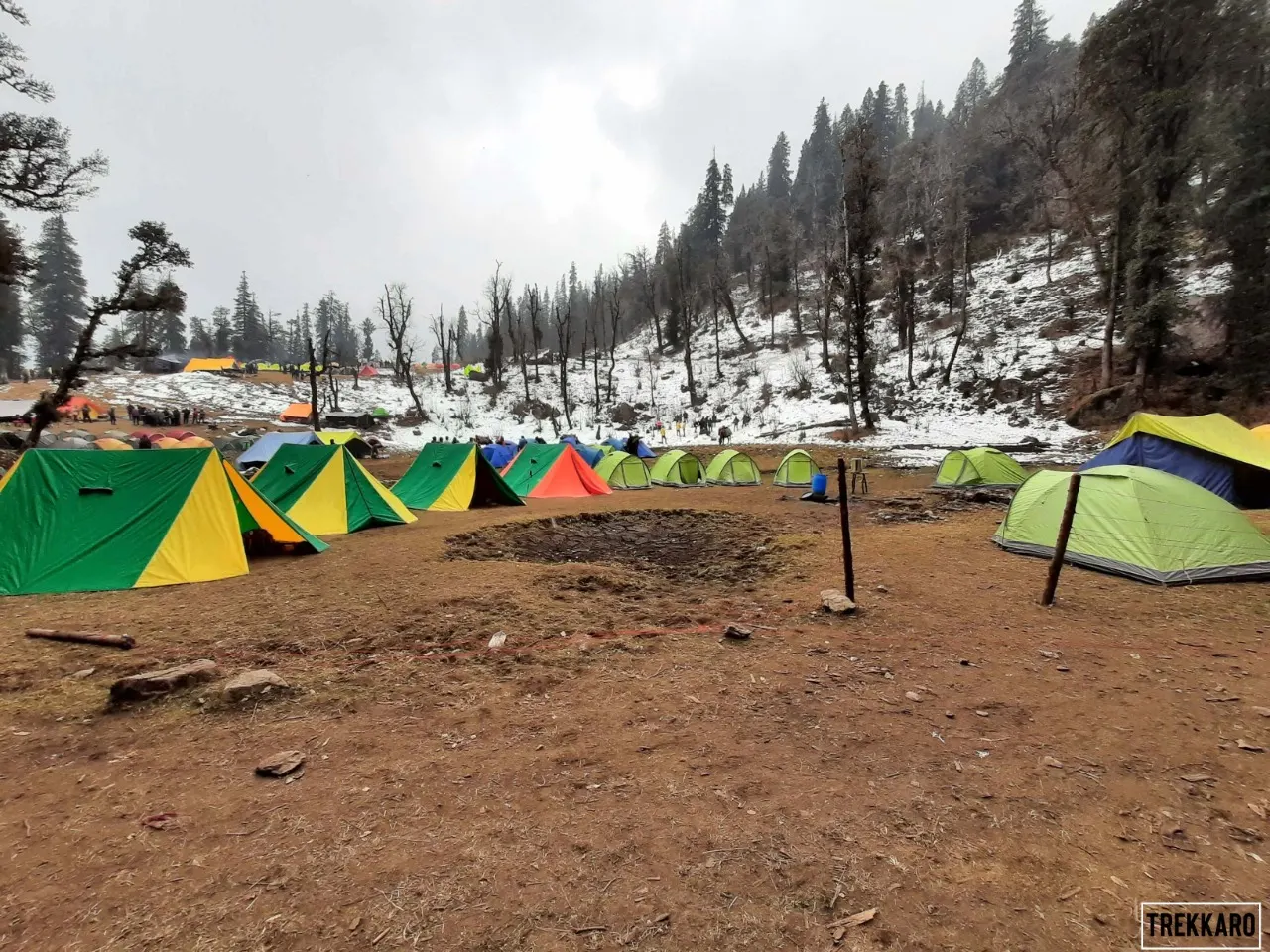
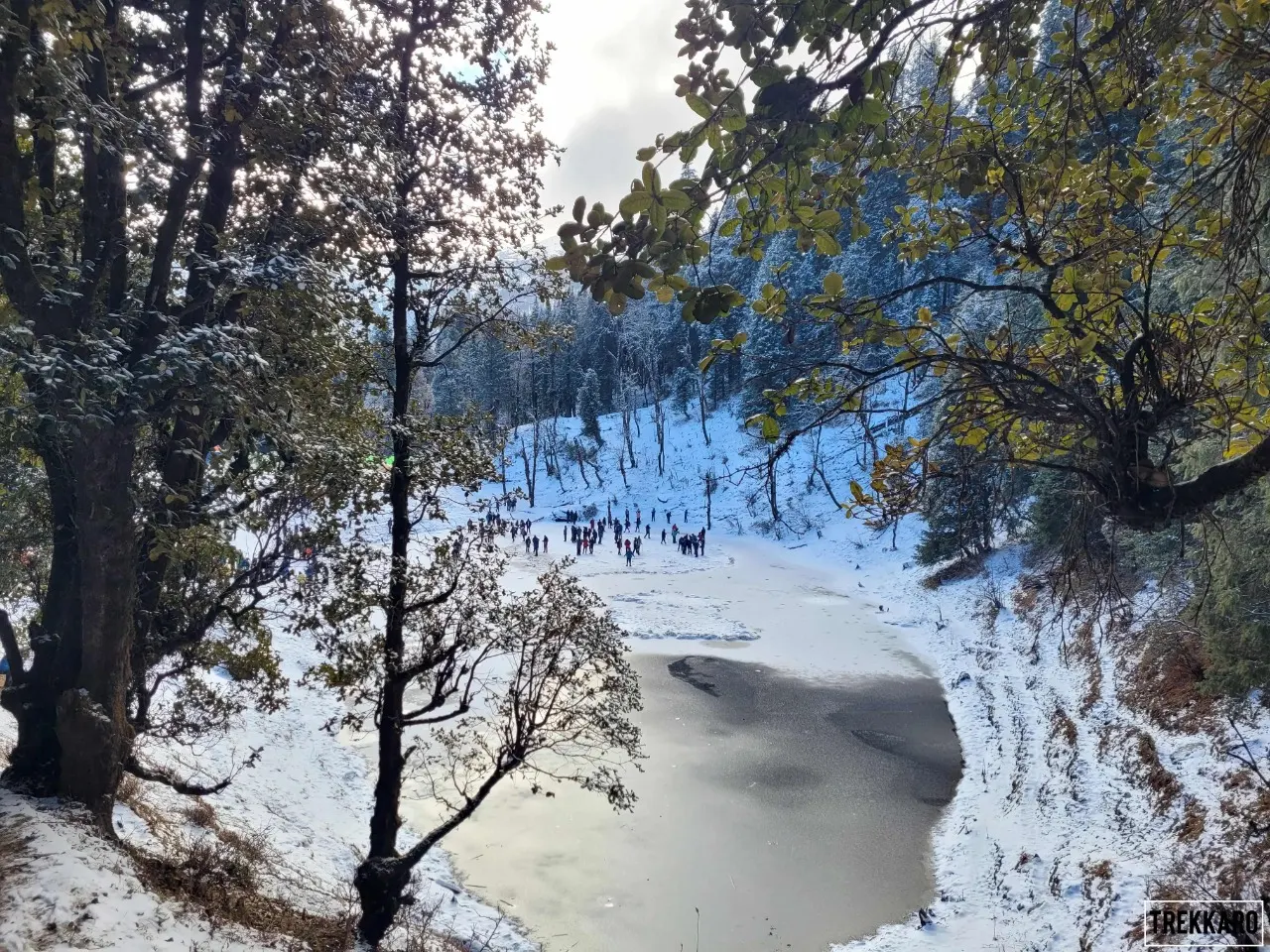
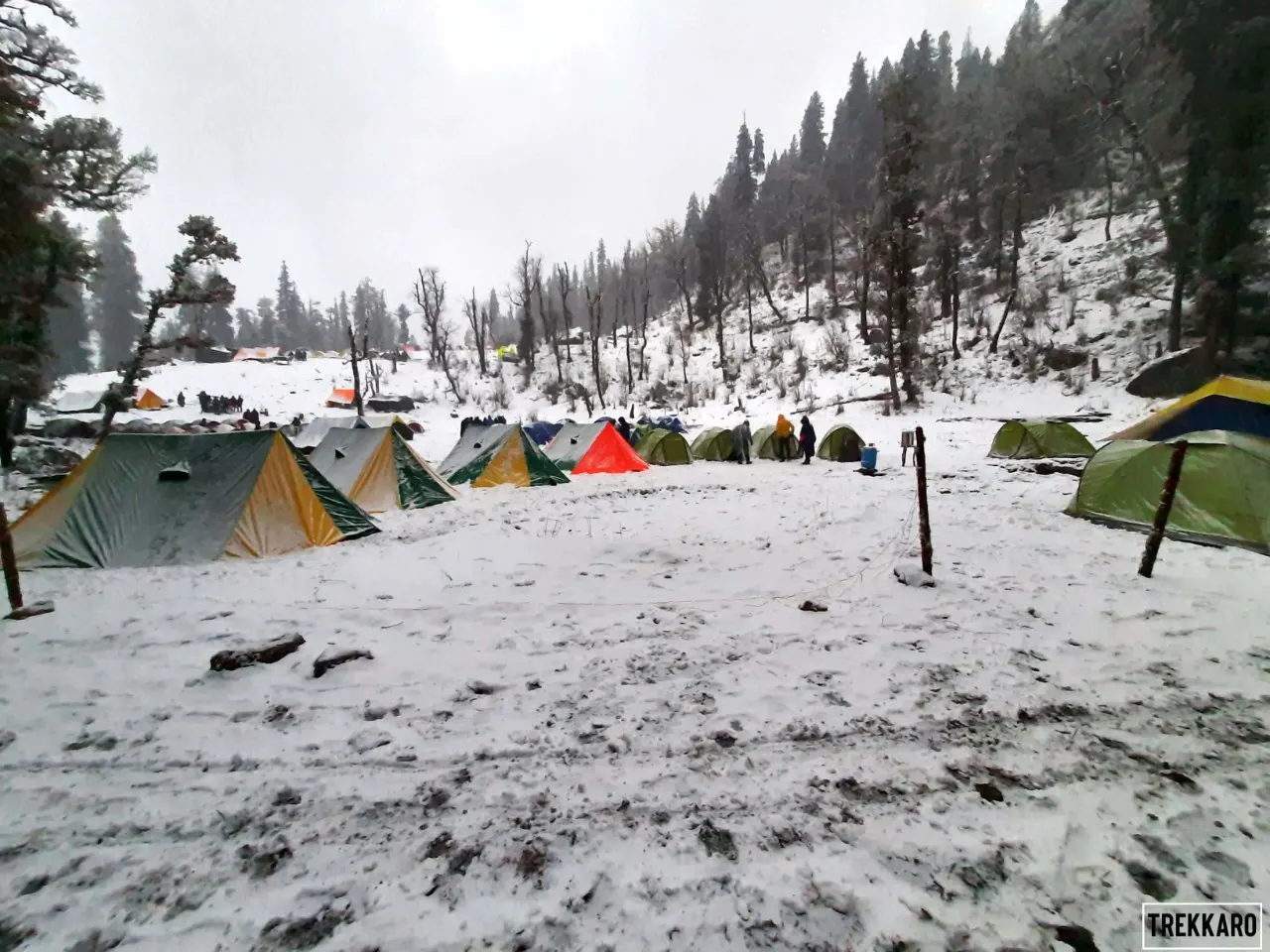
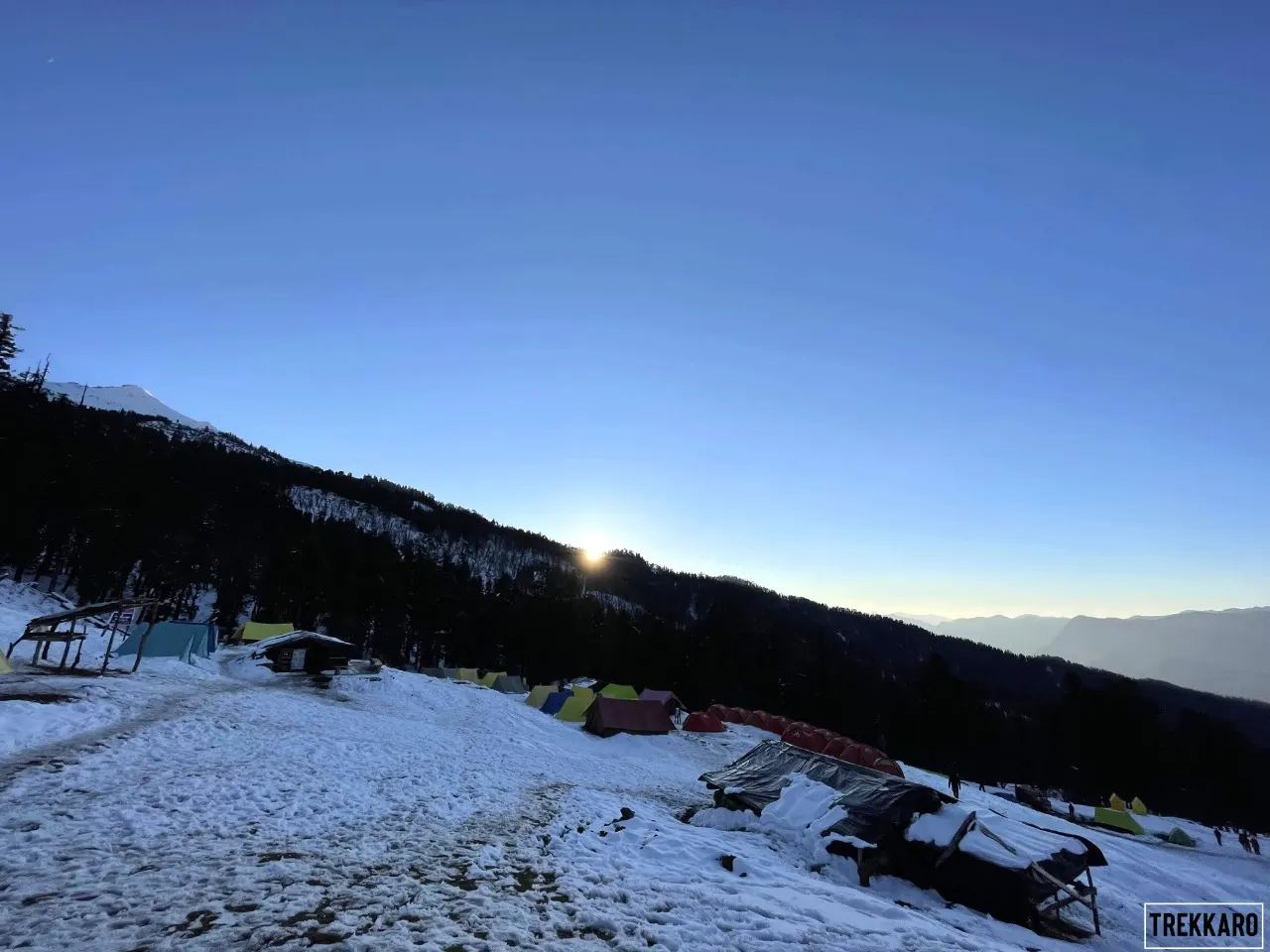
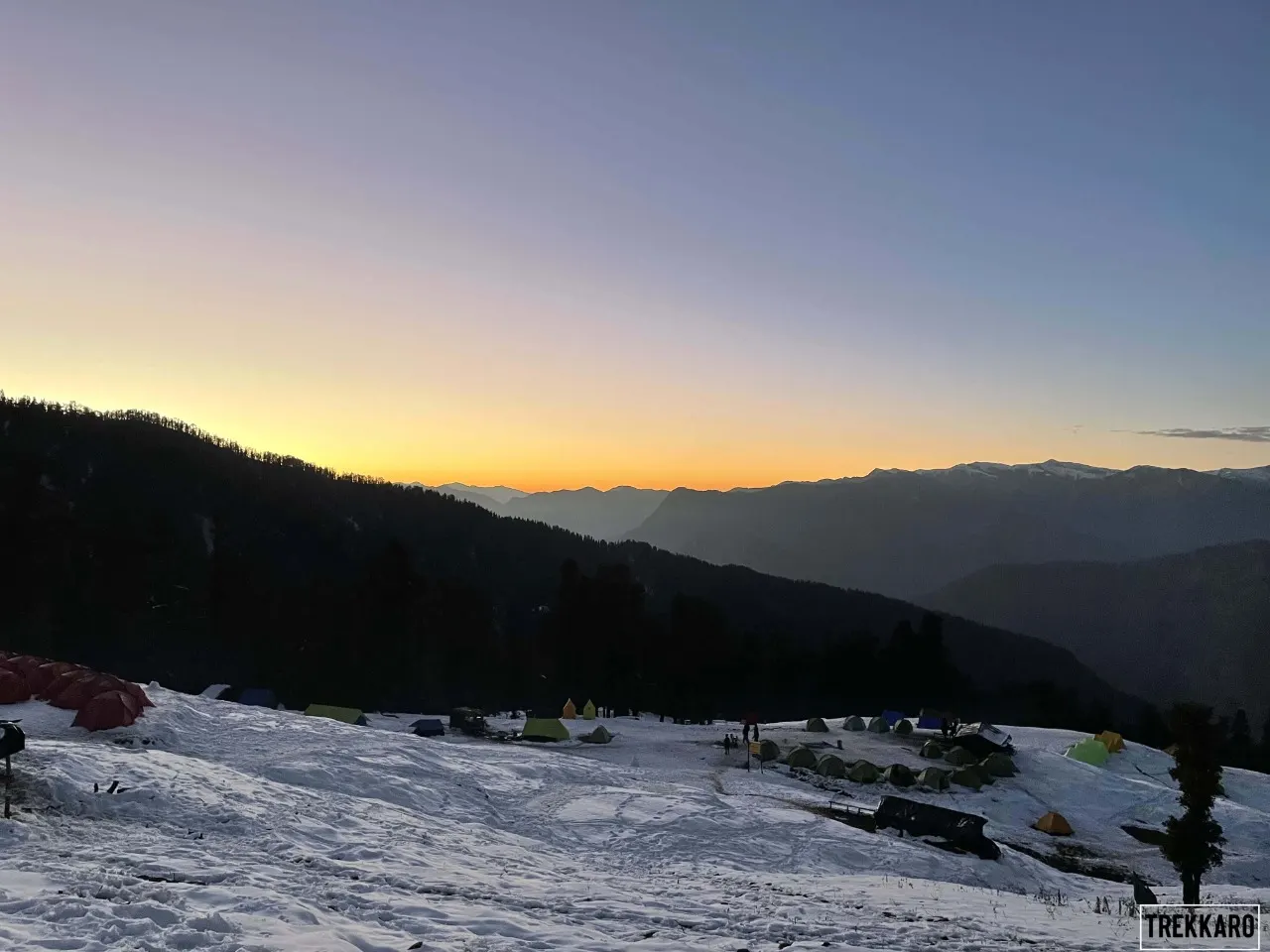
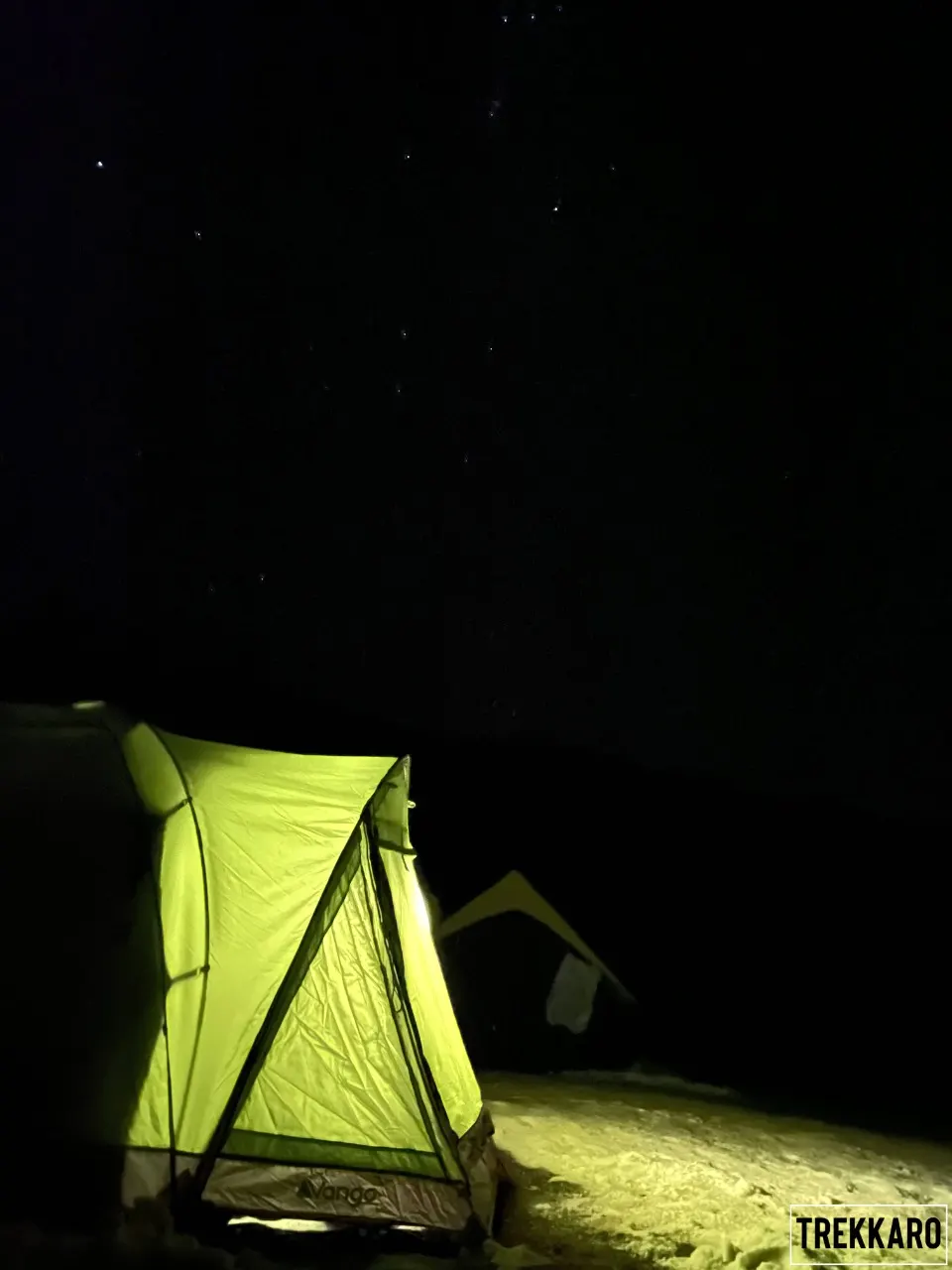
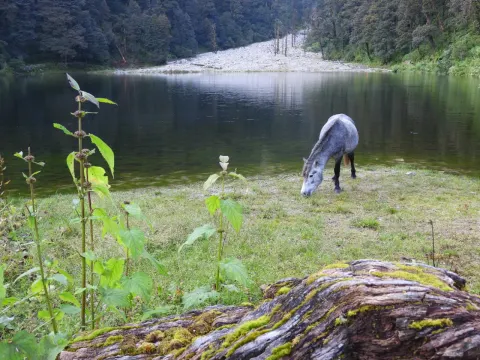
After a lunch break at a scenic ridge clearing, the trees thin and a wide, bowl-shaped meadow appears. At its heart sits Juda Ka Talab, a high-altitude lake that freezes solid in winter. Watching the surface, you may notice the ice has captured tiny air bubbles mid-motion, like a photograph of water itself. Pitch your tents at the campsite beside the lake as the sun drops and the temperature plummets. The sky at this altitude and in this season is almost violently clear. On cloudless nights, the Milky Way spans the full horizon above you. Tonight, it is your ceiling.
What to Expect:
- Trail through dense pine and oak forest laden with winter snow
- Consistent, manageable altitude gain ideal for first-time trekkers
- Lunch at a ridge clearing with early Himalayan views
- Arrival at Juda Ka Talab (9,100 ft): the iconic frozen lake campsite
- Dinner and overnight camping under a star-filled Himalayan sky
Day 3: Juda Ka Talab to Kedarkantha Base Camp
Route Details:
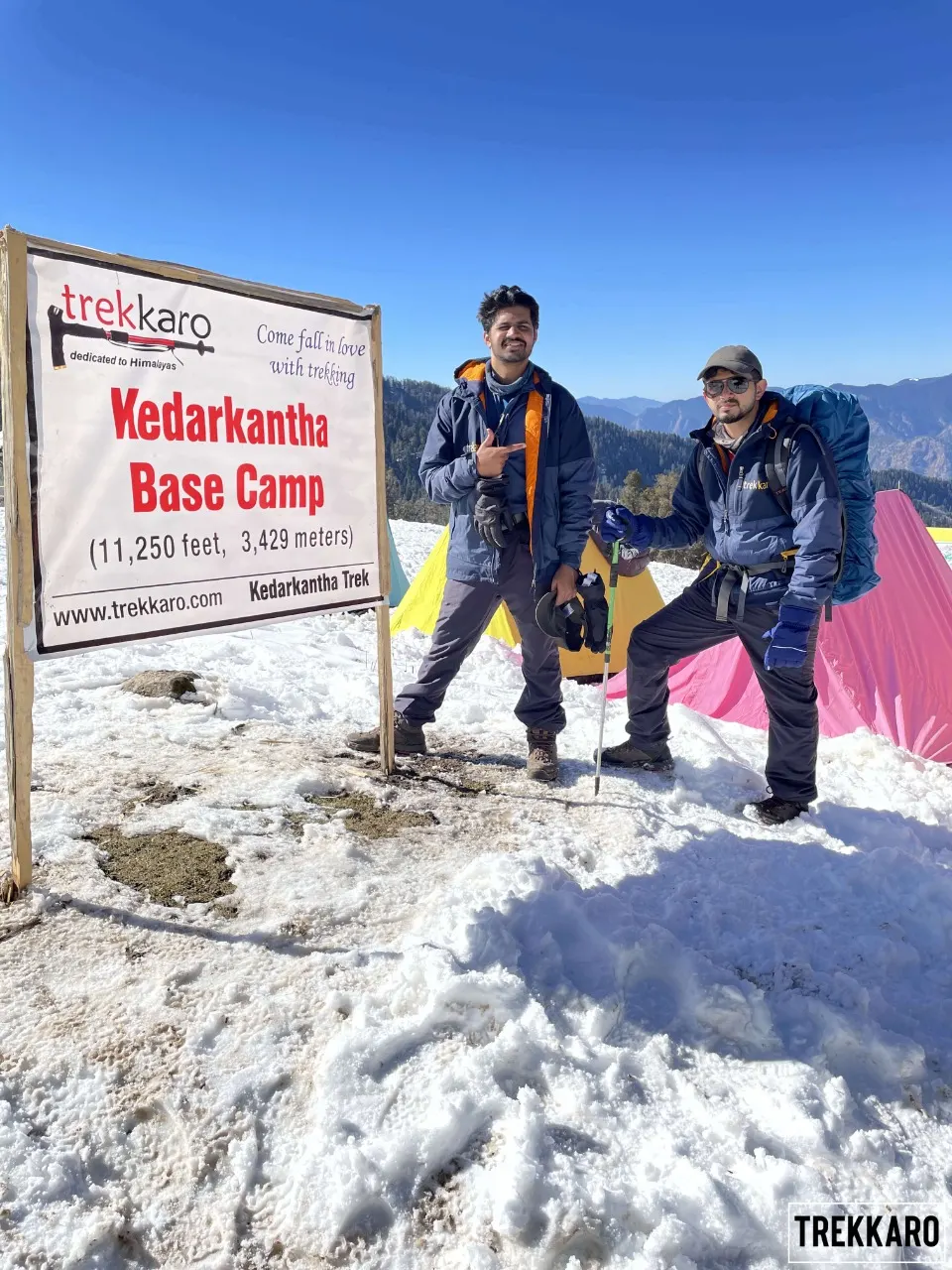
Altitude: 9,100 ft → 11,250 ft | Trek Distance: ~3 km | Duration: 2–3 hours | Terrain: Open alpine meadows & snow slopes
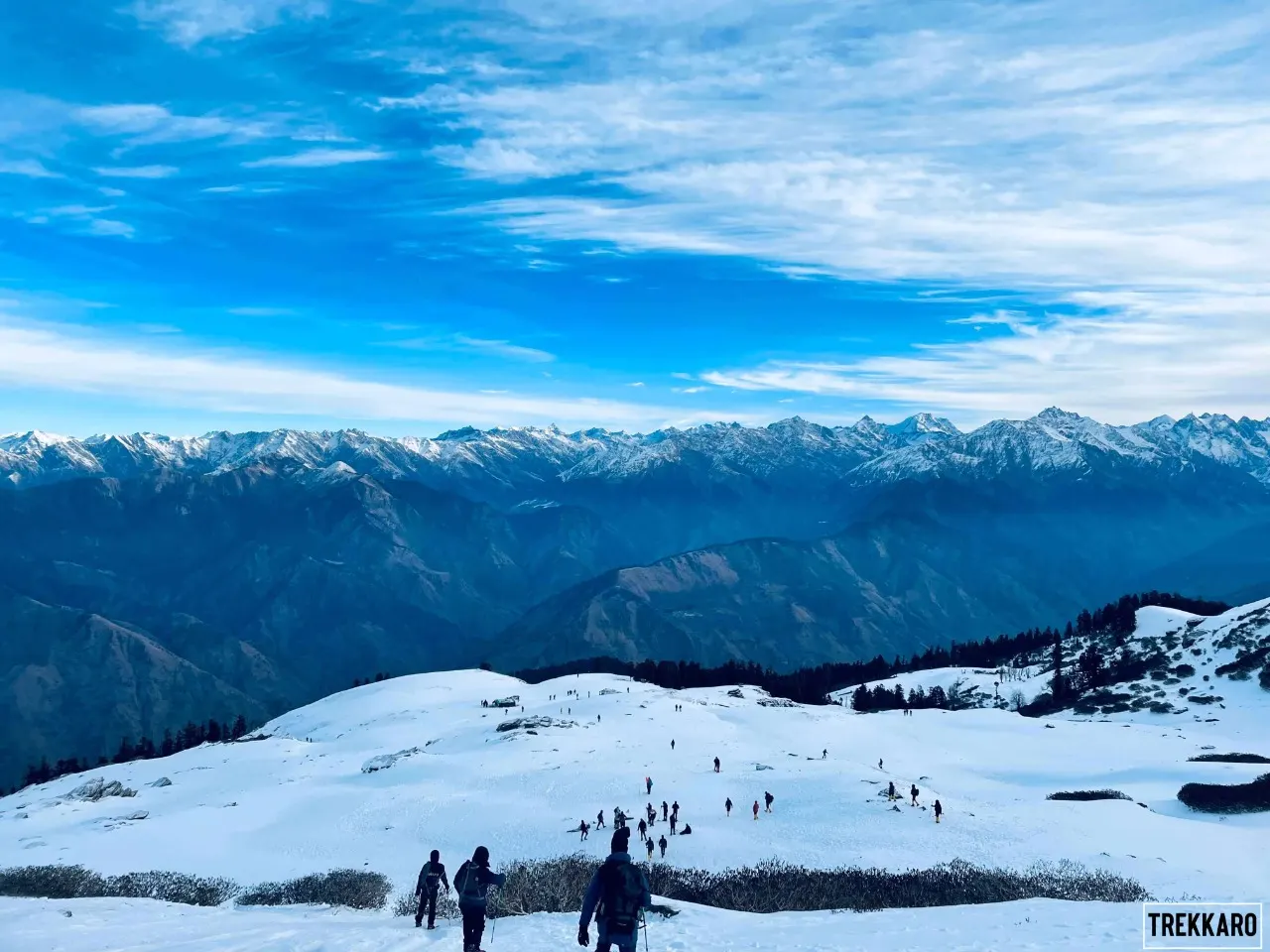
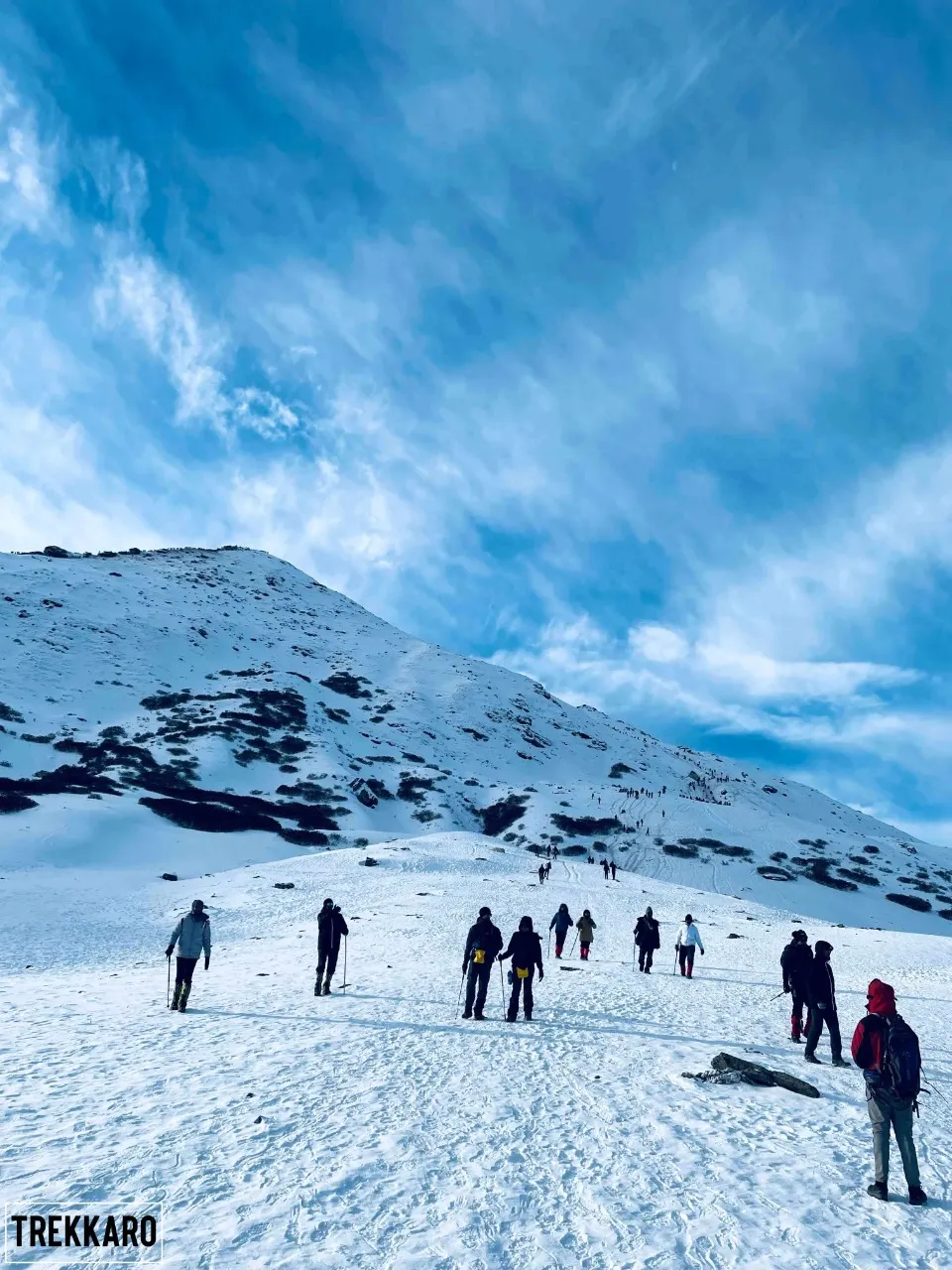
Day 3 is where the Kedarkantha trek undergoes its most dramatic visual transformation. As you leave the treeline behind, the dense pine forest gives way to sweeping open meadows draped in unbroken white. There are no more canopies filtering the sky. Instead, the sky is enormous, and all around it, a ring of Himalayan peaks stands in sharp, clean profile. The air is thinner here, the light harsher, and the silence deeper. You are now firmly above the world you came from.
The trail winds through a series of snow-covered alpine meadows locally called bugyals, gradual inclines carpeted in deep powder during peak winter. On either side, ridgelines reveal distant panoramas that grow more expansive with every 100 metres of altitude gained. On a clear day, you can identify Swargarohini, Black Peak, Ranglana, and Bandarpunch without any optical aid. This is also the section where first-time trekkers often stop mid-step, stare at the view in silence, and understand, perhaps for the first time, why people chase mountains.
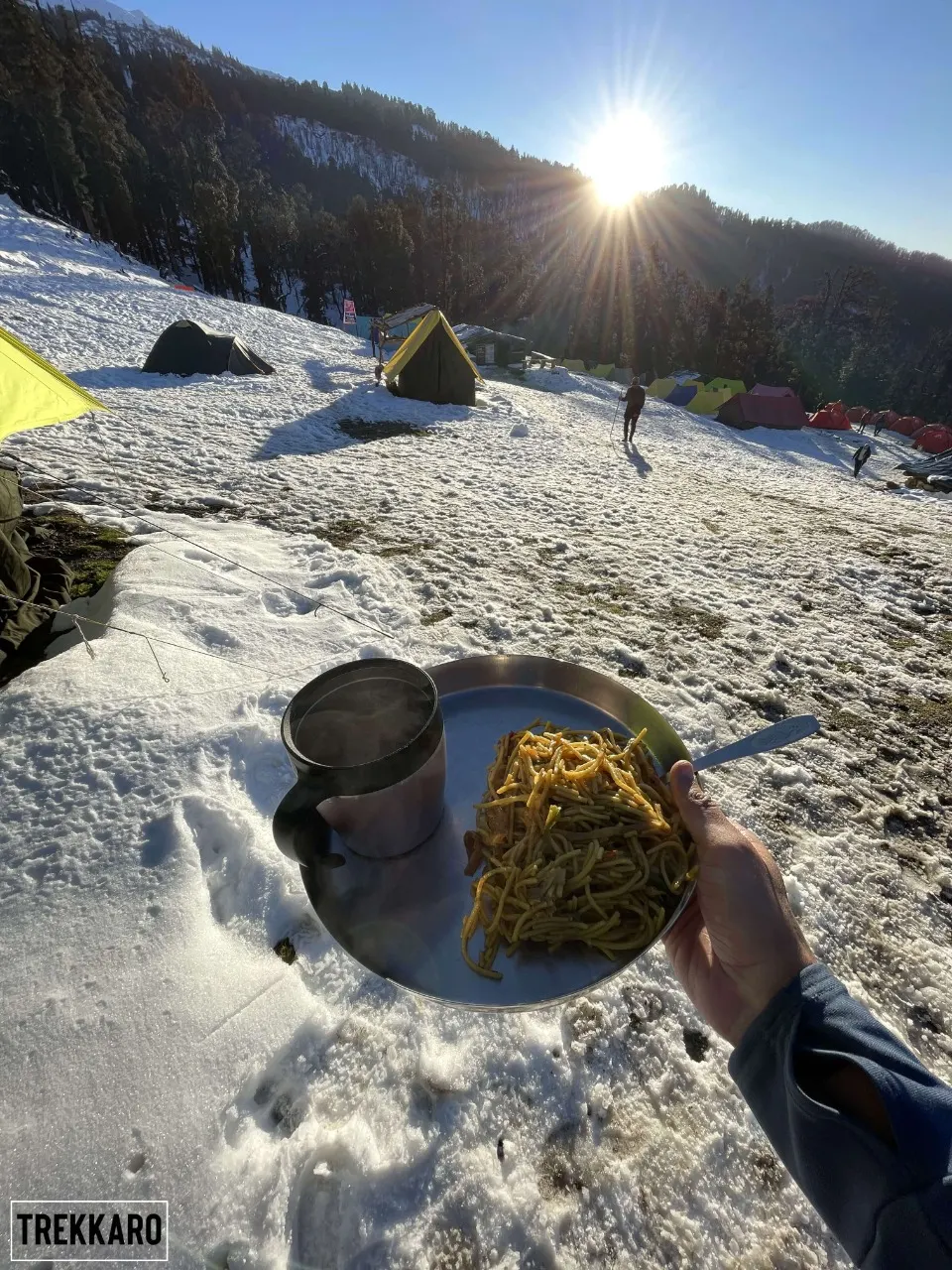
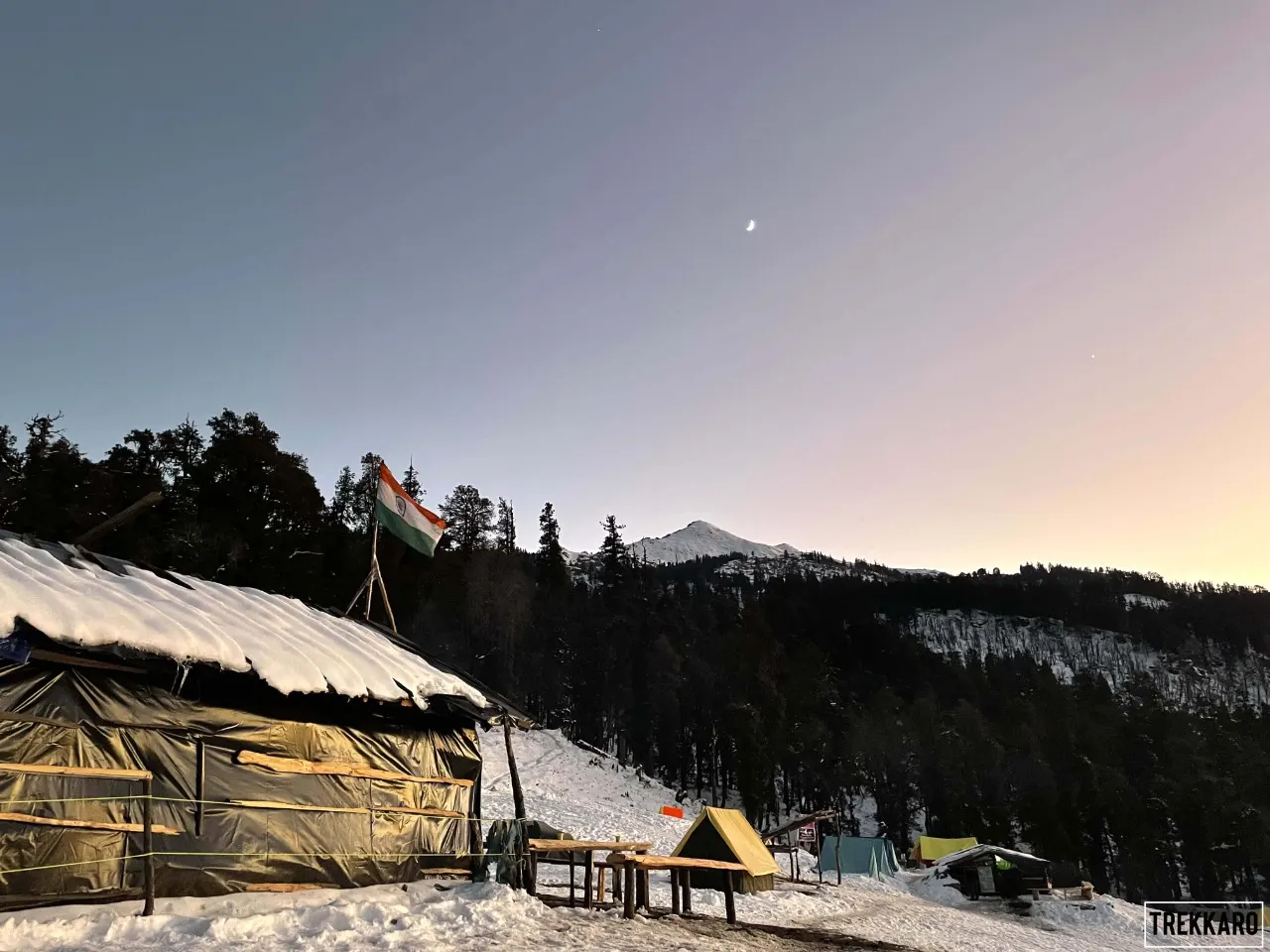
Base camp sits at 11,250 feet and serves as the launch point for tomorrow's summit push. Your Trekkaro guides will set up insulated tents, prepare a calorie-rich dinner, and walk you through the summit-day protocol: wake time, pace, turnaround policies, and what to expect in the dark hours of the early morning climb. Rest is critical tonight. The summit attempt begins before dawn, and every hour of sleep is fuel for the final ascent. Lay your layers out in order, double-check your water and snacks, and close your eyes to the sound of wind moving across the high Himalayas.
What to Expect:
- Dramatic transition from forest to open alpine meadows (bugyals)
- Panoramic views of Swargarohini, Black Peak, Bandarpunch & Ranglana
- Steady altitude gain with manageable terrain on snow slopes
- Arrival at Kedarkantha Base Camp (11,250 ft)
- Summit-day briefing, early dinner & rest
Day 4: Summit Day - Base Camp to Kedarkantha Peak & Back to Juda Ka Talab
Route Details:
Altitude: 11,250 ft → 12,500 ft → 9,100 ft | Summit Distance: ~3 km | Total Day: ~9 km | Start Time: 2:00 AM
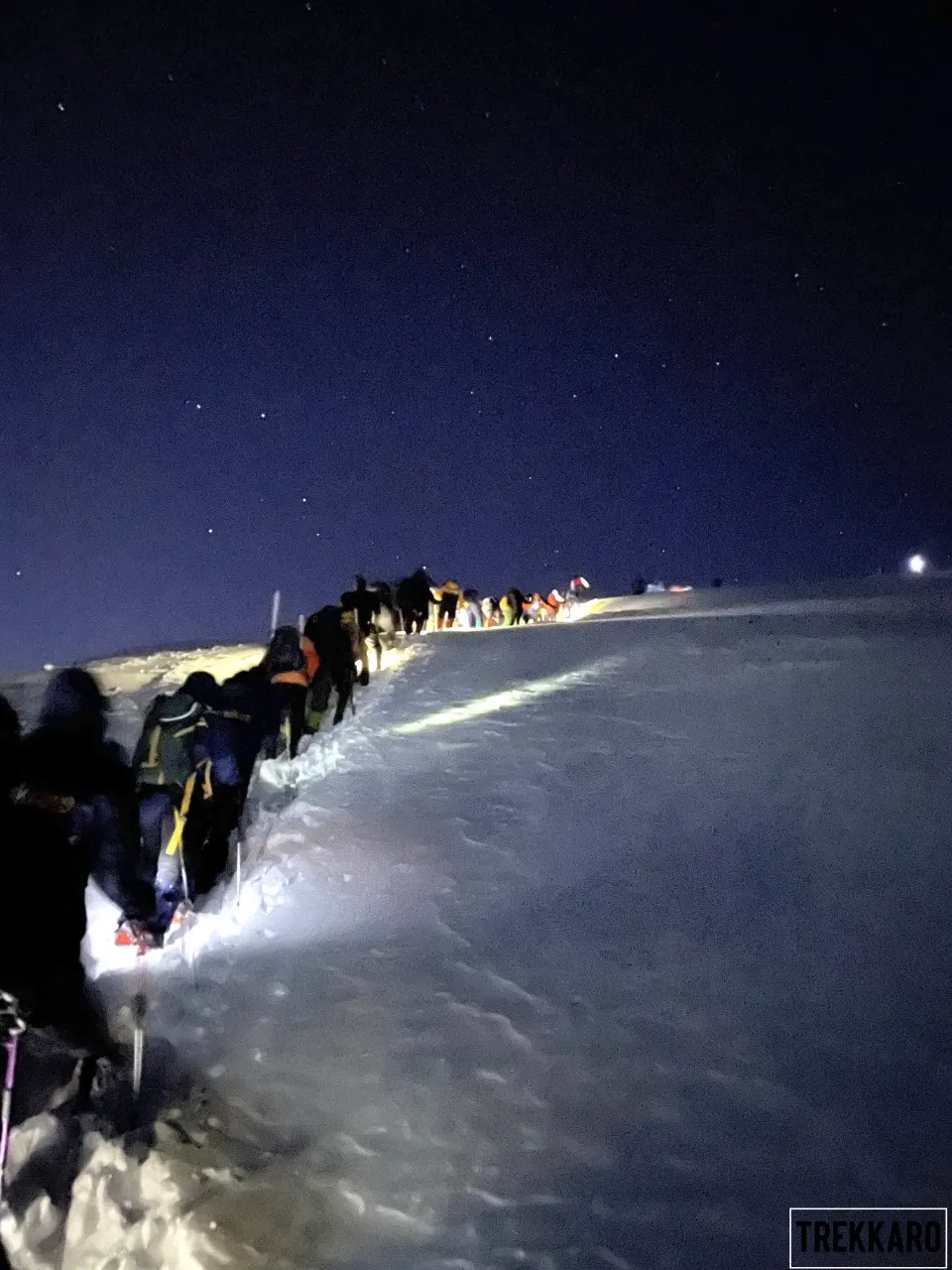
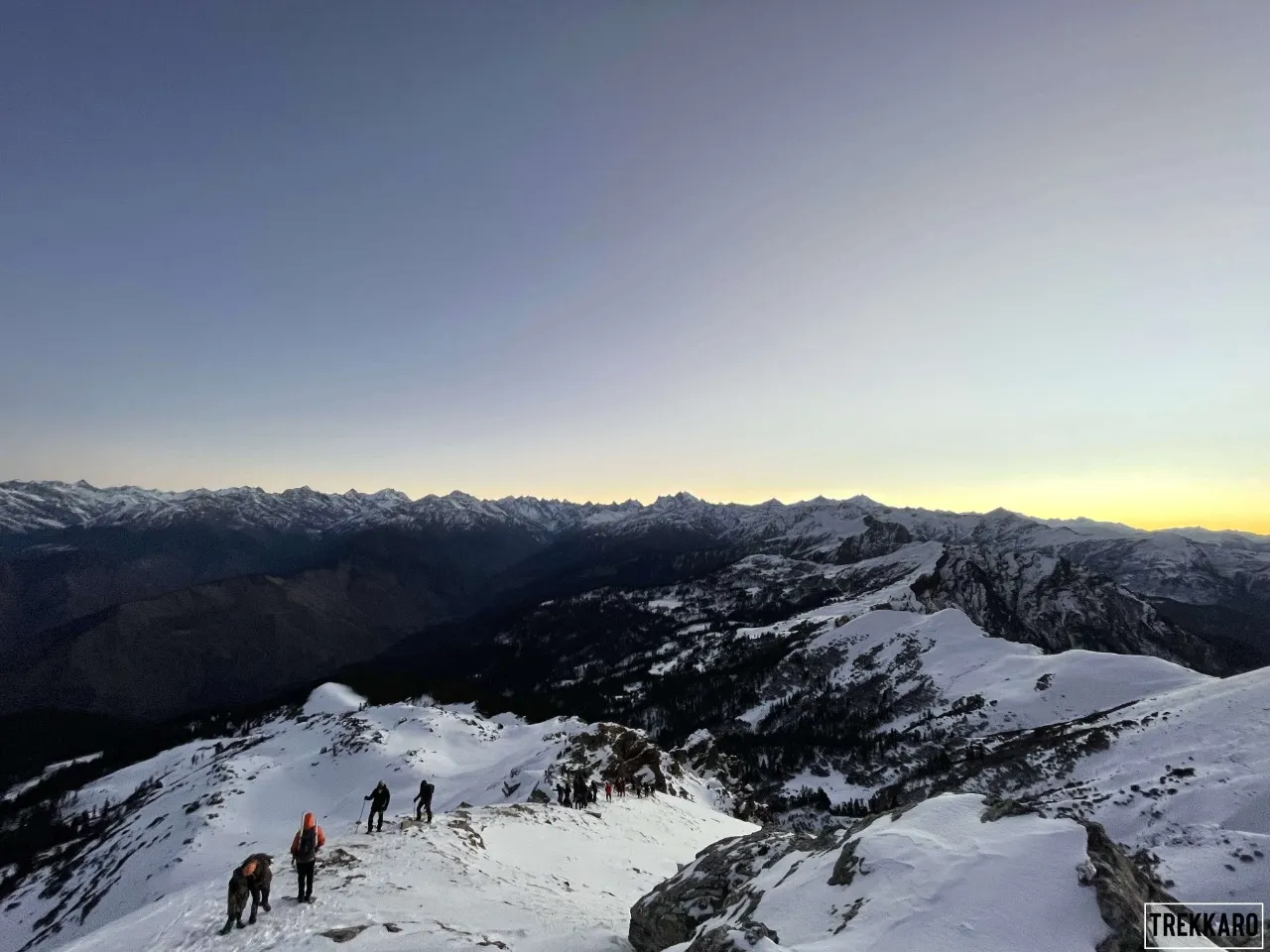
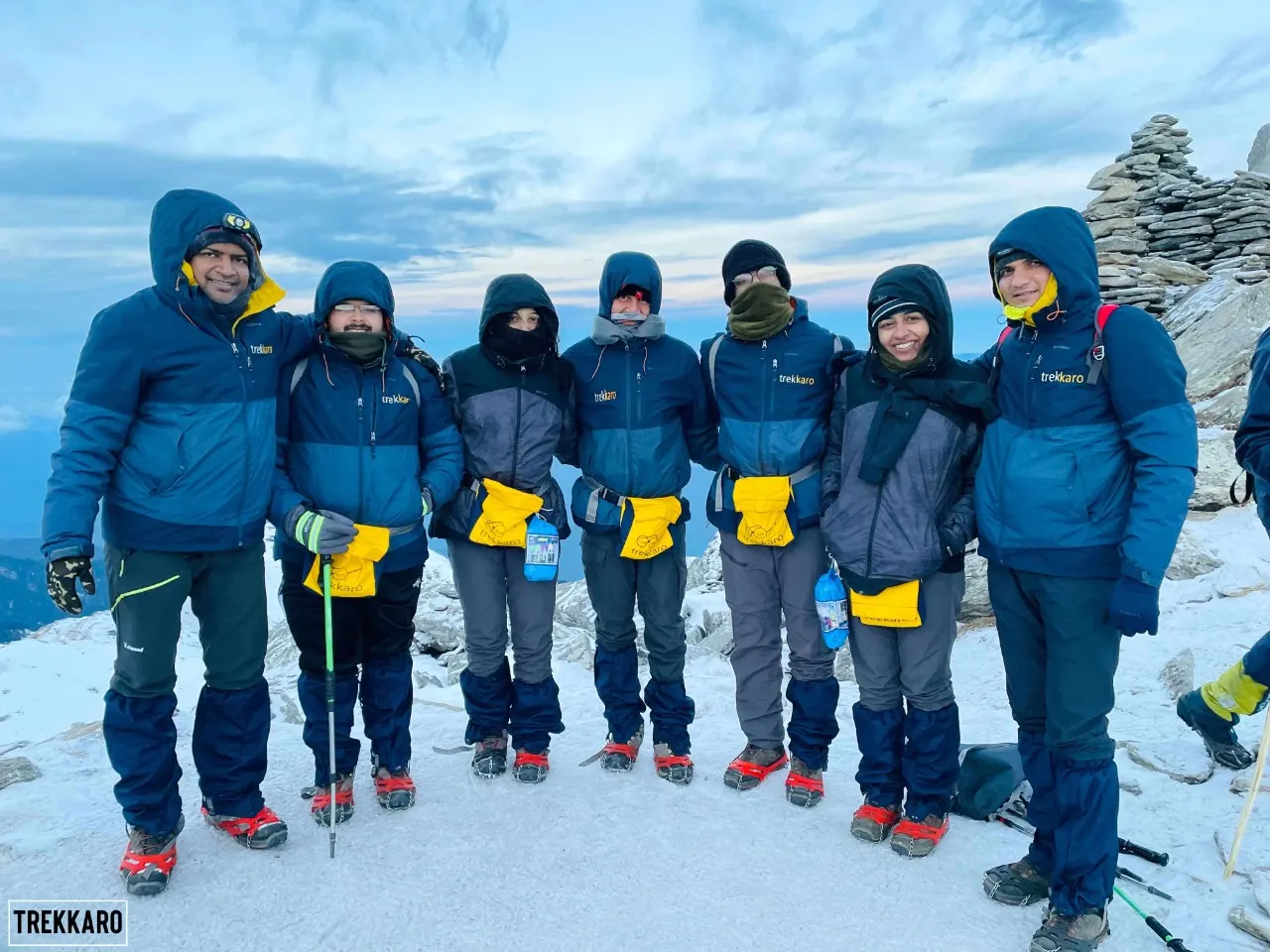
At 2:00 AM, your guide calls the tent. The temperature outside is well below freezing. The stars, improbably bright and impossibly close, form a hard canopy overhead. Headlamps switch on, breath fogs immediately, and the summit party begins moving in single file up the dark mountain. This is the moment the entire trek has been building toward. The summit trail is steep and unrelenting in places, cutting through deep snow across switchbacks that demand a rhythmic, deliberate pace. Your guide sets a tempo. You follow it. One step, breathe. One step, breathe.
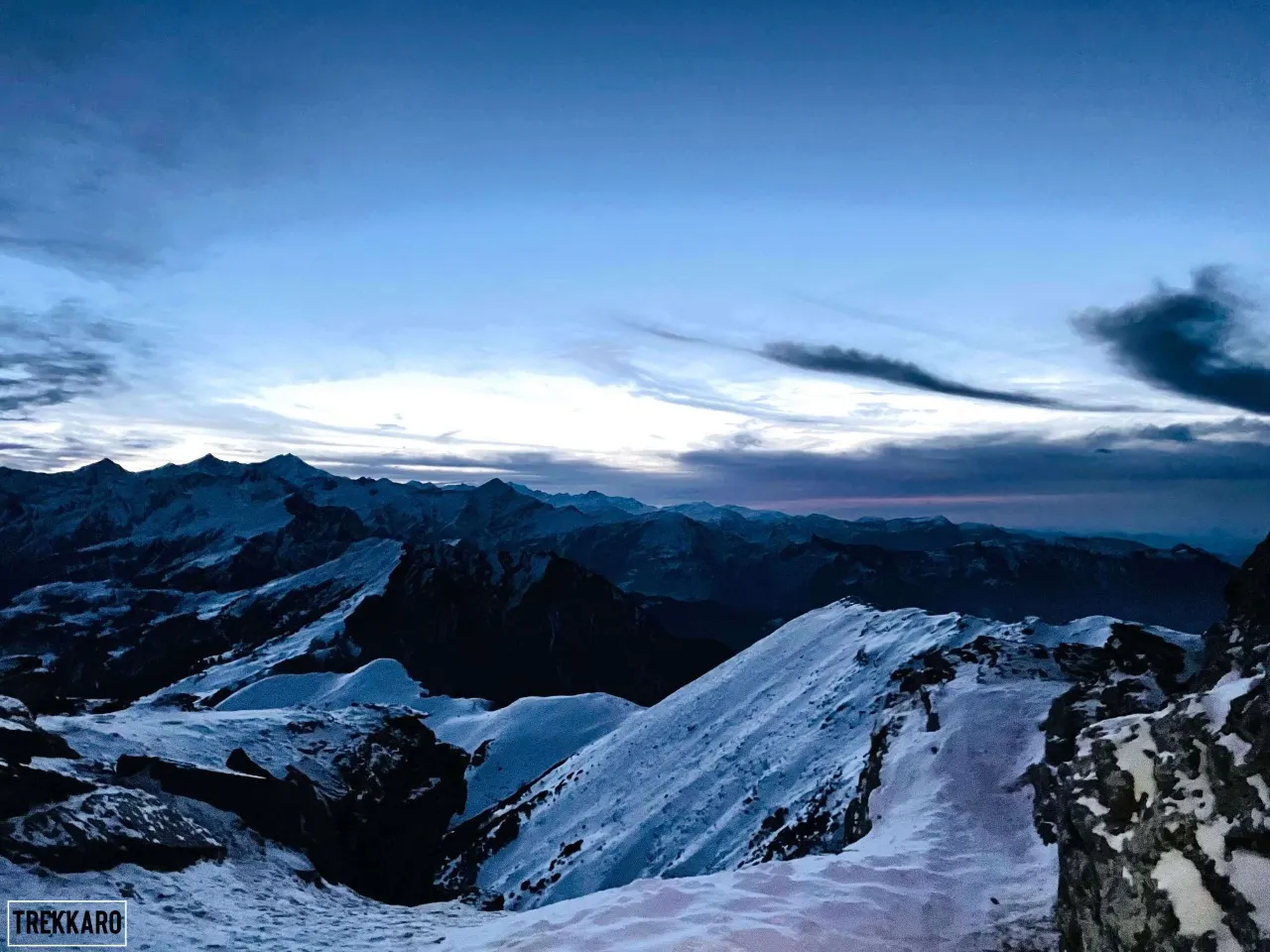
An hour into the climb, you stop to look back. The valley below is inky black, with only faint camp lights visible. Above you, the slope disappears into darkness. The Kedarkantha summit push strips the experience down to its essentials: cold, effort, breath, and will. But this is exactly the kind of simplicity that clears the mind like nothing else. As you approach the final ridge, the eastern horizon begins to shift from black to a deep bruised purple. The Himalayas are waking up. You keep moving.
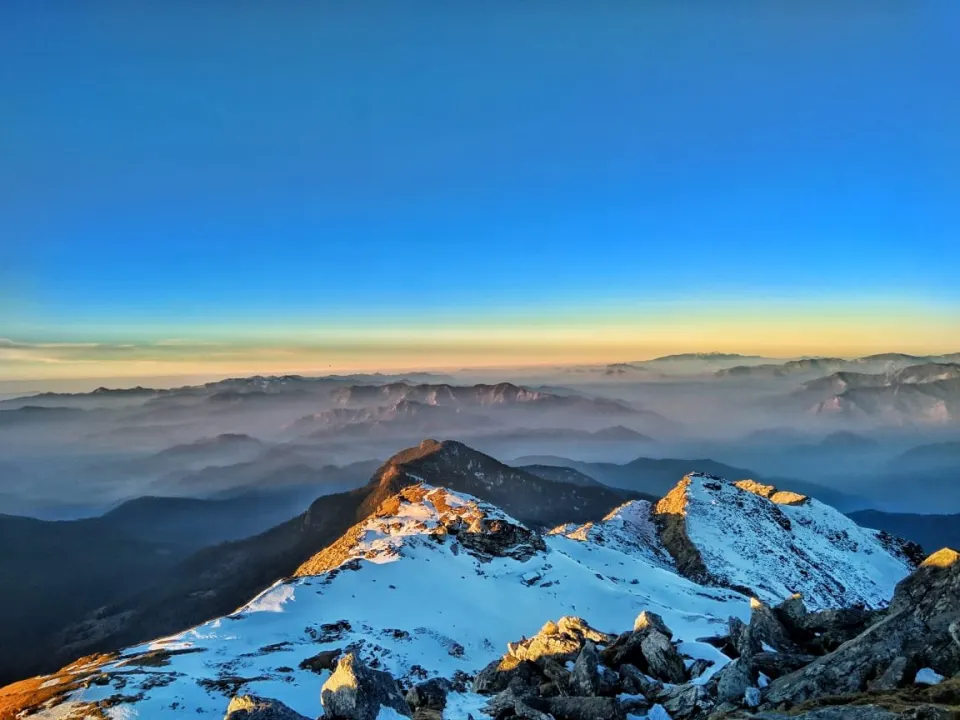
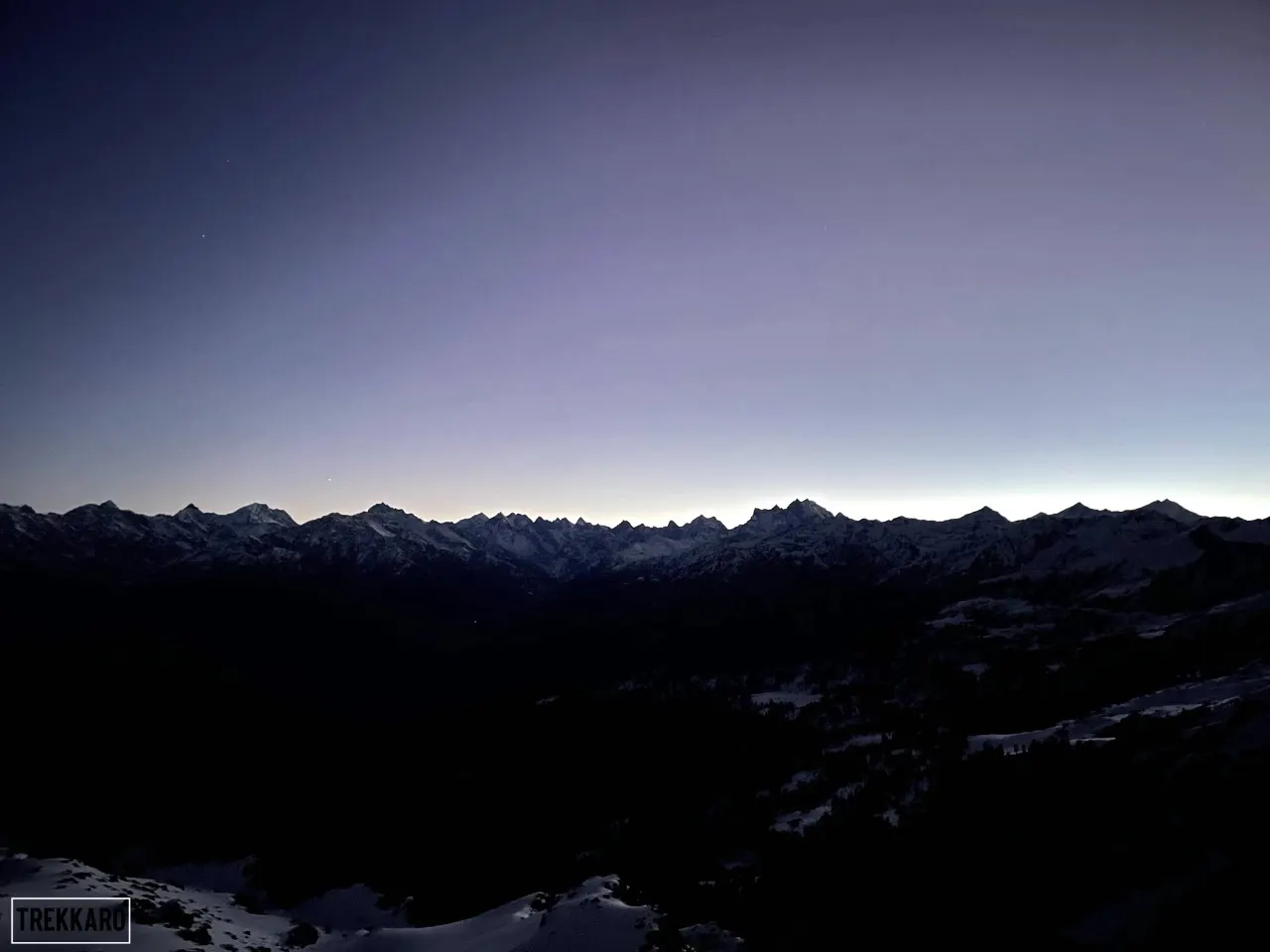
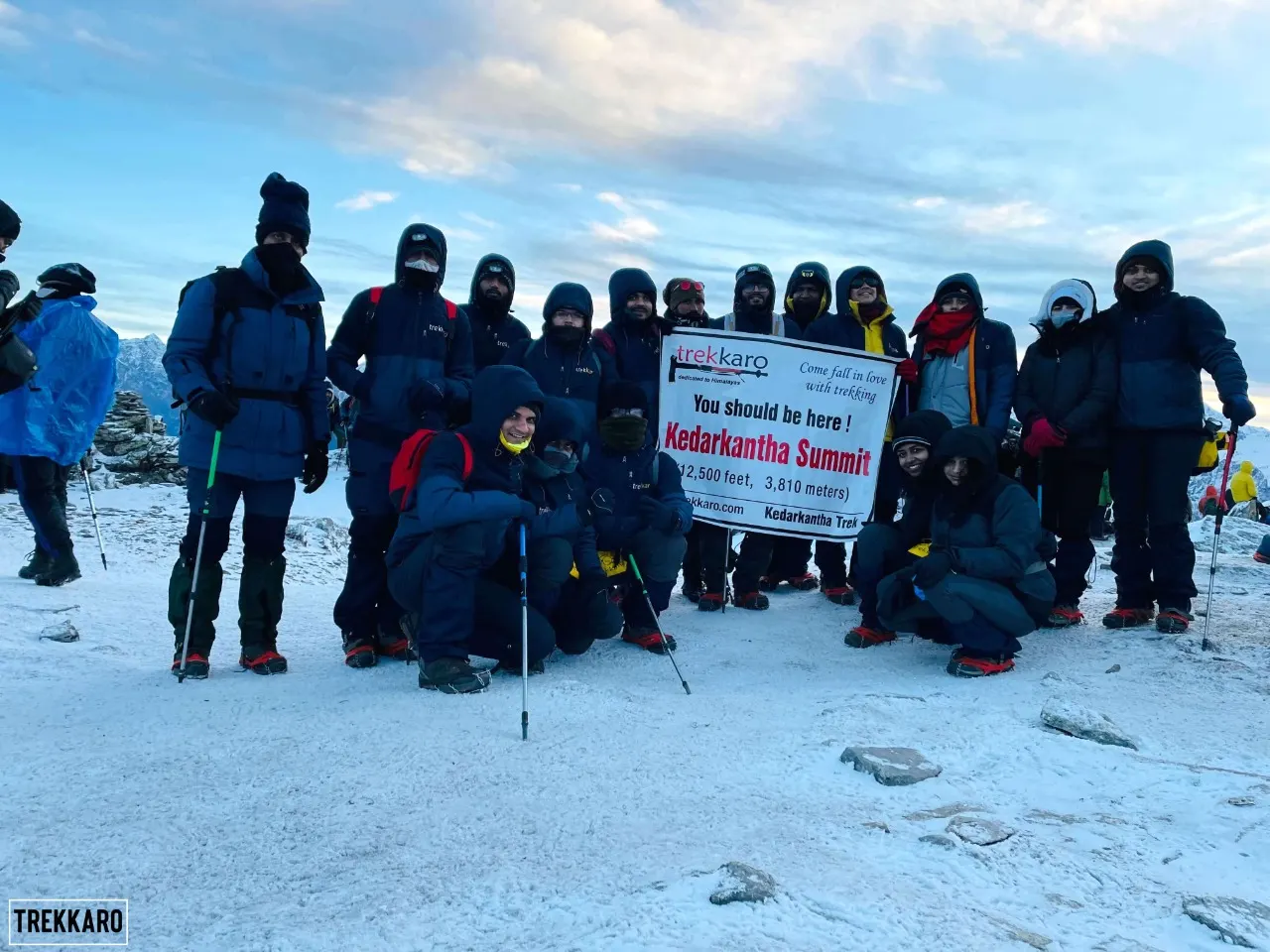
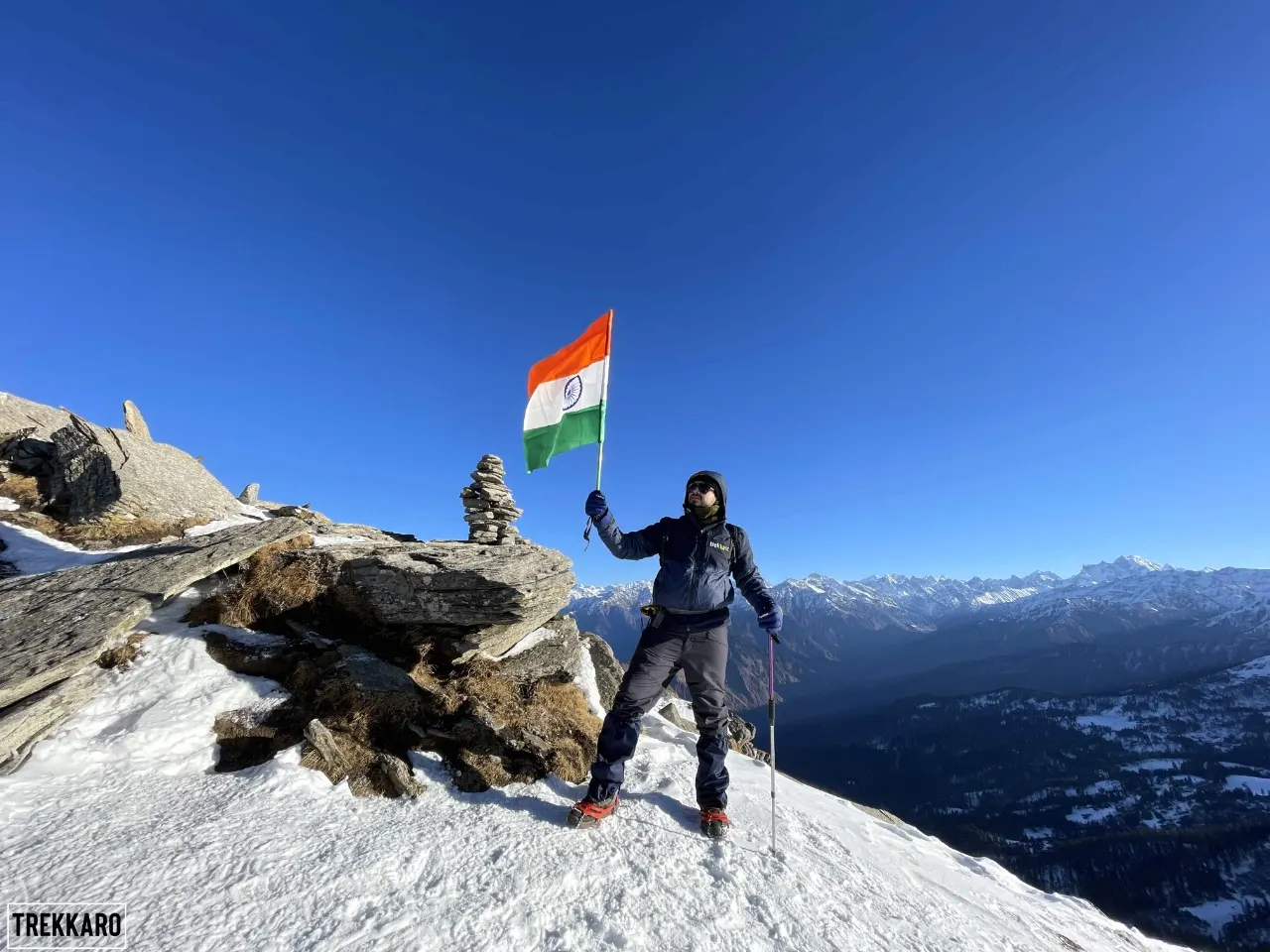
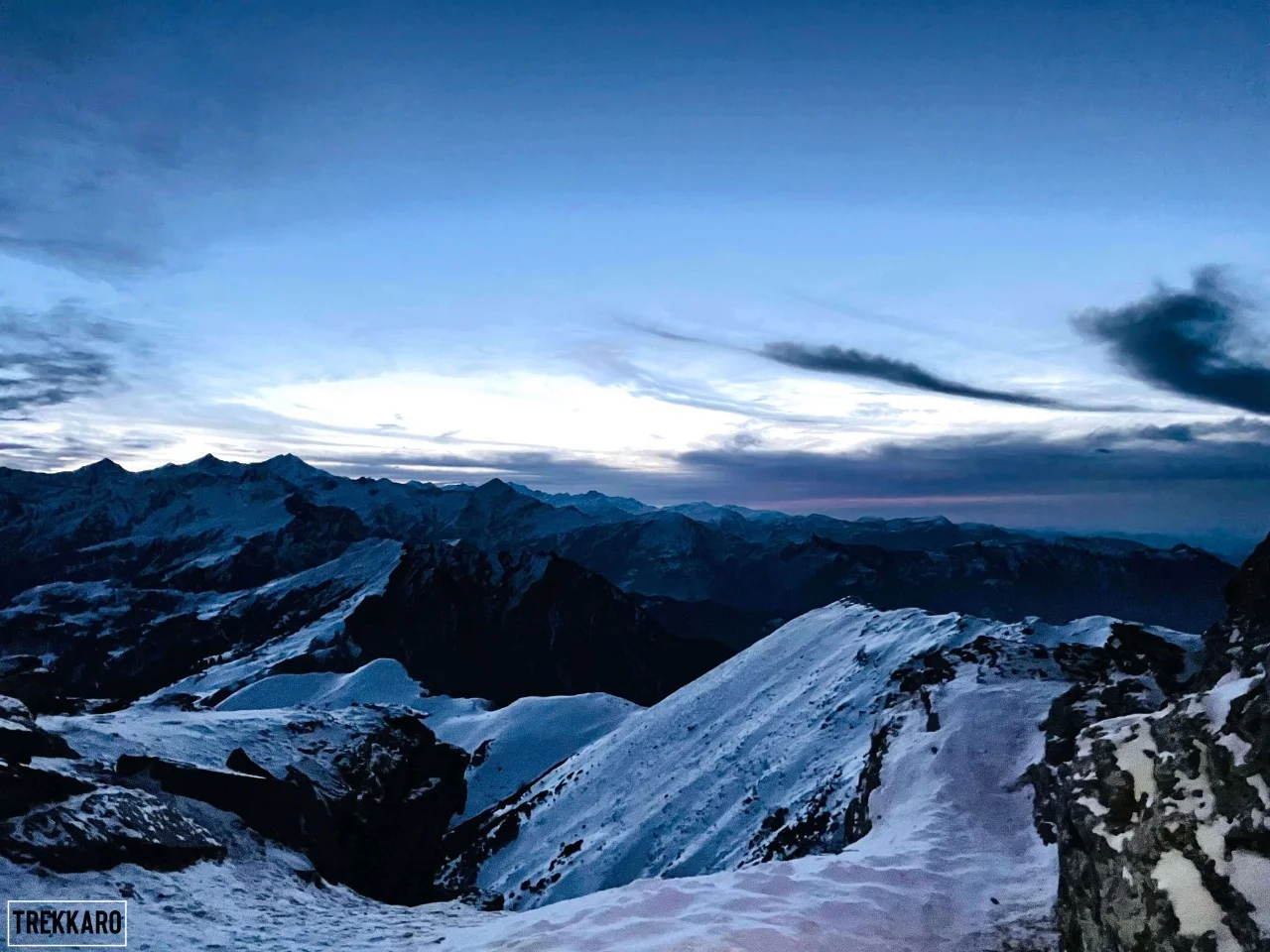
At the summit, 12,500 feet above sea level, the sun cracks the horizon in a sweep of crimson and gold. The peaks of Swargarohini, Black Peak, Bandarpunch, and Kalanag catch the first light and ignite like embers one by one. Below, the clouds lie flat in the valleys like a white sea, and you are above all of it. This is the summit view of Kedarkantha in winter, one of the finest sunrise panoramas in India, and you have earned every pixel of it. Celebrate, photograph, breathe it in. After a brief rest and hot tea from your guide's thermos, the descent begins. Moving downhill on snow-covered slopes is its own kind of joy: faster, looser, and often punctuated with involuntary laughter. Back at base camp by mid-morning, you continue descending through the meadows and back into the forest to reach Juda Ka Talab by early afternoon. Tonight, camp feels different. Quieter. Fuller.
What to Expect:
- Pre-dawn summit start at 2:00 AM from base camp
- Steep snow climb with headlamps through the dark
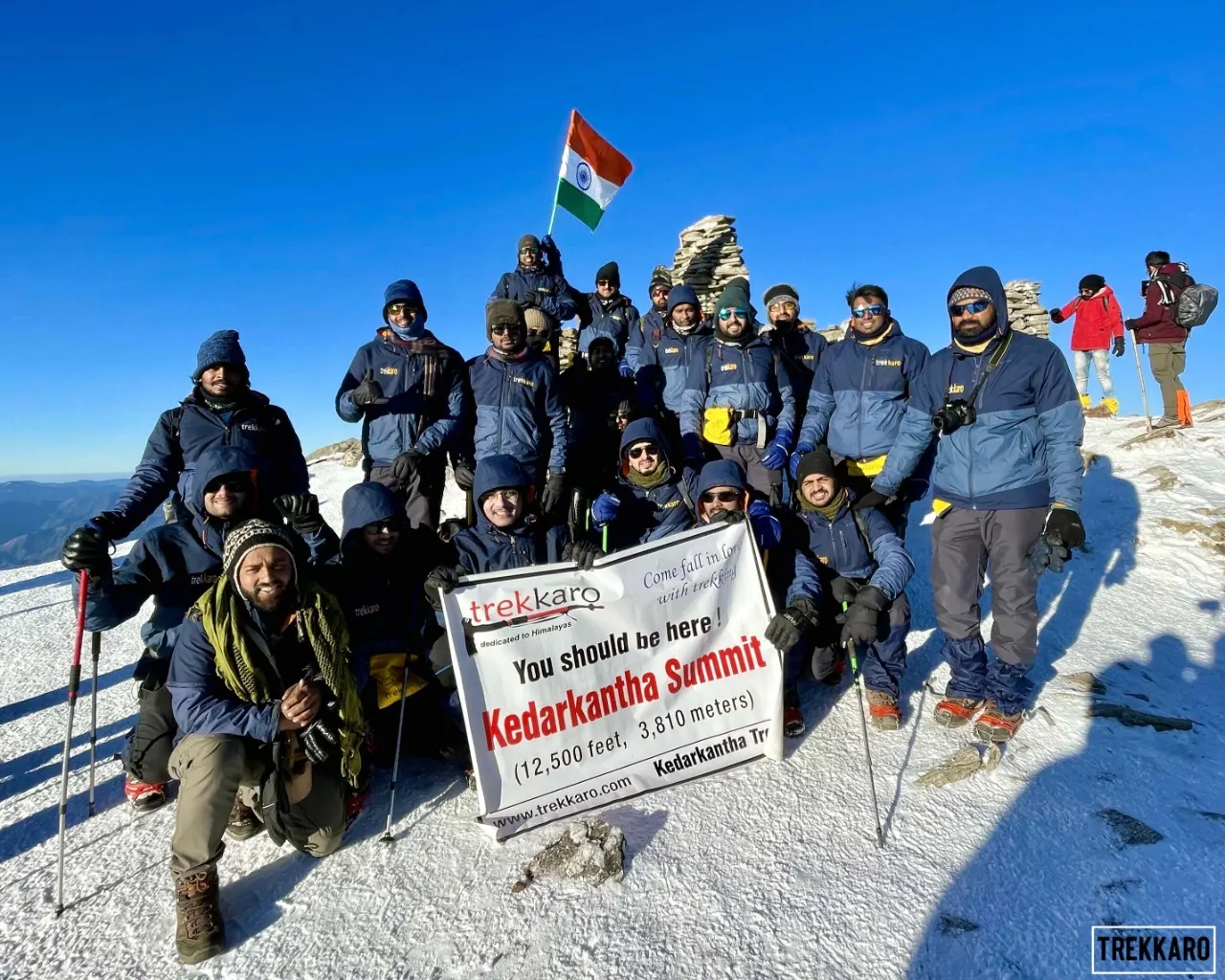
- Sunrise from the Kedarkantha summit (12,500 ft / 3,810 m)
- 360-degree panoramic views of the Garhwal & Himachal Himalayan ranges
- High-energy descent back through base camp to Juda Ka Talab
- Overnight camping at Juda Ka Talab with a celebratory dinner
Day 5: Juda Ka Talab to Sankri & Drive to Dehradun
Route Details:
Altitude: 9,100 ft → 6,400 ft | Trek to Sankri: ~4 km | Drive: Sankri → Dehradun (~7–8 hours)
The last morning at Juda Ka Talab arrives quietly. You wake to sunlight already moving across the frozen lake, turning the ice from grey to pale gold. There is no summit to chase today, no agenda beyond descent. Trekkers who experienced the same trail just three days ago as fresh and novel now move through it with an easy familiarity, recognising specific trees, trail bends, and the particular way a certain ridge lights up at this hour. The mountain has become familiar, and that, too, is a form of belonging.
The 4-kilometre descent through the pine forest back to Sankri passes quickly. Legs are stronger, lungs are adapted, and conversation flows freely. Your Trekkaro guide will walk the final stretch beside you, reviewing highlights, answering questions about the landscape, and ensuring no one rushes the last miles in a hurry to reach the road. At Sankri, a hot lunch waits. Trekkers share summit photographs over plates of rice and dal, and the trip documentation, memories, and laughter that define the end of every great expedition begin to take shape.
The drive back to Dehradun traces the same Tons River road you traveled four days ago. But it looks different now. Not because the landscape has changed, but because you have. The river is the same. The cliffs are the same. The pine forests above the road are the same. What is different is the trekker looking out the window. Kedarkantha has a well-documented effect on those who climb it: they return quieter in the best possible sense, with better posture, a deeper appetite for silence, and a persistent urge to look up at the sky. You will feel it on this drive. You will feel it for weeks after.
What to Expect:
- Final 4 km descent through pine forest back to Sankri
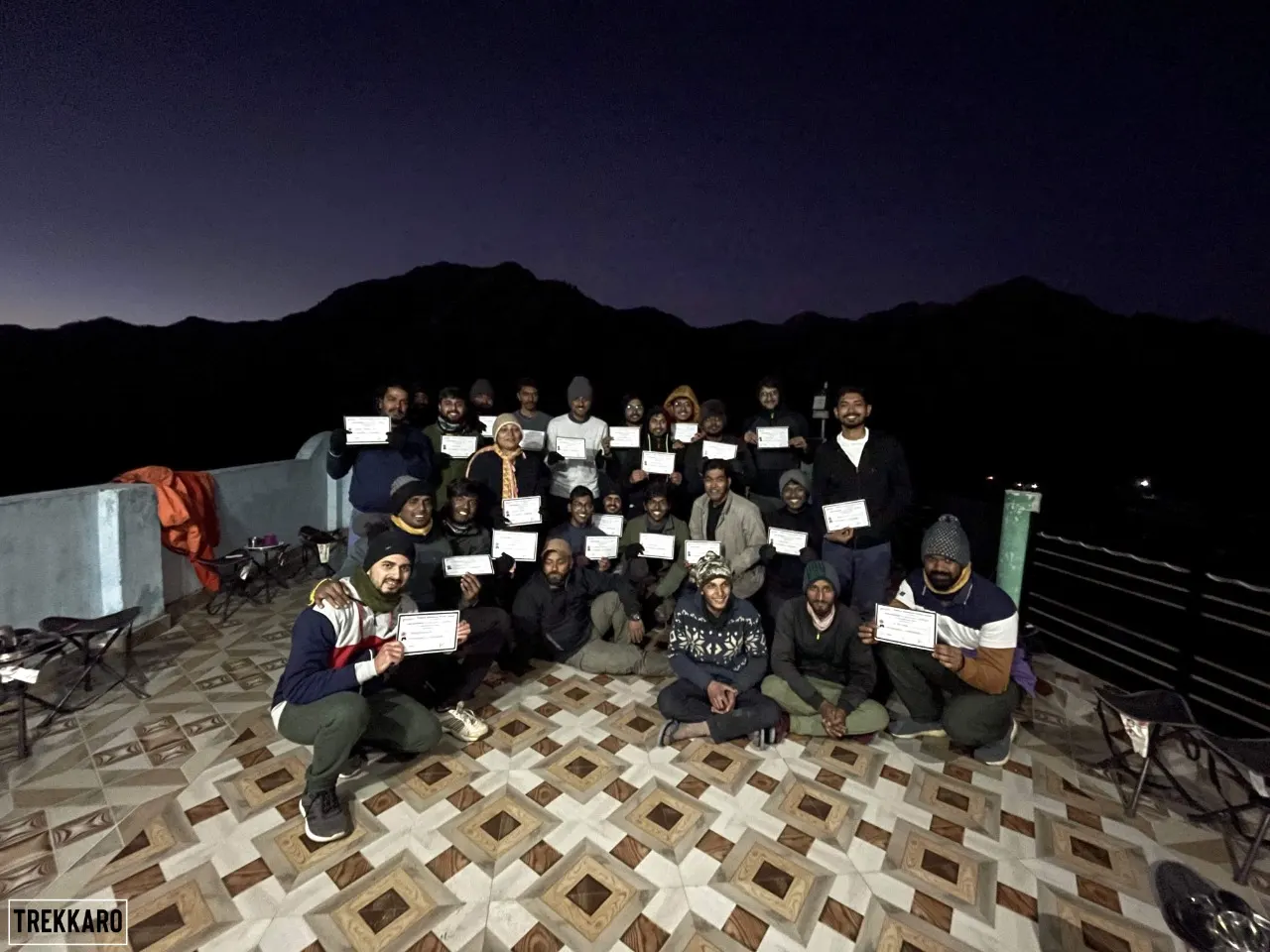
- Trek concludes at Sankri starting point of trek. Completion certificates issued.
- 7–8 hour scenic drive back to Dehradun along the Tons River
- Arrival in Dehradun by evening
How To Reach
Nearest airport: Jolly Grant Airport (DED), about 25 km / 45–60 min from Dehradun city, with direct flights from Delhi and other metros. The cab leaves Dehradun Railway Station at 06:30 AM, so fly in the day before and stay near the station.
From Dehradun to Sankri: 200 km, 7–8 hrs by road. A cab can be arranged at an additional cost from Dehradun Railway Station at 06:30 AM to Sankri Village; it costs approximately ₹6,500 one way per 5–6 seat vehicle, shared among the trekkers.
Return: On the last day you walk down from Juda Ka Talab to Sankri and drive back; the cab (at an additional cost, approximately ₹6,500 one way per vehicle, shared) is expected at Dehradun Railway Station by 06:00 PM. Book your flight home for the next day.
Nearest railway station: Dehradun (DDN), which is also the pickup point, with direct trains from Delhi. Take the overnight train to arrive on the morning of departure, or come a day early.
- Nanda Devi Express – overnight from Delhi, the easiest way to make the 06:30 AM cab.
- Dehradun Shatabdi, Jan Shatabdi and Vande Bharat – day trains; take them the day before the trek.
Check current timings and book early, especially for weekend and holiday batches.
From Dehradun to Sankri: 200 km, 7–8 hrs by road. A cab can be arranged at an additional cost from Dehradun Railway Station at 06:30 AM to Sankri Village; it costs approximately ₹6,500 one way per 5–6 seat vehicle, shared among the trekkers.
Return: On the last day you walk down from Juda Ka Talab to Sankri and drive back; the cab (at an additional cost, approximately ₹6,500 one way per vehicle, shared) is expected at Dehradun Railway Station by 06:00 PM. Book a late-night train or travel the next day.
By bus: Buses run through the night from Delhi ISBT Kashmere Gate to Dehradun ISBT, about 6–7 hrs. Prefer Uttarakhand Roadways (government) Volvo or ordinary buses from inside the ISBT, and from Dehradun ISBT take an auto or cab to the railway station for the 06:30 AM pickup.
From Dehradun to Sankri: 200 km, 7–8 hrs by road. A cab can be arranged at an additional cost from Dehradun Railway Station at 06:30 AM to Sankri Village; it costs approximately ₹6,500 one way per 5–6 seat vehicle, shared among the trekkers.
Return: On the last day you walk down from Juda Ka Talab to Sankri and drive back; the cab (at an additional cost, approximately ₹6,500 one way per vehicle, shared) is expected at Dehradun Railway Station by 06:00 PM. Book a late-night bus or travel the next day.
Things To Carry
Kedarkantha is a winter and snow trek with a 2:00 AM summit start, so grip, warmth and light matter most.
- Trekking shoes – Provided free with Trekkaro’s Free Trekking Gear (one refundable deposit of ₹3,000 + ₹200 washing charge covers the whole kit), handed over on the first day; your own broken-in, waterproof pair with ankle support is welcome too.
- Trekking poles – Provided free with Trekkaro’s Free Trekking Gear; a real help on the snowy descent.
- Microspikes and gaiters – Provided free with Trekkaro’s Free Trekking Gear when the trail has snow or ice.
- Backpack (50–60 L) – with a rain cover, big enough for winter layers.
- Day pack (20–30 L) – needed if you offload your main backpack; also carries water, snacks and a spare layer on summit day.
- Two water bottles (1 L each) – one insulated, so your water does not freeze.
- Headlamp – with spare batteries; essential for the pre-dawn summit climb.
- Lunch box – reusable, for packed lunch on the trail.
Nights at the upper camps drop below freezing and the summit climb starts in the dark, so carry 5 warm layers: thermal top and bottom, 2 fleece or woollen layers and a padded jacket.
- -10°C padded jacket – Provided free with Trekkaro’s Free Trekking Gear; your main warm layer at camp and on the summit.
- Thermal inners (top and bottom) – 2 sets, merino or synthetic; keep one set dry for sleeping.
- Fleece jackets or woollen sweaters x2 – 200–300 gsm fleece, for camp and rest stops.
- Waterproof, windproof jacket or poncho – the outer shell for snowfall, wet snow and wind on summit day.
- Trek pants x2 – quick-dry, no jeans; waterproof or snow pants help on the summit and snowfields.
- Warm trousers – fleece or woollen, for camp.
- Quick-dry collared T-shirts x3 – full sleeves, worn under your layers.
- Socks – 3–4 pairs: cotton or sports socks for walking and woollen socks for camp and night.
- Spare warm set in a dry bag – kept dry inside your backpack for emergencies.
Snow glare, cold wind and strong sun above 9,000 ft make these essential on Kedarkantha.
- Woollen cap – covering the ears.
- Balaclava – for the pre-dawn summit climb, when the wind chill is intense.
- Sun cap – for bright afternoons on the snow.
- Gloves – a fleece or woollen pair plus a waterproof outer pair for snow.
- Buff or neck gaiter – face and neck protection.
- UV sunglasses – category 3 or 4; snow glare can cause snow blindness.
- Sunscreen SPF 50+ and lip balm – UV is much stronger at altitude, even on cold days.
- Quick-dry towel and toiletries – biodegradable soap, toothbrush, toothpaste and hand sanitiser; no wet wipes, as they are not biodegradable.
- Ziploc or dry bags – for electronics, documents, wet clothes and waste.
Charging and mobile signal are limited on the trail and cards do not work in the mountains, so carry these from Dehradun.
- Personal medical kit – your regular medicines, blister plasters, pain relief and ORS; consult your doctor before the trek, including about Diamox.
- Snacks and ORS – trail mix, dates, energy bars, dark chocolate and electrolyte sachets.
- Power bank – there is no charging on the trail, and cold drains batteries fast, so keep spares close to your body.
- Cash – in small notes; ATMs are few in the hills and cards are not accepted in the mountains, so withdraw in Dehradun, including your share of the cab fare.
- Camp slippers or sandals – light, for camp and inside the tent.
- Offline map – downloaded on your phone before you leave.
- Waste bag – Trekkaro follows a zero-waste policy; carry all your packaging back out in the Swachh Bharat bag.
- Earplugs – optional, useful in shared stays.
- Government photo ID – original and a photocopy (Aadhaar card, passport, voter ID or driving licence).
- Passport – for international trekkers, needed for forest entry permits and any medical evacuation.
- Medical fitness certificate – signed by a doctor.
- Travel insurance – policy document with emergency evacuation cover (mandatory).
- Disclaimer form – signed, with your emergency contact details filled in.
- Trekkaro booking confirmation – e-ticket / tax invoice.
Frequently Asked Questions
Kedarkantha Trek is a 5-day easy–moderate trek in Uttarkashi, Uttarakhand, reaching 3,810 m (12,500 ft). It covers about 20 km on foot and starts and ends at Sankri. Best time: September to June. Trekkaro price: ₹9,000 per person + 5% GST, with free trekking gear (Decathlon shoes, -10°C jacket and poles). Next batch: 10 Oct 2026 (106 upcoming batches).
Updated
Terms & Conditions
- Decathlon Gear Quechua Trek 100 shoes, SH 100 (-10°C) jackets, and trekking poles with no rental fee (FTG Initiative: ₹3,000 refundable deposit + ₹200 washing charge)
- All meals on trek: breakfast, lunch, evening snacks, and dinner from Day 1 dinner to Day 5 breakfast
- Accommodation: 1 night in the guesthouse at Sankri and 3 nights camping on the trail at all designated campsites, on triple sharing basis.
- High-quality tents (double-wall, rain-rated) and -20°C sleeping bags at all campsites
- Trekking mattresses / sleeping pads at every campsite
- Certified trek leader and guide throughout all 5 days
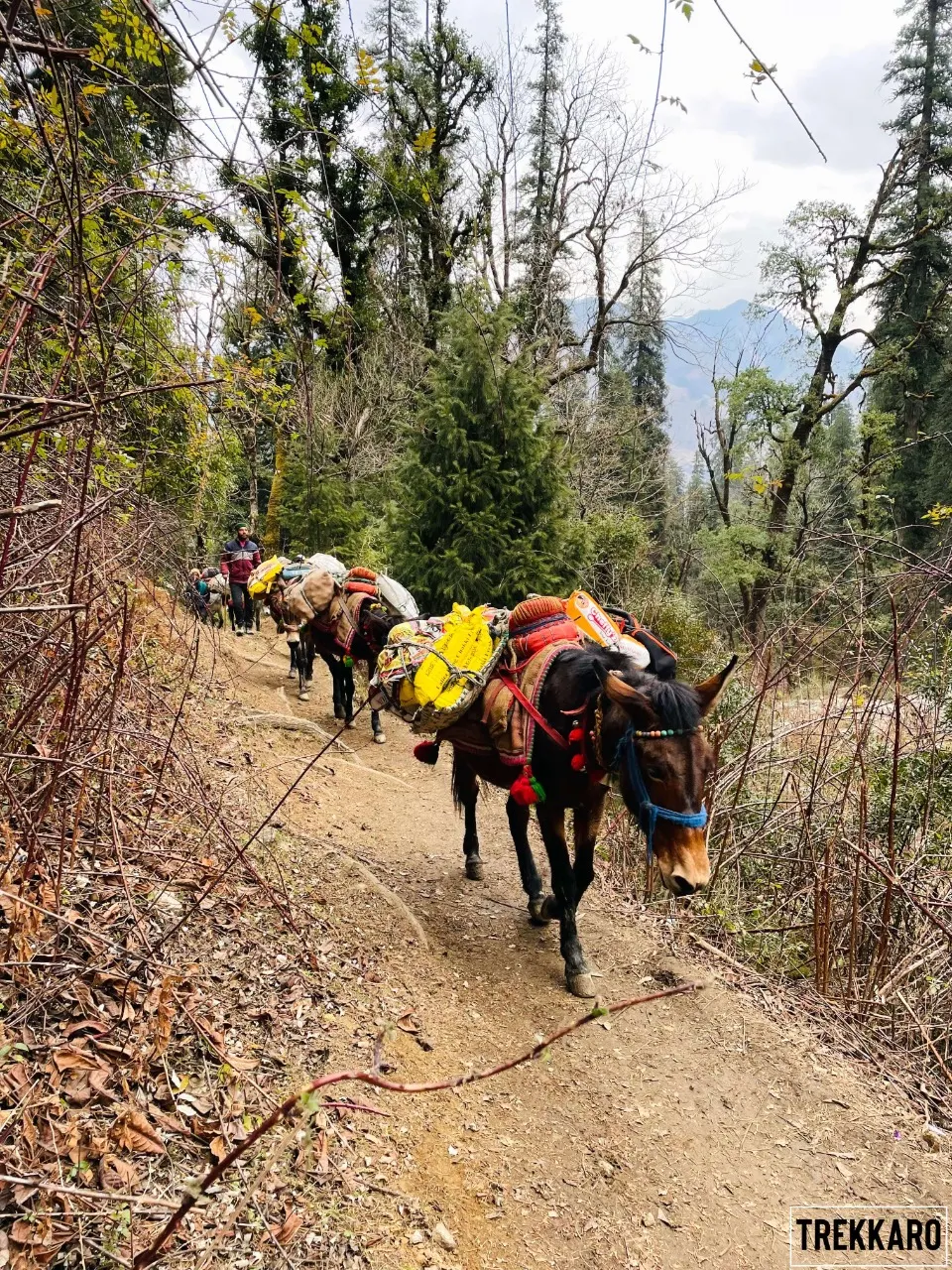
- Mountain kitchen staff, camp helpers, and mule/porter support for equipment transport
- Govind Pashu Vihar National Park entry permits and forest checkpost fees - fully arranged by Trekkaro
- Daily SpO2, pulse, and blood pressure health monitoring at every campsite (twice daily)
- Portable oxygen cylinder and emergency stretcher - standard on every Trekkaro Kedarkantha batch
- HF radio communication across the full trek team throughout the route
- Trek completion certificate on successful completion to Kedarkantha Summit and return to Sankri
- Food During Transit Meals during travel to and from the base camp
- Transport - Basecamp Transfers Shared taxi transfers from Dehradun to Sankri and from Sankri back to Dehradun upon trek completion, are not included in the package. Trekkaro can arrange these transfers on your behalf; the cost is approximately ₹6,500 (One way) per vehicle (5-6 seater, tentative), shared equally among trekkers in the same vehicle.
- Travel to / from Dehradun: flights, trains, buses - arranged independently by trekker
- Accommodation in Dehradun before or after the trek
- Personal trekking gear: clothing, backpack, sunglasses, etc. (shoes, jacket, poles, gaiters and microspikes come with Free Trekking Gear)
- Travel insurance: mandatory for this route. Must include high-altitude cover and helicopter evacuation.
- Personal expenses: tips, calls, laundry, additional snacks
- Backpack Offloading: ₹1,500 +5% GST for the entire trek (Max. 9 kg). No suitcases, trolleys, or duffel bags allowed. Charges may be higher for last-minute offloading requests made at Sankri
- Single Tent Occupancy: ₹2,000 + 5% GST per tent for the entire trek
- Costs from early exit, evacuation, or itinerary change due to weather or medical reasons
- Anything Not Mentioned Under Inclusions
Free rescheduling up to 7 days before · TrekCash voucher · refunds — tap to read
We know that cancelling a trek can be genuinely disappointing. Plans change, life intervenes, and sometimes the mountains have to wait. That is why Trekkaro has designed one of the most trekker-friendly cancellation policies in the industry — to reduce the financial impact on you and give you real options when things do not go as planned.
Important: Bookings made on trekkaro.com are cancelled online from My Bookings. Bookings made offline with our team must be cancelled in writing by e-mail by the person who originally booked the trek. Requests over the phone, via WhatsApp, or through third parties are not accepted.
How to Cancel Your Trek
Booked online on trekkaro.com:
- Log in and open My Bookings.
- Choose Cancel Booking on the trek you want to cancel.
- Pick a refund (as per the charges below) or Get TrekCash Voucher instead — the voucher is issued instantly and appears under My TrekCash Vouchers.
Booked offline with our team:
- Compose an e-mail from the registered e-mail ID used at the time of booking.
- Attach a copy of your tax invoice to the e-mail.
- Send both to info@trekkaro.com.
- Your cancellation is effective from the date Trekkaro receives and acknowledges your e-mail.
How to Reschedule Your Trek (Free)
- Once per booking, to another batch of the same trek, free of charge. A request we decline doesn’t count.
- Up to 7 days before departure — both your current and new batch must be at least 7 days away.
- Subject to seat availability for every trekker on the booking.
- Not available for bookings paid fully or partly with a TrekCash Voucher.
- No fee or price difference; add-ons and the number of trekkers stay as booked.
Booked online: My Bookings → Reschedule free → pick a batch. Our team confirms by e-mail and your booking moves once approved. Booked offline: e-mail info@trekkaro.com.
Cancellation Charges
| Cancellation Timeline | Refund | Details |
|---|---|---|
| 30 days or more before departure | 70% Refund | 30% cancellation charge |
| 15 to 29 days before departure | 50% Refund | 50% cancellation charge |
| Within 14 days / No-Show | No Refund | Free rescheduling (once per booking), transfer of booking, or a TrekCash Voucher (100% value, 1-year validity) — available until 7 days before departure |
Free rescheduling or a 100% voucher instead of a refund. At any time from the date of booking until 7 days before departure, you can reschedule to another batch free of charge (once per booking, subject to seat availability), transfer your booking to another trekker, or take a TrekCash Voucher worth 100% of the amount paid, valid for 1 year — whichever refund slab would otherwise apply. Online bookings take the voucher themselves from My Bookings → Cancel Booking (issued instantly); offline bookings request it by e-mail to info@trekkaro.com.
Cancellation of Voucher-Based Bookings
- The standard cancellation policy applies to voucher-based bookings in the same way it applies to direct bookings.
- Any remaining balance after the applicable cancellation charge has been deducted will be credited back to your Trekkaro account as a new voucher.
- If your voucher has already expired at the time of cancellation, no refund, credit, or extension will be issued under any circumstance.
- If a voucher is set to expire on a Sunday or public holiday, it must be redeemed before the expiry date.
Additional Terms
- Free Rescheduling: Switching to a different batch of the same trek is free of charge once per booking, up to 7 days before departure, subject to seat availability. Not available for bookings paid with a TrekCash Voucher. See “How to Reschedule Your Trek” above.
- Trek Transfers: Transferring your booking to another person is permitted, subject to Trekkaro's eligibility criteria. The new trekker must meet the fitness, age, and documentation requirements for that particular trek.
- No Refund Post-Commencement: Once the trek has commenced from Day 1 of your confirmed itinerary, no refunds or TrekCash Vouchers will be issued for any reason, including early exit, illness, or dissatisfaction with services.
- Policy Changes: Trekkaro reserves the right to amend or withdraw this cancellation policy at any time without prior notice. The version in effect at the time of your booking confirmation governs your booking.
Early Exit or Removal from Trek
A trekker may be required to leave the trek before completion for health concerns (AMS, hypertension, cardiac symptoms, or fitness that poses a safety risk), rule violations (alcohol or non-prescribed drugs on trail, smoking in prohibited zones, reckless behaviour, or misconduct), or by their own decision. In all cases of early exit or removal, no refund, partial refund, or TrekCash Voucher will be provided, and any additional transport or exit expenses are the trekker's responsibility. The trek leader's decision on health and safety grounds is final.
If Trekkaro Cancels Your Trek
In rare circumstances beyond our control — natural disasters (extreme snowfall, avalanche, floods, landslides, earthquakes) or unforeseen civil events (government curfews, lockdowns, political unrest) — Trekkaro will issue a TrekCash Voucher for the full trek fee paid, valid for 12 months on any trek listed on Trekkaro.com. If the new trek costs more, the difference is payable by the trekker. The voucher is sent to your registered e-mail within 10 working days and may be transferred to another person who meets Trekkaro's eligibility requirements.
Refund Processing
Refunds are processed within 10 working days of cancellation approval and credited to the original payment method only (credit card, debit card, net banking, UPI, or wallet). Your bank may take another 3–5 business days. Office hours: Monday to Saturday, 10:00 AM to 7:00 PM IST.
The full policy is part of our Terms & Conditions (Section 09).
Gallery
Oxygen, first aid, daily SpO₂ checks, trained leaders — tap to read
-
Why Trekking With Trekkaro Just Hits Different
Let’s skip the romanticising for a second.
The Himalayas are brutal, beautiful, and brutally expensive. Before you have even laced up for Day 1, you have already bled out on boots that actually grip ice, a jacket that won’t quit at -10°C, and poles that won’t snap on a ridge at 14,000 feet. For most people, the gear bill alone is enough to bury the dream.
We built Trekkaro to kill that excuse.
Our Free Trekking Gear (FTG) initiative is the only one of its kind in the industry. We don’t hand you a dusty rental bag and wish you luck - we kit you out in full, premium Decathlon gear, so the only thing you are spending on the mountain is energy.
1. Premium Gear. Zero Compromise. No Rental Fee.
When you show up to base camp with Trekkaro, you’re showing up equipped:
- ₹6,999 Quechua TREK 100 trekking shoes - built for altitude, not Instagram
- Quechua SH 100 insulated jackets (₹3,299) - rated to -10°C, because “a little chilly” at 13,000 feet is a lie
- Professional-grade trekking poles - the kind that give, not break
This isn’t charity. It’s a safety standard. Cheap gear doesn’t fail gracefully - it fails suddenly, in the cold, far from help. Our high-altitude tents and sleeping bags are rated from -5°C to -20°C, because when the wind is tearing through camp at 3 AM, the difference between good gear and great gear is the difference between sleeping and suffering.
2. Your Health Gets Checked - Every Single Day. No Exceptions.
The mountain doesn’t care about your fitness routine or your iron will. Altitude sickness doesn’t negotiate. It hits the first-timer and the seasoned trekker the same way - quietly, then all at once.
That’s why we don’t wait for symptoms. We track.
- Daily vitals: Pulse and blood oxygen (SpO2) checks for every trekker, every day
- Early detection over emergency reaction: A dip in your SpO2 is caught and addressed before it becomes Acute Mountain Sickness (AMS)
- Guides trained to make hard calls: If you’re not 100%, we don’t push you. We have the medical backup to act on the mountain, not after you’ve come down
Prevention isn’t cautious. It’s what separates a great trek from a dangerous one.
3. Real Safety Infrastructure - Not a Bag of Band-Aids
Most operators carry a first-aid kit. We carry a system.
- Portable oxygen cylinders - moving with the group at all times
- Emergency stretchers - staged at every campsite, not just base
- Radio communication across all camps - because mobile signal disappears the moment the real terrain begins
Our camps are always in contact. A weather change, a medical flag, a gear issue - our team knows before it becomes a crisis. When you’re with Trekkaro, you’re never truly off-grid where it matters.
4. Technical Muscle on the Hard Sections
Icy ridges. Steep snow slopes. The sections that look straightforward on a map and feel anything but underfoot.
We don’t just warn you and move on. We deploy a dedicated technical team to the sections that demand it — fixing ropes, cutting steps, and physically supporting trekkers through exposed terrain. This isn’t hand-holding. It’s the difference between a team that prepares for the mountain and one that just shows up to it.
A Word Before You Book
We’ll carry the gear and the safety infrastructure. But the mountain still asks something from you.
Start training at least 3 weeks out. Cycling, running, swimming - anything that works your cardiovascular system. At 12,000 feet, your lungs become the limiting factor, not your legs. The trekkers who put in the work before the trek are the ones who arrive at the summit with enough breath left to actually take it in.
The Himalayas are for everyone. But they reward the prepared.
That’s what Trekkaro is built on.
TREKKARO vs. THE INDUSTRY
A Transparent Feature Comparison
We believe transparency builds trust. Here's how Trekkaro stacks up against the rest of the market - across safety infrastructure, gear provision, and actual cost to the trekker. No fluff, no fine print.
|
Feature / Criteria |
TREKKARO |
Budget Operators |
Mid-Range Operators |
Premium Operators |
|
Free Premium Gear (FTG) |
Yes |
No |
No |
No |
|
Decathlon-Grade Equipment |
Yes |
No |
No |
Yes |
|
Daily SpO2 & Pulse Monitoring |
Yes |
No |
~ Limited |
~ Limited |
|
AMS Early Detection Protocol |
Yes |
No |
No |
~ Limited |
|
Portable O2 Cylinders On Trek |
Yes |
No |
~ Limited |
Yes |
|
Emergency Stretchers at Camps |
Yes |
No |
No |
Yes |
|
Radio Communication Network |
Yes |
No |
~ Limited |
Yes |
|
Technical Rope-Fixing Team |
Yes |
No |
No |
~ Limited |
|
-20°C Rated Sleeping Bags |
Yes |
No |
~ Limited |
Yes |
|
High-Altitude Tents (Own Kit) |
Yes |
No |
~ Limited |
Yes |
|
Transparent Gear Breakdown |
Yes |
No |
No |
No |
|
Gear Cost to Trekker |
No rental fee |
₹1K - 2K+ |
₹2K - 3K+ |
₹4K - 5K+ |
Legend: Yes = Fully available | ~ Limited = Partially available / inconsistent | No = Not offered
The numbers tell the story. No other operator in the industry combines free premium gear, daily medical monitoring, full safety infrastructure, and technical on-trail support at any price point — let alone at Trekkaro's.
What a day on the trek feels like — tap to read
What to Expect When You Trek with Trekkaro
Most people spend more time researching a laptop purchase than they do choosing who they hand their safety to at 13,000 feet. We think that deserves to change.
When you trek with Trekkaro, you’re not buying a package. You’re entering a relationship with a team that has thought carefully, sometimes obsessively about every variable between the trailhead and the summit. This section is our honest, specific answer to the question every serious trekker should be asking before they book: what actually happens when I’m up there?
What You Can Expect From Us
1. Safety That Goes Beyond Reassurance
We’ve said it elsewhere on this page and we’ll say it again here because it bears repeating: safety at altitude is not a vibe. It is a system.
Our guides don’t just “know the mountains.” They hold NIM (Nehru Institute of Mountaineering) certification or equivalent accreditation, which means their training covers casualty assessment, high-altitude medical response, rope mechanics and anchor building, and multi-team evacuation coordination specific to the terrain we operate in. They’ve been trained to make difficult calls including the one no trekker wants to hear: you need to descend now.
On the trail, safety looks like this: twice-daily SpO2 and pulse checks at every camp. Portable oxygen cylinders carried with the group in motion, not staged at basecamp. An emergency stretcher pre-positioned at every campsite before the trekking group arrives. HF radio contact maintained between trek leader, sweep guide, and base operations at all times because mobile signal above 10,000 feet is not a plan.
The calm, professional demeanor you’ll notice in our guides isn’t composure for its own sake. It is the result of training and preparation thorough enough that very few situations on the mountain come as a surprise. That is what you feel. That is what lets you actually enjoy the trek.
2. Personalised Attention - Not Group Management
Trekkaro caps every batch at a maximum of 20 trekkers. This is not a selling point. It is a structural decision that makes everything else on this list possible.
At a 1:8 guide-to-trekker ratio, your trek leader knows your pace by Day 2. They know whether you tend to push too hard on the ascent and fade in the afternoon. They know whether you’re someone who needs encouragement on technical sections or someone who needs to be quietly reined in. They know what you ate at breakfast and whether you filled your water bottle before leaving camp.
Altitude acclimatisation, gear fit, meal timing, hydration monitoring - these aren’t items on a checklist. They are the continuous, low-key background work of a Trekkaro guide throughout every day on the trail. You don’t have to ask for most of it. It simply happens, and you notice its absence only if you’ve ever trekked without it.
3. Guides Who Are Leaders, Not Just Route-Knowers
There’s a version of a trekking guide who walks fast, knows the path, and assumes everyone is keeping up. That is not the Trekkaro guide.
Our guides understand that a group of twelve people at 12,000 feet is twelve different physiological experiences happening simultaneously. One trekker is managing a blister they haven’t mentioned. Another is slightly dehydrated and doesn’t know it yet. A third is having the single best day of their life and just needs to be left in it. A guide who can read all three of those simultaneously and respond to each of them differently, is the difference between a trek that is merely completed and one that is genuinely unforgettable.
Our guides are trained motivators, yes. But more fundamentally, they are trained observers. The moment your stride changes, the moment your breathing pattern shifts, the moment you start answering questions with fewer words than usual, they notice. That attentiveness is what keeps you safe. It also, incidentally, makes for extraordinary mountain companionship.
4. An Itinerary Built Around How the Body Actually Works at Altitude
There is a temptation in trek design to maximise distance, minimise days, and push the daily elevation gain as high as the trail allows. The result is an itinerary that looks efficient on paper and feels brutal in practice.
Trekkaro itineraries are built around the golden rule of altitude acclimatisation: climb high, sleep low, and give the body time to adapt before demanding more of it. The daily elevation gains on our routes are calibrated to physiological reality, not to route efficiency. Rest and acclimatisation time is built into the schedule as a non-negotiable, not as padding that gets cut when groups run late.
Campsite selection is similarly intentional. We choose sites for their drainage, their shelter from prevailing winds, their proximity to clean water sources, and where possible for views that make the effort of getting there feel immediate and earned. Some campsites will simply take your breath away, and not because of the altitude.
5. Real Value - Which Means Transparency, Not Discounts
We are not the cheapest trekking company in India. We’re also not trying to be. What we are is genuinely transparent about what your money funds.
The cost of a Trekkaro trek covers: all meals on trail (breakfast, lunch, snacks, and dinner, planned for both caloric density and palatability at altitude), accommodation at all campsites, -20°C rated sleeping bags, NIM-certified leadership, medical infrastructure including portable oxygen and emergency stretchers, HF radio communication, forest permits, and the full Free Trekking Gear initiative - premium Decathlon kit with no rental fee (₹3,000 refundable deposit + ₹200 washing charge).
We do not charge separately for things that should be standard. We do not add line items after booking. And we do not cut corners on the things that determine whether your trek is safe and memorable. The value in trekking with Trekkaro is not in paying less. It is in knowing exactly what you are getting and getting all of it.
What We Expect From You
Trekkaro will prepare you, equip you, monitor you, and carry the weight of your safety across every metre of trail. But the Himalayas are not a theme park, and a trek is not a performance staged for your benefit. You are a participant in something genuinely serious and genuinely extraordinary and your contribution matters.
1. Show Up With a Willing Attitude
The Himalayas will not always cooperate. A weather window will close. A campsite will be windier than expected. A stream crossing will be colder than the photographs suggested. A summit morning will begin in darkness at temperatures that test every layer in your pack.
None of this is failure. All of it is the trek. The trekkers who look back on their Kedarkantha Trek experience as transformative are almost always the ones who met discomfort with curiosity rather than resistance. They leaned into the hard morning. They asked questions at camp. They were present for the difficult parts as well as the spectacular ones, and discovered reliably that the difficult parts often become the stories they tell most.
Bring flexibility. Bring patience with yourself and with the group. Bring the version of yourself that is willing to be surprised.
2. Prepare Your Body Honestly
You do not need to be an athlete to trek with Trekkaro. You do need to be honest with yourself about your current fitness level and put in the preparation that brings you to the trailhead in a condition to enjoy the experience, not merely endure it.
The single most important thing you can do is cardiovascular training over a sustained period, not a crash fitness programme in the final two weeks. Start six weeks out. Run, cycle, swim, or hike - any sustained aerobic activity that elevates your heart rate for 45 minutes or more, four to five days per week. Add stair climbing and uphill walking in the final three weeks. Introduce strength work for your quads and ankles, which will carry the real load on the descent.
Arrive in Dehradun at least one day before your batch departs. Sleep well, hydrate properly, and avoid alcohol the night before Day 1. You are not starting a holiday. You are beginning an acclimatisation process, and the first 24 hours set its trajectory.
3. Trust Your Guide’s Judgment - Including the Decisions You Don’t Want to Hear
Our guides make decisions based on complete information: your health readings, current weather data from base operations, the condition of the trail ahead, and five or more years of specific mountain experience. You make decisions based on how you feel and how badly you want to reach the summit.
These two information sets will occasionally conflict. When they do, the guide’s judgment takes precedence, not because we are authoritarian, but because the mountain has no interest in how determined you are.
If your guide adjusts the departure time, changes the route, slows the group’s pace, or recommends you descend rather than continue, it is because something in their complete picture warrants it. Pushing through that recommendation does not make you brave. It makes the situation harder for everyone, including the trekkers who are depending on the group moving as a coordinated unit.
Trust is not passive on a Trekkaro trek. It is an active choice you make every morning when you lace up your boots, and it is the foundation on which everything else - the safety, the experience, the memories - is built.
We are genuinely excited to be on the trail with you. The mountains will do the rest.
Last ATM and phone network on the route — tap to read
Important Pre - Trek Information
- Last ATM - Purola
Purola is the last reliable ATM stop before reaching Sankri (basecamp). Be sure to withdraw cash here, as you may not find any ATMs working after this point.
- Mobile Network - Sankri
Sankri is the last place with a stable mobile signal, and only Jio works consistently. Please make all important calls and inform your family about the poor or no connectivity during the trek. After leaving Sankri, there is no mobile signal.
Related Treks You May Like


Kedarkantha Trek Guides
What Our Trekkers Say
Recent reviews left on trekkaro.com by trekkers who booked with us.
"Trekkaro did a great job organising Kuari Pass Trek. Food was awesome"
"Winter Kuari Pass trek with the team of Trekkaro. Food was amazing for breakfast, lunch and diner. Views on top and during the track are amazing. Trek in total was completely amazing. Big thanks to all of hard work from trek leader, superhuman cooks, the mule team, our driver."
"I have trek with Trekkaro for kuari pass and it was an amazing experience ,food was excellent and experience trek trainer."
"Trekkaro was simply amazing from the guidance to food to stay everything was very good!!! Local guides and trek leaders where always motivating, fun and made sure entire group had always been together and interacted with each other!!!"
"Had an amazing experience! Thanks for making this an amazing experience - Trekkaro Team"
"Trekkaro has a amazing team capable of leading anyone over a trek. Had an amazing experience!"
Why Trekkaro?
Leaders in providing Free Trekking Gear for 8+ years — redefining the way everyone must trek.

World's first free trekking gear company — Decathlon shoes, jackets, poles, gaiters & microspikes. All included, zero cost.

Up to 7 days before departure, reschedule to another batch for free or take a TrekCash Voucher worth 100% of your amount — valid for 1 year on any future trek.

Rated 4.9/5 on Facebook & 4.7/5 on Google — India's most trusted trekking company by thousands of happy trekkers.

We keep you safe from the moment you book to the moment you head home — certified leaders, first aid & emergency support.

Well-planned itineraries balanced with the freedom to make the experience your own — no matter the trek difficulty.

Every decision we make is guided by our commitment to making trekking a force for good — for people and the planet.
Welcome to Trekkaro
Login or create an account to manage your bookings and profile
Login Create AccountTalk to an Expert
Enter your number — we'll call you back shortly.
*Free to use on the trek, returned after · refundable deposit
AI can make mistakes · don’t share personal details · Talk to a person