.webp)
Quick answer: Kedarkantha is graded easy–moderate. You walk about 20 km over four trekking days from Sankri (1,950 m) to a 3,810 m (12,500 ft) summit. Three days are short, 3–4 km climbs; the hard part is summit day: a 2:00 AM start and 9 km in 8–9 hours, often on snow. Fit beginners who train for 4–6 weeks manage it well.
"Easy–moderate" is a label that hides a lot. Kedarkantha is one of the most popular first Himalayan treks in India, and most of it is gentle. But it has one long, cold, steep day that decides whether you reach the top. This guide breaks the trek down day by day so you can judge it against your own fitness, and gives you a simple plan to get ready.

How hard is each day of the Kedarkantha trek?
These figures are from the Trekkaro Kedarkantha itinerary. Altitude gain is what makes a day tiring, not distance alone.
| Day | Route | Distance | Time | Altitude change | Effort |
|---|---|---|---|---|---|
| 1 | Dehradun to Sankri (drive) | about 200 km | 7–8 hours | to 6,400 ft | Long, winding road; no walking |
| 2 | Sankri to Juda Ka Talab | 4 km | 4–5 hours | 6,400 to 9,100 ft (+2,700 ft) | Moderate: steady climb through forest |
| 3 | Juda Ka Talab to Base Camp | 3 km | 2–3 hours | 9,100 to 11,250 ft (+2,150 ft) | Easy–moderate: short but steep in places |
| 4 | Base Camp to Summit to Juda Ka Talab | 9 km | 8–9 hours | up to 12,500 ft, down to 9,100 ft | Hard: pre-dawn start, snow, long descent |
| 5 | Juda Ka Talab to Sankri, drive to Dehradun | 4 km + drive | 3–4 hours trek | 9,100 to 6,400 ft | Easy on lungs, hard on knees |
Day 2: the first real climb
You gain about 2,700 ft in 4 km. The trail is a good forest path, but it climbs almost all the way. For most people this day is a test of pacing rather than strength. If you start too fast, you will feel it within the first hour.
Day 3: short, and it matters
Only 3 km, but you gain about 2,150 ft and sleep at 11,250 ft. The short distance is deliberate: it gives your body time to adjust before the summit push. Use the afternoon to rest, drink water and eat well.
Day 4: summit day is the real test
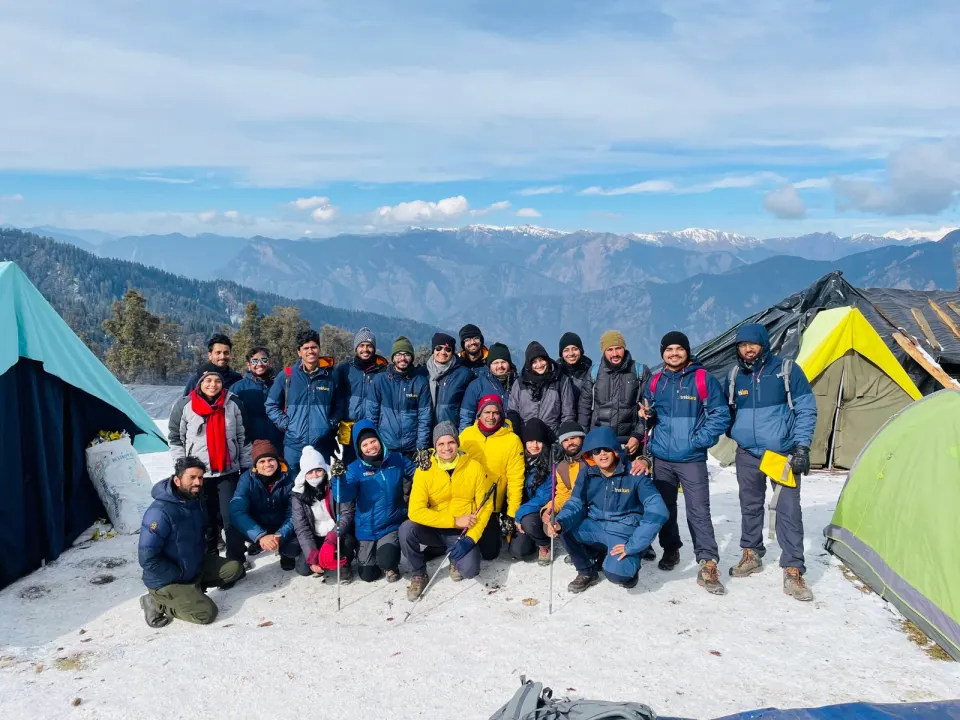
You leave Base Camp at about 2:00 AM in the dark. The final climb is roughly 3 km and 1,250 ft to the 12,500 ft top, usually on snow in winter, in sub-zero cold. Then you descend all the way to Juda Ka Talab. In total it is 9 km and 8–9 hours. Most people who struggle on Kedarkantha struggle here, mostly because of cold, sleep loss and tired legs on the way down.
Trek leader Kushal Bisht's tip: on summit morning, walk slower than feels necessary for the first half hour. Small steps, steady breathing, and short stops rather than long ones. People who rush the first slope are the ones who stall near the top.
What makes Kedarkantha harder than it looks?
- Cold: In December–February the trek page lists nights of -10 to -15°C and days of -2 to 8°C. Cold drains energy and makes sleep harder.
- Snow: Snow makes every step heavier and descents slippery. Microspikes and gaiters help a lot; both are part of Trekkaro's Free Trekking Gear.
- Altitude: 12,500 ft is high enough for headaches and breathlessness in some people. Your leader checks SpO2, pulse and BP twice a day.
- The descent: Coming down 3,400 ft on summit day and another 2,700 ft on Day 5 is tough on knees. Trekking poles are not optional here.
- Snow conditions vary: Snow depth changes year to year and week to week. A heavy-snow week is noticeably harder than a dry one.
How fit do you need to be?
You do not need to be an athlete. You need enough stamina to walk uphill for 4–5 hours with a day pack, and enough leg strength to handle a long descent. A practical target before departure is to be able to jog 5 km without stopping, or walk briskly for an hour on an incline, and climb 10 floors of stairs with a light backpack without needing a long rest.
The Trekkaro trek page asks you to start training at least 3 weeks before the trek, and elsewhere recommends six weeks. We suggest six if you are starting from a mostly sedentary routine.
A simple 6-week plan
- Weeks 1–2: 30–40 minutes of brisk walking or easy jogging, 4–5 days a week. Add 2 sessions of squats, lunges and step-ups.
- Weeks 3–4: Push to 45–60 minutes. One longer weekend walk of 2–3 hours, with stairs or hills if you have them.
- Week 5: Practise with a 5–6 kg day pack. Add stair climbing and longer step-up sets for knee strength.
- Week 6: Ease off. Short, easy sessions only, so you arrive at Sankri rested.
Who should think twice?
The minimum age on Trekkaro's Kedarkantha batches is 8 years (with adults), and trekkers over 60 may join depending on health. If you have heart or lung conditions, uncontrolled blood pressure, or recent knee injuries, speak to your doctor before booking. If you cannot walk for an hour without stopping today, Kedarkantha is still possible, but give yourself the full six weeks. And if you have never slept in a tent in sub-zero cold, a December or January batch will feel harder than a late-October or early-November one.
Trek leader Kushal Bisht's tip: first-timers usually worry about the climb and forget about the cold. Wear layers you can open and close, and take one off before you start sweating, not after.
What it costs
The Trekkaro Kedarkantha trek is ₹9,000 per person, Sankri to Sankri, plus 5% GST, which comes to ₹9,450. EMI starts at about ₹463 per month (24 months). Free Trekking Gear (Decathlon trek shoes, a -10°C jacket, poles, gaiters and microspikes) is included against a ₹3,000 refundable deposit and a ₹200 washing charge. Dehradun–Sankri transport is not included; a shared taxi costs about ₹6,500 one way per 5–6 seat vehicle, split among trekkers. Backpack offloading is ₹1,500 + GST if you would rather not carry your bag. Batches are capped at 20 trekkers, with one leader or guide per 8 trekkers.
Cancellation: 70% refund 30 or more days before departure, 50% at 15–29 days, or a free reschedule or 100% TrekCash voucher (valid 1 year) up to 7 days before departure. See the full Kedarkantha itinerary and dates.
See Kedarkantha dates and book | How to reach Sankri | Kedarkantha weather by month
Frequently asked questions
Can a complete beginner do Kedarkantha?
Yes, if you prepare. Most of the trek is short daily climbs of 3–4 km, and only summit day is long. Train for 4–6 weeks so you can walk uphill for a few hours without stopping.
What is the hardest part of the Kedarkantha trek?
Summit day. You start around 2:00 AM, climb to 12,500 ft in the cold, then descend to Juda Ka Talab, covering 9 km in 8–9 hours. The descent is what tires most people.
Is Kedarkantha harder in winter?
Yes, somewhat. December to February brings deeper snow and nights of -10 to -15°C, so each step costs more energy. Late October and November are usually drier and easier, though snow varies by year.
Do I need prior trekking experience for Kedarkantha?
No. Kedarkantha is often chosen as a first Himalayan trek. Experience helps with pacing and packing, but a fit first-timer with good gear and a patient leader does well.
Can I offload my backpack on Kedarkantha?
Yes. Trekkaro offers backpack offloading for ₹1,500 + GST, up to 9 kg. Suitcases, trolleys and duffels are not accepted, so pack in a proper rucksack.