Chadar Trek (Frozen River)
Inclusion:
Meals on the Trek
Leh ↔ Trailhead Transport
Expert Trek Leader & Guide
Chadar Trek (Frozen River) — Guide, Dates & Cost
Chadar Trek (Frozen River) is a 9-day difficult trek in Leh, Ladakh, reaching 3,400 m (11,155 ft). It covers about 60 km on foot and starts and ends at Leh. Best time: January to February. Trekkaro price: ₹25,500 per person + 5% GST, with free microspikes & gaiters (no deposit, no charge); bring your own trekking shoes, jacket and poles. Next batch: 9 Jan.
Updated
District: Leh
Duration: 9 Days
Difficulty Level: Difficult
Highest Altitude: 3,400 m / 11,155 ft
Trekking Distance: 60 km
Start and End: Leh
Best Time: January to February
Temperature: In winter (January - February) - Day time temperature: -5°C to 0°C and Night time temperature: -30°C to -15°C
The Chadar Trek is a 9-day winter trek on the frozen Zanskar River in Leh district, Ladakh, from Leh back to Leh: about 60 km on the ice over five walking days from Shingra Koma (3,150 m), with camps at Tsomo Paldar, Tibb Cave and Nerak, and a high point of 3,400 m (11,155 ft) at Nerak, beside the frozen Nerak waterfall. It is graded Difficult, open from age 14, and runs only in January and February.
The trek starts and ends in Leh (3,500 m / 11,483 ft), and in winter you can only reach Leh by air. Days 1 to 3 are spent in Leh: arrival and rest on Day 1, an acclimatisation day with a guided visit to the Hall of Fame, Shey Monastery and Thiksey Monastery on Day 2, and the mandatory medical check at the Government Medical Camp in Leh on Day 3. On Day 4 you drive 75 km (3–4 hours) to Shingra Koma and step onto the ice for a short 3 km walk to Tsomo Paldar. Days 5 and 6 take you up the river to Tibb Cave and Nerak; Days 7 and 8 bring you back the same way, and on Day 8 you drive back to Leh. Day 9 is departure, with hotel check-out at 10:00 AM.
Leh is higher than any point on the trail, so the altitude gain on the ice is small. The difficulty comes from the cold, with nights between -15°C and -30°C, and from the ice itself, which changes with the temperature and has slippery, slushy and fragile sections. Gumboots are mandatory on the ice, and you bring your own.
The fee is ₹25,500 + 5% GST per person. It includes four nights in centrally heated guesthouse rooms in Leh (Days 1, 2, 3 and 8) with attached washrooms, on twin sharing (triple in rare cases); four nights in tents (Days 4 to 7) shared by three trekkers, with men and women in separate tents, and sub-zero sleeping bags; pure vegetarian meals from Day 4 breakfast to Day 8 lunch; the drive from Leh to the trek start on Day 4 and back on Day 8; the Day 2 guided visit in Leh; and free microspikes and gaiters, with no deposit and no charge. Not included: flights to and from Leh, the airport cab (Trekkaro helps you book one, paid directly to the driver), meals in Leh, backpack offloading (optional, ₹5,000 + 5% GST), the Ladakh fees and the high-altitude risk insurance described below. The Chadar trek cost guide adds up the full budget.
Walking the Frozen Zanskar – What Makes the Chadar Trek Unmissable
Chadar means blanket, the name for the sheet of ice that covers the Zanskar River in winter. In those months the frozen river is the only way in and out of the remote Zanskar villages, so the trail you walk is the winter route of the valley. Nerak, where the trek turns back, is the first village of Zanskar on the route.
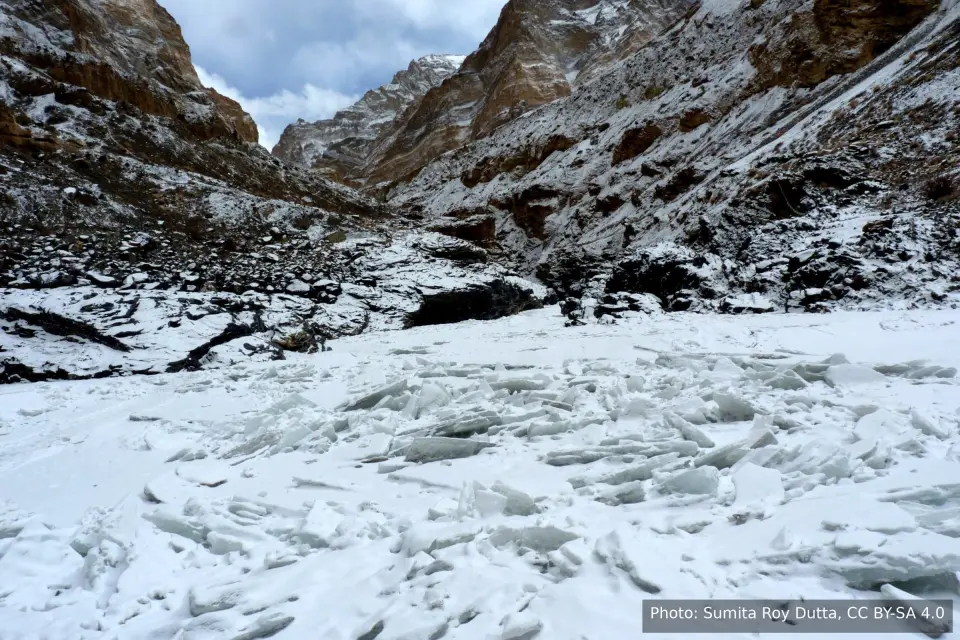
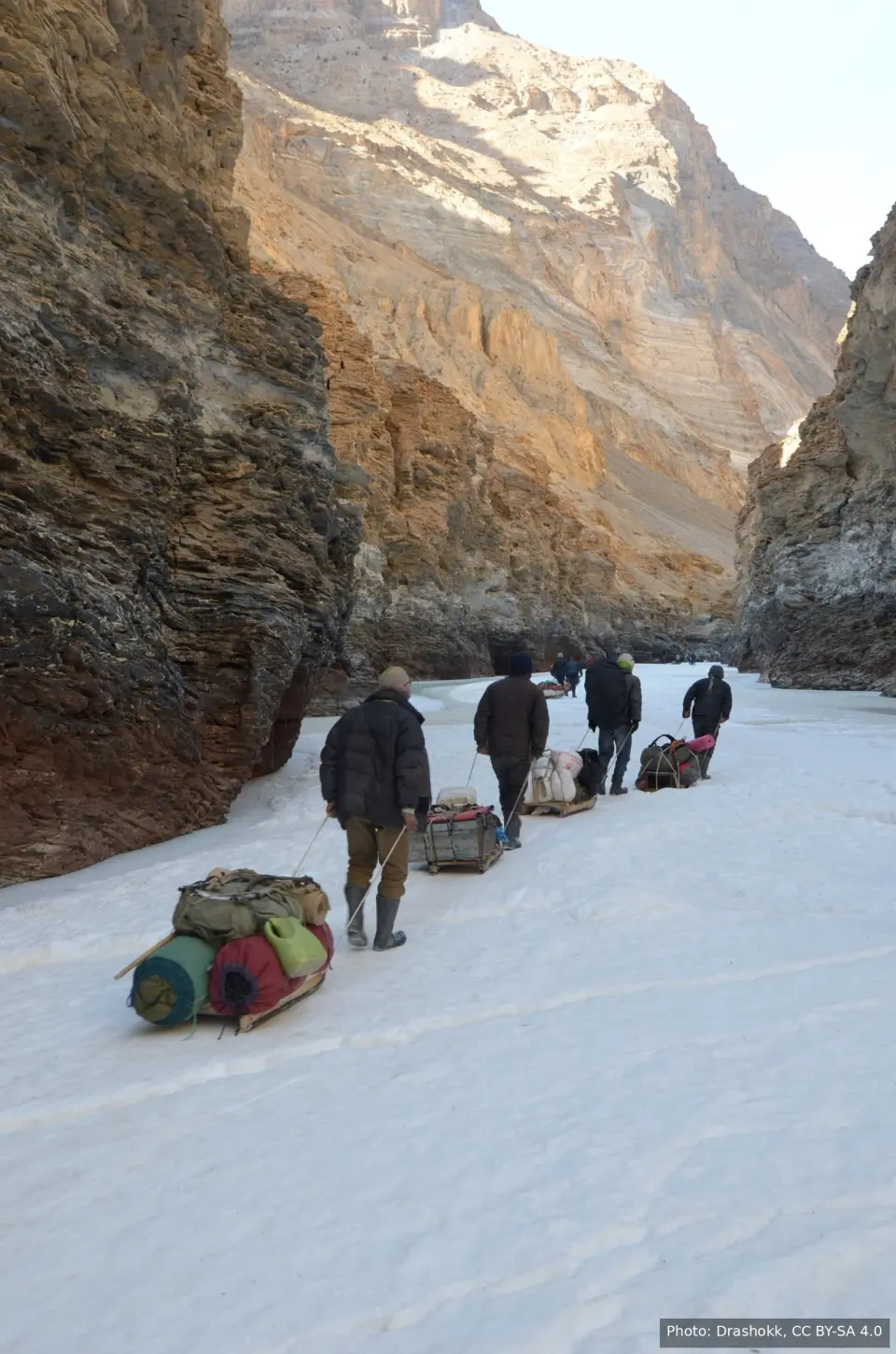
Walking on the ice is a skill you learn on the trek. The first walk on Day 4 is only 3 km, about 2 hours from Shingra Koma to Tsomo Paldar, and its purpose is to teach you the ice: keep your knees soft, take short steps, keep your weight over your feet and step where the people ahead have stepped. Over the next days you learn to tell fragile ice from firm. Your local guide picks the line, and the trek team clears the trail, cuts steps where needed and helps you across slippery sections.
The river does not stay the same. Ice you crossed on the way up may have cracked or gone by the time you walk back, and new layers form overnight, so the return on Days 7 and 8 is a different walk from the climb up the river on Days 5 and 6.
The Zanskar Gorge Itself
The drive from Leh to the start passes Gurudwara Pathar Sahib, Magnetic Hill and the confluence of the Indus and the Zanskar, your first sight of the river you will walk on. Shingra Koma (3,150 m / 10,335 ft) sits at a U-bend in the Zanskar among high cliffs, and the first camp at Tsomo Paldar (3,200 m / 10,500 ft) is on the river below them.
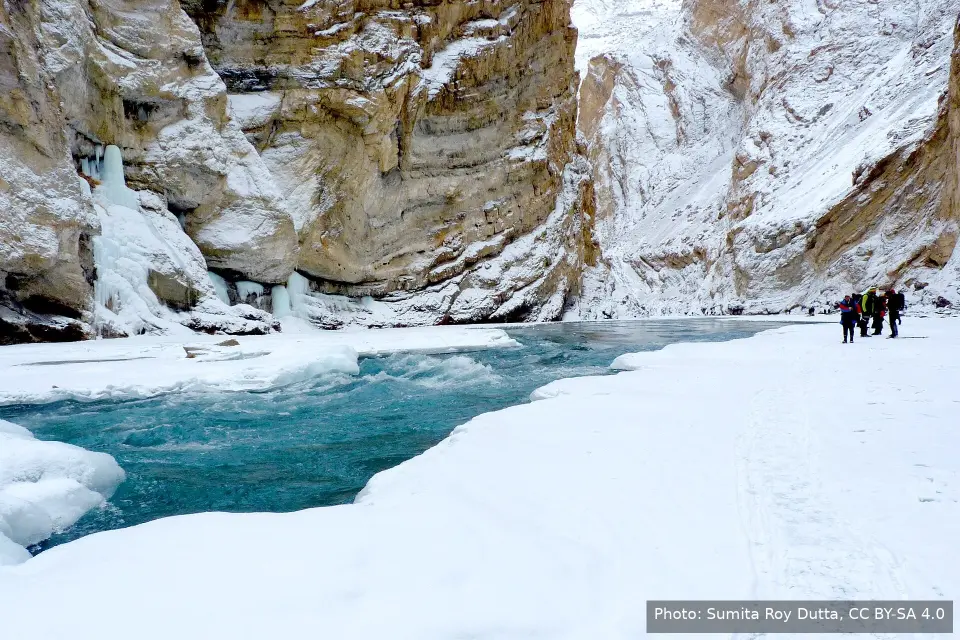
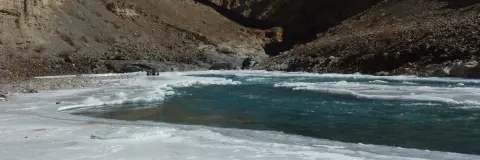
The 14 km from Tsomo Paldar to Tibb Cave (3,350 m / 10,991 ft) rises gradually, with no steep climbs, beside emerald-green water against the ice. Frozen waterfalls hang on the cliffs, and one waterfall on this stretch does not freeze even in sub-zero cold. Sunlight reaches the river here only between about 9 and 10 AM. Along the bank are small caves where local porters traditionally rest.
Beyond Tibb Cave, the 13 km to Nerak (3,400 m / 11,155 ft) runs through deep gorges and between tall cliffs. At Nerak the frozen Nerak waterfall hangs from the rock as a single cascade of ice, the best-known sight on the Chadar. Nerak is the coldest campsite of the trek, with nights down to -30°C, and a short visit to Nerak village can be arranged if time permits.
The table shows what each walking day asks of you. Distances add up to 60 km on the ice.
| Day | Route | Distance and time | Height up or down |
|---|---|---|---|
| Day 4 | Drive Leh to Shingra Koma (3,150 m), then walk to Tsomo Paldar (3,200 m) | 75 km drive, 3–4 hours; 3 km walk, 2 hours | About 50 m up |
| Day 5 | Tsomo Paldar to Tibb Cave (3,350 m) | 14 km, 6–7 hours | About 150 m up, gradual, no steep climbs |
| Day 6 | Tibb Cave to Nerak (3,400 m) | 13 km, 6–7 hours | About 50 m up |
| Day 7 | Nerak to Tibb Cave (3,350 m) | 13 km, 5–6 hours | About 50 m down |
| Day 8 | Tibb Cave to Shingra Koma (3,150 m), then drive to Leh | 17 km, 5–6 hours, the longest day; 75 km drive, 3–4 hours | About 200 m down |
A hot lunch is served on the way on every walking day.
Who Is This Trek For?
The Chadar trek is graded Difficult because of the conditions, not the climbing. You walk on ice in gumboots for five days, with day temperatures of -5°C to 0°C and nights of -15°C to -30°C, and Days 5 to 8 are long: 14 km, 13 km, 13 km and 17 km. It is not a first trek: you should have trekking experience in challenging terrain, good endurance and the ability to handle severe cold for several days and nights. Build your fitness before the trek with running, cycling or swimming, and take the free 2-minute Am I Ready? test on the Trekkaro website. The Chadar trek difficulty and fitness guide covers the training in detail.
The Chadar is a good pick if you have done a few Himalayan treks and want a winter trek unlike any other, if steep climbs are not your strength but long, steady days are, and if you can take three days in Leh before the walking starts. Think twice if this would be your first trek, if nights of -30°C and frostbite risk worry you, if you have a medical condition that may not pass the Day 3 medical check, or if you cannot set aside the full 9 days, three of them in Leh before the ice.
The minimum age is 14, and trekkers under 18 come with a parent or guardian. There is no upper age limit; trekkers above 60 are welcome if they are fit and in good cardiovascular health, and an ECG or TMT report is recommended. Every trekker brings a medical certificate signed by a doctor (the form is in My Bookings).
Ladakh has its own rules for the Chadar. Every trekker spends at least two days in Leh before the trek, then passes the compulsory medical check at the Government Medical Camp in Leh on Day 3: height, weight, blood pressure and oxygen level, with a wait of 3–4 hours possible. The result decides whether you are medically fit to go onto the river. In the afternoon you complete the insurance formalities: high-altitude risk insurance is mandatory under ALTOA guidelines and is not part of the trek fee. The Ladakh fees (pre-medical check-up, rescue fees, wildlife and environmental charges, the ALTOA NOC and entry fees) are paid in Leh directly to the authorities, at their current rates. Carry an original government photo ID with a photocopy, 2 photographs and your boarding pass, which is needed for the trek permission; foreign nationals carry their passport and visa.
The Ladakh Tourism advisory asks visitors to allow at least 48 hours for acclimatisation on arrival in Leh, with complete rest on the first day and no exertion on the second, and to descend at once if severe altitude-sickness symptoms appear. It names SNM Hospital, Leh as a source of emergency oxygen support.
Batches take up to 20 trekkers, with one trek leader or guide for every 8. Trek leaders are trained in wilderness first aid and lead with local guides who know the route, its weather and its campsites. Your SpO2 and pulse are checked twice a day at every campsite, and a falling reading is acted on early. An oxygen cylinder, a first-aid and medical kit and a stretcher travel with the group, and the trek team uses radios, as there is no reliable mobile signal on the river. A doctor is not part of the trek inclusions, and evacuation and hospital charges are not included. The trek leader’s decision on health and safety is final.
Leh is the last place with ATMs and the last stable mobile network, and only postpaid SIMs work in Ladakh. Withdraw enough cash in Leh for the Ladakh fees, meals in Leh and personal expenses, and carry small notes. Extra luggage stays safely in Leh while you are on the river. Food on the trek is pure vegetarian.
Trekkaro’s trek leaders have completed a basic mountaineering course and are trained in wilderness first aid, and the team carries ice axes and ropes for the ice. Trekkaro’s trek leaders see trekkers get three things wrong even after the briefing:
- Leave plastic water bottles at home and bring reusable ones, one of them insulated. You do not need to buy water: the mess tent gives hot water at every camp, and you fill your bottles there.
- Do not smoke on the trek, not even out of sight of the group. Smoking at height makes breathing harder.
- Keep your cap and gloves on when you stop on the ice, even for photos. Taking them off in the wind in the gorge is dangerous.
Key Highlights of the Chadar Trek
- Walking on the Chadar – five days and about 60 km on the frozen Zanskar River
- The frozen Nerak waterfall – a cascade frozen solid at Nerak (3,400 m / 11,155 ft), the high point of the trek
- A waterfall that does not freeze – on the way to Tibb Cave, flowing even in sub-zero cold
- Emerald water against the ice – the green of the Zanskar under and beside the white ice
- One hour of sun – on the Tibb Cave stretch, sunlight reaches the river only between about 9 and 10 AM
- Nerak, the first village of Zanskar – reached in winter by the frozen river, and the coldest camp of the trek at -30°C
- Deep gorges and tall cliffs – on the 13 km from Tibb Cave to Nerak
- Leh before the ice – the Hall of Fame, Shey Monastery and Thiksey Monastery on the Day 2 acclimatisation visit
Best Time to Do the Chadar Trek
Trekkaro runs the Chadar trek only in January and February. The best window is mid-January to mid-February, when the Zanskar is frozen into a thick sheet of ice. Both months have the same temperature range on the trek.
| Month | Day | Night | Ice and snow |
|---|---|---|---|
| January | -5°C to 0°C | -30°C to -15°C | The river is frozen by mid-January, when the best window opens; snow-covered cliffs, and snowfall is possible |
| February | -5°C to 0°C | -30°C to -15°C | The ice holds through mid-February, when the best window closes; snowfall is possible |
January – Deep Winter Sets the Ice
January is the deep Ladakh winter. Day temperatures on the trek are -5°C to 0°C and nights fall to -15°C to -30°C, with Nerak the coldest camp. From mid-January the river is frozen into the thick sheet of ice the trek is named after, and the frozen waterfalls hang on the gorge walls. Bring 5 warm layers (thermals, 2 fleece or woollen layers and a heavy padded or down jacket), a balaclava, a woollen cap, and fleece plus waterproof gloves.
- Temperatures: Day: -5°C to 0°C | Night: -30°C to -15°C
- Trail conditions: River frozen from mid-January; firm, fragile, slushy and wet ice by turns; gumboots mandatory.
- Best for: The Chadar in deep winter, with the frozen waterfalls on the gorge walls.
February – The Frozen River Holds
In February the frozen river holds through the middle of the month, with the same temperature range and the same long days on the ice. The Nerak waterfall stands frozen as the turning point of the trek. The first half of the month is the end of the best window.
- Temperatures: Day: -5°C to 0°C | Night: -30°C to -15°C
- Trail conditions: River frozen through mid-February; long days on the ice in gumboots.
- Best for: Trekkers whose leave falls in the first half of February.
Trekkaro Recommendation
Book a batch that starts between mid-January and mid-February, when the Zanskar is frozen. January and February are peak season and the only way into Leh in winter is by air, so book your flights early, for arrival on Day 1 and departure on Day 9. For the temperature detail, read the Chadar trek weather and temperature guide.
📅 Best months for the Chadar Trek (Frozen River): January to February. Still choosing dates? Compare all treks in January and treks in February.
🏃 Am I ready for the Chadar Trek (Frozen River)? Take the free 2-minute fitness test and get your readiness score and a personal training plan.
Take the test →Trek Itinerary
Airport transfers are not included in the trek fee: we help you book a cab from Leh Airport to the Trekkaro Leh Hotel, paid directly to the driver.
Airport transfers are not included in the trek fee: we help you book a cab from the Trekkaro Leh Hotel to Leh Airport, paid directly to the driver. (Check-out time: 10:00 AM)
Day 1: Arrival in Leh
Route Details:
Arrival: Leh by flight | Altitude: 3,500 m (11,483 ft) | Briefing: 12:00 noon (mandatory) | Stay: Centrally heated hotel (twin or triple sharing)
The Chadar Trek begins with a flight into Leh. Just before touchdown the approach gives you aerial views of the snow-covered Himalaya and the rugged Ladakhi landscape. Leh sits at 3,500 m (11,483 ft), and the cold, thin air meets you the moment you step out. Keep your woollen cap and gloves handy.
Check in to the centrally heated hotel; rooms have attached washrooms and hot water in buckets. At 12:00 noon the trek leader holds the mandatory orientation briefing on essential instructions, safety guidelines and acclimatisation. Bring your ID proof and 2 photographs; foreign nationals must carry their passport and visa. Keep your boarding pass as well, because it is required for the trek permission.
After the briefing, rest indoors and let your body adjust. Avoid high passes and any physical activity today. Smoking and alcohol are strictly prohibited. Leh has the last reliable ATM and mobile network, and only postpaid SIMs work here.
What to Expect:
- Aerial views of the snow-covered Himalaya on the flight into Leh
- Mandatory orientation briefing at 12:00 noon
- Documents: ID proof and 2 photographs (passport and visa for foreign nationals); keep your boarding pass
- Rest indoors – no high passes, no exertion, no smoking or alcohol
- Last ATM and last mobile network (postpaid SIMs only) in Leh
- Overnight: Centrally heated hotel in Leh (3,500 m / 11,483 ft)
Day 2: Acclimatisation Day in Leh
Route Details:
Rest day: Leh | Altitude: 3,500 m (11,483 ft) | Activity: short sightseeing tour (Hall of Fame, Shey Monastery, Thiksey Monastery) | Stay: Centrally heated hotel (twin or triple sharing)
Under the current regulations for the Chadar Trek, every trekker must spend at least two days in Leh before starting the trek. This is not a formality. Rest and gradual adaptation at 3,500 m reduce the risk of Acute Mountain Sickness (AMS) before you head out onto the frozen Zanskar, where nights fall far below freezing.
The day is easy by design. A short sightseeing tour, included in the trek, takes you to the Hall of Fame, Shey Monastery and the Thiksey Monastery. These places show the culture and history of Ladakh and keep the day light without tiring you out. Walk slowly between stops and drink water regularly.
The trek leaders also hold an orientation session for the Chadar preparation. Avoid very high passes and regions during acclimatisation, and remember that smoking and alcohol remain strictly prohibited. You stay in the same centrally heated hotel, with attached washrooms and hot water.
What to Expect:
- Mandatory acclimatisation in Leh to reduce the risk of AMS
- Short sightseeing tour: Hall of Fame, Shey Monastery and Thiksey Monastery
- Orientation session by the trek leaders for Chadar preparation
- No high passes, no alcohol, no smoking
- Mobile network (postpaid only) and ATM still available in Leh
- Overnight: Centrally heated hotel in Leh (3,500 m / 11,483 ft)
Day 3: Medical Test Day in Leh
Route Details:
Medical check: Government Medical Camp, Leh | Altitude: 3,500 m (11,483 ft) | Tests: height, weight, blood pressure, oxygen level | Afternoon: insurance formalities | Stay: Centrally heated hotel (twin or triple sharing)
Today decides whether you walk on the Chadar. Start early and head straight to the Government Medical Camp for the mandatory health check: height, weight, blood pressure and oxygen level. Because of the heavy tourist rush the process can take 3 to 4 hours, so be on time and carry water and a snack for the queue.
The results of the check-up determine whether you are medically fit to proceed with the trek. In the afternoon you complete the insurance formalities; high-altitude risk insurance is mandatory under ALTOA guidelines. The pre-medical check-up fee, rescue fees, wildlife and environmental charges, the ALTOA NOC and entry fees are paid directly to the authorities on the spot.
Once the formalities are done, the evening is free. Stroll around Leh at an easy pace, enjoy the crisp mountain air and then get a good night in the heated hotel. Tomorrow you leave for the river.
What to Expect:
- Early start for the mandatory check at the Government Medical Camp
- Tests: height, weight, blood pressure and oxygen level; a 3–4 hour wait is possible
- Insurance formalities in the afternoon (high-altitude risk insurance is mandatory)
- Medical, permit and NOC fees paid directly to the authorities
- Free evening to walk around Leh
- Overnight: Centrally heated hotel in Leh (3,500 m / 11,483 ft)
Day 4: Leh to Shingra Koma, Trek to Tsomo Paldar
Route Details:
Drive: Leh → Shingra Koma (75 km, 3–4 hrs) | Altitude: 3,150 m → 3,200 m (10,500 ft) | Distance: 3 km | Duration: 2 hrs | Terrain: frozen Zanskar River (the Chadar), in gumboots | Stay: Tents at Tsomo Paldar
After breakfast at the hotel you drive 75 km from Leh to Shingra Koma, about 3 to 4 hours. The road passes Gurudwara Pathar Sahib (3,500 m), Magnetic Hill (3,350 m) and the confluence of the Indus and the Zanskar (3,100 m). Look out for the meeting of the two rivers; it is your first sight of the Zanskar you will be walking on.
Shingra Koma sits at a U-bend in the Zanskar River, among dramatic cliffs, at 3,150 m (10,335 ft). This is where you step onto the Chadar for the first time. Chadar means blanket, the name for the sheet of ice that covers the river in winter. Gumboots are mandatory, and walking on ice in them takes practice.
The first walk is short, 3 km in about 2 hours, and its real purpose is to teach you the ice. Expect slips and slow progress at first. Keep your knees soft, take short steps and keep your weight over your feet. With patience you learn to tell fragile ice from firm. Follow the line your guide takes and step where the people ahead have stepped. The rock formations and patterns in the ice around you make the slow pace easy to accept.
A hot lunch is served on the way, before you reach Tsomo Paldar at 3,200 m (10,500 ft), your first camp on the river. Tents are on triple sharing, with towering cliffs around you and the frozen Zanskar beside camp. Night temperatures on the Chadar range from -15 to -30°C, so change into warm, dry layers as soon as you stop. Trekkaro provides sub-zero sleeping bags for the camping nights.
What to Expect:
- 75 km drive via Pathar Sahib, Magnetic Hill and the Indus–Zanskar confluence
- First steps on the Chadar at Shingra Koma (3,150 m / 10,335 ft), at a U-bend of the Zanskar
- Gumboots mandatory – learn to tell fragile ice from firm
- Short 3 km, 2-hour walk with a hot lunch on the way
- Riverside camp below towering cliffs
- Overnight: Tents at Tsomo Paldar (3,200 m / 10,500 ft)
Day 5: Tsomo Paldar to Tibb Cave
Route Details:
Altitude: 3,200 m → 3,350 m (10,991 ft) | Distance: 14 km | Duration: 6–7 hrs | Terrain: frozen river, gradual gain with no steep climbs | Stay: Tents at Tibb Cave
Today is long but gentle. You cover 14 km on the frozen Zanskar, and the trail rises only gradually, from 10,500 ft to 10,991 ft, with no steep climbs. The challenge is time on the ice. Six to seven hours in gumboots on slippery surfaces is tiring in its own way, so keep your pace even and take short pauses rather than long stops in the cold.
This is one of the most scenic stretches of the Chadar Trek. You walk beside the Zanskar, where emerald-green water shimmers against the frozen landscape. Frozen waterfalls hang on the cliffs along the way, their sources unknown and wrapped in local legends. One waterfall here never freezes, even in sub-zero temperatures, and it remains a mystery to trekkers and locals alike.
Sunlight reaches the river only between 9 and 10 AM on this stretch, so the hour of sun is something to look forward to. Along the trail you also pass small caves where local porters traditionally rest, a glimpse into their rugged way of life. Keep reading the ice the way you learnt yesterday and stay on the line your guide picks.
A hot lunch is served on the way. The day ends at the Tibb Cave campsite at 3,350 m, where you settle into triple-sharing tents beside the frozen river. Change out of damp socks as soon as you reach camp and keep your gloves dry for the evening.
What to Expect:
- Long 14 km day with gradual gain and no steep climbs
- Emerald-green Zanskar water against the white ice
- Frozen waterfalls, and one waterfall that never freezes
- Sunlight on the river only between 9 and 10 AM
- Small caves used by local porters as rest stops; hot lunch on the way
- Overnight: Tents at Tibb Cave (3,350 m / 10,991 ft)
Day 6: Tibb Cave to Nerak
Route Details:
Altitude: 3,350 m → 3,400 m (11,155 ft) | Distance: 13 km | Duration: 6–7 hrs | Terrain: frozen river through deep gorges and between tall cliffs | Stay: Tents at Nerak
This is the most awaited day of the Chadar Trek. Over 13 km you walk the frozen Zanskar through deep gorges and between tall cliffs, in a landscape that feels otherworldly. The ice changes with the temperature, so keep reading the surface the way you have learnt over the last two days and stay on the line your guide picks.
Midway you stop for a hot lunch, then continue towards Nerak. The highlight of the trek waits here: the frozen Nerak waterfall, a towering cascade frozen solid into a sculpture of ice. It is the most iconic sight on the Chadar and draws trekkers from around the world. Give yourself time with it before you move on to camp.
Nerak is the first village of the Zanskar region, and the campsite gives you a glimpse of life in this remote, frozen valley. If time permits, a short visit to Nerak village can be arranged. In winter the frozen river is the only way in and out of these villages, which helps you understand what the Chadar means to the people who live here.
Be ready for the cold. Nerak is the coldest campsite of the trek, and night temperatures can drop to -30°C. Proper layering, insulated gloves, a woollen cap and thermals are essential tonight. Eat a full meal, change into dry layers and get into your sub-zero sleeping bag early.
What to Expect:
- 13 km through deep gorges and tall cliffs on the frozen Zanskar
- Hot lunch break midway
- The frozen Nerak waterfall, the most iconic sight of the trek
- Nerak, the first village of Zanskar – short village visit if time permits
- Coldest campsite of the trek, with nights down to -30°C
- Overnight: Tents at Nerak (3,400 m / 11,155 ft)
Day 7: Nerak to Tibb Cave
Route Details:
Altitude: 3,400 m → 3,350 m (10,991 ft) | Distance: 13 km | Duration: 5–6 hrs | Terrain: frozen river, return leg on changing ice | Stay: Tents at Tibb Cave
Today you turn back down the river and begin the return leg. Do not expect a repeat of the walk up. The Chadar changes all the time: ice you crossed yesterday may have cracked or vanished, and new layers form overnight. The route can look completely different, and that constant change is both the challenge and the charm of this trek.
The scenery is just as striking on the way back. Snow-covered cliffs rise on both sides, emerald-green water flows beneath the ice and frozen waterfalls hang like glass sculptures. Along the way you say goodbye to the locals and porters you have met in the valley, a warm farewell to the people of the Zanskar.
A hot lunch break en route gives you warmth and energy in the freezing conditions. You will be tired by now, and tired legs are less careful. Keep the same discipline you had on the way up: short steps, a steady pace and your eyes on the ice. Treat any section that looks different with care, and follow your guide’s line.
By evening you reach Tibb Cave at 3,350 m for your final night in tents. Take a few minutes outside before bed. The valley is silent, the stars are bright on a clear night, and you can look back on days of walking one of the most iconic trails in the Himalaya.
What to Expect:
- Return leg on a Chadar that has changed since the way up
- Snow-covered cliffs, emerald water beneath the ice and frozen waterfalls
- Farewell to locals and porters along the way
- Hot lunch break en route
- Final night in tents on the Zanskar
- Overnight: Tents at Tibb Cave (3,350 m / 10,991 ft)
Day 8: Tibb Cave to Shingra Koma, Drive to Leh
Route Details:
Altitude: 3,350 m → 3,150 m (10,335 ft) | Distance: 17 km | Duration: 5–6 hrs | Terrain: frozen river | Drive: Shingra Koma → Leh (75 km, 3–4 hrs) | Stay: Centrally heated hotel in Leh
The final day on the ice starts early. The trail may feel familiar, but it is never quite the same. The ice sheet shifts with every change in temperature, so sections that were firm may now be fragile, and rocks and the emerald water of the Zanskar show up in new forms. At 17 km this is the longest day of the trek, so keep your focus to the last step.
The walk back to Shingra Koma is your last chance to take in the frozen wilderness, admire the sheer cliffs and the patterns in the ice, and take a few final photographs. Even on a return journey, the landscape looks entirely different from the way up. A hot lunch is served en route, a welcome break from the biting cold.
At Shingra Koma vehicles wait for the drive of about 75 km back to Leh. The road retraces the route through the confluence of the Zanskar and the Indus, Magnetic Hill and Gurudwara Pathar Sahib. Sit back and let your legs rest.
By evening you are back at the hotel in Leh, centrally heated and with running hot water. After days in tents and nights far below freezing, a hot shower and a warm room feel like pure luxury. It is the right place to rest, celebrate and look back on your days on the frozen Zanskar.
What to Expect:
- Early start for the longest day on the ice: 17 km
- A Chadar that keeps changing with the temperature
- Hot lunch on the way to Shingra Koma
- 75 km drive to Leh via the Indus–Zanskar confluence and Magnetic Hill
- Centrally heated hotel with running hot water
- Overnight: Hotel in Leh (3,500 m / 11,483 ft)
Day 9: Departure from Leh
Route Details:
Departure: Leh | Hotel check-out: 10:00 AM | Airport cab: not included; we help you book one
Your Chadar Trek ends in Leh today. Hotel check-out is at 10:00 AM, so pack the night before and leave yourself an unhurried morning. Airport transfers are not included in the trek fee: we help you book a cab from the Trekkaro hotel in Leh to the airport, paid directly to the driver.
If you have time to extend your stay, Ladakh has plenty more to see. Visit the historic Leh Palace, take in the panoramic views from the Shanti Stupa, or make a scenic trip to Pangong Lake. Try authentic Ladakhi cuisine before you leave and spend some time with the local culture that makes this region so distinct.
Whichever way you go, you leave having walked one of the most unusual trails in the Himalaya, on a river that is only a path for a short window each winter, from mid-January to mid-February.
What to Expect:
- Hotel check-out at 10:00 AM
- Cab to Leh airport: not included; we help you book one, paid directly to the driver
- Optional extensions: Leh Palace, Shanti Stupa, Pangong Lake
- Authentic Ladakhi cuisine before you fly out
- Trek ends at Leh
How To Reach
Nearest airport: Kushok Bakula Rimpochee Airport (IXL), Leh, about 4 km from Leh town, with flights from Delhi and other major cities; international trekkers can fly into Delhi and connect to Leh. In winter flying is the only way to reach Leh, and January–February is peak Chadar season, so book your flights early.
From Leh Airport to the hotel: airport transfers are not included in the trek fee; we help you book a cab from Leh Airport to the Trekkaro Leh Hotel, paid directly to the driver. You spend the first three days in Leh to acclimatise and complete the mandatory medical check; the drive from Leh to the trek start (Day 4) and back (Day 8) is included.
Return: On Day 9 we help you book a cab from the Trekkaro Leh Hotel to Leh Airport (airport transfers are not included in the trek fee; paid directly to the driver); hotel check-out is 10:00 AM. Book your flight out of Leh for Day 9.
Nearest railway station: there is no railway to Leh. The nearest stations – Jammu Tawi, Chandigarh and Pathankot – all need a long road journey, and in winter the roads to Leh are closed by snow, so the only way in is to fly. If you travel by train, go to Delhi (or another city with flights to Leh) and take a flight from there.
From Leh Airport to the hotel: airport transfers are not included in the trek fee; we help you book a cab from Leh Airport to the Trekkaro Leh Hotel, paid directly to the driver. You spend the first three days in Leh to acclimatise and complete the mandatory medical check; the drive from Leh to the trek start (Day 4) and back (Day 8) is included.
Return: On Day 9 we help you book a cab from the Trekkaro Leh Hotel to Leh Airport (airport transfers are not included in the trek fee; paid directly to the driver); hotel check-out is 10:00 AM. Book your flight out of Leh for Day 9 and your onward train from the city you land in.
By road: not possible in the Chadar season. The Manali–Leh and Srinagar–Leh highways close by October or November and stay shut until late April or early May, so you must fly into Leh (Kushok Bakula Rimpochee Airport, about 4 km from town).
From Leh Airport to the hotel: airport transfers are not included in the trek fee; we help you book a cab from Leh Airport to the Trekkaro Leh Hotel, paid directly to the driver. You spend the first three days in Leh to acclimatise and complete the mandatory medical check; the drive from Leh to the trek start (Day 4) and back (Day 8) is included.
Return: On Day 9 we help you book a cab from the Trekkaro Leh Hotel to Leh Airport (airport transfers are not included in the trek fee; paid directly to the driver); hotel check-out is 10:00 AM. Book your flight out of Leh for Day 9.
Things To Carry
Chadar is a January–February walk on the frozen Zanskar River, where temperatures can drop to -30°C, so bring your own expedition-grade footwear and gear.
- Gumboots – bring your own; essential for the icy, slushy and wet sections on the river
- Trekking shoes – bring your own: broken-in, waterproof, with good grip and ankle support
- Trekking poles – bring your own; they give balance on the ice and reduce strain on your knees
- Backpack – 50–60 L with a rain cover
- Day pack – 20–30 L; needed if you hire a porter for your main bag (porter charges are extra)
- Water bottles – 2 x 1 L, at least one insulated, as water freezes quickly here
- Headlamp – with spare batteries; keep spares close to your body, as cold drains batteries fast
- Microspikes and gaiters – provided free (no deposit, no charge)
- Tents and sleeping bags – part of the trek inclusions, so you do not need to bring them
Nights on the Chadar can fall to -30°C, so pack 5 warm layers – thermals, 2 fleece or woollen layers and a heavy padded or down jacket – and keep one dry set in a waterproof bag.
- Padded or down jacket – bring your own; heavily insulated and windproof, for extreme cold
- Thermal inners – 2 sets, top and bottom
- Fleece or woollen layers – 2 (a fleece jacket and a thick woollen sweater)
- Windproof, waterproof outer layer – to wear over your layers in wind and snowfall
- Trek pants – 2, worn over thermals; no jeans
- Collared T-shirts – 3, quick-dry, full sleeves
- Socks – 2 pairs of cotton or sports socks plus 4–5 woollen pairs, as feet can get wet in gumboots
- Caps – a woollen cap that covers your ears, and a sun cap
- Balaclava – essential against the freezing wind on the river
- Gloves – 1 fleece or woollen pair plus 1 waterproof pair
- Spare warm set – one set of dry clothes sealed in a waterproof bag for emergencies
Sun on ice and snow is harsh at 3,400 m in winter, and the air is very dry, so protect your eyes and skin.
- UV sunglasses – to prevent snow blindness from the ice and snow glare
- Sunscreen – SPF 50+
- Lip balm – with SPF, to prevent chapped lips
- Quick-dry towel – small and light
- Toiletries – toothbrush, toothpaste, biodegradable soap and hand sanitiser; no wet wipes, as they are not biodegradable
- Ziploc and plastic bags – to separate wet clothes from dry ones and to carry your waste back
- Personal medical kit – your regular and prescribed medicines plus basic first aid; consult your doctor about altitude sickness before the trek
Leh is the last place with an ATM and phone network, and only postpaid SIMs work in Ladakh, so sort out both before you leave town.
- Cash – withdraw enough in Leh for the on-the-spot fees (approx. ₹6,000–8,000), meals in Leh (not included) and personal expenses
- Postpaid SIM – prepaid SIMs do not work in Ladakh; network ends at Leh
- Lunch box – reusable, for packed lunches on the river
- Snacks and ORS – dry fruits, energy bars, chocolates and ORS sachets to stay hydrated in the dry cold
- Power bank – keep it in an inner pocket, as batteries drain fast in the cold
- Extra luggage – you can leave it safely in Leh while you are on the trek
- Government photo ID – original plus a photocopy (passport, Aadhaar card, driving licence or voter ID); needed for permits and trek registration, so keep them in a waterproof pouch
- Pre-trek medical check-up in Leh – mandatory; the fee is paid on the spot
- ALTOA NOC and permits – rescue fees, wildlife/environmental charges and entry fees (approx. ₹6,000–8,000 in total, including the medical check), paid directly to the authority on the spot
- High-altitude risk insurance – mandatory before joining, as per ALTOA guidelines; not part of the trek package
- Medical certificate – signed by a doctor; mandatory for every trekker. The form is in My Bookings.
Frequently Asked Questions
Chadar Trek (Frozen River) is a 9-day difficult trek in Leh, Ladakh, reaching 3,400 m (11,155 ft). It covers about 60 km on foot and starts and ends at Leh. Best time: January to February. Trekkaro price: ₹25,500 per person + 5% GST, with free microspikes & gaiters (no deposit, no charge); bring your own trekking shoes, jacket and poles. Next batch: 9 Jan.
The Chadar trek is in Leh district, Ladakh, on the frozen Zanskar River in the Zanskar region. You fly into Leh, spend three days there, then drive 75 km to Shingra Koma, where the walk on the ice begins.
The trek follows the river through deep gorges as far as Nerak, the first village of Zanskar, and returns the same way.
The Chadar trek takes 9 days (8 nights) from Leh to Leh, with 5 trekking days on the frozen river covering about 60 km.
- Days 1–3: arrival, acclimatisation and the mandatory medical test in Leh
- Days 4–8: trekking on the Chadar from Shingra Koma to Nerak and back, 3–17 km a day
- Day 9: departure from Leh, with hotel check-out at 10:00 AM
- Longest day: Day 8, 17 km back to Shingra Koma, then the drive to Leh
The highest point of the Chadar trek is Nerak, at about 3,400 m (11,155 ft). Leh, where you spend the first three nights, is actually higher at 3,500 m (11,483 ft).
- Shingra Koma (start): 3,150 m (10,335 ft)
- Tsomo Paldar camp: 3,200 m (10,500 ft)
- Tibb Cave camp: 3,350 m (10,991 ft)
- Nerak camp: 3,400 m (11,155 ft)
The Chadar trek is graded Difficult. There are no steep climbs, but you walk long days on ice in extreme cold, with nights falling to -30°C.
- Ice: the Chadar keeps changing with the temperature, with slippery, slushy and fragile sections
- Cold: the main challenge, with frostbite and hypothermia as real risks
- Long days: 14 km, 13 km, 13 km and 17 km on Days 5 to 8
The Chadar trek is graded Difficult, so it is not a first trek: you should have experience of trekking in challenging terrain. You need good fitness and must be ready for extreme cold and slippery, unstable ice.
Every trekker must also complete the mandatory medical test in Leh on Day 3 before going onto the river.
For the Chadar trek you need good endurance, strength and cardiovascular fitness to walk 5–7 hours a day on ice in extreme cold.
- Endurance: long days of 13–17 km on the frozen river
- Balance: trekking poles and gumboots on slippery ice
- Doctor: consult a doctor before the trek, as a medical test in Leh is mandatory
- Fitness test: take the free 2-minute Am I Ready? test on the Trekkaro website
The best time for the Chadar trek is mid-January to mid-February, when the Zanskar River freezes into a thick sheet of ice. The trek runs only in January and February.
- Temperatures: -5°C to 0°C by day and -15°C to -30°C at night
- Flights: this is peak season, so book your flights to Leh early
On the Chadar trek you walk on the frozen Zanskar River, and the ice changes from day to day with the temperature: firm in places, fragile, slushy or wet in others.
- Gumboots: mandatory; on Day 4 you learn to tell fragile ice from firm
- Return leg: the Chadar has changed by the time you walk back
- Snowfall: a windproof, waterproof outer layer protects you in wind and snow
On the Chadar trek, day temperatures are -5°C to 0°C and nights fall to between -15°C and -30°C. Nerak is the coldest campsite, with nights down to -30°C.
- Layers: 5 warm layers: thermals, 2 fleece or woollen layers and a heavy padded or down jacket
- Face and hands: a balaclava, a woollen cap, and fleece plus waterproof gloves
- Sun: in the gorges, sunlight reaches the river only between about 9 and 10 AM
The best-known sight on the Chadar trek is the frozen Nerak waterfall, along with emerald-green Zanskar water flowing beneath white ice.
- Gorges: deep gorges and tall, snow-covered cliffs
- Waterfalls: frozen waterfalls, and one that never freezes
- Nerak village: the first village of Zanskar, visited if time permits
- On the drive: Pathar Sahib, Magnetic Hill and the Indus–Zanskar confluence
The Chadar trek is walked on the frozen Zanskar River in gumboots, with gradual gains and no steep climbs.
- Ice: a mix of firm, fragile, slushy and wet ice that changes with the temperature
- Gorges: narrow sections between tall cliffs on the way to Nerak
- Rest stops: small caves used by local porters along the river
Yes, altitude sickness is a risk on the Chadar trek because you fly straight into Leh at 3,500 m (11,483 ft). That is why Days 1 and 2 are for rest and acclimatisation in Leh.
- In Leh: rest indoors on Day 1, with no exertion, smoking or alcohol
- Cold injuries: frostbite and hypothermia are risks; watch for numbness, skin discolouration and shivering
- On the trek: an oxygen cylinder, a medical kit and a stretcher travel with the group
- Before you go: consult your doctor about altitude sickness
Every trekker on the Chadar trek must take a mandatory medical check at the Government Medical Camp in Leh on Day 3, which tests height, weight, blood pressure and oxygen level.
- Waiting time: start early, as a 3–4 hour wait is possible
- Fee: paid in Leh directly to the authorities, at their current rates, with the other mandatory Ladakh fees
- Same day: insurance formalities are completed in the afternoon
In winter the only way to reach the Chadar trek is to fly to Leh (Kushok Bakula Rimpochee Airport, IXL), about 4 km from Leh town. The roads to Leh are closed by snow from about October or November to late April or May, and there is no railway.
- Flights: from Delhi and other major cities; book early, as January–February is peak season
- Airport to hotel: not included; we help you book a cab, paid directly to the driver
- Briefing: a mandatory orientation briefing at 12:00 noon on Day 1
- Return: book your flight out of Leh for Day 9
Yes, the drives between Leh and the trek start are included in the Chadar trek: Leh to Shingra Koma on Day 4 and back to Leh on Day 8 (75 km, 3–4 hours each way).
- Not included: airport transfers to and from the Trekkaro Leh Hotel; we help you book a cab, paid directly to the driver
- Day 2: the Leh sightseeing tour is included
On the Chadar trek you stay 4 nights in a centrally heated hotel in Leh (Days 1, 2, 3 and 8) and 4 nights in tents beside the river (Days 4 to 7).
- Leh: twin sharing (triple in rare cases), with attached washrooms
- Camps: Tsomo Paldar, Tibb Cave (twice) and Nerak
- Sleeping bags: tents and sub-zero sleeping bags are provided for the camping nights
Chadar trek batches take up to 20 trekkers, with one trek leader or guide for every 8. Trek leaders are trained in wilderness first aid and lead with local guides who know the route.
The trek leaders hold an orientation session in Leh on Day 2 to prepare the group for the Chadar.
Yes, the Chadar trek is safe for women trekking alone. Women share rooms and tents only with other women, and experienced trek leaders and local guides stay with the group.
Only postpaid SIMs work in Ladakh, so arrange one before you arrive to stay in touch while in Leh.
The Chadar trek includes nutritious pure vegetarian meals from breakfast on Day 4 to lunch on Day 8, with a hot lunch on the way every trekking day.
- In Leh: meals in Leh are not included
- Snacks: dry fruits, energy bars, chocolates and ORS sachets
- Lunch box: bring a reusable one
On the Chadar trek water freezes quickly, so carry two 1 L bottles, at least one of them insulated.
The air is very dry, so keep drinking through the day and add ORS sachets to stay hydrated in the cold.
Yes. On the Chadar trek you bring your own gumboots, trekking shoes, jacket and poles; microspikes and gaiters are provided free, with no deposit and no charge.
Yes, backpack offloading on the Chadar trek costs ₹5,000 + 5% GST, as porter charges are not part of the trek fee.
If you offload, carry a 20–30 L day pack for water, warm layers and snacks.
A doctor is not listed in the Chadar trek inclusions, but medical support travels with the group: first aid, an oxygen cylinder, a medical kit and a stretcher for emergencies.
- Medical check: a mandatory test at the Government Medical Camp in Leh on Day 3
- Your kit: your regular and prescribed medicines plus basic first aid
- Emergency costs: evacuation and hospital charges are not included
For the Chadar trek, carry an original government photo ID with a photocopy and 2 photographs; foreign nationals need their passport and visa. Keep your boarding pass too.
- Medical certificate: signed by a registered doctor, mandatory for every trekker; the form is in My Bookings
- ID: passport, Aadhaar card, driving licence or voter ID
- Insurance: high-altitude risk insurance, mandatory as per ALTOA guidelines
- Waterproof pouch: keep everything dry, as your ID is needed for permits and registration
The Chadar trek needs an ALTOA NOC and permits. The pre-medical check-up, rescue fees, wildlife and environmental charges, ALTOA NOC and entry fees are paid in Leh directly to the authorities, at their current rates.
These fees are not part of the trek price, so withdraw enough cash in Leh before Day 3.
Yes, high-altitude risk insurance is mandatory before joining the Chadar trek, as per ALTOA guidelines, and it is not part of the trek package.
The insurance formalities are completed in Leh on the afternoon of Day 3, after the medical check.
On the Chadar trek, Leh is the last place with an ATM and mobile network, and only postpaid SIMs work in Ladakh. Once you leave Leh, there are no ATMs and signal is scarce or unavailable.
- Cash: enough for the on-the-spot fees, meals in Leh and personal expenses
- Calls: finish important calls and tell your family about limited connectivity before Day 4
- Power bank: keep it in an inner pocket, as batteries drain fast in the cold
Yes, in Leh: your hotel rooms have attached washrooms, with hot water in buckets on Days 1 to 3 and running hot water on Day 8.
From Day 4 to Day 7 you camp on the river, so pack biodegradable toiletries, hand sanitiser and bags to carry your waste back; do not bring wet wipes, as they are not biodegradable.
Yes, on the Chadar trek you can leave extra luggage safely in Leh while you are on the river.
Take only what you need in a 50–60 L backpack, and keep one dry spare set of clothes sealed in a waterproof bag.
Yes, the Chadar trek includes a guided visit to the Hall of Fame, Shey Monastery and Thiksey Monastery on Day 2, the acclimatisation day in Leh.
Leh Palace, Shanti Stupa and Pangong Lake are optional extensions after the trek.
The Chadar trek is named after the thick sheet of ice, known as the Chadar, that covers the Zanskar River in winter. For several days you walk on this frozen river.
In winter the frozen river is the only way in and out of the remote Zanskar villages.
The minimum age for the Chadar trek is 14 years, because of the extreme cold on the frozen river, where nights drop to -30°C. Trekkers under 18 must come with a parent or guardian.
There is no upper age limit. Trekkers above 60 are welcome if they are fit and in good cardiovascular health; along with the medical certificate signed by a doctor that every trekker brings, we recommend an ECG or TMT report.
The Chadar trek covers about 60 km on foot over the 9-day trip, and its highest point is 3,400 m (11,155 ft). The kilometres and walking hours for each day are in the Itinerary tab on this page.
No. Trekkaro runs the Chadar trek only in January and February, when the Zanskar River is frozen. The best window is mid-January to mid-February.
- Temperatures: -5°C to 0°C by day and -15°C to -30°C at night in both months
- Flights: in winter you can only reach Leh by air, and January–February is peak season, so book early
The Chadar trek fee is ₹25,500 + 5% GST per person, from Leh to Leh. It covers four nights in Leh (Days 1, 2, 3 and 8), four nights in tents, pure vegetarian meals from Day 4 breakfast to Day 8 lunch, the drive from Leh to the trek start and back, the Day 2 guided visit in Leh, sub-zero sleeping bags, and free microspikes and gaiters with no deposit and no charge.
- Ladakh fees: pre-medical check-up, rescue fees, wildlife and environmental charges, ALTOA NOC and entry fees, paid in Leh directly to the authorities at their current rates
- Insurance: high-altitude risk insurance, mandatory under ALTOA guidelines, extra
- Travel: flights to and from Leh and the airport cab (we help you book one, paid directly to the driver) are extra
- Optional: backpack offloading, ₹5,000 + 5% GST
- Also extra: meals in Leh, and your own gumboots, which are mandatory
Leh is at 3,500 m (11,483 ft), and you fly straight in. Under the current rules every trekker spends at least two days in Leh before the trek, and the Ladakh Tourism advisory asks visitors to allow at least 48 hours to acclimatise, with complete rest on the first day.
- Day 1: arrival, rest indoors and the mandatory 12:00 noon briefing
- Day 2: acclimatisation and a guided visit to the Hall of Fame, Shey Monastery and Thiksey Monastery
- Day 3: the compulsory medical check at the Government Medical Camp in Leh, then the insurance formalities
Terms & Conditions
1. Accommodation
- Day 1, Day 2, Day 3 and Day 8: centrally heated guesthouse rooms in Leh with attached washrooms, on a twin-sharing basis (triple in rare cases)
- Hot water in buckets on Day 1, Day 2 and Day 3; running hot water in taps on Day 8
- Day 4 to Day 7: camping during the trek
- Extra luggage can be kept safely at Leh while you are on the trek
2. Meals
- Pure vegetarian meals from Day 4 breakfast to Day 8 lunch
3. Transport
- Leh to the trekking point on Day 4 and the trekking point back to Leh on Day 8, as per the itinerary
4. Camping & Safety Equipment
- Tents and sleeping bags
- Free microspikes and gaiters (no deposit, no charge), plus ice axes and ropes
- First aid, an oxygen cylinder, a medical kit and a stretcher with the group for emergencies
5. Trek Team
- Experienced trek leaders trained in wilderness first aid, with local guides who know the route
- Guided visit in Leh to the Hall of Fame, Shey Monastery and Thiksey Monastery
1. Transport
- Not included: pick-up and drop-off at Leh Airport
- We help you book a cab from Leh Airport to the Trekkaro Leh Hotel on arrival, and from the hotel to Leh Airport on Day 9, paid directly to the driver
- Flights to and from Leh, booked by you
2. Backpack Offloading (optional)
- Porter to carry your personal luggage: ₹5,000 + 5% GST
3. Personal Equipment
- Gumboots (mandatory), trekking shoes, jacket and trekking poles: bring your own (microspikes and gaiters are provided free)
4. Trek Insurance
- High-altitude risk insurance is mandatory before joining (as per ALTOA guidelines) and is not included
5. Anything Not Mentioned Under Inclusions
- Meals in Leh
- Mandatory Ladakh fees paid in Leh directly to the authorities, at their current rates: pre-medical check-up, rescue fees, wildlife/environmental charges, ALTOA NOC and entry fees
- Personal shopping, tips or additional services
- Charges for evacuation, hospitalisation or medical emergencies
- Additional costs from decisions made by local authorities or administration
We know that cancelling a trek can be genuinely disappointing. Plans change, life intervenes, and sometimes the mountains have to wait. That is why Trekkaro has designed one of the most trekker-friendly cancellation policies in the industry — to reduce the financial impact on you and give you real options when things do not go as planned.
Important: Bookings made on trekkaro.com are cancelled online from My Bookings. Bookings made offline with our team must be cancelled in writing by e-mail by the person who originally booked the trek. Requests over the phone, via WhatsApp, or through third parties are not accepted.
How to Cancel Your Trek
Booked online on trekkaro.com:
- Log in and open My Bookings.
- Choose Cancel Booking on the trek you want to cancel.
- Pick a refund (as per the charges below) or Get TrekCash Voucher instead — the voucher is issued instantly and appears under My TrekCash Vouchers.
Booked offline with our team:
- Compose an e-mail from the registered e-mail ID used at the time of booking.
- Attach a copy of your tax invoice to the e-mail.
- Send both to info@trekkaro.com.
- Your cancellation is effective from the date Trekkaro receives and acknowledges your e-mail.
How to Reschedule Your Trek (Free)
- Once per booking, to another batch of the same trek, free of charge. A request we decline doesn’t count.
- Up to 8 days before departure, also in the 8–14-day window when there is no cash refund. The new batch must start at least 7 days after the day you ask.
- Subject to seat availability for every trekker on the booking.
- Not available for bookings paid fully or partly with a TrekCash Voucher.
- No fee or price difference; add-ons and the number of trekkers stay as booked.
- The new batch must start within 1 year of your booking date.
- Not available for a booking you revived after a Trekkaro cancellation — a revived booking is final.
Booked online: My Bookings → Reschedule free → pick a batch. Our team confirms by e-mail and your booking moves once approved. Booked offline: e-mail info@trekkaro.com.
How to Transfer Your Booking
You can give your booking to another trekker up to 8 days before departure. E-mail info@trekkaro.com from your registered e-mail ID with your booking ID and the new trekker’s name, age, phone number and ID proof. The new trekker must meet the fitness, age and document rules of the trek. We confirm the transfer by e-mail.
Cancellation Charges
| When you cancel | Cash refund | Other options |
|---|---|---|
| 30 days or more before departure | 70% refund (30% cancellation charge) | Or instead: a 100% TrekCash Voucher (valid 1 year), a free reschedule or a transfer |
| 15 to 29 days before departure | 50% refund (50% cancellation charge) | Or instead: a 100% TrekCash Voucher (valid 1 year), a free reschedule or a transfer |
| 8 to 14 days before departure | No cash refund of the trek fee | You can take a 100% TrekCash Voucher (valid 1 year), a free reschedule (once per booking) or a transfer to another trekker |
| 7 days or less before departure, or no-show | No refund of the trek fee | None: no voucher, reschedule or transfer |
A 100% voucher instead of a refund. From the day you book until 8 days before departure, you can take a TrekCash Voucher worth 100% of the amount paid, valid for 1 year on any Trekkaro trek. This works in every slab above, including 8–14 days, when there is no cash refund. Online bookings take the voucher from My Bookings → Cancel Booking (issued instantly). Offline bookings ask for it by e-mail to info@trekkaro.com.
If you paid the FTG security deposit and the washing charge, both are refunded in full when you cancel before the trek starts, in every slab.
Cancellation of Voucher-Based Bookings
- The standard cancellation policy applies to voucher-based bookings in the same way it applies to direct bookings.
- Any remaining balance after the applicable cancellation charge has been deducted will be credited back to your Trekkaro account as a new voucher.
- If your voucher has already expired at the time of cancellation, no refund, credit, or extension will be issued under any circumstance.
- If a voucher is set to expire on a Sunday or public holiday, it must be redeemed before the expiry date.
Additional Terms
- Free Rescheduling: Switching to a different batch of the same trek is free of charge once per booking, up to 8 days before departure, to a batch starting within 1 year of the booking date, subject to seat availability. Not available for bookings paid with a TrekCash Voucher or for revived bookings.
- Trek Transfers: You can transfer your booking to another person up to 8 days before departure, by e-mail. The new trekker must meet the fitness, age and document rules of that trek. See “How to Transfer Your Booking” above.
- No Refund Post-Commencement: Once the trek has commenced from Day 1 of your confirmed itinerary, no refunds or TrekCash Vouchers will be issued for any reason, including early exit, illness, or dissatisfaction with services.
- Policy Changes: Trekkaro reserves the right to amend or withdraw this cancellation policy at any time without prior notice. The version in effect at the time of your booking confirmation governs your booking.
Early Exit or Removal from Trek
A trekker may be required to leave the trek before completion for health concerns (AMS, hypertension, cardiac symptoms, or fitness that poses a safety risk), rule violations (alcohol or non-prescribed drugs on trail, smoking in prohibited zones, reckless behaviour, or misconduct), or by their own decision. In all cases of early exit or removal, no refund, partial refund, or TrekCash Voucher will be provided, and any additional transport or exit expenses are the trekker's responsibility. The trek leader's decision on health and safety grounds is final.
If Trekkaro Cancels Your Trek
Trekkaro may have to cancel a batch when it does not reach the minimum group size, when a trek leader becomes unavailable, when the route is closed by the forest or permit office, or in circumstances beyond our control (natural disasters, curfews, lockdowns, political unrest). You are told by e-mail and WhatsApp with the reason, and you get 100% of everything you paid, however close to departure: as a TrekCash Voucher (instant, valid 12 months on any trek — if the new trek costs more, the difference is payable) or, if you prefer, a full refund to your original payment method within 7 working days. If we offer you the chance to revive the booking on another batch (from My Bookings, for a limited time), the 7 working days start when that offer ends. You can also ask to be moved to another batch of the same trek at no charge.
Reviving a Cancelled Booking
After cancelling a batch, Trekkaro may let you revive your booking yourself from My Bookings, on the treks and dates we offer, for a limited time (shown in the offer, 24 hours). Reviving removes the TrekCash Voucher from the cancellation or calls off the refund. Before you confirm, each date shows what it means for you: a costlier batch is either waived or added as a balance to pay; a cheaper one is refunded, added to your TrekCash or not refunded, as stated in the offer (never more than you paid). Add-ons the new trek also offers carry over at its price.
- Once per booking, and final: after reviving, the trek and date can’t be changed or rescheduled. In special cases Trekkaro may give one more chance.
- Only batches starting within 1 year of your booking date can be offered.
- If a revived booking is cancelled again, any part already refunded or credited for a cheaper batch is not returned a second time. A fee we waived on a move is never charged again on a later move by our team.
Refund Processing
Refunds are processed within 7 working days of cancellation approval and credited to the original payment method only (credit card, debit card, net banking, UPI, or wallet). Your bank may take another 3–5 business days. Office hours: Monday to Saturday, 10:00 AM to 7:00 PM IST.
The full policy is part of our Terms & Conditions (Section 09).
Gallery
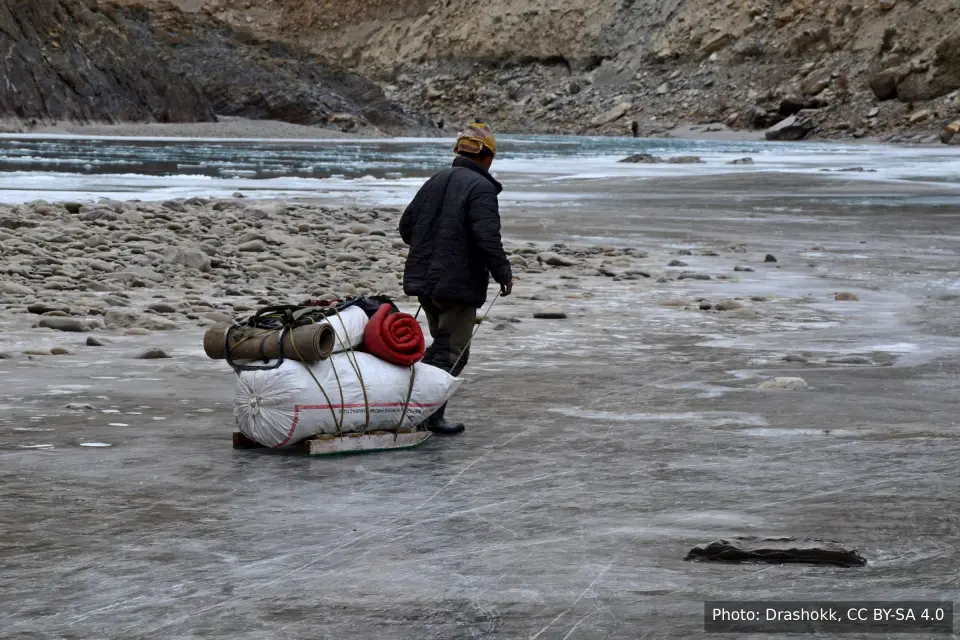
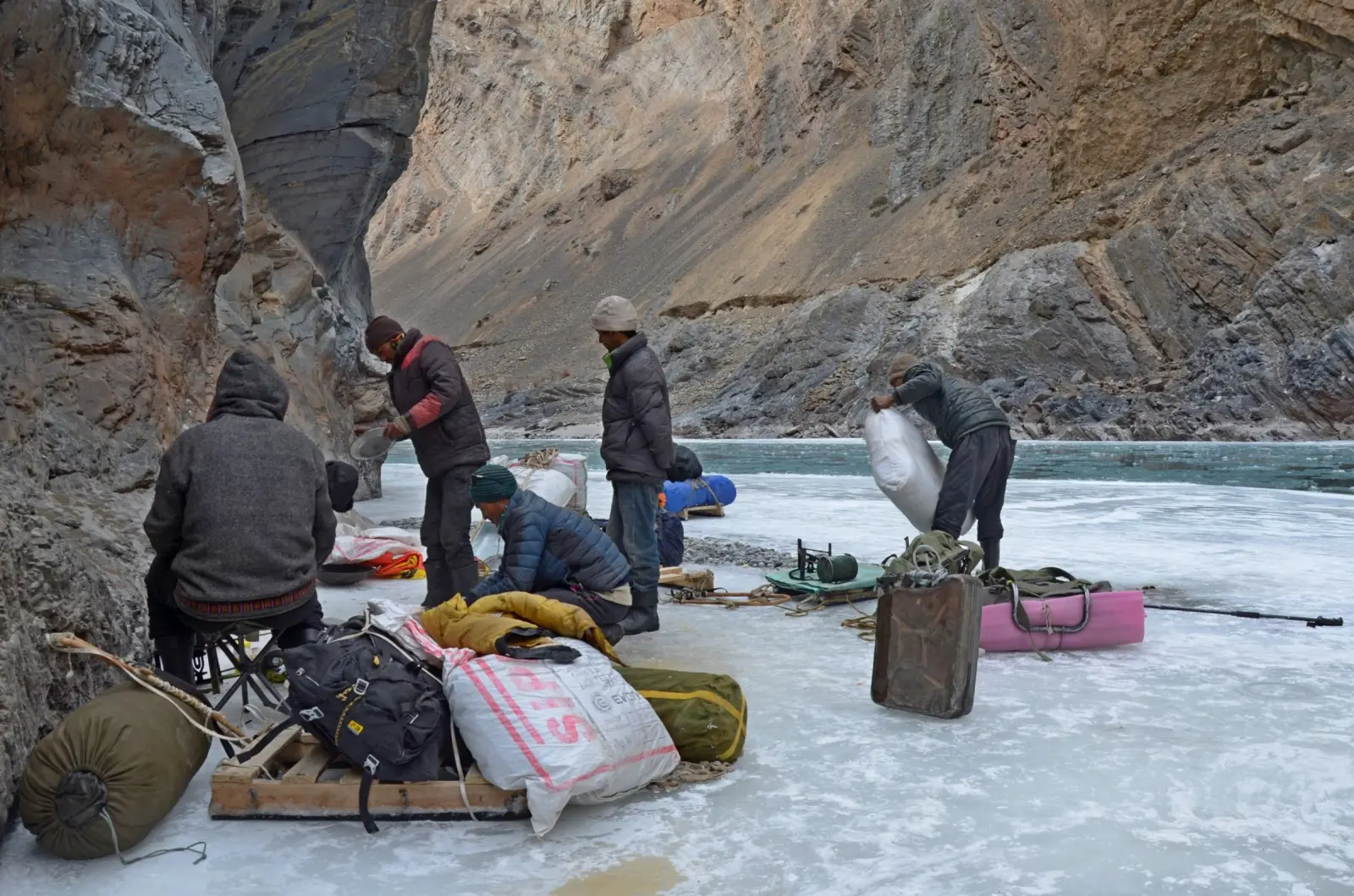 Porters packing the camp onto sledges on the ice. Photo: Drashokk, CC BY-SA 4.0, via Wikimedia Commons
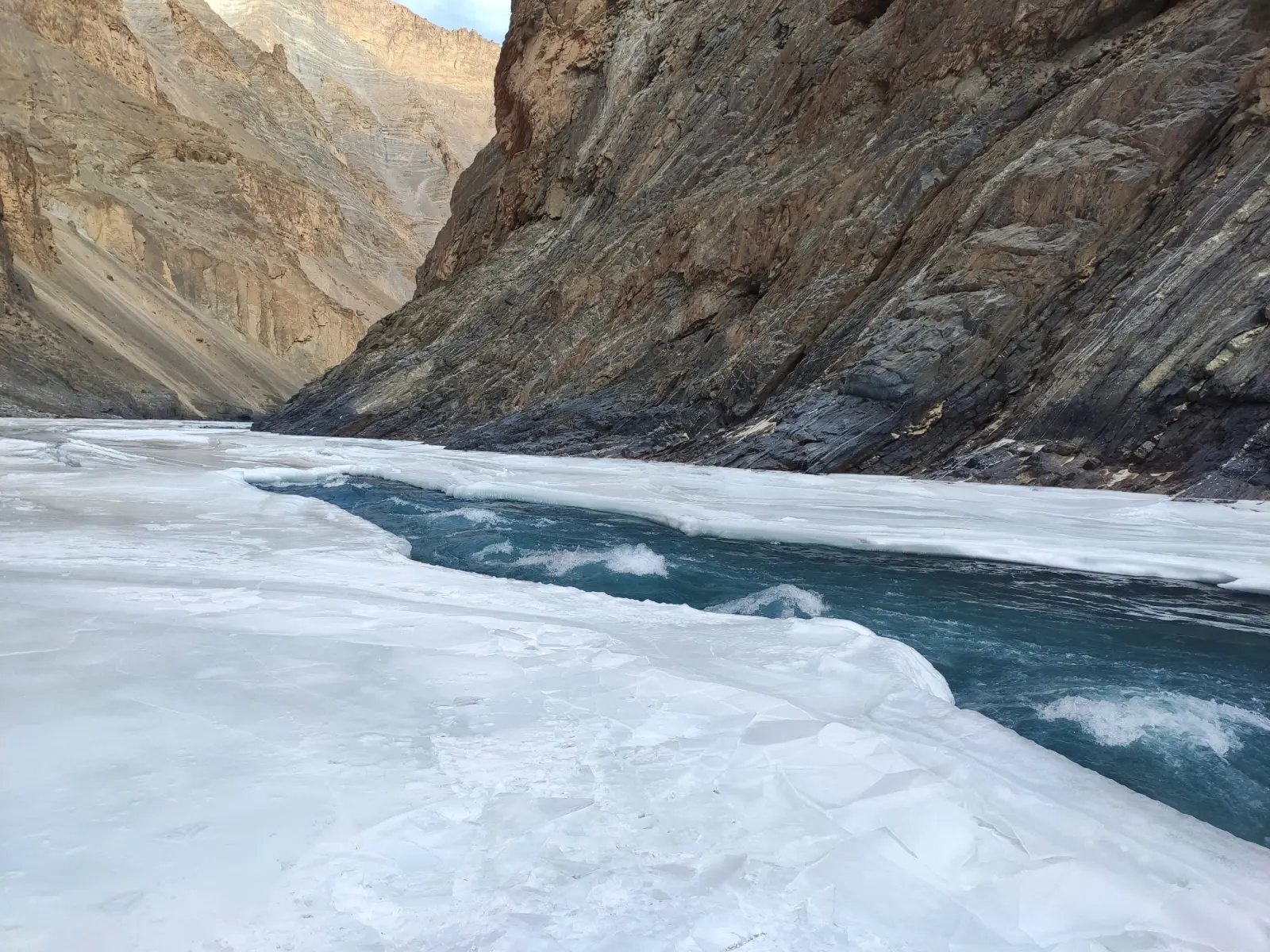 An open channel through the ice below a cliff. Photo: Atulbhats, CC BY-SA 4.0, via Wikimedia Commons
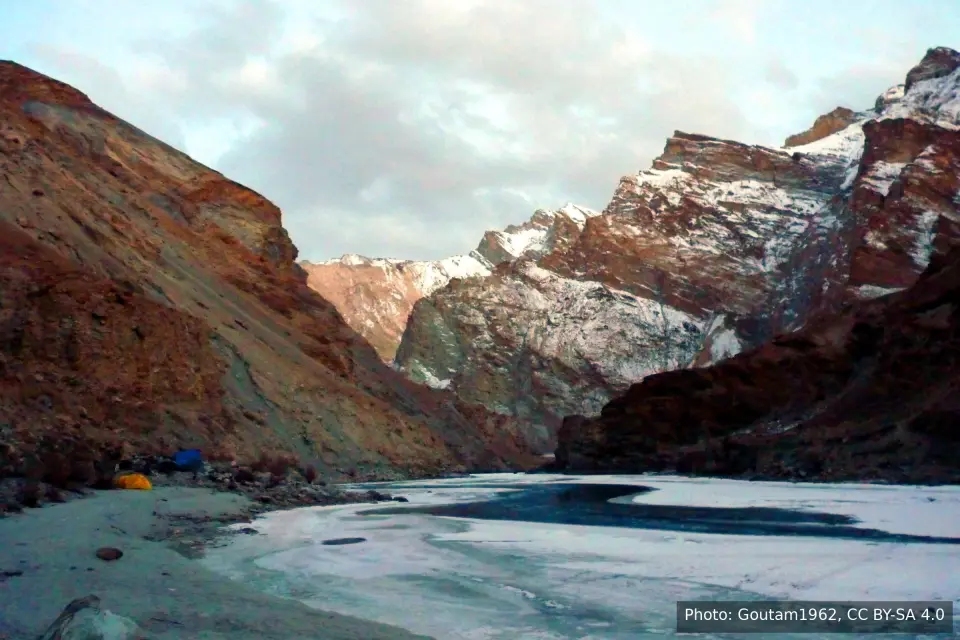
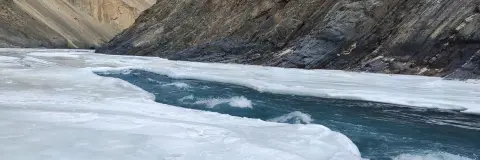
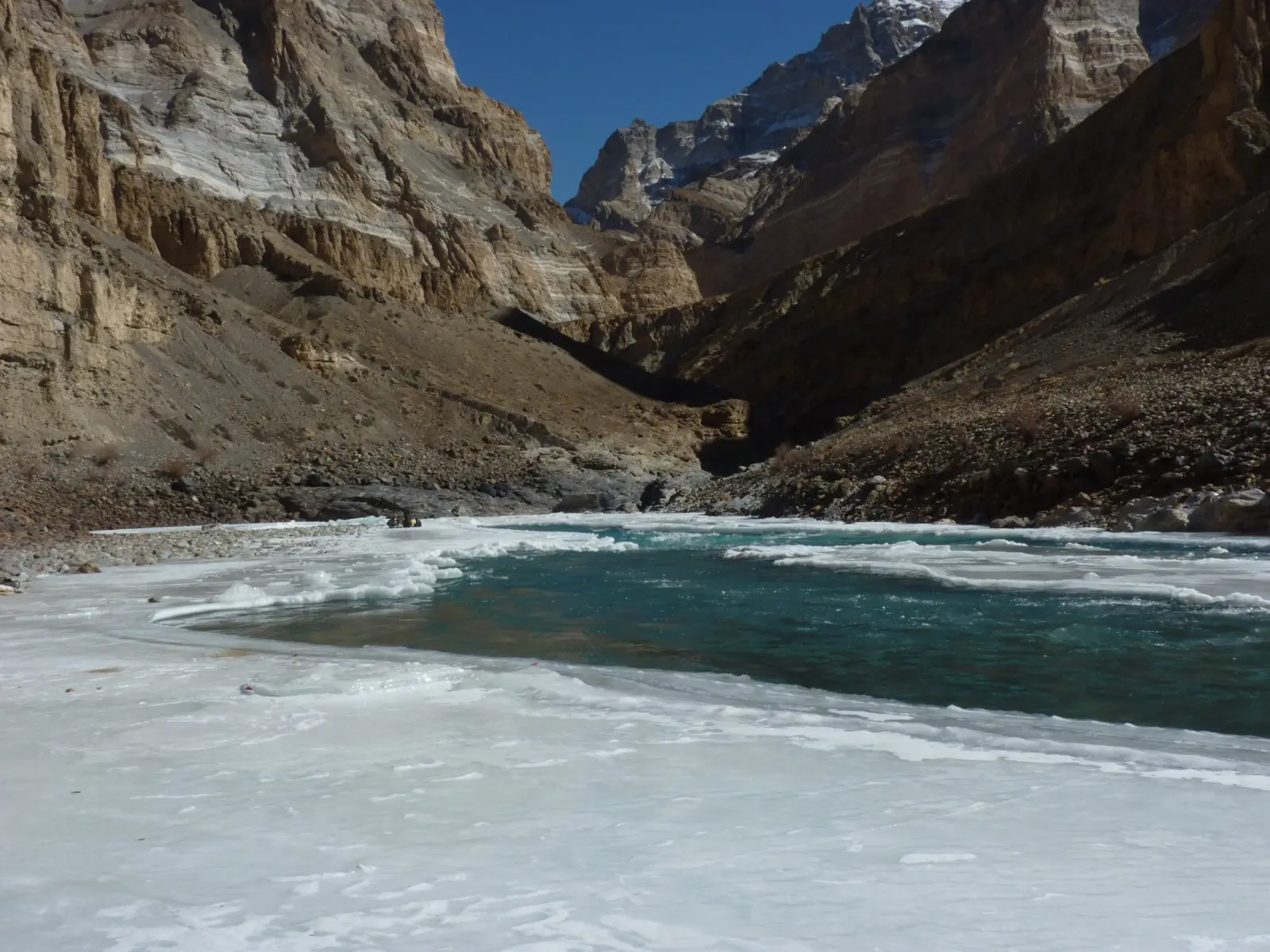 Open water between ice shelves on the Zanskar. Photo: Goutam1962, CC BY-SA 4.0, via Wikimedia Commons
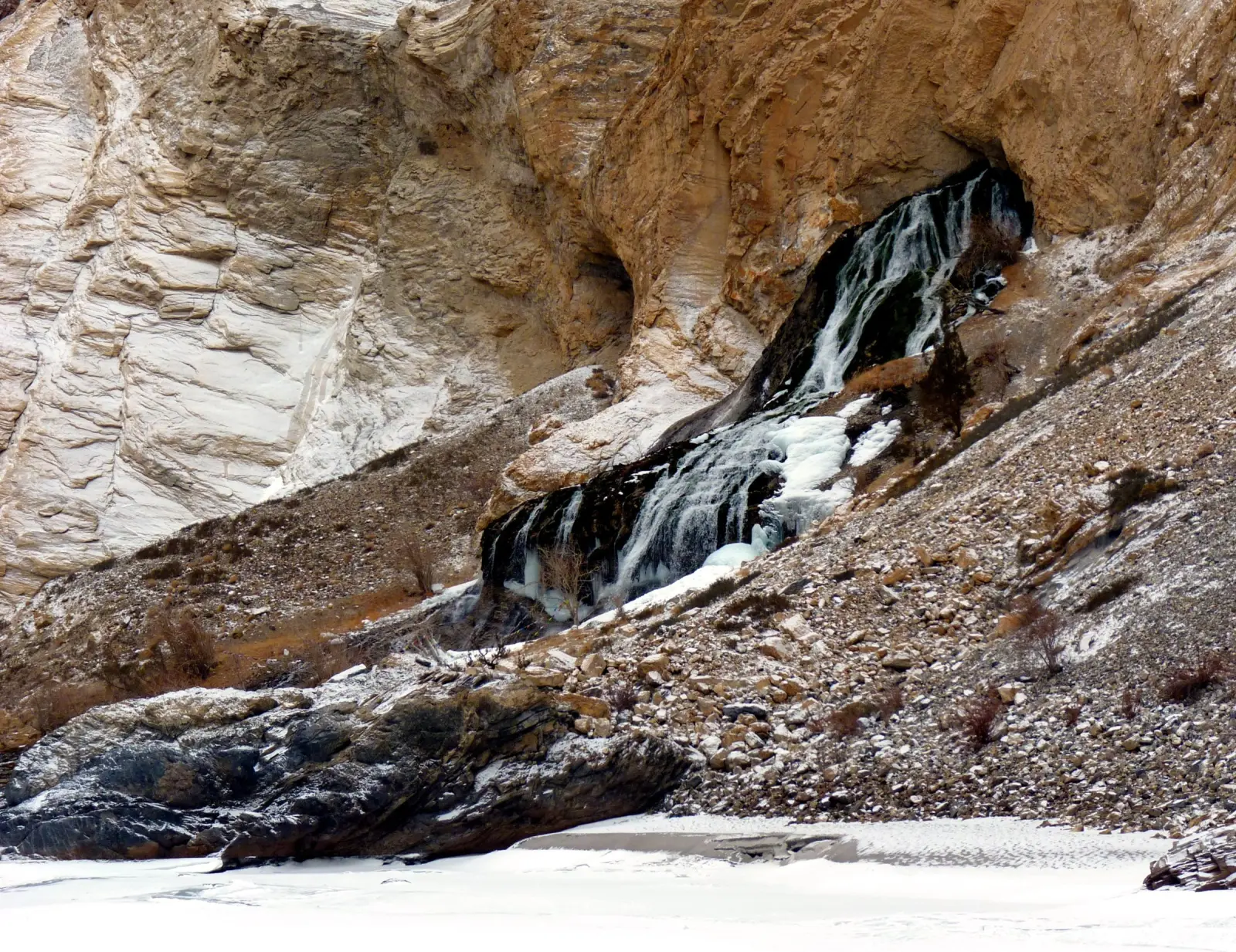 A half-frozen waterfall on the gorge wall. Photo: Sumita Roy Dutta, CC BY-SA 4.0, via Wikimedia Commons
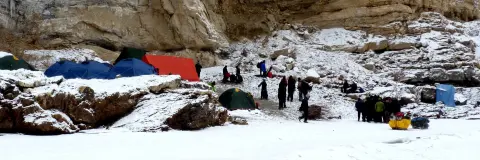
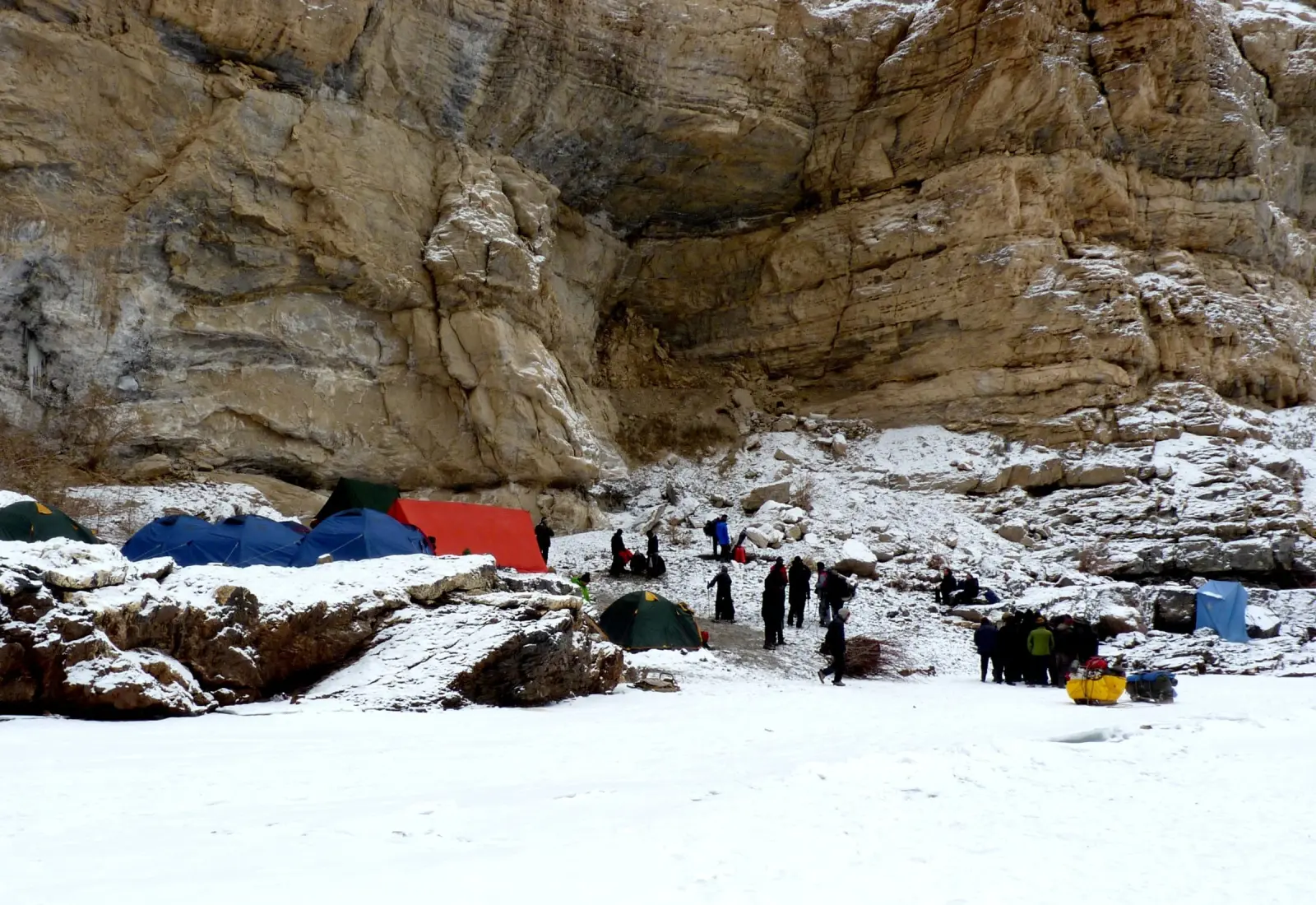 Camp under the cliffs beside the frozen river. Photo: Sumita Roy Dutta, CC BY-SA 4.0, via Wikimedia Commons
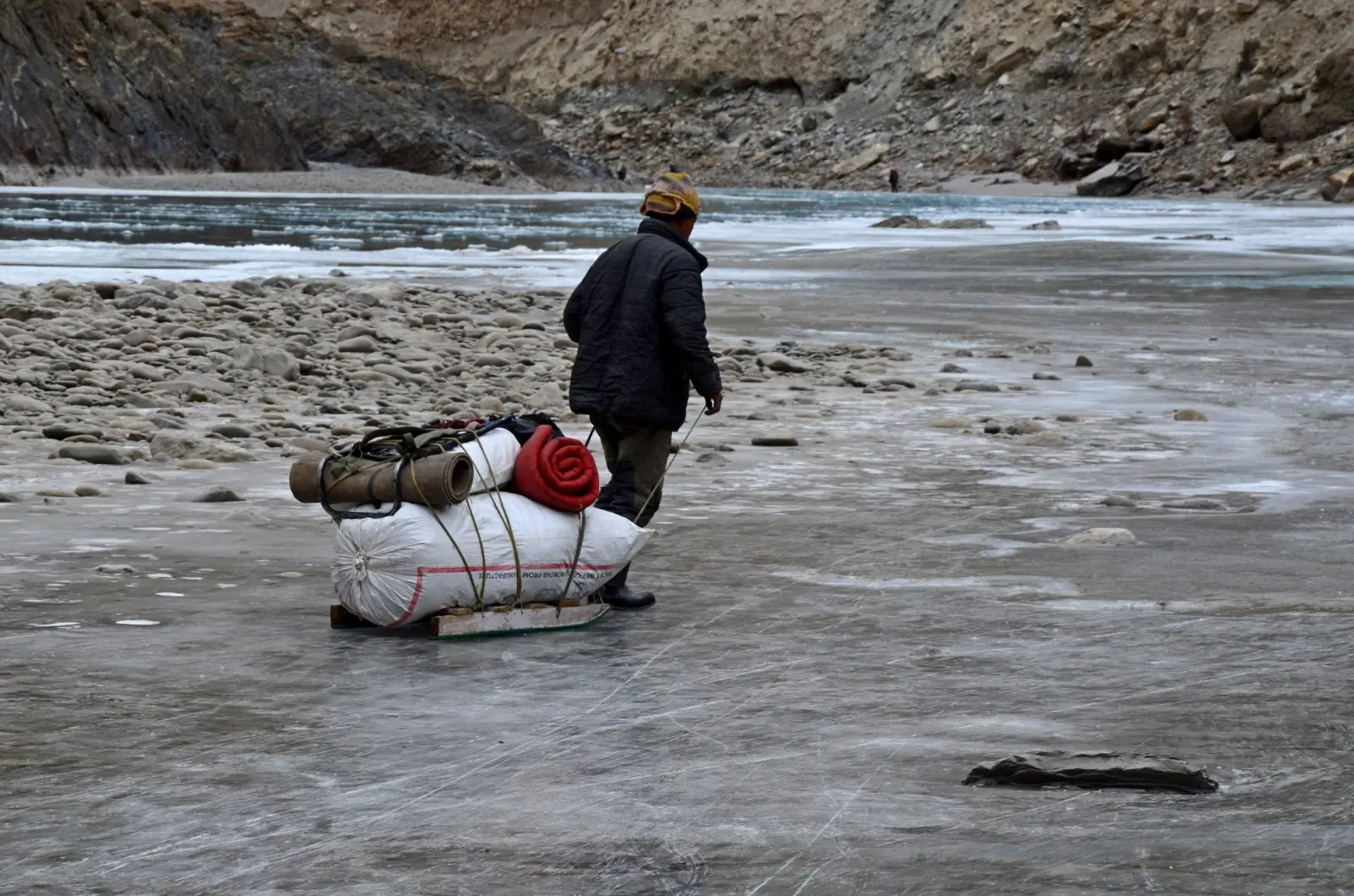 A porter pulling a sledge of camp gear on the ice. Photo: Drashokk, CC BY-SA 4.0, via Wikimedia Commons
Oxygen, first aid, SpO₂ checks twice a day, trained leaders — tap to read
1. Trained Trek Leaders
- Trek leaders lead with local guides who know the route, its weather and its campsites
- Trek leaders are trained in wilderness first aid
2. Health Checks Twice a Day
- Blood oxygen (SpO2) and pulse are checked for every trekker twice a day at every campsite
- A falling SpO2 reading is acted on early, before it turns into Acute Mountain Sickness (AMS)
- If you are not fit to continue, the trek leader will ask you to rest or descend; the trek leader’s decision on health and safety is final
3. Emergency Equipment
- A portable oxygen cylinder carried with the group
- First-aid and medical kit with the trek team
- A stretcher with the group for emergency evacuation
- Radio communication across the trek team, as mobile signal is not reliable on the trail
4. Proper Trekking Gear
- Free microspikes and gaiters on this trek (no deposit, no charge). Bring your own gumboots, trekking shoes and expedition-grade warm layers (see Things To Carry)
5. Tents and Sleeping Bags
- Sub-zero sleeping bags, and tents shared by three trekkers, with men and women in separate tents
6. Snow and Steep Sections
- On snow, ice or exposed ground, the trek team clears the trail, cuts steps where needed and helps you across slippery sections
7. Risks on the Chadar Trek
- Highest point: 3,400 m (11,155 ft)
- The ice keeps changing with the temperature, with slippery, slushy and fragile sections
- Extreme cold, with nights down to -30°C: frostbite and hypothermia are real risks
- Long days of 13–17 km on the ice on Days 5 to 8
8. Your Part
- Build your fitness before the trek with running, cycling or swimming
- Tell the trek leader about any medical condition and the medicines you carry before Day 1
- Report a headache, nausea, dizziness or breathlessness to the trek leader at once
- Buy the high-altitude risk insurance that is mandatory under ALTOA guidelines; it is not part of the trek fee
What a day on the trek feels like — tap to read
1. What You Can Expect From Us
- Safety first on the Chadar trek: SpO2 and pulse checks twice a day, an oxygen cylinder and a stretcher with the group
- Personal attention: batches of up to 20 trekkers, so the trek leader knows each trekker’s health and pace
- Trek leaders trained in wilderness first aid, with local guides who know the Chadar route, its weather and its campsites
- An itinerary planned for altitude, with daily distance and height gain set so your body can adjust
- Clear pricing: everything included and excluded is listed under Terms & Conditions, with the price of each optional add-on
2. What We Expect From You
- A willing attitude: cold nights, steep climbs and sudden weather changes are part of the mountains
- Physical preparation: you do not need to be an athlete, but train before the trek so the longest day feels comfortable
- Trust in your trek leader: follow their calls on route, pace, start times and turning back, as they are made for the group’s safety
Last ATM and phone network on the route — tap to read
1. Last ATM
- Leh is the last place with ATMs; there are none on the trail
- Carry enough cash for the on-the-spot fees and personal expenses
- Carry small notes: cards are not accepted on the trail
2. Mobile Network
- Leh has the last stable mobile network, and only postpaid SIMs work in Ladakh
- Once you leave Leh, the signal is scarce or unavailable
- Make your important calls and tell your family about the limited connectivity before you leave the base
Route Map & Altitude Profile
Follow the Chadar Trek (Frozen River) route on the map: from Shingra Koma (3,150 m) to Nerak (3,400 m), about 250 m of climbing. Press Walk the trail and follow the hiker camp to camp, or tap a day to jump to its camp.
Satellite imagery with a topographic map option. The trail is drawn from mapped footpaths and the Trekkaro route (417 points); it is for orientation, not a navigation map. Your trek leader walks the trail with you.
Camps and altitudes on the Chadar Trek (Frozen River)
- Day 4 Shingra Koma · 3,150 m / 10,335 ft Base — Road head on the Zanskar
- Day 4 Tsomo Paldar · 3,200 m / 10,499 ft Camp — First camp on the ice
- Day 5 Tibb Cave · 3,350 m / 10,991 ft Camp — Cave camp
- Day 6 Nerak · 3,400 m / 11,155 ft Summit — Frozen waterfall; turnaround
- Day 7 Tibb Cave (return) · 3,350 m / 10,991 ft Camp — Return camp
- Day 8 Shingra Koma (trek end) · 3,150 m / 10,335 ft Base — Drive to Leh
Related Treks You May Like
Chadar (Frozen River) Trek Guides
More Chadar (Frozen River) guides
Cost and booking
Distance and route
Season and weather
Difficulty and safety
More guides
What Trekkers Say About Trekkaro
Reviews left on trekkaro.com by trekkers across our treks.
"Winter Kuari Pass trek with the team of Trekkaro. Food was amazing for breakfast, lunch and diner. Views on top and during the track are amazing. Trek in total was completely amazing. Big thanks to all of hard work from trek leader, superhuman cooks, the mule team, our driver."
"I have trek with Trekkaro for kuari pass and it was an amazing experience ,food was excellent and experience trek trainer."
"Trekkaro was simply amazing from the guidance to food to stay everything was very good!!! Local guides and trek leaders where always motivating, fun and made sure entire group had always been together and interacted with each other!!!"
"Had an amazing experience! Thanks for making this an amazing experience - Trekkaro Team"
"Trekkaro has a amazing team capable of leading anyone over a trek. Had an amazing experience!"
"Very amazing experience with Kedartal trek. Awesome views, Trek leaders and coordinators were very helpful."
Why Trekkaro?
Leaders in providing Free Trekking Gear for 8+ years — redefining the way everyone must trek.

Up to 8 days before departure, reschedule to another batch for free or take a TrekCash Voucher worth 100% of your amount — valid for 1 year on any future trek.

Rated 4.9/5 on Facebook & 4.7/5 on Google by trekkers who trekked with us.

We keep you safe from the moment you book to the moment you head home — trek leaders trained in wilderness first aid, local guides & emergency support.

Well-planned itineraries balanced with the freedom to make the experience your own — no matter the trek difficulty.

Every decision we make is guided by our commitment to making trekking a force for good — for people and the planet.
Welcome to Trekkaro
Login or create an account to manage your bookings and profile
Login Create AccountTalk to an Expert
Enter your number — we'll call you back shortly.
Free microspikes & gaiters on this trek · no deposit
AI can make mistakes · never share payment or ID details · Talk to a person