This guide is about the Chadar Trek — dates, price, day-by-day itinerary and booking are on the trek page.
Cover photo: Sumita Roy Dutta, CC BY-SA 4.0, via Wikimedia Commons (cropped).
Quick answer: Chadar trek difficulty comes from the conditions, not the climbing: it is graded Difficult though the highest camp, Nerak, is only 3,400 m. You walk up to 17 km a day in gumboots on ice that changes overnight, with nights of -15°C to -30°C. It is not a first trek, and Trekkaro recommends at least 8 weeks of preparation.
This guide is for trekkers asking whether they are ready for the frozen Zanskar river. The trek facts come from our Chadar trek page, with the Kedarkantha comparison from its own trek page.
Why is the Chadar trek graded Difficult?
The trek page puts it in one line: "The Chadar trek is graded Difficult, and the reason is the conditions, not the climbing." Height is not the problem. The trek never goes higher than Nerak at 3,400 m (about 11,155 ft), which is lower than Leh at 3,500 m.
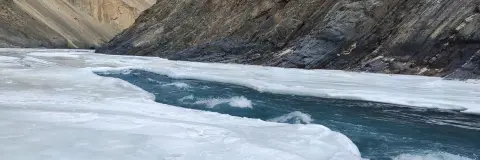
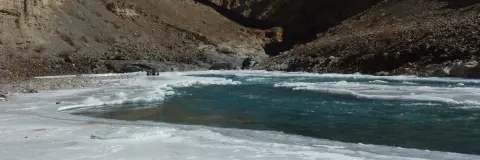
The difficulty comes from three things the page names: the cold, with night temperatures as low as -30°C; the ice itself, which may not be stable at all times; and unpredictable weather. The page adds that the trek "demands physical stamina and mental toughness as much as fitness."
Which days are the hardest?
Here are the days on the ice. The trek page calls the four long stages, Days 5 to 8, the hard days:
| Day | Stretch on the ice | Distance | Time | What makes it hard |
|---|---|---|---|---|
| 4 | Shingra Koma to Tsomo Paldar (after a 75 km, 3–4 hour drive from Leh) | 3 km | About 2 hours | First walk on the ice, in gumboots |
| 5 | Tsomo Paldar to Tibb Cave | 14 km | 6–7 hours | Sunlight on the river only from about 9 to 10 AM |
| 6 | Tibb Cave to Nerak | 13 km | 6–7 hours | Ends at Nerak, 3,400 m, the coldest camp |
| 7 | Nerak back to Tibb Cave | 13 km | 5–6 hours | Ice can change overnight on the way back |
| 8 | Tibb Cave to Shingra Koma, then 75 km by road to Leh | 17 km | 5–6 hours | The longest day on the ice |
Day 8 is the longest stretch at 17 km, and Day 6 ends at the coldest camp: Nerak, where nights reach about -30°C. In all you walk about 60 km. What makes these numbers harder than they look is the surface. The page describes ice that may be "firm, thin or slippery" from one section to the next, and warns that "six to seven hours in gumboots on slippery surfaces is tiring in its own way." Our Chadar distance and height guide has the route camp by camp.
How fit do you need to be?
The trek page asks for "good endurance, strength and cardiovascular fitness to walk 5–7 hours a day on ice in extreme cold". Fitness alone is not the bar, though. The page also says: "It is not a first trek: you should have experience of trekking in challenging terrain." Run through this before you book:
- You have done at least one trek on challenging terrain.
- You can walk 5 to 7 hours a day, several days in a row.
- You can handle severe cold for several days and nights.
- You can give at least 8 weeks to preparation before departure.
- You are 14 or older; trekkers under 18 come with a parent or guardian.
If any line is a no, build up on an easier winter trek first.
What should the 8 weeks of preparation cover?
The page's fitness answer lists endurance for "long days of 13–17 km on the frozen river" and balance with "trekking poles and gumboots on slippery ice". So train for both: work up to 5 to 7 hours of walking on consecutive days with a day pack, and walk in gumboots before you fly, because the page warns that walking on ice in them "takes practice". Take Trekkaro's free 2-minute "Am I Ready?" test, which gives a readiness score and a personal training plan, and see your doctor early: the page asks you to consult a doctor before the trek, and every trekker brings a medical certificate signed by a doctor (the form is in My Bookings).
How do you walk on the frozen river?
The first session on the ice is short on purpose: about 3 km to Tsomo Paldar on Day 4. The technique on the trek page is simple: "Keep your knees soft, take short steps and keep your weight over your feet."
For the rest of the trek, stay on the line your guide picks and step where the people ahead have stepped; on snow, ice or exposed ground the trek team fixes ropes and cuts steps where needed.
Gumboots are mandatory. Trekkaro gives free microspikes and gaiters on the Chadar (no deposit, no charge) and carries ice axes and ropes; you bring your own gumboots. You sleep in tents shared by 3 trekkers (men and women separate) in sub-zero sleeping bags.
What does the cold add to the difficulty?
Days on the river are -5°C to 0°C and nights -15°C to -30°C, so the cold wears you down on top of the walking. The page names frostbite and hypothermia as risks and asks you to watch for numbness, skin discolouration and shivering. Our Chadar temperature guide covers the coldest camp, clothing and keeping water from freezing.
Why does the medical check in Leh decide who walks?
The trek begins with a flight into Leh (3,500 m), and every trekker must spend at least two days acclimatising there before the trek. Day 1 is arrival and rest, with a briefing at noon; Day 2 is a sightseeing day around Leh (the Hall of Fame, Shey and Thiksey). The Ladakh Tourism travel advisory lists persistent headache, mild nausea and difficulty sleeping among the mild signs of altitude sickness and says to stop ascending if symptoms appear.
Day 3 is the medical check at the Government Medical Camp in Leh. It tests height, weight, blood pressure and oxygen level, and it can take 3 to 4 hours. The results decide whether you are medically fit to continue, so fitness here is a gate, not only a comfort. The same day you complete the high-altitude risk insurance, mandatory under ALTOA guidelines and not included in the fee. There is no upper age limit: trekkers above 60 are welcome if they are fit and in good cardiovascular health, with an ECG or TMT report recommended.
On the trail, first aid, oxygen cylinders, a medical kit and stretchers are kept at all campsites. Charges for evacuation, hospitalisation or medical emergencies are not covered by the fee. Leh is the last place with ATMs, and only postpaid SIMs work in Ladakh.
Who decides whether the group turns back?
The trek leader does. The trek page asks you to follow the leader's calls on route, pace, start times and turning back, "as they are made for the group's safety", and its terms say the trek leader's decision on health and safety grounds is final. A batch can also be cancelled when the route is closed by the forest or permit office; you are then told by email and WhatsApp and get back 100% of what you paid, as a TrekCash voucher or a full refund.
Who should start with an easier winter trek?
Skip the Chadar for now if it would be your first trek, if severe cold over several days and nights worries you, or if you cannot give it 8 weeks of preparation. Kedarkantha, a 5-day Easy–Moderate winter trek in Uttarakhand, lets you try a winter trek first; the table, from the two trek pages, shows how far apart the two are.
| What changes | Chadar | Kedarkantha |
|---|---|---|
| Grade | Difficult | Easy–Moderate |
| Highest point | Nerak camp, 3,400 m | Summit, 3,810 m |
| Winter nights at camp | -15°C to -30°C | -15°C to -10°C |
| Longest day on foot | 17 km | About 9 km (summit day) |
| Footwear | Your own gumboots, with free microspikes and gaiters | Free Decathlon trekking shoes, microspikes and gaiters (₹3,000 refundable deposit, ₹200 washing charge) |
| Minimum age | 14 | 8 |
What does the Chadar trek cost?
The Chadar trek fee is ₹25,500 + 5% GST (₹26,775), Leh to Leh, and the trek page shows EMI from ₹1,311 a month. On-the-spot fees of about ₹6,000–₹8,000 and the mandatory high-altitude insurance are extra. The season runs from January to February; see the trek page for live batch dates. Our Chadar cost breakdown has every line.
See Chadar dates and book | Chadar trek distance and height | Chadar trek cost breakdown
Frequently asked questions
Is the Chadar trek suitable for beginners?
No. The trek page says it is not a first trek: you need experience of trekking in challenging terrain and the ability to handle severe cold for several days and nights.
Is the Chadar trek risky?
It is a managed trek, not a risk-free one. The main risks are changing ice, frostbite, hypothermia and altitude sickness after flying into Leh, which is why the trek has acclimatisation days, a mandatory medical check in Leh, guides who pick the line on the ice, and oxygen and stretchers at all campsites.
What is the hardest day on the Chadar trek?
Day 8 is the longest, 17 km from Tibb Cave back to Shingra Koma. Day 6 ends at Nerak, the coldest camp, where nights reach about -30°C.
How many weeks should I train for the Chadar trek?
Trekkaro recommends at least 8 weeks of preparation. Build the endurance to walk 5 to 7 hours a day for several days in a row, practise walking in gumboots and consult your doctor before the trek.
Can I do the Chadar trek if I am over 60?
Yes. There is no upper age limit: trekkers above 60 are welcome if they are fit and in good cardiovascular health, and the trek page recommends an ECG or TMT report. Everyone still has to pass the mandatory medical check in Leh on Day 3.