
Gulabikantha Trek
Inclusion:
Accommodation
Meals
All Permits
Expert Trek Leader & Guide
Gulabikantha Trek — Guide, Dates & Cost
Region: UttarakhandDistrict: Uttarkashi
Duration: 5 Days
Difficulty Level: Easy–Moderate
Highest Altitude: 3,658 m / 12,000 ft.
Trekking Distance: 24 Kilometers
Temperature: Summer (April–June): Daytime: 8°C to 15°C, Night: 0°C to 7°C, Winter (Dec–Jan): Daytime: -2°C to 5°C, Night: -12°C to -5°C
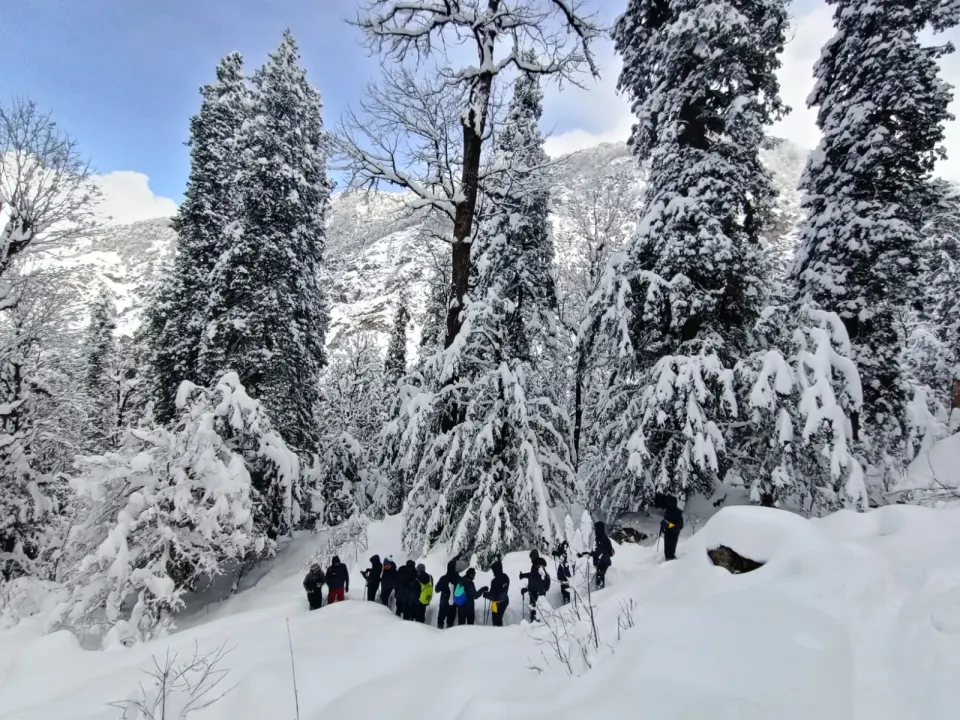
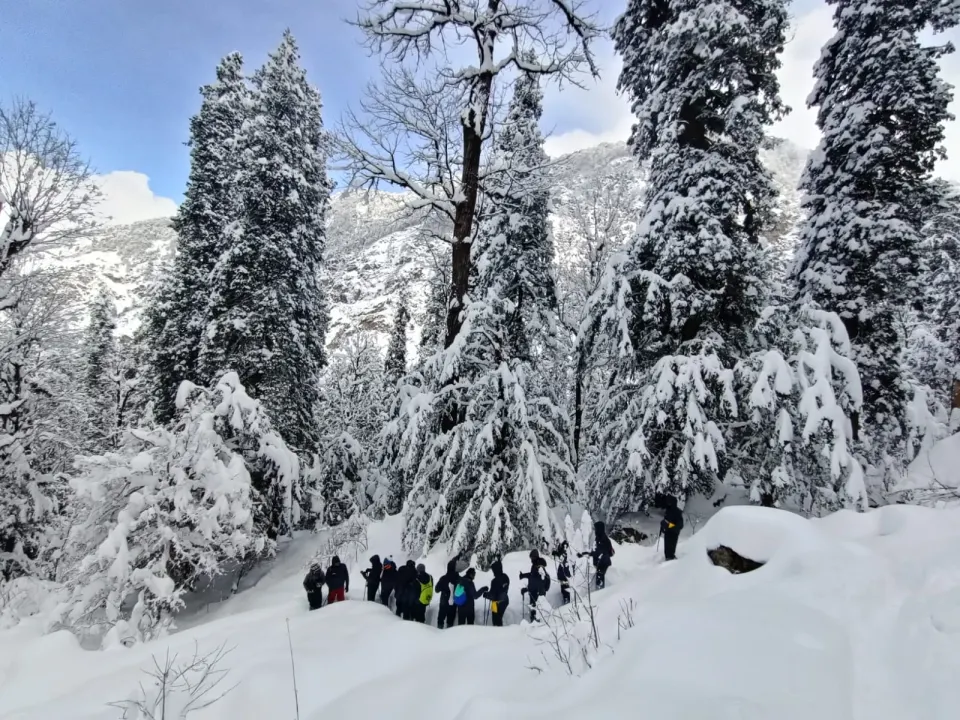
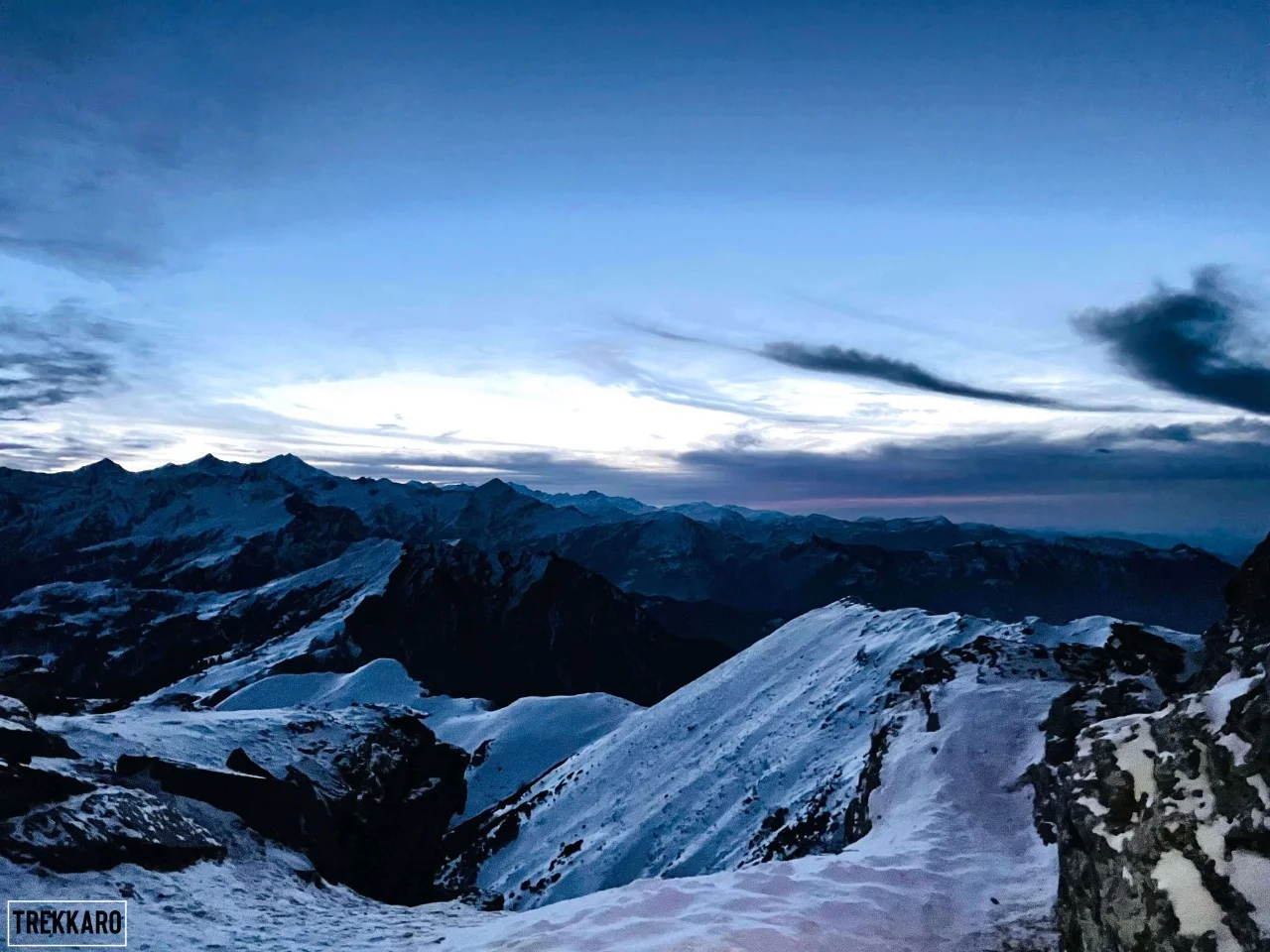
Gulabi Kantha is a meadow that has only recently been noticed. Local villagers and guides introduced it to a few media channels, and an ITBP team came up from Matli to see whether its slopes could one day host skiing. Walk up to it today and the trail is still quiet: tall pine, oak and maple overhead, a forest silence broken only by birdsong and rustling leaves. Then the forest gives way to open meadow, and at 12,000 ft the Garhwal peaks stand in a ring around you.
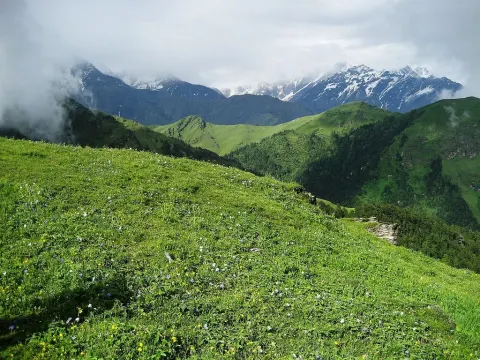
The Gulabikantha trek climbs out of the Yamuna Valley through dense forest of pine, oak and maple, past the wooden houses and terraced farms of Nishni village, to the forest camp of Kandola. From there it rises across the alpine meadows of Seema Thatch, scattered with wildflowers among rolling hills, and up a steeper trail to the Gulabikantha summit meadow. The view at the top runs a full 360°: Bandarpoonch and Chaukhamba, Swargarohini, Black Peak, Kalindi Srikala and Draupadi ka Danda, with the Shivalik ranges below. Gulabi Kantha is a vast alpine meadow on the way to the Dodital freshwater lake, and it remains largely untouched by heavy footfall.
The Gulabikantha trek is an easy-moderate trek in the Uttarkashi district of Uttarakhand. It starts and ends at Hanuman Chatti (2,134 m / 7,000 ft), a peaceful village and the last motorable point on the road to Janki Chatti, close to the sacred Yamunotri Temple, one of the Char Dham shrines. The trail climbs to a single camp at Kandola (2,590 m / 8,500 ft), and the summit day passes Seema Thatch (3,200 m / 10,500 ft) on the way to the top at 3,658 m (12,000 ft). Over five days the trek covers about 24 km on foot. It is still one of the lesser-known trekking destinations in Uttarakhand. In our experience, it is one of the most rewarding first summits a beginner can choose in the Uttarkashi district.
A Ring of Peaks at 12,000 Feet – What Makes the Gulabikantha Trek Unmissable
Everything on the Gulabikantha trek leads to one day and one view. You leave Kandola early, with a packed lunch and the summit still hidden somewhere above the trees. For the first hours you walk through pine and oak, and then the forest opens onto the meadows of Seema Thatch, a wide, gentle shelf of wildflowers and rolling ground at 10,500 ft. You pause there. You look up at what is left. From here the trail turns steeper and asks for real effort, and with every step more of the Himalaya appears over the shoulder of the slope. After about four to five hours of climbing from camp, the gradient eases, the ground levels into a broad meadow, and you are standing on the summit at 3,658 m (12,000 ft). You sit down. You take out your lunch. You turn slowly in a full circle, and in every direction there is another mountain.
The width of that view is what sets Gulabikantha apart. Bandarpoonch and Chaukhamba stand out first, with Swargarohini, Black Peak and Kalindi Srikala along the skyline, Draupadi ka Danda among them and the Shivalik ranges falling away below. Clouds drift across the peaks like brushstrokes on a canvas, and the panorama changes as they move. At sunrise and sunset these mountains are bathed in gold. Then, when you are ready, you walk back down the way you came, through Seema Thatch and the forest, to the same camp you left that morning. There is no camp to strike and no new site to reach before dark, and in our experience that makes the big day far more enjoyable, especially for first-time trekkers.
Kandola itself is part of what makes the trek. You spend two nights at this forest camp at 2,590 m (8,500 ft), set among alpine forest and mountain slopes. In the evening the sky over the surrounding ridges glows in warm colours as the sun goes down; at night the sky fills with stars; in the morning you wake to sunrise over the hills. After the summit, an evening back at Kandola is a time to rest and share stories of the day under a starlit sky.
The Trail Itself
The trail leaves Hanuman Chatti and enters dense forest almost at once. Tall pine, oak and maple form a canopy overhead, and the ground is often carpeted with fallen brown maple and pine leaves, so the path is soft underfoot. The climb is gradual, about 5 km and 456 m (1,500 ft) of height gain to Kandola, and the area is rich in flora and fauna, with seasonal wildflowers, Himalayan birds and the occasional sighting of wildlife. On the way you pass Nishni, a small Himalayan hamlet of traditional wooden houses and terraced farms. The mild climb around the village gives you a glimpse of everyday mountain life.
Above Kandola the forest gives way to the open meadows of Seema Thatch, and above that the upper slopes rise more steeply to the summit meadow. On the way down to Hanuman Chatti the trail is steady with some steep patches, and the views open over the Yamuna Valley. The trek ends where it began, in a quiet village where a stroll through the lanes introduces you to the warm hospitality of local people. A short 3 km drive or walk away is Garam Kund, a natural hot water spring whose warm, mineral-rich water is believed to soothe sore muscles after the summit day.
Who Is This Trek For?
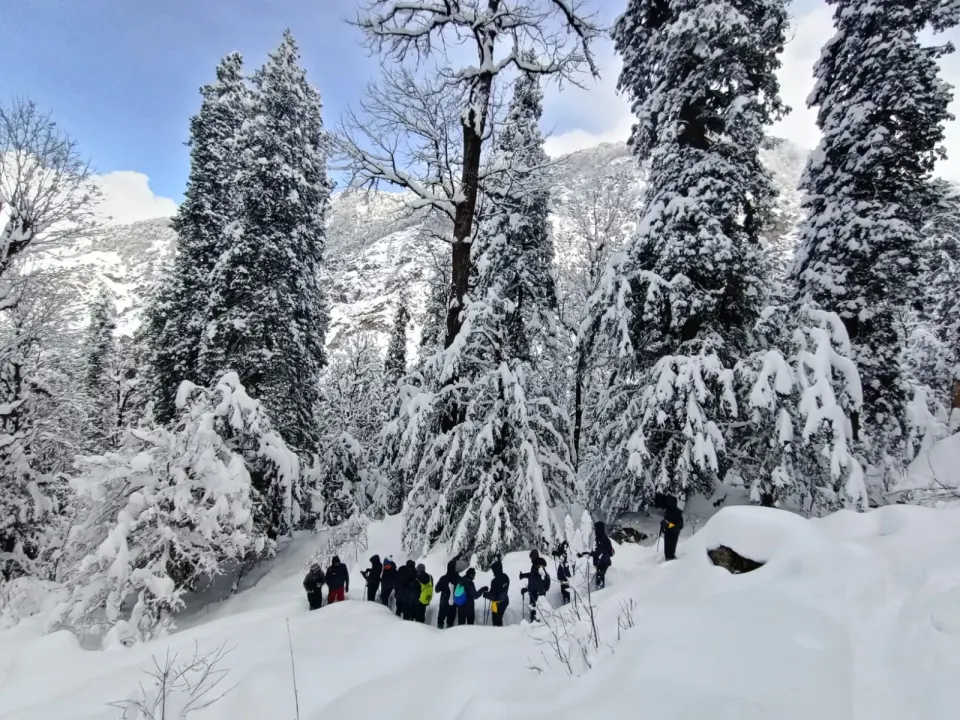
The Gulabikantha trek is graded Easy - Moderate, and in our view it makes an excellent first Himalayan trek. Without snow it is a gentle trek that beginners with basic fitness can manage; snow in the winter months adds some challenge. Two of the three walking days are short: 5 km in 3–4 hours up to Kandola, and 5 km in 2–3 hours back down, with some steep downhill patches. The hard day is the summit day: about 14 km (7 km up and 7 km down) in 7–8 hours, with a climb of about 1,068 m (3,500 ft) and the same height back down, on a trail that becomes noticeably steeper after Seema Thatch. Basic fitness, such as walking 4–5 km a day with a small backpack, is the minimum; good stamina and leg strength make the summit day far more enjoyable, especially on steep or snowy sections. We recommend 4–6 weeks of preparation before departure. Minimum age: 8 years, accompanied by adults. Upper age: depends on fitness, stamina and the ability to handle high altitude. Daily trekking hours: 2–8 hours. Season: January to April and October to December.
Key Highlights of the Gulabikantha Trek
- Gulabikantha summit (3,658 m / 12,000 ft) – a vast alpine meadow with a 360° Himalayan panorama
- A long line of Garhwal peaks – Bandarpoonch, Chaukhamba, Swargarohini, Black Peak, Kalindi Srikala and Draupadi ka Danda, with the Shivalik ranges below
- Seema Thatch (3,200 m / 10,500 ft) – open meadows with wildflowers and rolling hills on the way to the top
- Kandola forest camp (2,590 m / 8,500 ft) – two nights in one camp, with sunset over the ridges and a starry sky
- Pine, oak and maple forest – a soft, leaf-carpeted trail with Himalayan birdsong
- Nishni village – traditional wooden houses and terraced farms on the climb from Hanuman Chatti
- A quiet, offbeat meadow – largely untouched by heavy footfall, and explored by the ITBP for winter sports such as skiing
- Garam Kund – an optional dip in a natural hot spring, 3 km from Hanuman Chatti, after the trek
Best Time to Do the Gulabikantha Trek
The Gulabikantha trek runs from October right through to April, and Trekkaro recommends December to April as the best time to go. Across that window the meadow moves from settled autumn weather to deep winter snow and then into spring bloom, and each part of the season gives the same short route a very different feel.
October to November – Autumn (Clear Trails)
The season opens with pleasant weather, clear trails and green landscapes. The forest walking is comfortable, and the summit view can be enjoyed before the winter snow arrives. For trekkers who want a quiet, easy-going introduction to the Himalaya before the cold sets in, this is a calm and comfortable time to go.
- Trail conditions: Clear trails and pleasant walking weather.
- Best for: A comfortable first trek, quiet forest walking and the summit view before winter.
December to February – Winter (Snow Season)
In winter the meadow transforms. Snow settles over Gulabi Kantha, turning the summit into a wide white slope, and this becomes the season for those seeking a challenging snow trek or a skiing experience. Snow on the upper trail and the summit makes the climb slower and more tiring, and the nights at Kandola are properly cold. It is also, in our experience, the time when the meadow and its ring of peaks look most striking.
- Temperatures: December–January: Day: -2°C to 5°C | Night: -12°C to -5°C
- Trail conditions: Snow on the upper trail and summit; slower climbing; very cold nights.
- Best for: A snow trek, a snow-covered summit meadow and winter landscapes.
March to April – Spring (Meadows in Bloom)
As winter loosens its grip, March and April bring blooming meadows and pleasant trekking conditions. The days grow milder and the meadows begin to bloom, though snow can still lie on the higher slopes early in this period. We find this the most balanced window of the year.
- Temperatures: April: Day: 8°C to 15°C | Night: 0°C to 7°C
- Trail conditions: Pleasant walking; meadows starting to bloom; snow possible higher up early in the season.
- Best for: Blooming meadows, milder nights and comfortable conditions for beginners and families.
Trekkaro Recommendation
Trekkaro recommends December to April for Gulabikantha. For a full snow trek and the summit meadow under winter cover, book December to February. For blooming meadows, milder nights and the most comfortable conditions for first-time trekkers and families with children aged 8 and above, March to April is our pick. For a quiet trek on clear trails before the snow arrives, October to November works well.
🏃 Am I ready for the Gulabikantha Trek? Take the free 2-minute fitness test and get your readiness score and a personal training plan.
Take the test →Trek Itinerary
Trekkaro will arrange a cab from Dehradun to Hanuman Chatti and back at an additional cost. The fare is approximately ₹6,500 one way for a 5–6 seater vehicle. The cost will be shared among trekkers traveling together, making it an economical and convenient option to reach the basecamp without hassle.
Trekkaro will arrange a cab from Hanuman Chatti to Dehradun at an additional cost. The fare is approximately ₹6,500 one way for a 5–6 seater vehicle. The cost will be shared among trekkers traveling together, making it an economical and convenient option to reach Dehradun without hassle.
Day 1: Dehradun to Hanuman Chatti
Route Details:
Drive: Dehradun → Hanuman Chatti (162 km, 7–8 hrs) | Altitude: 2,134 m (7,000 ft) | Stay: Guesthouse / homestay (triple or quad sharing)
Day 1 is a road day. Start the drive from Dehradun by 6:30 to 7:00 AM and you reach Hanuman Chatti before dark. The 162 km take 7 to 8 hours. The road climbs through Mussoorie, then runs via Damta, Naugaon, Barkot and Syana Chatti, with deep valleys, pine and oak forest, and the Yamuna alongside.
Barkot, about 1 hour 30 minutes before the base camp, is the last reliable ATM and the last stable mobile network; Jio does not work well in this region. Withdraw enough cash and finish your calls there. Shops higher up mostly take cash, and the signal is almost gone by Hanuman Chatti.
Hanuman Chatti is a peaceful village in Uttarkashi district and the base camp for the trek. It lies on the road to Janki Chatti, 5 km from the Yamunotri Temple. You stay in a guesthouse or homestay on a triple or quad sharing basis, with dinner included. Spend a quiet evening by the river and sleep early.
What to Expect:
- Early start from Dehradun, by 6:30–7:00 AM
- 162 km drive (7–8 hrs) via Mussoorie, Barkot and Syana Chatti
- Last ATM and stable mobile network at Barkot
- Yamuna River views and pine and oak forest along the road
- Quiet evening by the river, dinner included
- Overnight: Hanuman Chatti (2,134 m / 7,000 ft)
Day 2: Hanuman Chatti to Kandola
Route Details:
Altitude: 2,134 m → 2,590 m (8,500 ft) | Distance: 5 km | Duration: 3–4 hrs | Terrain: gradual forest trail of pine, oak and maple, past Nishni village | Stay: Tents at Kandola
Day 2 begins with a light breakfast and a short briefing from the Trekkaro team, and you set off at 7:00 AM. The walk to Kandola is a gradual ascent of about 456 m (1,500 ft) over 5 km, which takes 3 to 4 hours. It is a gentle first day and a good one for finding your rhythm.
Soon after Hanuman Chatti, the trail enters dense forest. Tall pine, oak and maple trees close overhead, and the path is often covered with fallen brown maple and pine leaves, soft and quiet underfoot. The only sounds are birdsong and rustling leaves. Walk at a pace where you can still talk. If you are too out of breath to speak, slow down.
Partway up, you pass through Nishni village, a small hamlet of traditional wooden houses and terraced farms. The climb is mild around the village, and it is a good place for a short break and a look at mountain life up close.
The last stretch brings you to Kandola at 2,590 m (8,500 ft). The campsite sits among forest and mountain slopes, with views of the surrounding ridges. Lunch and evening snacks are served at camp, and the afternoon is yours to rest. Drinking water at camp is boiled or treated with chlorine tablets; ask your trek leader before you refill anywhere else. At sunset the sky over the ridges glows warm, and on a clear night the stars are out in full. Sleep early. Tomorrow is the longest day of the trek.
What to Expect:
- 7:00 AM start after breakfast and a short briefing
- Gradual 5 km climb with about 456 m (1,500 ft) of height gain
- Dense pine, oak and maple forest on a leaf-covered trail
- Nishni village, with wooden houses and terraced farms
- Sunset and sunrise views over the ridges from camp
- Overnight: Tents at Kandola (2,590 m / 8,500 ft)
Day 3: Summit Day - Kandola to Gulabikantha via Seema Thatch and back
Route Details:
Altitude: 2,590 m → 3,200 m (Seema Thatch) → 3,658 m (12,000 ft) → 2,590 m | Distance: 14 km (7 km up, 7 km down) | Duration: 7–8 hrs | Terrain: pine and oak forest, alpine meadow, steeper climb to the summit | Stay: Tents at Kandola
Summit day is long, so you start early from Kandola with a packed lunch in your bag. The first part of the trail winds through dense pine and oak forest at a steady gradient, which gives you time to warm up before the real climbing. The forest then opens onto the alpine meadows of Seema Thatch at 3,200 m (10,500 ft), with rolling hills around you and wildflowers in season. Take a short break here and drink water.
Above Seema Thatch the trail turns steeper. This is the hard section of the day, and it stays with you until the top. The full ascent takes about 4 to 5 hours. Climb in short steps, pause briefly and often, and keep your breathing steady. In winter, snow adds to the effort, so use your poles and walk in the line your guide sets.
At the Gulabikantha summit, 3,658 m (12,000 ft), the view opens in a full 360° circle. Peaks line the skyline: Bandarpoonch, Black Peak, Swargarohini, Kalindi Srikala, Chaukhamba, Draupadi ka Danda, Jorkanden, Gangotri and Yamunotri, along with the Shivalik mountains. Clouds drift across the ridges. You eat your packed lunch at the top, take your photographs and rest.
Then you retrace your steps down through Seema Thatch to Kandola. The return is quicker, but it is still 7 km downhill on tired legs, so keep your poles out and your steps short. The evening at camp is relaxed. Dinner, a warm tent and a starlit sky over the forest close the day.
What to Expect:
- Early start with a packed lunch for the summit
- Pine and oak forest, then the meadows of Seema Thatch (3,200 m / 10,500 ft)
- Steeper climb above Seema Thatch; about 4–5 hrs of ascent in total
- 360° summit view including Bandarpoonch, Swargarohini, Black Peak and Chaukhamba
- Lunch at the summit, then descent by the same route
- Overnight: Tents at Kandola (2,590 m / 8,500 ft)
Day 4: Kandola to Hanuman Chatti
Route Details:
Altitude: 2,590 m → 2,134 m (7,000 ft) | Distance: 5 km | Duration: 2–3 hrs | Terrain: steady downhill through pine and oak forest, some steep patches | Stay: Guesthouse / homestay at Hanuman Chatti
The last walking day is short and easy. You have breakfast around 7:00 AM and start down from Kandola. The trail is a steady descent of about 456 m (1,500 ft) over 5 km, back through the pine and oak forest you climbed through on Day 2. It takes 2 to 3 hours.
Easy does not mean careless. There are some steep descending patches, and trekking poles make a real difference on them. Keep your weight over your feet, shorten your stride on the steep parts and let the poles take load off your knees. On the way you pass Nishni village again, and the trees open to views over the Yamuna Valley.
The trek concludes at Hanuman Chatti. If you want more from the day, Garam Kund, a natural hot water spring, is a short 3 km away by road or on foot. We recommend the dip. The warm, mineral-rich water is believed to soothe sore muscles after summit day.
You spend the night at a guesthouse or homestay in Hanuman Chatti on a triple or quad sharing basis, with lunch and dinner included. Take a slow walk through the village lanes in the evening. The locals are warm, and a few words in their language are always appreciated.
What to Expect:
- Breakfast around 7:00 AM, then an easy 5 km descent
- Some steep patches on the way down; trekking poles help
- Nishni village and views over the Yamuna Valley
- Optional 3 km trip to the Garam Kund hot spring
- Evening walk through the village lanes
- Overnight: Hanuman Chatti (2,134 m / 7,000 ft)
Day 5: Hanuman Chatti to Dehradun
Route Details:
Drive: Hanuman Chatti → Dehradun (162 km, 7–8 hrs) | Altitude: 2,134 m (7,000 ft) | Route: Syana Chatti, Barkot, Naugaon, Damta, Mussoorie
The last day is the drive back to Dehradun, about 162 km and 7 to 8 hours by road. The route runs through Syana Chatti, Barkot, Naugaon and Damta, then descends via Mussoorie into the Doon Valley. Pine and oak forest line the road, and the Yamuna flows alongside in parts.
Barkot is the first place on the way down with a reliable ATM and mobile network, and a good spot for a short halt. Meals on the road are not included, so plan a stop for lunch.
As the road winds down, the cool mountain air gives way to the plains. You arrive in Dehradun by evening, with easy onward connections by train, bus or flight.
What to Expect:
- 162 km drive, 7–8 hrs, via Barkot, Naugaon, Damta and Mussoorie
- Yamuna River and pine and oak forest along the road
- ATM and mobile network again at Barkot
- Meals on the road are not included
- Evening arrival with onward train, bus and flight connections
- Trek ends at Dehradun
How To Reach
Nearest airport: Jolly Grant Airport (DED), about 25 km and 45–60 min from Dehradun city, with direct flights from Delhi and other metros. The drive to Hanuman Chatti takes 7–8 hrs, so fly in the day before and stay the night in Dehradun.
From Dehradun to Hanuman Chatti: The 162 km drive takes 7–8 hrs. Trekkaro arranges a cab from Dehradun at an additional cost of about ₹6,500 one way per 5–6 seater, shared among trekkers and paid directly to the driver; confirm the pickup point and time with Trekkaro when you book.
Return: On the last day Trekkaro arranges a cab from Hanuman Chatti to Dehradun at an additional cost (about ₹6,500 one way per vehicle, shared); the drive takes 7–8 hrs. Book your flight for the next day.
Nearest railway station: Dehradun Railway Station (DDN), with direct trains from Delhi. Take the overnight train or reach Dehradun a day early; book ahead in peak season and check current timings.
- Nanda Devi Express – overnight from Delhi, arriving early in the morning.
- Dehradun Shatabdi, Jan Shatabdi or Vande Bharat – good choices if you travel the day before and stay the night in Dehradun.
From Dehradun to Hanuman Chatti: The 162 km drive takes 7–8 hrs. Trekkaro arranges a cab from Dehradun at an additional cost of about ₹6,500 one way per 5–6 seater, shared among trekkers and paid directly to the driver; confirm the pickup point and time with Trekkaro when you book.
Return: On the last day the cab from Hanuman Chatti takes 7–8 hrs to reach Dehradun. Book a late-night train with a good margin, or travel the next day – check current timings.
Bus route: Delhi ISBT Kashmere Gate to Dehradun ISBT takes about 6–7 hrs. Uttarakhand Roadways (government) Volvo and ordinary buses run through the night, so an overnight bus gets you to Dehradun by morning.
- Take a government bus – board from inside ISBT Kashmere Gate; avoid private buses that leave from outside the ISBT premises, as they are less reliable.
- Dehradun ISBT to the pickup – take an app cab, an auto rickshaw or a shared three-wheeler to the pickup point Trekkaro confirms.
From Dehradun to Hanuman Chatti: The 162 km drive takes 7–8 hrs. Trekkaro arranges a cab from Dehradun at an additional cost of about ₹6,500 one way per 5–6 seater, shared among trekkers and paid directly to the driver; confirm the pickup point and time with Trekkaro when you book.
Return: On the last day the cab from Hanuman Chatti takes 7–8 hrs to reach Dehradun. Book a night bus back to Delhi from Dehradun ISBT with a good margin for road delays, or travel the next day – check current timings.
Things To Carry
Gulabikantha is usually under snow from December to April, so pack for snow in those months and for cold nights in October–November.
- Backpack – 50–60 L with a rain cover and a padded hip belt.
- Day pack – 20–30 L for water, snacks and a layer on the summit day; needed if you offload your main backpack (book offloading at least 15 days ahead; max 9 kg).
- Trekking shoes – Provided free with Trekkaro’s Free Trekking Gear (one refundable deposit of ₹3,000 + ₹200 washing charge covers the whole kit); waterproof with ankle support.
- Trekking pole – Provided free with Trekkaro’s Free Trekking Gear; steadies you on steep and snowy sections.
- Microspikes and gaiters – Provided free with Trekkaro’s Free Trekking Gear when there is snow on the trail.
- Headlamp – with spare batteries, for early starts and camp.
- Water bottles – two 1 L bottles; make one insulated in the snow months so your water does not freeze.
Temperatures range from about 10°C in the day to -8°C at night, so plan on 5 warm layers from December to April and 3–4 in October–November.
- Padded jacket (-10°C) – Provided free with Trekkaro’s Free Trekking Gear; your outer warm layer at camp and on the summit.
- Thermal innerwear – 1 set, top and bottom, for cold nights.
- Fleece or woollen layers – 2 from December to April, 1–2 in October–November.
- Trek pants – 2, quick-dry (one to wear, one spare); avoid jeans.
- Collared T-shirts – 3, quick-dry, full-sleeved to protect against the sun.
- Rain jacket or poncho – for unexpected showers or snowfall.
The sun is strong at 3,658 m and the summit may have snow, so cover your eyes, skin, head and hands.
- Sunglasses – UV-protected; essential on snow to prevent snow blindness.
- Sun cap – wide-brimmed or with a neck flap.
- Woollen cap – covering the ears, for early mornings and nights.
- Balaclava – for the snow months (December–April).
- Gloves – 1 fleece pair; add a waterproof pair from December to April for snow.
- Socks – 3 pairs of cotton or sports socks for walking and 2 pairs of woollen socks for nights.
- Sunscreen – SPF 50+; reapply through the day.
- Lip balm – with SPF, to prevent chapped lips.
Barkot, about 1 hr 30 min before Hanuman Chatti, is the last reliable ATM and mobile network point, and shops beyond it mostly take cash, so sort out money and calls there.
- Lunch box – reusable, for packed lunches on the trail.
- Toiletries – toothbrush, toothpaste, biodegradable soap and toilet paper; no wet wipes, as they are not biodegradable.
- Quick-dry towel – small and light.
- Plastic or ziploc bags – to keep wet clothes away from dry ones and to carry your waste back down.
- Personal medical kit – your regular medicines and basics such as blister plasters; consult your doctor before the trek.
- Snacks and ORS – dry fruits, energy bars and a few ORS sachets for the trail.
- Power bank – cold drains phone batteries fast.
- Cash – withdraw enough in Dehradun or at Barkot, the last reliable ATM, for the shared cab fare (paid to the driver) and small expenses.
- Original government photo ID – passport, Aadhaar card, driving licence or voter ID; checked at forest check posts and for trek registration.
- Photocopy of the same ID – keep it with the original in a waterproof pouch.
- Travel insurance policy – mandatory; it must cover high-altitude trekking and emergency evacuation.
Frequently Asked Questions
Gulabikantha Trek is a 5-day easy–moderate trek in Uttarkashi, Uttarakhand, reaching 3,658 m (12,000 ft). It covers about 24 km on foot and starts and ends at Hanuman Chatti. Best time: October to April. Trekkaro price: ₹8,500 per person + 5% GST, with free trekking gear (Decathlon shoes, -10°C jacket and poles). Next batch: 10 Oct 2026 (35 upcoming batches).
Updated
Terms & Conditions
1. Free Trekking Gear (FTG) – A Budget-Saving Game Changer!
Trekkaro’s Free Trekking Gear (FTG) initiative lets you save 100% on gear purchases and rentals—ideal for budget-conscious trekkers!
Get access to premium-quality gear, including:
-
Quechua Trek 100 Shoes (worth ₹6,999)
-
Quechua SH100 Jacket (-10°C) (worth ₹3,299)
-
Trekking pole and more—no rental fee (a ₹3,000 refundable deposit + a ₹200 washing charge)!
2. Comfortable Accommodation
- Day 1 to Day 4: Full-service camping with large mess tents, tables, and 3-person tents during the trek.
-
Hanuman Chatti Stay: Guesthouse or homestay on a triple/quad sharing basis.
3. Nutritious Meals
- All meals are included from Day 1 dinner to Day 4 dinner
-
Freshly prepared, simple vegetarian food
-
Tea, coffee, soups, and snacks are served regularly during the trek
4. Camping & Permit Charges
- All necessary trekking permits and forest camping fees included
5. Certified Trek Leaders & Guides
- Experienced trek leaders supported by local certified mountain guides
-
Ensuring both safety and local expertise
6. Premium Trekking Equipment Provided
- All technical equipment required during the trek is included:
-
High-quality tents, sleeping bags
-
Ice axes, micro spikes, gaiters, ropes, and more
7. Safety First – Emergency Support at Every Camp
- First-aid kit, medical support, and oxygen cylinders
-
Stretchers are available at each campsite for emergency evacuation
1. Food During Transit
- Meals during travel to and from the base camp (Hanuman Chatti) are not included. You’ll need to arrange your food while in transit.
2. Transport – Basecamp Transfers
- Shared taxis from Dehradun to Hanuman Chatti and back are not included. They can be arranged at an additional cost of ₹6,500 per vehicle (one-way, 6-seater), payable directly to the driver.
-
We help arrange shared cabs for the group; the fare is paid directly to the driver and split among trekkers
3. Backpack Offloading Charges
If you choose not to carry your backpack:
-
₹1,500 + 5% GST for the full trek
-
Max weight: 9 kg
-
No suitcases, trolleys, or duffel bags allowed
-
Charges may be higher for last-minute offloading requests made at Hanuman Chatti
4. Single Tent Occupancy
Do you prefer your tent or travelling as a couple?
-
₹2,000 + 5% GST per tent for the entire trek
-
Ideal for solo trekkers seeking privacy or couples sharing a tent
-
Spacious enough for 1 or 2 people to stay comfortably
5. Anything Not Mentioned Under Inclusions
- If it’s not specifically listed under the “What’s Included” section, it’s not part of the package. Please plan accordingly and ask in advance if you’re unsure.
- Travel insurance: mandatory and not included. Your policy must cover high-altitude trekking and emergency evacuation.
Free rescheduling up to 7 days before · TrekCash voucher · refunds — tap to read
We know that cancelling a trek can be genuinely disappointing. Plans change, life intervenes, and sometimes the mountains have to wait. That is why Trekkaro has designed one of the most trekker-friendly cancellation policies in the industry — to reduce the financial impact on you and give you real options when things do not go as planned.
Important: Bookings made on trekkaro.com are cancelled online from My Bookings. Bookings made offline with our team must be cancelled in writing by e-mail by the person who originally booked the trek. Requests over the phone, via WhatsApp, or through third parties are not accepted.
How to Cancel Your Trek
Booked online on trekkaro.com:
- Log in and open My Bookings.
- Choose Cancel Booking on the trek you want to cancel.
- Pick a refund (as per the charges below) or Get TrekCash Voucher instead — the voucher is issued instantly and appears under My TrekCash Vouchers.
Booked offline with our team:
- Compose an e-mail from the registered e-mail ID used at the time of booking.
- Attach a copy of your tax invoice to the e-mail.
- Send both to info@trekkaro.com.
- Your cancellation is effective from the date Trekkaro receives and acknowledges your e-mail.
How to Reschedule Your Trek (Free)
- Once per booking, to another batch of the same trek, free of charge. A request we decline doesn’t count.
- Up to 7 days before departure — both your current and new batch must be at least 7 days away.
- Subject to seat availability for every trekker on the booking.
- Not available for bookings paid fully or partly with a TrekCash Voucher.
- No fee or price difference; add-ons and the number of trekkers stay as booked.
Booked online: My Bookings → Reschedule free → pick a batch. Our team confirms by e-mail and your booking moves once approved. Booked offline: e-mail info@trekkaro.com.
Cancellation Charges
| Cancellation Timeline | Refund | Details |
|---|---|---|
| 30 days or more before departure | 70% Refund | 30% cancellation charge |
| 15 to 29 days before departure | 50% Refund | 50% cancellation charge |
| Within 14 days / No-Show | No Refund | Free rescheduling (once per booking), transfer of booking, or a TrekCash Voucher (100% value, 1-year validity) — available until 7 days before departure |
Free rescheduling or a 100% voucher instead of a refund. At any time from the date of booking until 7 days before departure, you can reschedule to another batch free of charge (once per booking, subject to seat availability), transfer your booking to another trekker, or take a TrekCash Voucher worth 100% of the amount paid, valid for 1 year — whichever refund slab would otherwise apply. Online bookings take the voucher themselves from My Bookings → Cancel Booking (issued instantly); offline bookings request it by e-mail to info@trekkaro.com.
Cancellation of Voucher-Based Bookings
- The standard cancellation policy applies to voucher-based bookings in the same way it applies to direct bookings.
- Any remaining balance after the applicable cancellation charge has been deducted will be credited back to your Trekkaro account as a new voucher.
- If your voucher has already expired at the time of cancellation, no refund, credit, or extension will be issued under any circumstance.
- If a voucher is set to expire on a Sunday or public holiday, it must be redeemed before the expiry date.
Additional Terms
- Free Rescheduling: Switching to a different batch of the same trek is free of charge once per booking, up to 7 days before departure, subject to seat availability. Not available for bookings paid with a TrekCash Voucher. See “How to Reschedule Your Trek” above.
- Trek Transfers: Transferring your booking to another person is permitted, subject to Trekkaro's eligibility criteria. The new trekker must meet the fitness, age, and documentation requirements for that particular trek.
- No Refund Post-Commencement: Once the trek has commenced from Day 1 of your confirmed itinerary, no refunds or TrekCash Vouchers will be issued for any reason, including early exit, illness, or dissatisfaction with services.
- Policy Changes: Trekkaro reserves the right to amend or withdraw this cancellation policy at any time without prior notice. The version in effect at the time of your booking confirmation governs your booking.
Early Exit or Removal from Trek
A trekker may be required to leave the trek before completion for health concerns (AMS, hypertension, cardiac symptoms, or fitness that poses a safety risk), rule violations (alcohol or non-prescribed drugs on trail, smoking in prohibited zones, reckless behaviour, or misconduct), or by their own decision. In all cases of early exit or removal, no refund, partial refund, or TrekCash Voucher will be provided, and any additional transport or exit expenses are the trekker's responsibility. The trek leader's decision on health and safety grounds is final.
If Trekkaro Cancels Your Trek
In rare circumstances beyond our control — natural disasters (extreme snowfall, avalanche, floods, landslides, earthquakes) or unforeseen civil events (government curfews, lockdowns, political unrest) — Trekkaro will issue a TrekCash Voucher for the full trek fee paid, valid for 12 months on any trek listed on Trekkaro.com. If the new trek costs more, the difference is payable by the trekker. The voucher is sent to your registered e-mail within 10 working days and may be transferred to another person who meets Trekkaro's eligibility requirements.
Refund Processing
Refunds are processed within 10 working days of cancellation approval and credited to the original payment method only (credit card, debit card, net banking, UPI, or wallet). Your bank may take another 3–5 business days. Office hours: Monday to Saturday, 10:00 AM to 7:00 PM IST.
The full policy is part of our Terms & Conditions (Section 09).
Oxygen, first aid, daily SpO₂ checks, trained leaders — tap to read
-
At Trekkaro, we redefine the trekking experience with our Free Trekking Gear (FTG) initiative—a game-changer in the adventure travel industry. We equip our trekkers with top-tier trekking gear at zero additional cost, including premium Decathlon products like:
• Shoes (worth ₹6,999)
• Insulated Jackets (-10°C) (worth ₹3,299)
• Trekking Poles (worth ₹1,299)
This ensures every adventurer, whether first-time or experienced, can enjoy the mountains without the financial burden of buying expensive gear. It's trekking made accessible, safe, and seamless.
1. Gear Built for the Mountains
Our high-performance tents and sleeping bags are engineered for extreme alpine conditions.
• Sleeping Bags: Designed to endure temperatures as low as -5°C to -20°C
• Tents: Provide additional insulation and wind protection for a warm, secure rest each night.
We are always prepared for unpredictable mountain weather—and encourage trekkers to share any safety concerns with our team for quick support.
2. Health Monitoring: Daily Oxygen & Pulse Checks
Your well-being is our priority. For high-altitude treks, we conduct daily oxygen saturation and pulse monitoring (as needed) before and during the trek.
This proactive step helps us:
• Detect early signs of altitude sickness
• Make informed decisions for your safety.
• Ensure every trekker remains fit and comfortable throughout the journey.
3. Emergency Support & Medical Backup
- Oxygen Cylinders & Medical Kit:
Altitude affects everyone differently. Our guides are equipped with portable oxygen cylinders and essential first-aid medicines for immediate use in case of altitude-related symptoms.
Tip for trekkers: Stay physically prepared—activities like running, cycling, and swimming greatly improve endurance at high altitudes.
- Stretchers at Every Campsite:
In case of emergencies or injuries, stretchers are available at all campsites, ensuring a safe and swift evacuation to base camp for further care.
- Radio Communication Across Camps:
Cell networks can be unreliable in the mountains. To bridge the gap, our camps and guides stay connected via a dedicated radio communication system, ensuring quick response in cases of bad weather, missing items, or medical needs.
4. Technical Support on Snowy Slopes
For treks involving snow-covered or technically challenging terrain, our trained technical team is deployed to assist. They ensure:
• Proper route safety
• Emergency handling
• Support in difficult sections like icy slopes or narrow ridgelines
With Trekkaro, you’re always in safe and experienced hands—so you can focus on what truly matters: the adventure of a lifetime.
What a day on the trek feels like — tap to read
What to Expect When You Trek with TREKKARO
When you choose an adventure with TREKKARO, you’re signing up for more than just a trek—you're joining a journey crafted with passion, precision, and care. From the moment you reach out to us to the moment your boots hit the trail (and even after you return), we’re committed to exceeding your expectations at every step.
There's no greater reward for us than hearing, "That was another trip of a lifetime with Trekkaro.”
What You Can Expect from Us
- Safety First — Always
Your well-being is our highest priority. Our team is trained to manage high-altitude and wilderness conditions with professionalism, calm, and skill. The trust we’ve earned from our trekkers is rooted in this unwavering focus on safety—so you can focus on the journey, not the risks.
- Personalized Service & Unmatched Attention to Detail
Where others may compromise, we never do. Beyond safety, our second-most important promise is attention to the little things. Whether it’s perfectly timed meals, well-planned acclimatisation, or last-minute gear support—we sweat the small stuff so you don’t have to.
- Incredible Guides — The Heart of Our Treks
Your guides are more than just leaders—they're motivators, chefs, first responders, and sometimes magicians. With deep knowledge of the terrain and genuine care for your experience, they ensure that every day on the trail is both safe and memorable.
- Thoughtfully Designed Itineraries
Crafting the perfect trek isn’t easy—but we’ve mastered the art. Each Trekkaro itinerary is refined to strike the ideal balance between activity, rest, flexibility, and discovery. We handpick our stay locations for comfort and character, ensuring a unique experience each night.
- Real Value for Your Adventure
We don’t just sell treks—we deliver value. Our packages are thoughtfully priced to offer the best possible experience without unnecessary frills. For those seeking to maximize time, budget, and experience, Trekkaro is your perfect partner in adventure.
What We Expect from You
Trekking with Trekkaro is a shared experience—and you play a vital role in making it amazing, not just for yourself, but for your entire group.
- A Positive, Open Attitude
This is not a vacation—it's a transformational journey. Embrace it with a spirit of curiosity, resilience, and flexibility. Whether it’s a cold night, a steep climb, or a sudden change in weather, your attitude defines your adventure.
- Physical Readiness
You don’t need to be an athlete, but a basic level of fitness will enhance your trek. We’re here to help you choose the right trek and get prepared, physically and mentally. A little prep goes a long way toward making your trek enjoyable and safe.
- Respect for Your Guide
Our trek leaders are trained professionals and safety experts. Trust their decisions—they're made with the group’s well-being in mind. Whether it's a change in route, pace, or a safety call, your cooperation ensures everyone stays safe and gets the most out of the experience.
At Trekkaro, adventure begins with trust, continues with passion, and ends with lifelong memories. We’re ready—and we’re excited to have you on the trail with us.
Last ATM and phone network on the route — tap to read
Important Pre-Trek Information
Last ATM – Barkot
- The last reliable ATM before reaching Hanuman Chatti is located at Barkot, which is about 1 hour and 30 minutes before the basecamp. Trekkers are strongly advised to withdraw sufficient cash here, as ATMs are either unavailable or non-functional beyond this point. Local shops, tea stalls, and transport providers in the higher regions mostly rely on cash transactions, so carrying enough money is a must.
Mobile Network – Barkot
- Barkot is also the last point where you’re likely to get a stable mobile network, except for Jio, which doesn’t work well in this region. After Barkot, connectivity drops significantly, and by the time you reach Hanuman Chatti, mobile signals are almost non-existent. Ensure you complete all important calls, update family members, and settle urgent communication needs before moving ahead.
By keeping these essentials in mind, you’ll have a smoother transition from city convenience to the peaceful wilderness of Hanuman Chatti and beyond.
Reviews
Related Treks You May Like


Gulabikantha Trek Guides
Why Trekkaro?
Leaders in providing Free Trekking Gear for 8+ years — redefining the way everyone must trek.

World's first free trekking gear company — Decathlon shoes, jackets, poles, gaiters & microspikes. All included, zero cost.

Up to 7 days before departure, reschedule to another batch for free or take a TrekCash Voucher worth 100% of your amount — valid for 1 year on any future trek.

Rated 4.9/5 on Facebook & 4.7/5 on Google — India's most trusted trekking company by thousands of happy trekkers.

We keep you safe from the moment you book to the moment you head home — certified leaders, first aid & emergency support.

Well-planned itineraries balanced with the freedom to make the experience your own — no matter the trek difficulty.

Every decision we make is guided by our commitment to making trekking a force for good — for people and the planet.
Welcome to Trekkaro
Login or create an account to manage your bookings and profile
Login Create AccountTalk to an Expert
Enter your number — we'll call you back shortly.
*Free to use on the trek, returned after · refundable deposit
AI can make mistakes · don’t share personal details · Talk to a person