This guide is about the Chadar Trek — dates, price, day-by-day itinerary and booking are on the trek page.
Quick answer: For the Chadar trek, pack your own gumboots (mandatory), trekking shoes, jacket and poles, 5 warm layers plus a windproof outer, a balaclava, a woollen cap, fleece and waterproof gloves, two 1 L bottles (one insulated) and your ID, 2 photos and boarding pass. Trekkaro gives free microspikes and gaiters, tents and sub-zero sleeping bags; nights fall to -30°C at Nerak.
What does Trekkaro give, and what must you bring?
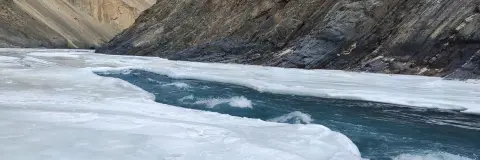
The Chadar Trek is 9 days, Leh to Leh, with about 60 km on foot, mostly on the frozen Zanskar River. Trekkaro runs it only in January and February. Days on the ice are -5°C to 0°C and nights -15°C to -30°C, with Nerak (3,400 m) the coldest camp at about -30°C. The full Free Trekking Gear set offered on other Trekkaro treks does not apply here, so most of your kit is your own.
| Item | Who brings it |
|---|---|
| Microspikes and gaiters | Trekkaro, free, with no deposit and no charge |
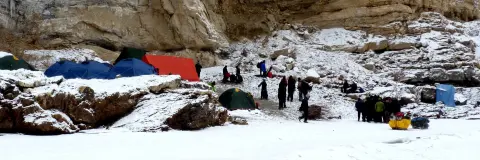
| Tents (shared by 3, men and women separate) and sub-zero sleeping bags | Trekkaro, for the four nights on the river |
| Ice axes, ropes, first-aid kit, oxygen cylinder, stretcher and radios | Trekkaro, carried with the group |
| Pure vegetarian meals from Day 4 breakfast to Day 8 lunch, and hot water at every camp | Trekkaro |
| Gumboots | You (mandatory) |
| Trekking shoes, jacket and trekking poles | You |
| Warm layers, balaclava, cap and gloves | You |
| Backpack, day pack, bottles, snacks and toiletries | You |
Why are gumboots mandatory on the Chadar?
The frozen river is not one smooth sheet. It has slippery, slushy and fragile sections, and gumboots are mandatory on the ice for that reason. Trekkaro does not provide them: you bring your own pair, along with ordinary trekking shoes. Gaiters and microspikes, which Trekkaro gives free, complete your footwear for the ice.
Your first walk, on Day 4 from Shingra Koma (3,150 m) to Tsomo Paldar (3,200 m), is only 3 km, and its real purpose is to teach you the ice. Keep your knees soft, take short steps and keep your weight over your feet. Change out of damp socks as soon as you reach camp, into the dry spare set you keep sealed in a waterproof bag.
Which clothes go in your Chadar bag?
Plan five warm layers: two sets of thermal inners, two fleece or woollen layers and a padded or down jacket, with a windproof, waterproof outer layer over them. Wear two pairs of trek pants over your thermals on the ice, never jeans. Add a balaclava, a woollen cap, and two kinds of gloves, fleece plus waterproof. Keep one dry spare set of clothes sealed in a waterproof bag, so you always have something dry to change into at camp.
Keep your gloves dry for the evening. Our Chadar weather guide explains how to stay warm in the tent.
Which documents do you need in Leh?
Paperwork decides whether you reach the river, so pack it first and keep it dry.
| Document | Why you need it |
|---|---|
| Original government photo ID and a photocopy | Needed for permits and registration |
| 2 photographs | For the trek permission |
| Your boarding pass | Required for the trek permission, so keep it after you land |
| Medical certificate signed by a doctor | Every trekker brings one; the form is in My Bookings |
| Passport and visa | For foreign nationals |
Day 3 is the medical check at the Government Medical Camp in Leh, which tests your height, weight, blood pressure and oxygen level. The wait can be 3 to 4 hours. The result decides whether you are medically fit to go onto the river. High-altitude risk insurance, mandatory under ALTOA guidelines, is sorted out that afternoon and is not part of the trek fee.
What cash and which SIM go in your bag?
Leh is the last place with ATMs; there are none on the trail, and cards are not accepted there. Withdraw enough cash in Leh, in small notes, for the Ladakh fees, your meals in Leh and personal expenses. The fees cover the pre-medical check-up, rescue fees, wildlife and environmental charges, the ALTOA NOC and entry fees, and you pay them directly to the authorities at the rates they set. Our Chadar trek cost guide lists what else sits outside the fee.
Leh has the last stable mobile network, and only postpaid SIMs work in Ladakh. Once you leave Leh the signal is scarce or absent, which is why the team uses radios on the river.
What goes in your backpack and day pack?
Take only what you need in a 50 to 60 L backpack. If you offload it to a porter, which costs ₹5,000 plus GST, carry a 20 to 30 L day pack for water, warm layers and snacks. Extra luggage stays safely in Leh while you are on the river.
| Pack this | Why |
|---|---|
| Two 1 L reusable bottles, at least one insulated | The mess tent gives hot water at every camp, so you do not need to buy water |
| ORS sachets | Add to your water to stay hydrated in the cold |
| Dry fruits, energy bars and chocolates | Snacks between camps on the walking days |
| A reusable lunch box | Trekkaro asks every trekker to bring a reusable one |
| Power bank | Keep it in an inner pocket, as batteries drain fast in the cold |
| Biodegradable toiletries, hand sanitiser and waste bags | You carry your waste back off the river |
| Your regular medicines and a basic first-aid kit | Keep them in the bag you carry yourself |
Ladakh Tourism's high-altitude advisory also asks visitors to carry a well-stocked personal first-aid kit, to drink 3 to 4 litres of water a day and to allow at least 48 hours to acclimatise in Leh. Trekkaro's itinerary keeps you in Leh from Day 1 to Day 3 for exactly that, with complete rest on the day you land.
Which small items should you add for the snow and the cold?
The Chadar trek page lists the first four items below; the last three come from our winter trek packing list, written for Trekkaro's Uttarakhand snow treks, and suit the Chadar's cold too. On the Chadar you carry all of them yourself.
| Item | Why it matters |
|---|---|
| UV-protection sunglasses | Snow and ice glare can cause snow blindness |
| Sunscreen (SPF 50+) | For the sun on snow and ice |
| A headlamp with spare batteries | Keep the spare batteries in an inner pocket, as batteries drain fast in the cold |
| 2 pairs of cotton or sports socks and 4 to 5 pairs of woollen socks | Keep a dry pair sealed in your waterproof bag for camp |
| SPF lip balm | Cold, dry air and glare crack the lips |
| A thin liner pair of gloves, in addition to your fleece and waterproof pairs | Keep your gloves dry for the evening |
| A pair of warm fleece or woollen trousers for camp | Change into them when you reach the tent |
What should you leave behind?
Trekkaro's trek leaders name three common mistakes on the Chadar. Trekkers bring plastic water bottles instead of reusable ones, they smoke on the trek even out of sight of the group, and they take off their cap and gloves on the ice for photos. Leave the plastic bottles and cigarettes at home, and keep your cap and gloves on whenever you stop on the ice.
Do not bring wet wipes, as they are not biodegradable. Leave anything you will not use on the river in Leh, so your bag stays light for the ice.
What does the Chadar trek cost?
The fee for the Chadar Trek is ₹25,500 per person plus 5% GST (₹26,775 with GST). EMI starts at ₹1,311 a month. Flights, the airport cab, meals in Leh, the Ladakh fees, the high-altitude insurance and backpack offloading are not included, so budget for them on top of your gear.
See Chadar Trek dates and book | Chadar trek weather | Chadar trek cost
Frequently asked questions
Are gumboots compulsory for the Chadar trek?
Yes. Gumboots are mandatory on the ice because the frozen river has slippery, slushy and fragile sections. You bring your own pair, as Trekkaro does not provide them.
Does Trekkaro give trekking gear on the Chadar trek?
Only microspikes and gaiters, free with no deposit and no charge. You bring your own gumboots, trekking shoes, jacket and trekking poles.
How many warm layers do I need for the Chadar trek?
Five: two sets of thermal inners, two fleece or woollen layers and a padded or down jacket, with a windproof, waterproof outer layer on top. Add a balaclava, a woollen cap and fleece plus waterproof gloves.
What documents do I need for the Chadar trek?
An original government photo ID with a photocopy, 2 photographs, your boarding pass and a medical certificate signed by a doctor. Foreign nationals also need their passport and visa.
Does my phone work on the Chadar trek?
Only postpaid SIMs work in Ladakh, and Leh has the last stable network. On the river the signal is scarce or absent, and the team uses radios; keep your power bank in an inner pocket, as batteries drain fast in the cold.