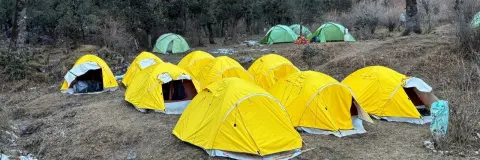
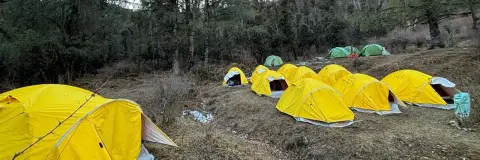
Quick answer: Winter camping in a tent on a Himalayan trek means nights of -15°C to -10°C at camps like Kedarkantha base camp (3,429 m). You stay warm with a -20°C sleeping bag, a sleeping pad, dry thermals and a hot drink before bed. Trekkaro sets up the tents and checks SpO2 twice a day at every campsite.
What is a winter campsite on a Himalayan trek like?
On a guided trek you do not carry or pitch your own tent. Mules or porters carry the group equipment, and the kitchen staff and camp helpers set up camp. You walk in with your backpack, or with only a day pack if you offload it, and sleep in a tent the team has pitched.
A winter camp has sleeping tents shared by three and a mess or dining tent; on Dayara Bugyal, Kuari Pass, Chopta Chandrashila and Gulabikantha these are large mess tents with tables. Toilet tents are set up at the campsites on treks such as Kuari Pass, Nag Tibba and Aancha Top; on Kuari Pass you bring your own toilet paper and hand sanitiser.
| Trek | Winter camps and height | Winter nights at camp |
|---|---|---|
| Kedarkantha | Juda Ka Talab (2,773 m), base camp (3,429 m) | -15°C to -10°C |
| Brahmatal | Bekaltal (2,798 m), base camp (3,106 m) | -10°C to -3°C at Bekaltal, -15°C to -5°C at base camp |
| Kuari Pass | Gulling (2,900 m), Khullara (3,350 m) | -14°C to -8°C |
| Dayara Bugyal | Gui (2,936 m) | -10°C to -2°C |
| Chopta Chandrashila | Deoriatal camp (2,390 m), about 200 m from the lake; Baniyakund (2,610 m) | -10°C to -6°C |
| Gulabikantha | Kandola (2,590 m) | -10°C to -5°C |
| Nag Tibba | Camp near the Nag Devta temple (about 2,300 m) | About -7°C to -2°C |
The figures are the winter range, December to February. The coldest night Trekkaro's trek leaders have recorded is -17°C at Kedarkantha base camp, and -16°C at Gui and at Khullara. On Chadar in Ladakh you camp beside the frozen river for four nights, where nights fall to between -15°C and -30°C and Nerak is the coldest campsite.
What tent and sleeping kit do you get on a winter trek?
The tent and the sleeping bag decide how well you sleep, so it is worth knowing exactly what you get.
- Tents are shared by three trekkers. On Kedarkantha and Brahmatal they are four-person tents shared by only three, and they are double-wall, rain-rated tents.
- Women share tents only with other women. On Kedarkantha and Chopta Chandrashila, couples and families get separate tents as needed.
- On treks such as Kedarkantha, Brahmatal, Dayara Bugyal and Kuari Pass, a single tent is an optional add-on for an extra charge.
- Sleeping bags are rated to -20°C on the Uttarakhand winter treks. On Chadar, tents and sub-zero sleeping bags are provided for the camping nights.
- On Kedarkantha and Brahmatal you sleep on a trekking mattress or sleeping pad, and on Nag Tibba mats are provided.
The pad matters as much as the bag. A sleeping bag keeps the air around you warm, but the frozen ground under the tent pulls heat out of your back all night; the pad is the layer between you and the ground.
How do you stay warm in a tent at night?
A -20°C sleeping bag does most of the work, but how you use it makes the difference between a warm night and a long one.
- Change into dry thermals before you get into the sleeping bag. Keep one set of thermals for sleeping only, because clothes damp from the day's sweat make you colder.
- Eat a full dinner and have something hot, tea or soup, before bed. Your body warms the bag, and it needs food to do it.
- Wear a woollen cap and a dry pair of woollen socks to sleep, and keep the day's damp socks out of the bag.
- Close the hood of the sleeping bag around your face, but keep your mouth and nose outside it. Breathing into the bag fills it with moisture.
- Keep your water bottles, phone and power bank inside the tent, and the next day's gloves inside the sleeping bag, so they are not frozen in the morning.
- Go to the toilet before you settle in, so you do not have to leave the bag in the coldest hours.
If you still feel cold, tell your trek leader rather than waiting for morning. Shivering that does not stop is a warning sign; our guide to hypothermia on a winter trek lists the signs and what to do.
What does an evening at a winter camp look like?
At camp, tea and evening snacks are served after the day's walk, and on Kuari Pass, Chopta Chandrashila and Gulabikantha coffee and soup too. Put on your warm layers before the sun goes down, because the temperature drops quickly once it does.
At camp the trek leader checks every trekker's SpO2 and pulse, twice a day as at every campsite; on Kedarkantha and Brahmatal blood pressure is checked too. Dinner is served in the mess tent. On Kedarkantha the summit-day briefing and dinner come early, because the summit climb starts well before dawn and an early night is part of the plan. Hot water comes from the mess tent at every camp, and you fill your own bottles there.
What should you bring for nights in camp?
You do not need a tent, a sleeping bag or a snow kit of your own on Trekkaro's Uttarakhand winter treks. These are the things that do go in your bag for the nights.
| Item | Why you need it at camp |
|---|---|
| A thermal top and bottom kept for sleeping | A dry layer next to your skin for the night |
| Two fleece or woollen layers | For the evening at camp and the mess tent |
| A woollen cap and a balaclava | For sleeping, and for the summit morning wind |
| Spare woollen socks | A dry pair for the night |
| A headlamp | For the tent at night, and for the Kedarkantha summit climb in the dark |
| Two 1 L water bottles, one insulated | Filled with hot water at camp; the insulated one does not freeze |
| Toilet paper and hand sanitiser | For the toilet tents at camp |
The jacket rated to -10°C, the trekking shoes, poles, gaiters and microspikes come with Trekkaro's Free Trekking Gear. There is no rental fee, only a ₹3,000 refundable deposit and a ₹200 washing charge, and buying the same five items costs about ₹13,395. Our winter trek packing list has the full list, and our guide on how to pack a trekking backpack shows where the night kit goes. Check the forecast for the trek's district on the India Meteorological Department's Dehradun centre before you travel.
What should you check before you book a winter trek?
The camp is where a winter trek is won or lost, so ask about it before you pay. The last column shows what comes with a Trekkaro winter batch.
| What to check | Why it matters | With Trekkaro |
|---|---|---|
| What are the sleeping bags rated for? | A summer bag at a -15°C camp means a sleepless night and a weak next day. | -20°C sleeping bags on the Uttarakhand winter treks; sub-zero bags on Chadar. |
| Is there a mattress or sleeping pad? | Without one, the frozen ground pulls heat out of you all night. | Trekking mattresses or sleeping pads on Kedarkantha and Brahmatal, and mats on Nag Tibba. |
| How are tents shared? | Crowded or mixed tents make a cold night worse. | Three per tent, women only with women; on Kedarkantha and Brahmatal, four-person tents for three. |
| Are there toilet tents at camp? | Without them, nights at a snowy camp are harder for everyone. | Toilet tents at the campsites on treks such as Kuari Pass, Nag Tibba and Aancha Top. |
| Are shoes, a jacket, poles, gaiters and microspikes in the fee? | Without them you buy or rent a snow kit on top of your camp clothes. | Yes, Free Trekking Gear, with a ₹3,000 refundable deposit and a ₹200 washing charge. |
| What does the fee include? | Without a written list, camp fees and meals become extras. | Stays, tents, pure vegetarian meals, permits and the gear kit. On the Kuari Pass trek, for example, the fee is ₹9,400 per person plus 5% GST (₹9,870 with GST). |
| What if you cancel? | Without clear terms, a change of plan can cost the whole fee. | 70% back at 30 or more days, 50% at 15 to 29 days and no cash refund from 14 days; up to 8 days before, a 100% TrekCash voucher, a free reschedule or a transfer instead. |
| Is EMI available? | Without it the full fee is due at booking. | EMI starts at ₹484 a month. |
See Kuari Pass Trek dates and book | Hypothermia on a winter trek | Winter trek packing list
Frequently asked questions
How cold does it get in a tent on a Himalayan winter trek?
Winter nights at camp fall to -15°C to -10°C on Kedarkantha and -14°C to -8°C on Kuari Pass. The coldest reading Trekkaro's trek leaders have recorded at Kedarkantha base camp is -17°C.
Do I need my own sleeping bag for a winter trek?
Not on Trekkaro's Uttarakhand winter treks, where -20°C sleeping bags are provided at camp. On Chadar, tents and sub-zero sleeping bags are provided for the camping nights.
How many people share a tent on a trek?
Three trekkers share each tent, and women share only with other women. On treks such as Kedarkantha, Brahmatal, Dayara Bugyal and Kuari Pass, a single tent is an optional add-on for an extra charge.
Are there toilets at winter campsites?
Toilet tents are set up at the campsites on treks such as Kuari Pass, Nag Tibba and Aancha Top. Bring toilet paper and hand sanitiser, and ask our team about the arrangement on your trek.
What should I look for when choosing a company for a winter trek?
Ask what the sleeping bags are rated for, whether there is a sleeping pad and how tents are shared. Then compare toilet tents, snow gear in the fee, SpO2 checks, cancellation terms and EMI.