This guide is about the Dayara Bugyal Trek — dates, price, day-by-day itinerary and booking are on the trek page.
Quick answer: Pick Dayara Bugyal if you have 4 days: about 20 km to a wide high meadow at 3,749 m, from Raithal in Uttarkashi. Pick Kuari Pass if you have 6 days and want the bigger walk: about 35 km to a 3,815 m pass facing Nanda Devi and Kamet, from Pipalkoti. Both are Easy to Moderate, from age 8.
How do Kuari Pass and Dayara Bugyal compare?
The Kuari Pass Trek and the Dayara Bugyal Trek are both winter snow treks in Uttarakhand with the same grade, the same minimum age and summit tops within 66 m of each other. The difference is in length, setting and the mountains you see.
| Fact | Kuari Pass | Dayara Bugyal |
|---|---|---|
| Grade | Easy to Moderate | Easy to Moderate |
| Days | 6 (Pipalkoti to Pipalkoti) | 4 (Raithal to Raithal) |
| Distance on foot | About 35 km over four walking days | About 20 km over three walking days |
| Highest point | Kuari Pass, 3,815 m / 12,516 ft | Dayara Top, 3,749 m / 12,300 ft |
| Highest camp | Khullara, 3,350 m (two nights) | Gui, 2,936 m (two nights) |
| Summit day | 13 km, 8 to 9 hours | 10 km, 8 to 9 hours |
| Base and district | Pipalkoti (1,883 m), Chamoli | Raithal (2,256 m), Uttarkashi |
| Drive to the base | About 215 km from Rishikesh, about 9 hours | About 180 km from Dehradun, 8 to 9 hours |
| Season | October to April | September to June |
| Minimum age | 8 | 8 |
| Fee with GST | ₹9,870 | ₹8,190 |
Which trek asks more of your legs?
Dayara is the shorter and lower trek. Day 2 is 5 km from Raithal to Gui in 3 to 4 hours, about 680 m up through oak, pine and rhododendron forest. Day 3 is the summit day, 10 km in 8 to 9 hours from Gui to Dayara Top and back, with a steep half hour towards Chilapada and a steeper final climb. Day 4 is 5 km back down to Raithal in 2 to 3 hours. You sleep no higher than 2,936 m. Fit beginners can do it, and some prior trekking experience helps.
Kuari asks for more. You walk 6 km on Day 2 (about 850 m up), 5 km on Day 3 (about 450 m up), the 13 km summit day on Day 4 and 11 km on Day 5, a descent of about 1,300 m. The highest camp is 3,350 m, about 400 m higher than Gui, though the gain is gradual and Day 3 is short to help you adjust. Fit beginners can do it, but they should train for two long days back to back. Our Kuari Pass difficulty guide breaks down each day.
How does snow on the meadow differ from snow on the pass?
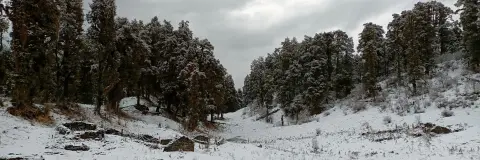
On both treks the trail is under snow from December to March, and on both the snow is deepest in January on the climb from the high camp to the top: Gui to Dayara Top, and Khullara to Kuari Pass. On both, February is the month Trekkaro's trek leaders rate highest, because the snow is at its best for walking and the trail is quieter than in the last part of December.
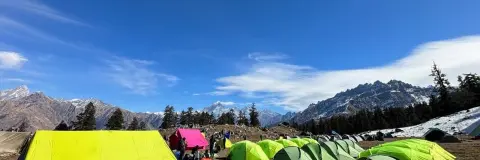
The snow feels different. Dayara is one of the largest high-altitude pastures in India, so in winter you walk out of the forest onto an open snowfield. On Kuari the snow lies on the forest, the meadows near Khullara, a stream that freezes below Khullara Top and the ridge to the pass. Outside winter, Dayara runs until June, while Kuari ends in April.
Which trek has the colder camp nights?
Kuari's camp nights run colder in winter, Dayara's days run colder, and the coldest night the team has recorded is the same on both.
| Winter figure | Kuari Pass (December to February) | Dayara Bugyal (December to March) |
|---|---|---|
| Days | 8°C to 14°C | 4°C to 11°C |
| Camp nights | -14°C to -8°C | -10°C to -2°C |
| Coldest night the team has recorded | -16°C at Khullara | -16°C at Gui |
On both treks Trekkaro gives -20°C sleeping bags, tents shared by three with men and women in separate tents, and Free Trekking Gear: Decathlon trekking shoes, a -10°C jacket, trekking poles, gaiters and microspikes, against a ₹3,000 refundable deposit and a ₹200 washing charge. The team carries ice axes on both, and ropes are not needed on either.
What will you see from the top?
This is the clearest difference. Kuari Pass looks across a 180° arc of 14 peaks, among them Nanda Devi, Kamet, Chaukhamba, Kedarnath, Dronagiri, Trishul and Hathi Ghodi Parvat. Dayara Top gives a 360° view of the Garhwal Himalaya, with Bandarpoonch, Black Peak, Srikanth, Draupadi ka Danda, Jaunli and Bakariya Top.
On both treks groups reach the top between 9 and 10 AM and stay 30 to 45 minutes. Wind on the Kuari ridge can be strong, so pull on a layer at the pass, and on both tops keep your cap and gloves on, even for photos.
Which trek should you choose?
| Choose Kuari Pass if | Choose Dayara Bugyal if |
|---|---|
| You can take 6 days, plus travel to Rishikesh or Dehradun | You have 4 days, plus travel to Dehradun |
| You want a pass with Nanda Devi and Kamet in front of you | You want a huge open meadow and a 360° view |
| You are fit for a 13 km summit day and an 11 km descent the next day | You want a 10 km summit day and short days either side |
| You can handle camp nights of -14°C to -8°C | You prefer milder nights of -10°C to -2°C |
| You are going between October and April | You are going between September and June |
If Kedarkantha is also on your list, our Dayara Bugyal vs Kedarkantha comparison covers that choice.
How do the costs and logistics compare?
The Kuari Pass fee is ₹9,400 per person plus 5% GST (₹9,870 with GST), and the Dayara Bugyal fee is ₹7,800 per person plus 5% GST (₹8,190 with GST), a difference of ₹1,680 for a trek two days longer. Meals are pure vegetarian on both: from Day 1 dinner to Day 5 dinner on Kuari, and from Day 1 dinner to Day 4 breakfast on Dayara. Kuari's fee also covers the 15 km cab between Pipalkoti and Dhak on Days 2 and 5.
Transport to the base is not included on either trek. We help the group book shared cabs at ₹6,500 one way per 5 to 6 seat vehicle, paid directly to the driver and split among trekkers. With six in the cab, the fee, both cab shares and the washing charge come to ₹12,237 for Kuari and ₹10,557 for Dayara.
| Logistics | Kuari Pass | Dayara Bugyal |
|---|---|---|
| Free luggage store | Pipalkoti | Raithal |
| Backpack offloading (optional) | ₹1,800 plus GST | ₹1,000 plus GST |
| Single tent (optional) | ₹2,000 plus GST | ₹2,000 plus GST |
| Cash | No ATM at Pipalkoti; carry cash from Rishikesh or Dehradun | Bhatwari, about an hour before Raithal, has the last reliable ATM |
| Mobile signal | Patchy Jio and BSNL at Pipalkoti | Bhatwari is the last place with a stable signal |
On both treks every trekker brings a medical certificate signed by a doctor (the form is in My Bookings), and travel insurance covering high-altitude trekking and emergency evacuation is mandatory and not included. Check the forecast on the India Meteorological Department's Dehradun centre before you travel; it covers both Chamoli and Uttarkashi districts.
See Kuari Pass Trek dates and book | See Dayara Bugyal Trek dates and book | Brahmatal vs Kuari Pass
Frequently asked questions
Which is easier, Kuari Pass or Dayara Bugyal?
Dayara Bugyal is easier: about 20 km over four days, with the highest camp at 2,936 m. Kuari Pass is about 35 km over six days, with the highest camp at 3,350 m and a 13 km summit day.
Which trek has better snow in winter?
Both are under snow from December to March, with the deepest snow in January on the climb to the top. Dayara gives an open snow meadow, while Kuari gives snow in the forest and on the ridge to the pass.
Which trek has the better mountain view?
Kuari Pass faces 14 peaks including Nanda Devi and Kamet. Dayara Top gives a 360° view of the Garhwal Himalaya with Bandarpoonch, Black Peak and Srikanth.
Can I do Kuari Pass or Dayara Bugyal as my first trek?
Yes, both are graded Easy to Moderate and suit fit beginners from age 8. Dayara is the gentler first trek, while Kuari needs training for two long days back to back.
Which trek is colder?
Kuari Pass has colder winter nights, -14°C to -8°C at camp against -10°C to -2°C on Dayara, but Dayara's winter days are colder, 4°C to 11°C against 8°C to 14°C. The team has recorded -16°C as the coldest night on both treks.