Quick answer: Chaukhamba peak is a massif with four summits in the Garhwal Himalaya, west of Badrinath in Uttarakhand. Its highest summit, Chaukhamba I, is 7,138 m. Trekkers see it reflected in Deoriatal and from Chandrashila on the Chopta Chandrashila trek, and from Gulabikantha and Kuari Pass. A Trekkaro batch includes Free Trekking Gear and SpO2 checks twice a day.
Where is Chaukhamba peak?
Chaukhamba stands in Uttarakhand, west of the town of Badrinath, in the Gangotri group of the Garhwal Himalaya. The Uttarakhand Forest Department's Chaukhamba peak page says it towers above the Gangotri glacier and forms the eastern anchor of the group, with Mana Pass as the key col for Chaukhamba I.
South of the massif lies a protected area. The Wildlife Institute of India describes the Kedarnath Wildlife Sanctuary, in Rudraprayag and Chamoli districts, as bordered in the north by peaks that include Kedarnath (6,940 m), Mandani and Chaukhamba. The Chopta Chandrashila trek walks through that sanctuary, and Chaukhamba appears on its skyline on three days.
How high is Chaukhamba, and how many summits does it have?
Chaukhamba has four summits, named Chaukhamba I, II, III and IV, along a ridge that runs north-east to south-west. Each has a different height, and the Forest Department gives the range as 7,138 m down to 6,854 m.
| Fact | Figure | Source |
|---|---|---|
| Summits | Four: Chaukhamba I, II, III and IV | Uttarakhand Forest Department |
| Height of Chaukhamba I, the highest summit | 7,138 m | Uttarakhand Forest Department |
| Range of the four summits | 7,138 m to 6,854 m | Uttarakhand Forest Department |
| Prominence of Chaukhamba I | 1,594 m (an ultra-prominent peak) | Uttarakhand Forest Department |
| Height given for Chaukhamba on the Kedarnath Wildlife Sanctuary boundary | 7,068 m | Wildlife Institute of India |
So you will see more than one figure for Chaukhamba. The Forest Department's 7,138 m is for Chaukhamba I, the top of the massif. The Wildlife Institute of India gives 7,068 m for Chaukhamba in its description of the sanctuary boundary, without naming a summit. When you compare figures, check which summit each one refers to.
Can you trek to the top of Chaukhamba?
No. Every summit of Chaukhamba is above 6,800 m, and no trek goes to the top. The viewpoints on the treks below are far lower: Deoriatal at 2,390 m, Gulabikantha at 3,658 m, Kuari Pass at 3,815 m and Chandrashila at 3,962 m. Chaukhamba I is more than 3,000 m higher than even Chandrashila, so from each of these points you look across at the massif, not up a trail to it.
Where can you see Chaukhamba on a winter trek?
Chaukhamba is named in the views of several Trekkaro treks, among them Chopta Chandrashila, Gulabikantha and Kuari Pass.
| Trek | Where and when | Height there | The view |
|---|---|---|---|
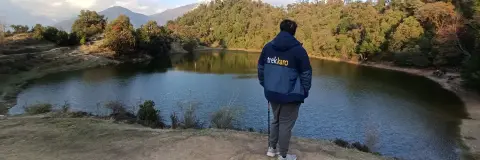
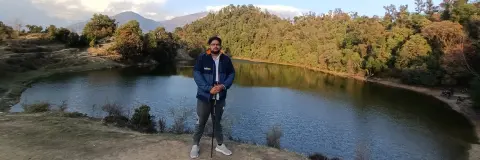
| Chopta Chandrashila | Deoriatal, Day 2 | 2,390 m | On a clear day the lake holds a reflection of the Chaukhamba massif |
| Chopta Chandrashila | Forest route to Baniyakund, Day 3 | 2,390 m to 2,610 m | The Chaukhamba massif and Mount Kedar behind the trees for much of the day |
| Chopta Chandrashila | Chandrashila summit, Day 4 | 3,962 m | A 360° view of Chaukhamba, Kedarnath, Trishul, Bandarpoonch and Nanda Devi |
| Gulabikantha | Gulabikantha summit, Day 3 | 3,658 m | A 360° view of Bandarpoonch, Black Peak, Swargarohini, Kalindi Srikala, Chaukhamba, Draupadi ka Danda and Jorkanden |
| Kuari Pass | Kuari Pass, Day 4 | 3,815 m | A 180° view from the pass that includes Chaukhamba, Nanda Devi and Kedarnath |
Why choose Chopta Chandrashila for Chaukhamba views?
On the Gulabikantha and Kuari Pass treks, Chaukhamba is one peak in the summit view. On the Chopta Chandrashila trek it is in sight on three different days, from three different places.
Day 2: the reflection at Deoriatal
Day 2 is a 3 km walk from Sari (2,012 m) up to Deoriatal at 2,390 m. On a clear day the water holds a reflection of the Chaukhamba massif. You sleep the night in tents set about 200 m from the lake, so you have the evening and the next morning to look for the reflection. Our Deoriatal lake guide covers the walk and the camp.
Day 3: the massif above the forest
Day 3 is the longest day, about 16 km from Deoriatal to Baniyakund across the Rohini Bugyal meadow. As you gain height, the Chaukhamba massif and Mount Kedar rise behind the trees and stay with you through the day. Our guide to Rohini Bugyal describes the meadow in each season.
Day 4: the summit view from Chandrashila
Day 4 is an 11 km day. You drive a short way from Baniyakund to Chopta (2,679 m), climb to Tungnath (3,680 m), then walk about 1 km more to Chandrashila at 3,962 m. From the top, Chaukhamba is one of the snow peaks in a full 360° view.
When is the view of Chaukhamba clearest?
On the Chopta Chandrashila trek, October and November bring clear trails and open views, with days of 10°C to 15°C and nights around 0°C. From December to April snow lies on the higher sections, Rohini Bugyal and the summit, and winter nights from December to February fall to -10°C to -6°C.
Whatever the month, the reflection at Deoriatal needs a clear day, and a night by the lake gives you the evening and the next morning to catch it. On the summit, keep your cap and gloves on, even for photos, because the open top is windy in the morning. Trekkaro runs the trek from October to June; see the trek page for live batch dates.
What should you check before you book a trek for the Chaukhamba view?
The Chaukhamba views on Chopta Chandrashila are spread over a one-way route, a long Day 3 and a summit day through Tungnath, so these are the points to compare. The last column gives Trekkaro's answers.
| What to check | Why it matters | With Trekkaro |
|---|---|---|
| Does the itinerary include a night at Deoriatal? | Without a night there, you get one short stop at the lake and one chance at the reflection. | Yes. Day 2 ends in tents about 200 m from the lake. |
| Does the summit day go on to Chandrashila, not only Tungnath? | Without the last 1 km above Tungnath, you miss the full 360° view. | Yes. Day 4 goes from Chopta past Tungnath to Chandrashila (3,962 m) and back, 11 km. |
| Are snow shoes, a jacket, poles, gaiters and microspikes in the fee? | Without them you rent or buy a snow kit for a summit that is under snow from December to April. | Yes, Free Trekking Gear: Decathlon trekking shoes, a jacket rated to -10°C, poles, gaiters and microspikes. A ₹3,000 refundable deposit and a ₹200 washing charge; buying the kit costs about ₹13,395. |
| Is SpO2 checked at camp? | Without readings before the summit day, a trekker who is not coping with the height starts the climb anyway. | SpO2 and pulse are checked twice a day at every campsite. |
| How many trekkers per trek leader or guide? | With too few leaders, nobody can stay back with a slow walker on the 16 km Day 3. | Up to 20 trekkers per batch, one trek leader or guide for every 8. Leaders are trained in wilderness first aid and lead with local guides. |
| What happens to extra luggage on a one-way route? | A bag left at the start cannot be collected at the finish. | The trek starts at Sari and ends at Baniyakund, so there is no luggage store. Store extra bags in Rishikesh before you travel. |
| What are the cancellation terms? | Without them, a change of plan can cost you the whole fee. | 70% back at 30 or more days, 50% at 15 to 29 days, no cash refund from 14 days; up to 8 days before, a 100% TrekCash voucher (valid 1 year), a free reschedule or a transfer instead. |
| Can you pay in EMI? | Without EMI the full fee is due when you book. | EMI starts at ₹425 a month. |
What does the Chopta Chandrashila trek fee include?
The Chopta Chandrashila trek fee is ₹8,250 per person plus 5% GST (₹8,662.50 with GST). It covers a guesthouse or homestay in Sari on Day 1, 3-person tents near Deoriatal on Day 2 and at Baniyakund on Days 3 and 4 (shared by three, with men and women in separate tents), pure vegetarian meals from Day 1 dinner to Day 4 dinner, all trekking permits and forest camping fees, ice axes with the team and the Free Trekking Gear.
Transport is not included on either leg: Rishikesh to Sari is about 185 km, and Baniyakund back to Rishikesh about 200 km. We help the group book shared cabs at ₹6,500 one way per 5 to 6 seat vehicle, paid directly to the driver and split among the trekkers in it, which is ₹1,083 each when six share. Rudraprayag has the last reliable ATM and Sari the last stable mobile signal. The minimum age is 8. Each trekker brings a medical certificate signed by a doctor (the form is in My Bookings), and travel insurance that covers high-altitude trekking and emergency evacuation is mandatory and not included. Live batch dates and fees are on the Chopta Chandrashila trek page.
See Chopta Chandrashila Trek dates and book | Nanda Devi peak | Trishul peak
Frequently asked questions
How high is Chaukhamba peak?
Chaukhamba I, the highest of its four summits, is 7,138 m, according to the Uttarakhand Forest Department. The four summits range from 7,138 m down to 6,854 m.
Can you see Chaukhamba from Deoriatal?
Yes. On a clear day the lake holds a reflection of the Chaukhamba massif. On the Chopta Chandrashila trek you reach Deoriatal on Day 2 and sleep nearby.
How many summits does Chaukhamba have?
Chaukhamba has four summits, Chaukhamba I to IV, along a ridge that runs north-east to south-west. Each summit has a different height.
Can you see Chaukhamba from Chandrashila?
Yes. The 360° view from Chandrashila, at 3,962 m, includes Chaukhamba with Kedarnath, Trishul, Bandarpoonch and Nanda Devi. You reach the summit on Day 4.
What should I look for when choosing a company for a trek with a Chaukhamba view?
Check that the itinerary includes a night at Deoriatal and a summit day that goes on to Chandrashila, and that Free Trekking Gear is in the fee. Then compare SpO2 checks, a 1:8 ratio, refunds and the plan for extra luggage.