Quick answer: Snow reaches the higher trail above Chopta in December. From January to March it covers Rohini Bugyal, the higher forest and the summit trail to Tungnath and Chandrashila, and it is deepest in January on the summit climb. Patches stay on the higher sections into April. The Wildlife Institute of India gives December to February for heavy snowfall.
How does snow build up through the winter?
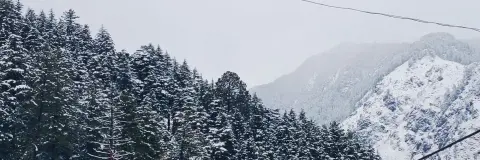
On the route of Trekkaro's Chopta Chandrashila Trek, snow arrives on the higher sections in December, when nights fall to -10°C to -6°C. From January to March it lies as full cover on the meadows, the higher forest and the summit trail. In April only patches remain on the higher sections. How much lies in a given week depends on that winter's snowfall, so treat December as the month snow can arrive and January to March as the months it covers the route. Trekkaro runs the trek from October to June, so the whole snow season falls inside it.
The official record matches the core months. Tungnath lies inside the Kedarnath Wildlife Sanctuary, and the Wildlife Institute of India's page on the Kedarnath Wildlife Sanctuary states that heavy snowfall takes place in the winter months, December to February, in the sanctuary's alpine and temperate regions. For the clear-sky and rhododendron months, see our Chandrashila best-time guide.
Where on the route does the snow lie?
Snow does not sit evenly along the trek. It builds with height, so it matters most on the two walking days above Deoriatal.
| Section | Day | Height | Snow in winter |
|---|---|---|---|
| Rohini Bugyal meadow | Day 3 | Between 2,390 m and 2,610 m | Under full cover from January to March |
| Chopta to Tungnath | Day 4 | 2,679 m to 3,680 m | The forest gives way to alpine slopes, white with snow in winter |
| Tungnath to Chandrashila | Day 4 | 3,680 m to 3,962 m | The steep last 1 km, snow-covered from January to March and deepest in January |
Chopta itself is the road point at 2,679 m (8,790 ft) where summit day starts on foot; the deepest snow on the trek lies above it, on the alpine slopes to Tungnath and on the summit trail. Trekkaro's trek leaders put the deepest snow on the climb from Baniyakund to Chandrashila in January. The camp at Baniyakund is an open meadow with snow peaks behind it; our Baniyakund camp guide explains how it fits into the trek.
What does snow change on Day 3?
Day 3 is about 16 km from Deoriatal to Baniyakund in 7 to 8 hours. In the snow months the open meadow of Rohini Bugyal lies under snow, and the forest ridges after it include steep descents. Keep your poles out on those descents and take a proper break on the meadow, because forest ridges still lie between it and camp.
What does snow change on summit day?
Summit day is 11 km in 8 to 9 hours: a short drive from Baniyakund to Chopta, about 3 to 3.5 km to Tungnath (the temple committee gives 3 km), then about 1 km to Chandrashila, and back. That is about 1,280 m up from Chopta and the same down. The distance stays the same in snow; the pace does not. From January to March snow covers the summit trail, and the steep last 1 km above Tungnath needs the most care, on the way down as much as on the way up.
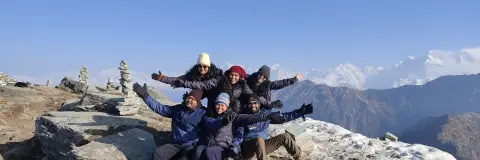
After fresh snowfall the trek team clears the trail, cuts steps where needed and helps trekkers across slippery sections. Ice axes travel with the group; ropes are not used on this trek. Plant your poles and walk in the line your guide sets. Groups reach Chandrashila between 9 and 10 AM and stay 30 to 45 minutes, and the rule at the top is to keep your cap and gloves on, even for photos.
Snow and crowds do not peak together. The trail is busiest in the last part of December, the Christmas and New Year weeks, while February is the month Trekkaro's team rates highest, because the snow is at its best for walking and the trail is quieter.
Is Tungnath temple open when it snows?
No. The Shri Badarinath Kedarnath Temple Committee gives Tungnath's height as 3,680 m and states that the winter puja of Tungnath is performed at Makkumath, 45 km from Ukhimath. In the snow months the temple is shut, so the walk past it is a snow trek rather than a darshan. Trekkaro's batches still walk from Chopta past Tungnath to Chandrashila on summit day in the snow months. Our Tungnath temple guide covers the temple itself.
What do you need for snow on this trek?
Microspikes and gaiters come with Trekkaro's Free Trekking Gear on this trek, against a ₹3,000 refundable deposit and a ₹200 washing charge, so you do not rent them. Sleeping bags are rated to -20°C. Carry reusable water bottles, one of them insulated so the water does not freeze, and warm layers for nights of -10°C to -6°C.
The fee for the Chopta Chandrashila Trek is ₹8,250 per person plus 5% GST (₹8,662.50 with GST). EMI starts at ₹425 a month. Shared cabs are extra at ₹6,500 one way per 5 to 6 seat vehicle, paid directly to the driver and split among trekkers. Every trekker brings a medical certificate signed by a doctor (the form is in My Bookings), and travel insurance covering high-altitude trekking and emergency evacuation is mandatory and not included. The minimum age is 8, with a parent or guardian under 18.
See Chopta Chandrashila Trek dates and book | Chopta and Tungnath weather | Chandrashila trek in December
Frequently asked questions
Which month has the most snow at Chopta and Tungnath?
January has the deepest snow, above all on the climb from Baniyakund to Chandrashila. Snow covers the meadows, forest and summit trail from January to March.
Is there snow at Chopta in December?
Snow reaches the higher sections above Chopta in December. How much lies on the trail depends on that winter's snowfall, so early December can still be patchy.
Is there snow at Tungnath in April?
Patches of snow can stay on the higher sections in April. The full cover lasts from January to March.
Is Tungnath temple open in winter?
No. The temple is closed in the snow months, and the winter puja of Tungnath is performed at Makkumath, 45 km from Ukhimath.
Do I need microspikes for Tungnath in the snow months?
Yes. Microspikes and gaiters come with the Free Trekking Gear on this trek, so you have them without renting.