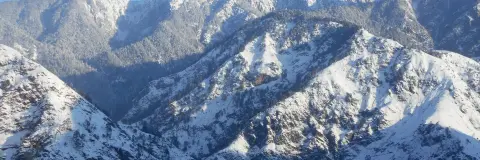
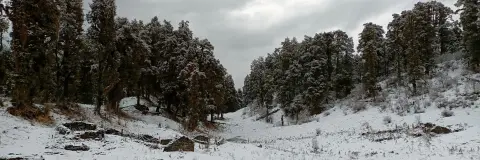
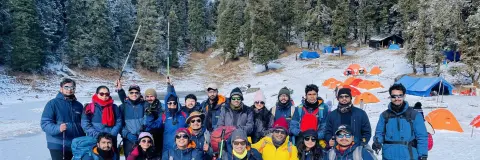
This guide is about the Chopta Chandrashila Trek — dates, price, day-by-day itinerary and booking are on the trek page.
Quick answer: Kedarkantha vs Chandrashila comes down to snow against season length. Chandrashila is higher (3,962 m against 3,810 m) and graded Moderate, with about 30 km in 5 days past a lake and a temple. Kedarkantha is Easy–Moderate, about 20 km, colder and snowier in winter. Pick Kedarkantha for deep snow, Chandrashila for variety and milder nights.
Trekkaro runs both. The Kedarkantha trek runs Sankri to Sankri from a Dehradun pickup; the Chopta Chandrashila trek runs from Sari past Deoriatal and Tungnath to Baniyakund, from a Rishikesh pickup.
How do Kedarkantha and Chandrashila compare in one table?
| Point | Kedarkantha | Chopta Chandrashila |
|---|---|---|
| Days | 5 | 5 |
| Distance on foot | About 20 km over 4 walking days | About 30 km over 3 walking days (3, 16 and 11 km) |
| Highest point | 3,810 m / 12,500 ft | 3,962 m / 13,000 ft |
| Highest night | Base Camp, 3,429 m | Baniyakund, 2,610 m |
| Grade | Easy–Moderate | Moderate |
| Walking starts and ends | Sankri (1,950 m) to Sankri | Sari (2,012 m) to Baniyakund |
| Season | September to April | October to June |
| Camp nights, December–February | -15°C to -10°C | -10°C to -6°C |
| Summit day | 2:00 AM start from Base Camp; about 9 km, 8–9 hours | Short drive to Chopta, then about 11 km, 8–9 hours |
| Minimum age | 8 | 8 |
| Trek fee | ₹9,000 per person plus 5% GST (₹9,450 with GST) | ₹8,250 per person plus 5% GST (₹8,662.50 with GST) |
Which summit is higher, and which trek is harder?
Chandrashila is 152 m higher, and its trek is the harder one because of the walking. Day 3 is about 16 km of rolling forest with steep descents. Day 4 follows straight after. From Chopta (2,679 m) you climb about 1,000 m on a long, steady path to Tungnath temple (3,680 m), about 3 to 3.5 km (the temple committee gives 3 km). Then comes about 1 km of steep ground, gaining about 280 m, to the summit. In all, summit day climbs about 1,280 m on foot.
Kedarkantha spreads its climbing over short days: 4 km to Juda Ka Talab, then 3 km to Base Camp. Its hard part is the night. You leave Base Camp at 2:00 AM, climb about 380 m by headlamp, on steep snow in winter, reach the top around 5:30 to 5:45 AM and stay about 30 minutes for sunrise. Then you walk down past Base Camp to Juda Ka Talab, about 1,037 m below the summit. Trekkaro’s trek leaders rate that pre-dawn climb, at about -15°C to -20°C, as the hardest part of the trek.
On Kedarkantha you sleep one night at 3,429 m. On Chandrashila you never sleep above 2,610 m and spend only the hours of summit day above 3,000 m. Kedarkantha asks that you can walk briskly for 4–5 hours; Chandrashila sets walking 4–5 km a day with a small backpack as the minimum, with 6–8 weeks of preparation. Our Tungnath and Chandrashila difficulty guide breaks the Chopta climb down section by section.
What do you see from each top?
From Kedarkantha the 360-degree view takes in Swargarohini, Bandarpunch, Black Peak, Kalanag, Ranglana and the distant Kedarnath range. From Chandrashila the circle holds Nanda Devi, Trishul, Chaukhamba, Bandarpunch and the Kedarnath peaks.
So the two tops share Bandarpunch and the Kedarnath peaks. Kedarkantha adds Swargarohini and Black Peak; Chandrashila adds Nanda Devi, Trishul and Chaukhamba.
Which is better in each month?
The two seasons overlap from October to April only. Kedarkantha has no batches May to August; Chandrashila has none July to September.
| Month | Kedarkantha | Chopta Chandrashila |
|---|---|---|
| September | Clear trail after the monsoon; nights -8°C to -2°C | No batches |
| October | Clear trail, first snow on the high peaks | Clear skies, Chaukhamba in Deoriatal; nights around 0°C |
| November | Early snow on the upper trail possible | Clear summit views; colder towards December |
| December | Deep snow, a little milder than January | Snow can reach the higher sections |
| January | Heaviest snowfall, deepest at Base Camp; Juda Ka Talab frozen | Snow over meadows, forest trail and summit slopes |
| February | Deep snow, heaviest in the early weeks; the month Trekkaro’s trek leaders rate highest | Full winter trek |
| March | Upper-trail snow, clear skies; nights -6°C to -2°C | Snow cover continues; nights around 0°C |
| April | Upper-trail snow, rhododendrons; afternoon cloud possible | Rhododendrons; snow patches can stay on the summit |
| May and June | No batches | Nights 3°C to 8°C; rhododendrons in May |
For deep snow, Kedarkantha in January or February is the stronger pick, with Base Camp down to -17°C on the coldest nights. For a white summit with milder camp nights, choose Chandrashila from January to March. More month detail is in our Kedarkantha best time and Chandrashila best time guides.
Lake and temple, or forest and frozen lake: how do the camps differ?
Chandrashila changes setting every night. Night one is a guesthouse or homestay at Sari. Night two is a tent camp about 200 m from Deoriatal (2,390 m). Nights three and four are at Baniyakund (2,610 m), an open meadow where the sun drops behind snow peaks. Tungnath, one of the Panch Kedar, sits on the summit route, so temple and summit come on the same morning.
Kedarkantha stays in forest and meadow. After a guesthouse night in Sankri you camp twice at Juda Ka Talab (2,773 m), by the lake that freezes solid in winter, and once at Base Camp (3,429 m) on open slopes that lie under snow in winter.
Both use tents shared by three, men and women separate, with -20°C sleeping bags and pure vegetarian food. Meals run to Day 5 breakfast on Kedarkantha and to Day 4 dinner on Chandrashila.
How do you reach each one?
For Kedarkantha, the shared cab leaves Dehradun Railway Station at 6:30 AM for Sankri, about 200 km and 8–9 hours along the Tons River gorge.
For Chandrashila, the cab leaves Jumping Heights, Tapovan (Rishikesh) at 7:00 AM for Sari, about 185 km and 8–9 hours via Devprayag, Srinagar and Rudraprayag. On Day 5 it leaves Baniyakund at 6:30 AM and reaches Tapovan by about 5:00 PM.
Jolly Grant Airport is about 25 km from Dehradun city and about 45 minutes from Rishikesh, so it serves both; fly in the day before. The last reliable ATM is Purola for Kedarkantha and Rudraprayag for Chandrashila, and cards are not accepted on either trail.
What does each trek cost from your pickup city?
The Kedarkantha trek fee is ₹9,000 per person plus 5% GST (₹9,450 with GST). The Chopta Chandrashila trek fee is ₹8,250 per person plus 5% GST (₹8,662.50 with GST). With GST, Kedarkantha costs ₹787.50 more.
Transport is not included: we help the group book shared cabs, paid directly to the driver. The Dehradun–Sankri cab is ₹1,000 per person each way, so Kedarkantha from Dehradun comes to ₹11,450 with the return cab. The Rishikesh cab is about ₹6,500 per 5–6 seat vehicle each way, split among trekkers, so Chandrashila from Rishikesh comes to about ₹10,829 with six in the cab, or ₹11,262.50 with five.
Both include Free Trekking Gear (Decathlon trekking shoes, a -10°C jacket, poles, gaiters and microspikes) against a ₹3,000 refundable deposit and a ₹200 washing charge. Backpack offloading is ₹1,500 + 5% GST on Kedarkantha and ₹1,000 + 5% GST on Chandrashila. Travel insurance covering high-altitude trekking and evacuation is mandatory and not included on both.
So which should you choose?
Pick Kedarkantha if you want deeper snow and a sunrise summit, and you can face a 2:00 AM start in the cold. It also fits if your dates fall in September, if Dehradun is easier to reach, or if you want the gentler grade for a first Himalayan trek.
Pick Chandrashila if you want more in five days: a lake camp, a meadow, Tungnath temple and the higher summit. It also fits if you want milder winter nights, would rather sleep below 2,700 m, or can only travel in May or June. Train for the 16 km forest day and the 1,280 m summit climb back to back.
See Kedarkantha trek dates and book | See Chopta Chandrashila trek dates and book | Kedarkantha vs Brahmatal | Chandrashila distance and height
Frequently asked questions
Is Kedarkantha or Chandrashila better for beginners?
Kedarkantha is graded Easy–Moderate with shorter walking days, so it is the gentler first trek. Chandrashila is graded Moderate for its 16 km forest day and steep last kilometre, but fit beginners who train for 6–8 weeks can do it.
Which is colder, Kedarkantha or Chandrashila?
Kedarkantha. From December to February its camp nights fall to -15°C to -10°C, against -10°C to -6°C on Chandrashila.
Is Kedarkantha vs Tungnath the same comparison?
Nearly. Tungnath is a temple, not a separate trek: Tungnath temple (3,680 m) is on the way to Chandrashila summit (3,962 m), and both come on Day 4 of the Chopta Chandrashila trek. Kedarkantha (3,810 m) is higher than Tungnath but lower than Chandrashila.
Can I do Kedarkantha or Chandrashila in May?
Only Chandrashila. It runs through May and June, with rhododendrons in May and nights of 3°C to 8°C. Kedarkantha has no batches from May to August.
Do I need to bring my own microspikes for either trek?
No. Microspikes and gaiters come with Free Trekking Gear on both treks. On Kedarkantha ropes are not needed either, as the team clears the trail after fresh snow.