This guide is about the Kedarkantha Trek — dates, price, day-by-day itinerary and booking are on the trek page.
Quick answer: The Kedarkantha trek packing list is short because Trekkaro’s Free Trekking Gear covers five items you would otherwise buy: trekking shoes, a -10°C jacket, trekking poles, gaiters and microspikes, for a ₹3,000 refundable deposit and a ₹200 washing charge. You bring 5 warm layers, a 50–60 L backpack, a headlamp, two 1 L bottles and your documents.
Kedarkantha is a snow trek whose summit climb starts at 2:00 AM, so grip, warmth and light decide how your five days feel. This list is built from the gear, clothing and document sections of the Kedarkantha trek page and its inclusions and exclusions. General layering theory is in the winter trek packing list for the Himalayas; this article covers only Kedarkantha.
What does Trekkaro give you free on Kedarkantha, and what do you pay?
Free Trekking Gear on Kedarkantha means Decathlon trekking shoes, a Decathlon jacket rated to -10°C, trekking poles, gaiters and microspikes. There is no rental fee. You pay one refundable deposit of ₹3,000 and a washing charge of ₹200, and that single deposit covers the whole kit. The gear is handed over on Day 1 at the gear check in Sankri.
Your own broken-in, waterproof pair with ankle support is welcome instead; shoes for snow trekking helps you decide, and microspikes for winter treks covers how the spikes go on.
What do you not need to buy for Kedarkantha?
Because of Free Trekking Gear, five items that fill most “what to carry” lists come off yours; what stays is what the exclusions call personal equipment.
- You do not need to buy or rent trekking shoes, because Decathlon trekking shoes are in the free kit.
- You do not need a padded jacket, because the -10°C jacket is your main warm layer at camp and on the summit.
- You do not need trekking poles, which the page calls a real help on the snowy descent.
- You do not need microspikes or gaiters, which are issued for snow and ice.
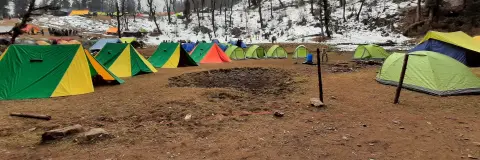
- You do not need a sleeping bag, tent or mat, because -20°C sleeping bags, double-wall tents and mattresses are at every campsite, with tents shared by three.
Which clothes should you pack, and why five layers?
The trek page gives winter days of -2°C to 8°C and camp nights of -15°C to -10°C. That gap is why it asks for 5 warm layers: a thermal top and bottom, 2 fleece or woollen layers and a padded jacket. The padded jacket is the free one, so you pack the other four.
| Clothing item | How many | Why it is on the Kedarkantha list |
|---|---|---|
| Thermal inners, top and bottom | 2 sets, merino or synthetic | One set stays dry for sleeping. |
| Fleece jackets or woollen sweaters | 2, of 200–300 gsm fleece | Mid layers for camp and rest stops. |
| Waterproof, windproof jacket or poncho | 1 | The outer shell for snowfall, wet snow and summit-day wind. |
| Trek pants, quick-dry | 2, no jeans | Waterproof or snow pants help on the summit and snowfields. |
| Warm trousers, fleece or woollen | 1 | For camp. |
| Quick-dry collared T-shirts, full sleeves | 3 | Worn under the layers. |
| Socks | 3–4 pairs | Cotton or sports socks for walking, woollen for camp and night. |
| Spare warm set in a dry bag | 1 | Kept dry inside the backpack for emergencies. |
Which gear and accessories go in your backpack?
The page sets the backpack at 50–60 L with a rain cover, plus a 20–30 L day pack if you offload, which also carries water, snacks and a spare layer on summit day.
- A headlamp with spare batteries is essential, because the summit climb begins at 2:00 AM.
- Carry two 1 L water bottles, one insulated so your water does not freeze, and a reusable lunch box for the packed lunch.
- Carry a woollen cap that covers the ears, a balaclava for the pre-dawn wind chill, a buff, and a fleece pair of gloves with a waterproof outer pair for snow.
- Carry UV sunglasses of category 3 or 4 and a sun cap, because snow glare above 9,000 ft can cause snow blindness, plus SPF 50+ sunscreen and lip balm.
- Pack a quick-dry towel, biodegradable soap and no wet wipes, with Ziploc or dry bags for electronics, documents and wet clothes.
- Keep a power bank close to your body, because there is no charging on the trail and cold drains batteries fast, and download an offline map before you leave.
What changes by season on the Kedarkantha packing list?
Trekkaro runs Kedarkantha from September to April in three temperature bands. The core list does not change, but how hard each item works does.
| Season | Day and night temperature | Trail and snow | What to adjust |
|---|---|---|---|
| September to November | Day 5°C to 18°C, night -8°C to -2°C | Clear trail; first snow on the peaks from October; early snowfall can reach the upper trail in November. | All 5 layers for the nights, fewer on the walk; sun cap and sunscreen earn their place. |
| December to February | Day -2°C to 8°C, night -15°C to -10°C | Deep snow from the forest above Sankri to the summit; Juda Ka Talab freezes; snow is deepest in January on the climb from the base camp to the summit. | Every layer in use; the insulated bottle, balaclava, waterproof gloves, microspikes and gaiters matter most. Busiest from 20 to 31 December. |
| March to April | Day 5°C to 15°C, night -6°C to -2°C | Partial snow on the upper sections; clear lower forest trail; rhododendrons in bloom. | Nights stay below freezing, so thermals and both fleeces stay; the shell handles April afternoon cloud. |
Trekkaro’s trek leaders rate February the highest of the winter months, while January carries the heaviest snow on the summit climb. The gear and the deposit are the same in every month. Before you travel, check the forecast on the IMD Dehradun page.
How do bags, offloading and the Sankri luggage store work?
Luggage you do not need can stay in Trekkaro’s store in Sankri free of charge until you return; jewellery, laptops, wallets, cash and documents stay with you, and the stored bag is kept at your own risk. Pack it into one closed bag.
Backpack offloading is optional, with a porter or mule carrying your main backpack, up to 9 kg and never a suitcase, trolley or duffel bag. Tell Trekkaro at least 15 days in advance, because charges may be higher for last-minute requests at Sankri; the price is under exclusions on the trek page.
What about water, food and waste on the trail?
Water at camp is boiled or treated with chlorine tablets, and hot water comes from the mess tent, which is why the list asks for two reusable 1 L bottles rather than anything you buy and throw away. Meals are pure vegetarian with a packed lunch on the trail, but carry trail mix, energy bars and ORS, plus a personal medical kit with your regular medicines and blister plasters. Trekkaro follows a zero-waste policy inside Govind Pashu Vihar National Park, so every wrapper goes back out in the Swachh Bharat waste bag.
Which documents and small items do you need?
Carry a government photo ID in original and photocopy (Aadhaar card, passport, voter ID or driving licence); international trekkers need a passport. Every trekker brings a medical certificate signed by a doctor, and the form is in My Bookings. Travel insurance covering high-altitude trekking and helicopter evacuation is mandatory and not included; carry the policy, the signed disclaimer form and your booking confirmation.
Cash goes on the list in small notes, because cards are not accepted on the trail and Purola has the last reliable ATM before Sankri. Withdraw in Dehradun, including the shared cab fare of ₹1,000 per person each way, paid directly to the driver. ₹9,000 per person plus 5% GST (₹9,450 with GST) EMI starts at ₹463 a month.
See Kedarkantha trek dates and book | Rent or buy trekking gear? Real cost for a Himalayan trek | Kedarkantha trek cost: fee with GST, cab and full budget
Frequently asked questions
Do I need to buy trekking shoes for the Kedarkantha trek?
No. Decathlon trekking shoes are part of Trekkaro’s Free Trekking Gear on Kedarkantha, covered by the single ₹3,000 refundable deposit and ₹200 washing charge. Your own broken-in, waterproof pair with ankle support is welcome too.
What clothes should I carry for Kedarkantha in winter?
Carry 5 warm layers: a thermal top and bottom, 2 fleece or woollen layers and a padded jacket, of which the -10°C jacket is provided free. Add a waterproof shell, two quick-dry trek pants, warm trousers for camp, three full-sleeve T-shirts and 3–4 pairs of socks.
Is gear rental available for Kedarkantha, and what does it cost?
You do not need to rent, because shoes, the jacket, poles, gaiters and microspikes come with Free Trekking Gear at no rental fee. You pay a refundable deposit of ₹3,000 and a ₹200 washing charge, and collect the kit at the gear check in Sankri on Day 1.
How big should my backpack be for the Kedarkantha trek?
The trek page asks for a 50–60 L backpack with a rain cover. If you offload it, the limit is 9 kg in a backpack, not a suitcase, and you carry a 20–30 L day pack for water, snacks and a spare layer.
Do I need to carry a sleeping bag or tent for the Kedarkantha trek?
No. Sleeping bags rated to -20°C, double-wall tents and trekking mattresses or sleeping pads are at every campsite, with tents shared by three trekkers and men and women in separate tents. You carry your clothes, backpack and personal items only.