.webp)
Quick answer: January is Kedarkantha at its most wintry. It usually has the deepest snow of the season, frozen Juda Ka Talab, and the coldest nights: about -10°C to -15°C at camp, with days around -2°C to 5°C. It is still very doable for beginners with good layers and six weeks of training. Avoid the Republic Day long weekend if you want quiet campsites.
If you have ever seen a photo of Kedarkantha with pine trees bent under snow and a trail that is just a white groove through the forest, there is a good chance it was taken in January. This is the month people picture when they say "snow trek". It is also the month that asks the most of you, so it pays to know what you are signing up for.
Why January is the snowiest month
By January, the snow that started falling in December has piled up, and fresh snowfall keeps adding to it. The forest sections between Sankri and Juda Ka Talab are usually snow-covered, the lake freezes solid, and the meadows above the treeline become one smooth white slope up to the summit.
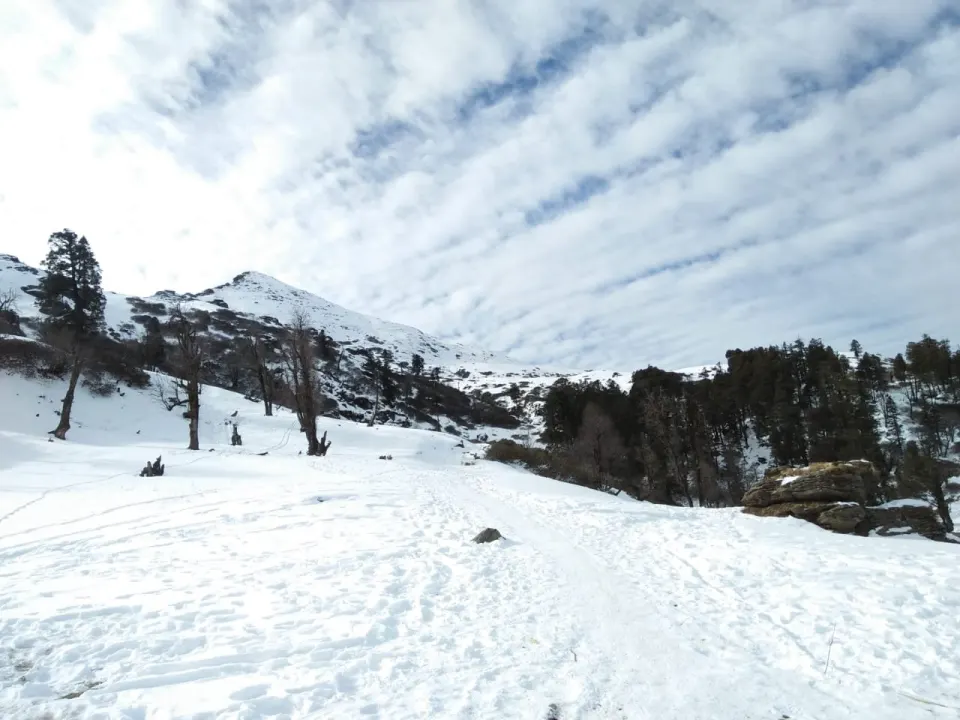
As always in the mountains, every year is different. Some Januaries bring heavy snow early in the month, others later. But if snow is your top priority, January gives you the best odds of the whole season.
How cold does it really get?
| Where and when | Typical temperature in January |
|---|---|
| Trail, during the day | About -2°C to 5°C (feels warmer in the sun) |
| Juda Ka Talab and base camp, at night | About -10°C to -15°C |
| Summit push, 2–6 AM | The coldest part of the trek, with wind chill |
The number that matters most is not the lowest temperature; it is how warm you stay at camp after sunset. That comes down to three things:
- Layers, not one big jacket: two thermal sets, a fleece, an insulated jacket and a waterproof shell. Our winter trek packing list covers exactly what to bring.
- A dry set for the night: keep one pair of socks and one thermal set only for sleeping.
- A proper sleeping bag: on Trekkaro batches you sleep in -20°C rated bags, so the bag is not your weak point.
Summit day in January
Summit day is where January feels different from December. You leave base camp around 2 AM in deep, hard snow, often on a trail freshly packed by the group ahead. Microspikes are essential on the steeper upper section; they are part of Trekkaro's Free Trekking Gear, along with gaiters to keep snow out of your shoes.
The reward is the sharpest summit view of the year. Cold, dry January air makes Swargarohini, Bandarpunch, Black Peak and the Kedarnath range look close enough to touch at sunrise.
A word on safety: after very heavy fresh snowfall, the trek leader may delay the start, take a different line, or turn the group around below the top. It is frustrating, but it is the right call, and it is exactly why you go with a team that carries oxygen, checks everyone's SpO2 twice a day and knows the mountain in winter.
Is January too hard for a first-time trekker?
No, but it is the version of Kedarkantha that rewards preparation most. Walking in snow uses more energy than walking on a dry trail, and the cold makes everything feel slower. If you:
- train for about six weeks (running, cycling or stair climbing, four to five days a week),
- can jog 3–5 km comfortably, and
- bring the right layers,
then January is a fantastic first snow trek. If you are unsure about your fitness or hate the cold, December or late February are gentler options with snow still on top.
Crowds and dates in January
- 1–4 January: the tail end of the New Year rush. Busy.
- 5–22 January: the quietest stretch of the deep-snow season. Our favourite window.
- Republic Day weekend (around 26 January): busy again with long-weekend groups. Book early if you need these dates.
- Last days of January: quieter again.
Trekkaro runs Kedarkantha batches almost every day through January, so you can pick a mid-week start and avoid the busiest campsites.
Five January-specific tips
- Arrive in Dehradun the evening before, and do not plan a same-day connection. Winter roads can be slow.
- Keep water from freezing: use an insulated bottle, and keep it inside your sleeping bag at night.
- Keep batteries warm: phone and power bank in an inside pocket by day, and in your sleeping bag at night.
- Wear sunglasses on the snow, even on cloudy days. Snow blindness is real at this altitude.
- Tell your trek leader early if you feel unwell. A headache at 11,000 ft is information they need, not a weakness.
January or December?
Choose January for the deepest snow and the most dramatic winter scenery, if you are fit and comfortable with real cold. Choose December for slightly milder nights, very clear skies and, outside Christmas week, quieter trails. Both are excellent; January is simply the more intense version.
Not set on Kedarkantha? Compare it with Brahmatal, which is also superb in January.
See Kedarkantha January dates and price
Frequently asked questions
Is there snow on Kedarkantha in January?
Yes. January usually has the deepest snow of the season on Kedarkantha, from the forest above Sankri all the way to the summit. Exact snow depth varies from year to year.
How cold is Kedarkantha in January?
Days are about -2°C to 5°C, and nights at camp drop to about -10°C to -15°C. The pre-dawn summit climb is the coldest part of the trek.
Can beginners do Kedarkantha in January?
Yes, if they train for about six weeks and bring proper layers. January is harder than December because of deeper snow and colder nights, but it is still graded Easy–Moderate.
Is Kedarkantha crowded in January?
It is busy on 1–4 January and over the Republic Day long weekend. The period from about 5 to 22 January is usually the quietest time for deep snow.
What gear do I need for Kedarkantha in January?
Waterproof trekking shoes, a -10°C jacket, poles, gaiters and microspikes are essential, and all are free with Trekkaro. Bring your own thermals, fleece, waterproof outer layers, woollen socks, gloves and a balaclava.