This guide is about the Kedarkantha Trek — dates, price, day-by-day itinerary and booking are on the trek page.
Quick answer: The Kedarkantha snow update below is the latest report from Trekkaro's team in Sankri. It shows the posting date and the lowest point where snow lies on the trail: Sankri (1,950 m), Juda Ka Talab (2,773 m), Base Camp (3,429 m), near the 3,810 m summit, or none. From December to February snow lies along the whole trail.
What is the latest snow on Kedarkantha?
Latest snow report from Trekkaro's Sankri team
No fresh snow report is posted right now. The team posts one here when the snow on the trail changes during the snow months. For what to expect in each month, see Kedarkantha snowfall time.
Trekkaro runs the 5-day Kedarkantha trek from Sankri to Sankri, from September to April. A month guide gives you the snow pattern, but not the snow on the ground on a given day. This page carries the latest report from Sankri and explains what each snow level means for your 4 trekking days.
The report comes from Trekkaro's team in Sankri, the village at 1,950 m where the trek starts and ends, and it names the lowest point where snow lies on the trail. When the box says no fresh report is posted, the month guides linked below give the snow pattern.
What does each snow level in the report mean for your trek?
The report names one of five levels. Each level is the lowest point where snow lies on the trail, and everything higher on the route carries snow too. Find your level and read across the row to see which days you walk on snow.
| Snow on the trail | Snow starts at | Day 2: Sankri to Juda Ka Talab | Day 3: to Base Camp | Day 4: summit day | What you use |
|---|---|---|---|---|---|
| No snow on the trail | Not on the path; snow can show on the high peaks | Forest trail on dry ground | Meadows (bugyals) on dry ground | Headlamp climb on dry ground | Trekking shoes and poles; the leader tells you if microspikes are needed |
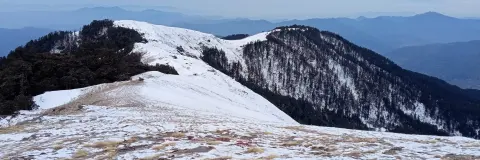
| Snow only near the summit | Below the 3,810 m top | Clear forest trail | Clear up to Base Camp | The upper slope to the top is on snow | Microspikes for the summit climb |
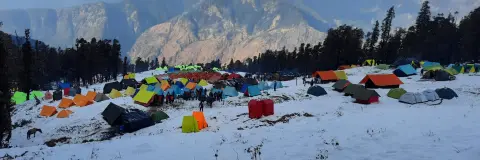
| Snow from Kedarkantha Base Camp (3,429 m) up | 3,429 m / 11,250 ft | Clear forest trail | Clear meadows; you camp at Base Camp on snow | The whole climb from Base Camp is on snow, steep in places | Gaiters and microspikes on summit day |
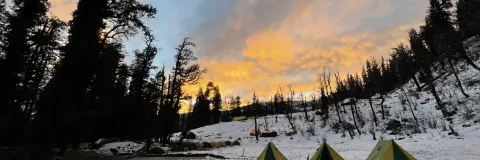
| Snow from Juda Ka Talab (2,773 m) up | 2,773 m / 9,100 ft | Clear in the lower forest, snow as you reach the lake; you camp on snow | The meadows are on snow all the way | Snow from Base Camp to the top and back down to Juda Ka Talab | Gaiters on the snow sections; microspikes on summit day |
| Snow from Sankri (1,950 m) up | 1,950 m / 6,400 ft | The forest trail is on snow from the first km | Meadows under snow | Snow for the whole day, the deep-winter pattern of December to February | Gaiters from Day 2; microspikes on summit day |
At any level with snow, the trek team clears the trail after fresh snowfall so it is easier to walk, and helps you across slippery sections; ropes are not needed on Kedarkantha. Microspikes, gaiters, Decathlon trekking shoes, a -10°C jacket and trekking poles come with Free Trekking Gear, so you do not buy or rent snow gear for any level.
The lower the snow starts, the more of the trek you walk on it. Walking in snow takes more effort than a dry trail, so the fitness to walk briskly for 4–5 hours matters most when the report shows snow from Juda Ka Talab or Sankri.
Which camps does the report cover, and how high are they?
The five levels follow the four points of the route, from the roadhead to the top.
| Point on the route | Height | Distance from the point below | When you are there |
|---|---|---|---|
| Sankri | 1,950 m / 6,400 ft | About 200 km by road from Dehradun | Night of Day 1; trek starts on Day 2 and ends on Day 5 |
| Juda Ka Talab | 2,773 m / 9,100 ft | 4 km from Sankri, 4–5 hours | Nights of Day 2 and Day 4 |
| Kedarkantha Base Camp | 3,429 m / 11,250 ft | 3 km from Juda Ka Talab, 2–3 hours | Night of Day 3 |
| Kedarkantha Summit | 3,810 m / 12,500 ft | About 3 km from Base Camp | Sunrise on Day 4, after a 2:00 AM start |
Snow reaches Kedarkantha from the top down. First snow shows on the high peaks, early snow can then reach the upper trail, and in spring the snow melts from the lower slopes first while the summit stays white. So one point is enough to describe the whole trail: the lowest place where snow lies tells you the day you first step onto it, and every point above it has snow as well.
Summit day covers about 9 km in 8–9 hours. You climb from Base Camp to the top, come back through Base Camp and walk down to Juda Ka Talab, so a report of snow from Base Camp up means about 6 km of that day on snow.
What happens if it snows just before or during your batch?
Summit day starts at 2:00 AM by headlamp on steep snow, and after fresh snowfall the team clears the trail first.
The trek leader's decision on safety is final. If fresh snow or weather makes the climb unsafe, the leader can turn the group back below the top or ask it to rest. The itinerary can change for weather, but the completion date stays as scheduled. Costs from a change made for weather are not included in the trek fee, and travel insurance that covers high-altitude trekking and helicopter evacuation is mandatory.
Timing matters if the report worries you. Up to 8 days before departure you can take a 100% TrekCash Voucher (valid 1 year), one free reschedule, or a transfer to another trekker. At 7 days or less there is no refund, and once the trek has started on Day 1 there are no refunds or vouchers for any reason. Sankri is the last place with mobile signal, so make your calls and tell your family about the missing signal before you leave it.
For the snow pattern of each month, see Kedarkantha snowfall time, Kedarkantha in December and Kedarkantha in January.
How much does a Kedarkantha snow batch cost?
The fee is ₹9,000 per person plus 5% GST (₹9,450 with GST). EMI starts at ₹463 a month. Transport is not included: the shared cab from Dehradun to Sankri is ₹1,000 per person each way, paid directly to the driver, so the all-in cost from Dehradun with the return cab is ₹11,450.
Free Trekking Gear has no rental fee, only a ₹3,000 refundable deposit and a ₹200 washing charge. Optional backpack offloading costs ₹1,500 + 5% GST for the whole trek; book it at least 15 days ahead. See the Kedarkantha trek page for live batch dates.
See Kedarkantha trek dates and book | Kedarkantha snowfall time | Kedarkantha weather by month
Frequently asked questions
Is there snow on Kedarkantha right now?
See the live report near the top of this page. Trekkaro's team in Sankri posts it with the date and the lowest point where snow lies on the trail. From December to February snow lies along the whole trail, from the forest above Sankri to the summit.
When does the Sankri team update the Kedarkantha snow report?
The Sankri team posts a new report when the snow on the trail changes during the snow months. Each report shows the date it was posted, and when no report is fresher than 21 days the box says so and points you to the month guide.
Do I need my own microspikes for Kedarkantha?
No. Microspikes and gaiters come with Free Trekking Gear on Kedarkantha, along with Decathlon trekking shoes, a -10°C jacket and trekking poles. There is no rental fee, only a refundable deposit and a washing charge.
Can heavy snow cancel summit day?
It can change the plan. If fresh snow or weather makes the climb unsafe, the trek leader can turn the group back or ask it to rest, and that decision is final. The completion date stays as scheduled.
Is snow guaranteed in December?
December has reliable snow cover, and snow lies along the trail from December to February. No one can promise fresh snowfall on a given date, and the depth changes from year to year, so check the latest report before you travel.