Quick answer: Gaiters for trekking close the gap between trousers and shoes, so snow, scree and stream water cannot get in from above. You need them whenever the trail is under snow, 2 to 4 feet deep on Brahmatal from December to February. Trekkaro's winter treks include gaiters in the Free Trekking Gear, with SpO2 checked twice a day at every campsite.
What do gaiters do on a trek?
A trekking shoe keeps water out from below and from the sides. The weak point is the top: every step in soft snow pushes snow against your ankle, and it melts into your socks. A gaiter wraps your lower leg and the top of the shoe and seals that opening. It keeps out snow, loose scree and stream water, so your socks stay dry and your feet stay warm.
Gaiters work together with the rest of your snow gear. Waterproof shoes keep the foot dry, microspikes for winter treks give grip on packed snow and ice, poles give balance, and gaiters stop the snow from getting in over the top. Leave one out and the others do less. Our guide to shoes for snow trekking covers what the shoe itself needs.
When do you need gaiters on a Himalayan winter trek?
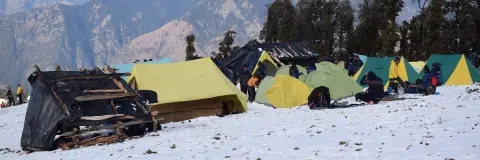
You need gaiters whenever you walk through snow, and on the Uttarakhand winter treks that is most of the winter. This is where the snow lies on Trekkaro's winter treks.
| Trek | Snow on the trail | Where the snow is deepest |
|---|---|---|
| Kedarkantha | From December, along the whole trail from the forest above Sankri to the summit | At base camp, in January |
| Brahmatal | 2 to 4 feet deep on the trail above Lohajung from December to February | At Tilandi, above Bekaltal, in late January |
| Dayara Bugyal | From December to March, through the forest above Raithal, the meadow and the final slopes | On the climb from Gui to Dayara Top, in January |
| Kuari Pass | Thick snow in the forest between Gulling and Khullara from December to March | On the climb from Khullara to the pass, in January |
| Chopta Chandrashila | On the higher sections, Rohini Bugyal and the summit from December to April | On the climb from Baniyakund to Chandrashila, in January |
| Nag Tibba | On the upper forest and the summit ridge from late December to February | On the climb from the Nag Devta camp to the summit, in January |
Fresh snow is the time gaiters matter most, because soft snow comes up over the ankle with every step. On firm, packed snow they still stop the snow kicked up by your own feet from getting into the shoe. On Nag Tibba, for example, the steep section above the Nag Devta temple can be slippery, and the trek team uses microspikes and gaiters there.
Snow is not the only reason. Gaiters also keep scree out of your shoes on loose, stony ground and keep stream water out at crossings, so they earn their place in spring and autumn too.
How do you put gaiters on?
Put your gaiters on before you reach the snow, not after your socks are already wet. Most trekking gaiters follow the same pattern.
- Put on your trekking shoes and lace them fully first.
- Wrap the gaiter around your lower leg with the opening at the front or the side, as the maker intends, and close it.
- Pass the strap under the sole of the shoe, just in front of the heel, and tighten it so the gaiter cannot ride up.
- Hook the front of the gaiter onto the laces so it covers the top of the shoe.
- Pull the top tight around your calf, over your trousers, so snow cannot drop in from above.
- If you wear microspikes, fit them over the shoe after the gaiters, and check that the strap under the sole does not get in the way of the spikes.
Walk a few steps and check that the gaiter stays in place without rubbing your ankle. If it slides, tighten the strap under the sole.
How should gaiters fit?
A gaiter should fit snugly over your shoe and trousers without squeezing your calf. Check three things: the bottom edge sits low over the shoe with no gap at the heel, the top closes firmly over your trouser leg, and the strap under the sole is long enough for your shoe size. Trekking trousers tucked inside the gaiter stay dry; trousers pulled over it let snow in.
Gaiters come in different heights. For snow treks, choose a pair that comes well up the calf, because a low ankle gaiter is soon buried in deep, soft snow. Look for a waterproof fabric on the lower part, a front closure (hook-and-loop or zip) you can work with gloves on, and a front hook that holds the laces firmly. Take care of the strap under the sole: it wears against rock, and a broken strap lets the gaiter ride up mid-trek.
Do you need to buy or rent gaiters?
Not for Trekkaro's winter treks. Gaiters are one of the five items in our Free Trekking Gear, along with Decathlon Quechua TREK 100 trekking shoes, a Quechua SH100 jacket rated to -10°C, trekking poles and microspikes. The gaiters alone are worth ₹599, and the five items together cost about ₹13,395 to buy. There is no rental fee, only a ₹3,000 refundable deposit and a ₹200 washing charge, plus GST on the washing charge.
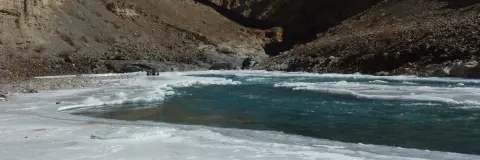
You give your shoe size when you book, and the kit is packed and labelled before you arrive. On the treks that do not include the full kit (Chadar, Hampta Pass, Kashmir Great Lakes, Valley of Flowers, Bhrigu Lake and Rupin Pass), Trekkaro still gives free microspikes and gaiters, with no deposit and no charge. You bring your own shoes, jacket and poles on those treks.
If you do buy or rent a pair for another trek, check that the under-sole strap is not cracked, the fastening closes properly and the fabric has no tears. Our guide to renting, buying or using free trekking gear compares the costs.
What should you check before you book a winter trek?
Whether you need to buy gaiters depends on what the trek fee includes. Ask these questions before you pay; the right-hand column gives Trekkaro's answers on its winter treks.
| What to check | Why it matters | With Trekkaro |
|---|---|---|
| Are gaiters and microspikes part of the fee? | Without them you buy or rent snow gear for a trek of a few days, and wet socks in sub-zero nights are a risk. | Yes, in the Free Trekking Gear with trekking shoes, a -10°C jacket and poles. No rental fee; a ₹3,000 refundable deposit and a ₹200 washing charge. |
| Are shoes and a jacket included too? | Without them, gaiters alone do not keep you dry and warm. | Yes, Decathlon trekking shoes and a jacket rated to -10°C. Buying all five items costs about ₹13,395. |
| How many times a day is SpO2 checked? | Without regular checks, early altitude sickness can go unnoticed. | SpO2 and pulse twice a day at every campsite. |
| What emergency kit travels with the group? | Without oxygen and a stretcher on the trail, help for a sick trekker waits for a team from the road. | One oxygen cylinder, one stretcher and a first-aid kit with every batch. |
| How many trekkers per trek leader or guide? | With too few leaders, nobody checks that your gear is on right before the snow. | Up to 20 trekkers per batch, one trek leader or guide for every 8. |
| What does the fee include? | Without a written list, extras appear later. | Stays, tents shared by three, -20°C sleeping bags, pure vegetarian meals, permits and the gear kit. On Brahmatal, for example, the fee is ₹9,000 per person plus 5% GST (₹9,450 with GST). |
| What happens if you cancel? | Without clear terms you may lose the whole fee. | 70% back at 30 or more days, 50% at 15 to 29 days, or a 100% TrekCash voucher, a free reschedule or a transfer up to 8 days before. |
| Can you pay in parts? | Without EMI the whole fee is due at once. | EMI starts at ₹463 a month. |
| Where do extra bags stay? | Without a store you carry everything you brought for the journey. | Free stores in Sankri, Lohajung, Raithal and Pipalkoti for Kedarkantha, Brahmatal, Dayara Bugyal and Kuari Pass, kept at your own risk. |
Before you travel, check the district forecast on the India Meteorological Department's Dehradun centre to see whether fresh snow is on the way.
See the Free Trekking Gear | Winter trek packing list | Trekking shoes on rent
Frequently asked questions
Are gaiters necessary for a snow trek?
Yes. Without gaiters, soft snow gets into your shoes over the top and wets your socks. On treks like Brahmatal, where snow lies 2 to 4 feet deep in mid-winter, gaiters keep your feet dry.
Do I wear gaiters over or under my trousers?
Wear them over your trousers, with the trouser legs tucked inside the gaiter. The top closes around your calf so snow cannot drop in from above.
Can I use gaiters with microspikes?
Yes. Put the gaiters on first, then fit the microspikes over the shoe, and check that the strap under the sole does not catch on the spikes.
Does Trekkaro give gaiters on the Chadar trek?
Yes. On Chadar, Trekkaro gives free microspikes and gaiters with no deposit and no charge. You bring your own shoes, jacket and poles for that trek.
What should I look for when choosing a company for a winter trek?
Check whether the fee includes gaiters, microspikes, shoes, a jacket and poles, how many times a day SpO2 is checked, the emergency kit, the trekker-to-leader ratio, what the fee covers, the cancellation terms, EMI and where extra bags stay.