Quick answer: Before you rent trekking shoes, test seven things: fit in your trekking socks, ankle height, sole grip, waterproofing, wear on the upper, whether microspikes fit over the sole and a clean lining. On Trekkaro's winter treks, Decathlon shoes come free with the Free Trekking Gear, and SpO2 is checked twice a day at every campsite.
How does renting trekking shoes work?
A rental service lends you a pair for a set number of days. You pay a rental charge for those days plus a deposit, collect the shoes before you travel and return them after the trek. The deposit comes back once the shop has checked the pair. Rates, deposits and damage rules differ from shop to shop, so read the damage rules before you sign. If you want the cost side of the decision, our guide to renting, buying or using free trekking gear sets out what each option costs for one trek.
A rented shoe has been worn by other people on other trails, so the check you do at the counter matters more than the price list.
What should you check in a rented trekking shoe?
Take your trekking socks with you and give each pair ten minutes. These are the checks, what to do and why each one matters on a Himalayan winter trek.
| Check | How to test it at the counter | Why it matters on a winter trek |
|---|---|---|
| Fit | Lace up fully in your thick trekking socks. Walk, then stand on a slope or a step facing down. Your toes should not touch the front and your heel should not lift. | Summit days are long. On Kedarkantha the summit day is about 9 km in 8 to 9 hours, much of it downhill, and toes that hit the front of the shoe blister fast. |
| Ankle height | Choose a mid or high cut that covers the ankle bone and holds it when laced. | Snow hides stones and holes, and an unsupported ankle twists easily on a snow-covered trail. |
| Sole grip | Turn the shoe over. The lugs should be deep and sharp, not worn flat at the heel or the ball of the foot. | A smooth sole slides on packed snow and wet rock, even with careful steps. |
| Waterproofing | Ask whether the shoe is waterproof or only water-resistant, and look for a waterproof label inside the tongue. | Snow melts on a warm shoe all day. Wet feet in sub-zero nights are cold feet, and cold feet are a risk. |
| Upper and stitching | Bend the shoe. Look for splits where the upper meets the sole, peeling at the toe and torn eyelets. | A split seam lets in snow, and a sole that is lifting can tear open mid-trek. |
| Room for microspikes | If the shop has microspikes, strap a pair over the shoe. The rubber should grip the sole without twisting. | On Brahmatal, microspikes go on from the Bekaltal camp upward on Day 3, and they must stay put on your shoe for hours. |
| Hygiene | Pull out the insole and look at the lining. Ask whether the pair has been cleaned since the last renter. | You wear the same pair for several days in a row, and a damp, dirty lining rubs and smells. |
If a pair fails any of these, ask for another pair or another size.
How do you choose the right size?
Size a rented trekking shoe for the socks you will wear, not for the socks you walk into the shop in. Winter treks call for thick woollen socks, and they take up room. Try both feet and fit the shoe to the larger one.
Leave about a finger's width between your longest toe and the front of the shoe. Descents decide this. On the Kuari Pass trek, Day 5 is an 11 km walk down from Khullara to Dhak that loses about 1,300 m, and every step pushes your foot forward. If the shop has no slope, walk down a staircase in the shoes before you decide.
If your heel still lifts after you tighten the top laces, the pair is too big. Walk in the rented pair for an hour or two on the day you collect it, so a pressure point shows up at home and not on the trail.
When do you not need to rent trekking shoes at all?
On Trekkaro's winter treks the shoes come with the trek. Our Free Trekking Gear is a five-piece Decathlon kit: Quechua TREK 100 trekking shoes, a Quechua SH100 jacket rated to -10°C, trekking poles, gaiters and microspikes. Buying the same five items costs about ₹13,395. There is no rental fee, only a ₹3,000 refundable deposit and a ₹200 washing charge, plus GST on the washing charge.
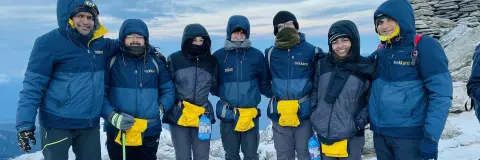
You give your shoe and jacket size when you book. The kit is packed and labelled before you arrive, and before the drive to the trailhead the shoes are laced and tested on your feet, the jacket is fitted and the poles are set to your height. The fit check you would do at a rental counter is done with the trek team at the gear check.
The Kedarkantha, Brahmatal, Dayara Bugyal and Kuari Pass treks include the kit. The full list and the exceptions are on the Free Trekking Gear page. On the Chadar Trek, for example, you bring your own trekking shoes and gumboots, and Trekkaro gives free microspikes and gaiters with no deposit and no charge.
What should you check before you book a winter trek?
Whether you rent or not depends on what your trek fee covers, so ask the trek company these questions before you pay. The right-hand column shows Trekkaro's answer on Kedarkantha, Brahmatal, Dayara Bugyal and Kuari Pass.
| What to check | Why it matters | With Trekkaro |
|---|---|---|
| Does the fee include trekking shoes, a jacket, poles, gaiters and microspikes? | Without them you rent or buy all five before the trek, and you check every rented item yourself. | Free Trekking Gear: no rental fee, a ₹3,000 refundable deposit and a ₹200 washing charge. Buying the kit costs about ₹13,395. |
| How many times a day is your oxygen level checked? | Without regular checks, early altitude sickness can go unnoticed until it is serious. | SpO2 and pulse are checked twice a day at every campsite. |
| What emergency kit travels with the group? | Without oxygen and a stretcher on the trail, help for a sick trekker waits until a team arrives from the road. | One oxygen cylinder, one stretcher and a first-aid kit travel with every batch. Trek leaders are trained in wilderness first aid. |
| How many trekkers per trek leader or guide? | In a large group with few leaders, a slow or unwell trekker gets less attention. | Up to 20 trekkers per batch, with one trek leader or guide for every 8. |
| What does the fee include? | Without a clear list, meals, permits or tents turn up as extra charges later. | Stays, tents shared by three with -20°C sleeping bags, pure vegetarian meals, permits and the gear kit. For example, the Kedarkantha fee is ₹9,000 per person plus 5% GST (₹9,450 with GST). |
| What happens if you cancel? | Without clear terms you may lose the whole fee if plans change. | 70% back 30 or more days before departure and 50% at 15 to 29 days, or a 100% TrekCash voucher, a free reschedule or a transfer up to 8 days before. |
| Can you pay in parts? | Without an EMI option the full fee is due at once. | EMI starts at ₹463 a month. |
| Where do extra bags stay during the trek? | Without a store you carry or pay for everything you brought for the journey. | Free stores in Sankri, Lohajung, Raithal and Pipalkoti for these four treks, kept at your own risk. |
What happens to the shoes after the trek?
With a rental, you take the shoes back to the shop, it checks them, and it returns your deposit minus any damage charge under its own rules.
With Trekkaro's kit, you hand all the gear back at the end of the trek when your trek leader asks. You then fill in the gear-return form in My Bookings, marking each item as good, damaged or lost, and add your UPI ID. The deposit is refunded by UPI after the team checks the gear. If something is damaged or lost, its cost comes out of the deposit, and the deduction can never be more than the deposit. If you cancel before the trek starts, the deposit and the washing charge are both refunded in full.
Your own warm layers, thermals, woollen socks, cap and gloves are not part of the kit, so pack those yourself. Our guide to shoes for snow trekking covers what goes over and inside the shoe on a winter trail. Before you travel, check the district forecast on the India Meteorological Department's Dehradun centre so you know whether snow is on the trail.
See the Free Trekking Gear | Rent, buy or free gear | Winter trek packing list
Frequently asked questions
What should I check before renting trekking shoes?
Check the fit in thick trekking socks, an ankle-high cut, deep sole lugs, a waterproof label, no splits where the upper meets the sole and a clean, dry lining. If you can, strap microspikes over the shoe to see that they hold.
What size trekking shoe should I rent?
Rent the size that leaves about a finger's width in front of your longest toe while you wear thick woollen socks. Fit it to your larger foot, and walk down a slope or stairs to check that your toes do not hit the front.
Do I need to rent trekking shoes for the Kedarkantha trek?
No. Kedarkantha includes Trekkaro's Free Trekking Gear, so Decathlon trekking shoes come with the trek. You pay a refundable deposit and a washing charge, not a rental fee.
Do I need my own shoes for the Chadar trek?
Yes. On Chadar you bring your own trekking shoes and gumboots, and Trekkaro gives free microspikes and gaiters. The Free Trekking Gear page notes that gumboots and expedition-grade layers are available in Leh.
What should I look for when choosing a company for a winter trek?
Check whether the fee includes shoes, a jacket, poles, gaiters and microspikes, how many times a day SpO2 is checked, what emergency kit travels with the group, the trekker-to-leader ratio, what the fee covers, the cancellation terms, EMI and where your extra bags stay.