This guide is about the Kuari Pass Trek — dates, price, day-by-day itinerary and booking are on the trek page.
Quick answer: Yes. The Kuari Pass trek is safe for a fit beginner who follows the trek leader. It is graded Easy to Moderate, you never sleep above 3,350 m, and the climbs are gradual. The care points are the 13 km summit day to the 3,815 m pass, snow and wind on the ridge, and winter nights down to -14°C.
How safe is the Kuari Pass trek, risk by risk?
The Kuari Pass Trek is a 6-day trek from Pipalkoti in Chamoli, about 35 km on foot over four walking days, with no technical climbing; ropes are not needed on this trek. Trekkaro runs it from October to April. The table sets out what can go wrong and what is in place for it.
| Risk | Where it shows up | What is in place |
|---|---|---|
| Altitude | Khullara camp at 3,350 m (nights 3 and 4) and the pass at 3,815 m | Gradual gain, SpO2 and pulse checks twice a day at every campsite, an oxygen cylinder with the group |
| A long summit day | Day 4: 13 km, 8 to 9 hours, Khullara to the pass and back | An early start, a short break every 15 minutes on the ridge |
| Snow and ice | December to March: the forest, the frozen stream below Khullara Top and the ridge | Free microspikes and gaiters; ice axes with the team; the trail cleared after fresh snowfall |
| Cold and wind | Winter camp nights of -14°C to -8°C; strong wind on the ridge | -20°C sleeping bags and a -10°C jacket in the Free Trekking Gear |
| Distance from the road | Khullara is 11 km, 6 to 7 hours on foot, from the road at Dhak | A stretcher and radios with the group; insurance with emergency evacuation is mandatory |
Will the altitude make you sick on Kuari Pass?
The risk is mild: the pass is at 3,815 m (12,516 ft), but the height gain is gradual. The highest place you sleep is Khullara at 3,350 m, and you reach it in two short walking days.
| Day | Walk | Height change | You sleep at |
|---|---|---|---|
| 1 | Drive Rishikesh to Pipalkoti | Drive | Pipalkoti, 1,883 m |
| 2 | Cab to Dhak (2,050 m), trek 6 km to Gulling | About 850 m up | Gulling, 2,900 m |
| 3 | Gulling to Khullara, 5 km in about 4 hours | About 450 m up | Khullara, 3,350 m |
| 4 | Khullara to the pass and back, 13 km | About 465 m up and down | Khullara, 3,350 m |
| 5 | Khullara to Dhak, 11 km, cab to Pipalkoti | About 1,300 m down | Pipalkoti, 1,883 m |
| 6 | Drive Pipalkoti to Rishikesh or Dehradun | Drive | Home |
No day climbs more than about 850 m, within the 800 to 1,000 m that the Uttarakhand health department's yatra health advisory gives as the most height to gain in a day. Day 3 is short on purpose: it gives your body time to adjust before the climb to the pass. The same advisory asks you to rest 5 to 10 minutes in every hour of walking, to seek help at once for chest pain, shortness of breath, a persistent cough, dizziness or vomiting, and to descend if you feel unwell. Tell your trek leader about a headache or poor sleep early, and consult your doctor before the trek.
Who looks after you on the trail?
Trekkaro's trek leaders have completed a basic mountaineering course, are trained in wilderness first aid and lead with local guides. A batch takes up to 20 trekkers, with one trek leader or guide for every 8.
Your SpO2 and pulse are checked twice a day at every campsite, and a falling reading is acted on early. A portable oxygen cylinder, a first-aid and medical kit and a stretcher go with the group, and the team uses radios because the mobile signal is not reliable on the trail. Pipalkoti has patchy Jio and BSNL signal, and there is little or none beyond it, so tell your family about the limited signal before you leave Pipalkoti.
Where can things go wrong on summit day?
It is the one demanding day, and it is long rather than technical. Summit day starts early from Khullara. The first 3.5 km take you to Khullara Top, across a broken bridge and a stream that freezes in winter, and then the trail climbs a ridge to the pass. Groups reach the pass between 9 and 10 AM and stay 30 to 45 minutes before walking back down.
Three things keep the day safe. In winter the ridge is a snow climb, so microspikes and gaiters go on, and after fresh snowfall the team clears the trail and helps you across slippery sections. Wind on the ridge can be strong, so pull on a layer at the top before it chills you, and keep your cap and gloves on: taking them off in the morning wind on an open top is dangerous. And there are no water sources anywhere on the route, so carry all your water from Khullara, with one insulated bottle filled with hot water from the mess tent.
Day 5 is the other long day, about 1,300 m down to Dhak through the forest. Use your poles for your knees. Our Kuari Pass difficulty guide has a six-week fitness plan.
Can the Kuari Pass cold hurt you, and what keeps you warm?
From December to February, days are 8°C to 14°C and camp nights -14°C to -8°C, and the coldest night the team has recorded is -16°C at Khullara. In October, November, March and April nights are around 0°C. Snow lies on the forest from December to March and is deepest on the climb from Khullara to the pass in January.
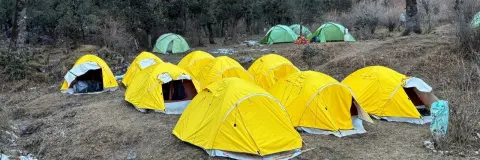
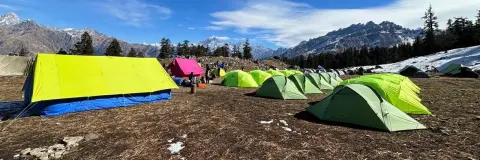
Tents are shared by three trekkers, with men and women in separate tents, and the sleeping bags are rated to -20°C. The Free Trekking Gear includes Decathlon trekking shoes, a -10°C jacket, trekking poles, gaiters and microspikes, against a ₹3,000 refundable deposit and a ₹200 washing charge. For December to February bring five warm layers and keep one set of thermals dry for the night. Our Kuari Pass weather guide has the month-by-month table.
What happens if someone falls ill on the trek?
If a trekker cannot walk, the staff carry them on the stretcher down to the base and on to the nearest hospital. Health staff are posted at Pipalkoti, and the nearest public facilities beyond it are the primary health centre at Chamoli, the district hospital at Gopeshwar and the sub-district hospital at Karnaprayag.
Because Rishikesh is about 9 hours away by road, travel insurance is mandatory and not included; it must cover high-altitude trekking and emergency evacuation. Helicopter and hospital bills fall to your insurer. Every trekker also brings a medical certificate signed by a doctor (the form is in My Bookings).
Can children, over-60s and first-timers do Kuari Pass?
Fit beginners can do it: the daily climbs are gradual and you sleep no higher than 3,350 m, but summit day takes 8 to 9 hours. The minimum age is 8, and trekkers under 18 come with a parent or guardian. There is no upper age limit, but trekkers above 60 need to be fit and in good cardiovascular health.
What do trekkers get wrong on Kuari Pass?
Trekkaro's trek leaders see four mistakes. Step to the mountain side when mules carrying the group's equipment come along the trail, never the valley side. Bring reusable water bottles instead of plastic. Keep your cap and gloves on at the pass, even for photos. And do not smoke: smoking at height makes breathing harder, and smoking in prohibited zones can get a trekker removed from the trek.
The trail is busiest in the last part of December, the Christmas and New Year weeks. Weather in the hills changes from week to week, so check the forecast for Chamoli district on the India Meteorological Department's Dehradun centre before you travel.
What does the trek cost?
The fee for the Kuari Pass Trek is ₹9,400 per person plus 5% GST (₹9,870 with GST). EMI starts at ₹484 a month. It covers pure vegetarian meals from Day 1 dinner to Day 5 dinner, stays in Pipalkoti and tents at Gulling and Khullara, permits, the safety kit above, the Free Trekking Gear and the 15 km cab between Pipalkoti and Dhak on Days 2 and 5. Transport to Pipalkoti is not included: we help the group book shared cabs at ₹6,500 one way per 5 to 6 seat vehicle, paid directly to the driver and split among trekkers, which is ₹1,083 each, one way, when six share. Pipalkoti has no ATM, so carry cash in small notes from Rishikesh or Dehradun.
See Kuari Pass Trek dates and book | Kuari Pass best time | Kuari Pass in February
Frequently asked questions
Is the Kuari Pass trek safe for beginners?
Yes, for fit beginners. It is graded Easy to Moderate, the daily climbs are gradual and you sleep no higher than 3,350 m. Train before you go, because summit day takes 8 to 9 hours.
Is the Kuari Pass trek safe in winter?
Yes, with the right kit. Snow lies on the trail from December to March and camp nights reach -14°C, so microspikes, gaiters, -20°C sleeping bags and five warm layers matter.
Is there a risk of altitude sickness on Kuari Pass?
Yes, a mild one, because the pass is at 3,815 m. The gain is gradual, the highest camp is 3,350 m, and your SpO2 and pulse are checked twice a day at every campsite.
Are ropes needed on the Kuari Pass trek?
No, ropes are not needed on this trek. The team carries ice axes, and microspikes and gaiters come free with the trek for the snow.
Where is the nearest hospital to the Kuari Pass trek?
Health staff are posted at Pipalkoti, the start of the trek. Beyond it are the primary health centre at Chamoli, the district hospital at Gopeshwar and the sub-district hospital at Karnaprayag.