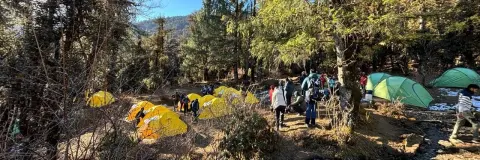
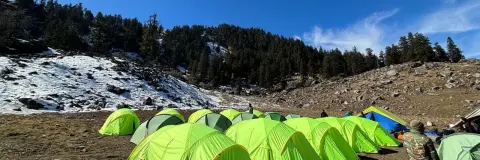
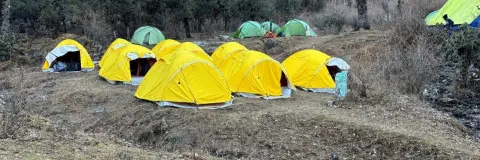
This guide is about the Kuari Pass Trek — dates, price, day-by-day itinerary and booking are on the trek page.
Quick answer: The best time for the Kuari Pass trek is December to February for a full snow trek, with nights of -14°C to -8°C at camp. March and April bring rhododendrons below and snow higher up, and October and November open the season without guaranteed snow. Trekkaro runs Kuari Pass from October to April; the pass stands at 3,815 m.
When is the best time for the Kuari Pass trek?
Trekkaro runs Kuari Pass from October to April, with December to March the window for snow, and the season splits into three windows. All three use the same 6-day, 35 km route from Pipalkoti and end at the same 180° view of fourteen peaks, including Kedarnath, Chaukhamba, Kamet and Nanda Devi. What changes is the ground under your feet and the cold at night.
| Window | Trail | Pick it for | Month guides |
|---|---|---|---|
| October to November | Same route; full snow cover not promised | The view with milder nights | November |
| December to February | Snow on the trail, forests and meadows; the stream below Khullara Top frozen | The full snow trek | December |
| March to April | Snow melting on the lower trail; higher sections still snowy | Rhododendrons below and snow above | March |
| May to September | No batches | – | – |
Is the December to February snow trek worth the cold?
These three months are the peak winter window, when Kuari Pass is a snow trek from start to finish. Snow covers the trail, the forests and the meadows, and the stream on the way to Khullara Top lies frozen.
The cost of that snow is a harder summit day. The round trip from Khullara (3,350 m) to the pass and back is 13 km and takes 8 to 9 hours. On the way you cross a broken bridge, and expect icy sections and high winds on the ridge. Microspikes and gaiters come with Free Trekking Gear, and they earn their place on this day. Nights at camp fall to -14°C to -8°C, the coldest of the three windows.
Choose this window if snow is the point of the trip and you are ready for long, cold nights. The Uttarakhand Health Department's advisory for pilgrims going above 3,000 m asks travellers to pack for cold, rain and sun, and to descend if they feel unwell.
Why pick March or April instead?
In March and April the rhododendrons come into bloom, while the higher sections still hold their snow. Snow melts first on the lower trail, so you walk through flowering forest early in the trek and reach snow on the higher ground towards the pass.
The nights are the big difference. March and April bring around 0°C at night and 13°C to 17°C by day, against -14°C to -8°C at night in peak winter. That makes this window the gentler way to see Kuari Pass with some snow still on the route. March is also inside the December to March snow window, which April is not.
What do October and November offer?
October and November open the season. The route is the same and so is the view from the pass, but full snow cover, the mark of the winter trek, comes from December. Days run from 10°C to 15°C and nights sit around 0°C.
Pick this window if the view and milder nights matter more to you than snow, or if your leave falls before winter. For a route fully under snow, wait for December.
What does the Kuari Pass trek cost?
The fee is ₹9,400 per person plus 5% GST (₹9,870 with GST). EMI starts at ₹484 a month. The trek starts and ends at Pipalkoti (1,883 m), about 215 km and 9 hours by road from Rishikesh. Transport is not included: the shared 5–6 seat cab is paid directly to the driver and split among the trekkers in it, and your trek coordinator confirms the fare. There is no ATM at Pipalkoti, so carry cash.
Free Trekking Gear (Decathlon trekking shoes, a -10°C jacket, trekking poles, gaiters and microspikes) comes with a ₹3,000 refundable deposit and a ₹200 washing charge. The minimum age is 8, with trekkers under 18 joining with a parent or guardian. Every trekker brings a doctor-signed medical certificate, and travel insurance is mandatory and not included.
See Kuari Pass trek dates and book | Kuari Pass temperature by month | Kuari Pass trek cost
Frequently asked questions
Which is the best month for the Kuari Pass trek?
December to February is best for a full snow trek, with snow on the trail, forests and meadows. March suits trekkers who want rhododendrons below and snow on the higher sections. October, November and April give the same view with milder nights.
Is there snow on the Kuari Pass trek in October?
Full snow cover is not promised in October or November. December to March is the snow window, so pick those months if snow is the reason you are going.
When do rhododendrons bloom on the Kuari Pass trek?
In March and April, while the higher sections still hold their snow. Nights in this window are around 0°C at camp.
Is the Kuari Pass trek open from May to September?
No. Trekkaro runs Kuari Pass from October to April. Choose your batch on the Kuari Pass trek page.
How cold does it get on the Kuari Pass trek in winter?
From December to February nights at camp run from -14°C to -8°C and days from 8°C to 14°C. Free Trekking Gear includes a -10°C jacket, and the ridge to the pass can be windy.