This guide is about the Kuari Pass Trek — dates, price, day-by-day itinerary and booking are on the trek page.
Quick answer: Yes, February is a good month for the Kuari Pass trek, and it is the month Trekkaro's trek leaders rate highest: the snow from the forest to the 3,815 m pass is at its best for walking, after the late-December rush. Days are 8°C to 14°C and camp nights -14°C to -8°C on the 6-day route from Pipalkoti.
What is the snow like on Kuari Pass in February?
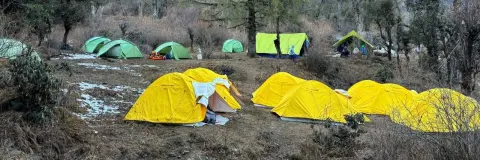
February is the last month of Kuari Pass's December to February cold band, though the snow stays on the trail into March. From December to March the forest on the Kuari Pass Trek lies under thick snow, and in winter the ridge from Khullara to the pass is a snow climb. The stream you cross below Khullara Top on summit day freezes over in the winter months.
The snow is deepest in January, on the climb from Khullara to the pass. By February the snow cover is still complete, from the oak and rhododendron forest above Dhak to the top, and Trekkaro's trek leaders rate it the best month of the season because the snow is at its best for walking. In March the snow melts on the lower trail but stays on the higher sections, and April falls outside the main snow months.
The table shows where you meet snow on a February batch.
| Section | Height | In February |
|---|---|---|
| Pipalkoti (start and end) | 1,883 m | The road town where you sleep on Days 1 and 5 |
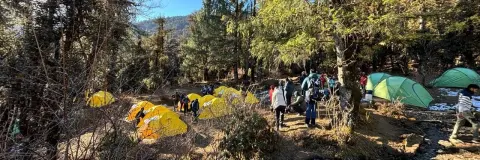
| Dhak to Gulling, through Tugasi village | 2,050 m to 2,900 m | Terraced fields and Tugasi village, then oak and rhododendron forest under snow |
| Gulling to Khullara | 2,900 m to 3,350 m | Snow-covered mixed forest and open meadows near camp |
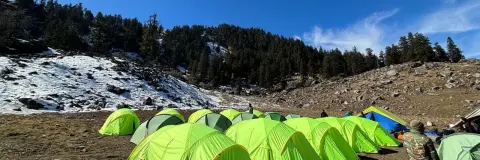
| Khullara to Kuari Pass | 3,350 m to 3,815 m | A frozen stream, then a snow climb up the ridge to the pass |
Why do Trekkaro's trek leaders rate February highest?
There are two reasons. The first is the snow: February keeps the full winter cover, and the team finds it the best snow of the season to walk on. January has the deepest snow, on the Khullara climb.
The second is the crowd. The trail is at its busiest in the last part of December, the Christmas and New Year weeks. A February batch walks the same snow with fewer groups on the trail.
What February does not change is the cold. It sits inside the same December to February temperature band as January, so plan your kit for the coldest nights of the year.
How cold are February days and nights?
Trekkaro gives one winter range for December to February: days of 8°C to 14°C and camp nights of -14°C to -8°C. The coldest night the team has recorded on this trek is -16°C at Khullara, the high camp, where you sleep on nights 3 and 4. March moves into the spring range.
| Month | Day | Night at camp | Snow |
|---|---|---|---|
| January | 8°C to 14°C | -14°C to -8°C | Deepest on the Khullara to pass climb |
| February | 8°C to 14°C | -14°C to -8°C | Full cover, rated best for walking |
| March | 13°C to 17°C | Around 0°C | Melting on the lower trail, still on the higher sections |
Our Kuari Pass weather guide has the full month table from October to April. For live forecasts and district warnings in the days before you leave, check the India Meteorological Department's Dehradun centre, which covers the Uttarakhand districts.
What does February snow change on each day?
The route stays the same all season: about 35 km on foot over the four trekking days, Days 2 to 5, of the 6-day trip from Pipalkoti. Days 1 and 6 are the drives from and back to Rishikesh, about 215 km each way. The snow changes how each trekking day feels.
| Day | Route | Distance and time | What to expect in February |
|---|---|---|---|
| 2 | Cab to Dhak, trek to Gulling | 6 km, 5 to 6 hours, about 850 m up | Fill your bottles at Dhak, as water sources on the way are limited |
| 3 | Gulling to Khullara | 5 km, about 4 hours, about 450 m up | A short day through snow-covered forest and a small stream crossing |
| 4 | Khullara to Kuari Pass and back | 13 km, 8 to 9 hours, about 465 m up and down | The frozen stream, then the snow ridge; no water on the route |
| 5 | Khullara to Dhak, cab to Pipalkoti | 11 km, 6 to 7 hours, about 1,300 m down | A long descent on snow; keep your poles out for your knees |
Summit day is where February matters most. You cross a broken bridge and the frozen stream, then climb the ridge in snow, taking a short break every 15 minutes. Microspikes and gaiters go on for the snow, and the team carries ice axes; ropes are not used on this trek. Groups reach the pass between 9 and 10 AM and stay 30 to 45 minutes, with a 180° view of 14 peaks that includes Nanda Devi and Kamet. Wind on the ridge can be strong in these months, so pull on a layer at the top before it chills you, and keep your cap and gloves on at the pass, even for photos.
Carry all your water for Day 4 from Khullara, because the route has no water sources. The mess tent gives hot water at every camp, so fill an insulated bottle before you leave.
Who should pick February over January or March?
Kuari Pass is graded Easy to Moderate, with a minimum age of 8; trekkers under 18 come with a parent or guardian. There is no upper age limit, but trekkers over 60 need good fitness and good cardiovascular health.
Pick February if you want full snow from the forest to the pass and a quieter trail than in late December. Pick January if the deepest snow on the summit climb is the point of the trip. Pick March if you would rather trade some cold for warmer days: nights move to around 0°C and snow stays on the higher sections and the climb to the pass.
Safety cover is the same on every batch. Trek leaders are trained in wilderness first aid and lead with local guides, one leader or guide for every 8 trekkers and up to 20 per batch. SpO2 and pulse are checked twice a day at every campsite, the group carries one oxygen cylinder, a first-aid kit and a stretcher, and the team uses radios because the mobile signal is unreliable.
What should you pack for February?
Pack for camp nights of -14°C to -8°C; the coldest the team has recorded at Khullara is -16°C. The fee includes Free Trekking Gear: Decathlon trekking shoes, a -10°C jacket, trekking poles, gaiters and microspikes, against a ₹3,000 refundable deposit and a ₹200 washing charge. Tents are shared by three trekkers, with men and women in separate tents, and the sleeping bags are rated to -20°C.
For December to February, Trekkaro asks for five warm layers: a thermal top and bottom, two fleece or woollen layers and a padded jacket. Pack 2 sets of thermals (keep one dry for the night), 2 quick-dry trek pants, 3 to 4 pairs of socks, a woollen cap, a balaclava, two pairs of gloves, UV sunglasses and SPF 50+ sunscreen. Add a headlamp, a power bank, your regular medicines with blister plasters and ORS, and two 1 L reusable bottles, one of them insulated so your water does not freeze; leave plastic bottles at home. Our winter trek packing list covers layering in detail. On the trail, step to the mountain side when mules pass, never the valley side, and do not smoke on the trek.
Bags you do not need on the trail stay free of charge in Trekkaro's store in Pipalkoti; keep valuables with you. Backpack offloading is optional at ₹1,800 plus GST for one bag of up to 9 kg, and a single tent costs ₹2,000 plus GST.
How do you reach Pipalkoti, and what does the trek cost?
The fee for the Kuari Pass Trek is ₹9,400 per person plus 5% GST (₹9,870 with GST). EMI starts at ₹484 a month. It covers pure vegetarian meals from Day 1 dinner to Day 5 dinner, the guesthouse or homestay in Pipalkoti on Days 1 and 5, three nights in tents at Gulling and Khullara, permits and forest camping fees, and the 15 km cab between Pipalkoti and Dhak on Days 2 and 5.
Transport to Pipalkoti is not included. We help the group book shared cabs from Dehradun Railway Station or Rishikesh, at ₹6,500 one way per 5 to 6 seat vehicle, paid directly to the driver and split among trekkers. With six in the cab, the fee, both cab shares and the washing charge come to ₹12,237; with five, ₹12,670.
Pipalkoti has no ATM, so carry enough cash from Rishikesh, Dehradun or your home city, in small notes. Jio and BSNL work at Pipalkoti, but the signal is patchy and depends on the weather, and there is little or none on the trail. Every trekker brings a medical certificate signed by a doctor (the form is in My Bookings), and travel insurance is mandatory and not included; it must cover high-altitude trekking and emergency evacuation.
See Kuari Pass Trek dates and book | Kuari Pass in March | Kuari Pass best time
Frequently asked questions
Is there snow on the Kuari Pass trek in February?
Yes. From December to March the forest lies under thick snow, and in February the snow runs from the forest above Dhak to the pass. Trekkaro's trek leaders rate February snow the best of the season for walking.
How cold is Kuari Pass in February?
Days are 8°C to 14°C and camp nights -14°C to -8°C, the same winter range as December and January. The coldest night the team has recorded is -16°C at Khullara.
Is February better than January for the Kuari Pass trek?
February has full snow that walks better and fewer groups than late December. January has the deepest snow on the climb from Khullara to the pass, so choose it if deep snow is your goal.
Do I need microspikes for Kuari Pass in February?
Yes, for the snow on the forest trail and the ridge. Microspikes and gaiters come free with Trekkaro's Free Trekking Gear, and the team carries ice axes.
Can a beginner do the Kuari Pass trek in February?
Yes, if you are fit and ready for camp nights down to -14°C. The trek is graded Easy to Moderate, the minimum age is 8, and summit day, 13 km in 8 to 9 hours, is the longest day.