Quick answer: A family trek in the Himalayas suits a short, easy winter trek with a low minimum age: Brahmatal from 7, Kedarkantha, Dayara Bugyal, Kuari Pass, Chopta Chandrashila and Gulabikantha from 8, and Nag Tibba from 9. Under-18s trek with a parent or guardian. Trekkaro's Uttarakhand winter treks include Free Trekking Gear and SpO2 checks twice a day at every campsite.
Can you take children on a Himalayan trek?
Yes, once a child reaches the trek's minimum age. Families trek together on Trekkaro's batches. These are the rules:
- Each trek has its own minimum age, from 7 on Brahmatal to 14 on Chadar.
- Trekkers under 18 must come with a parent or guardian, and on Dayara Bugyal the parent or guardian signs the disclaimer for them.
- The person who makes the booking must be 18 or older.
- Every trekker, child or adult, brings a medical certificate signed by a doctor; our guide to the medical certificate for trekking explains what it needs.
There is no upper age limit, so grandparents can come. Trekkers above 60 are welcome if they are fit and in good cardiovascular health, and an ECG or TMT report is recommended along with the medical certificate.
Which winter treks suit a family?
For a first family trek, look at the minimum age, the number of days and the highest point together. Six of Trekkaro's winter treks in Uttarakhand compare like this.
| Trek | Days | Walking distance | Highest point | Grade | Minimum age |
|---|---|---|---|---|---|
| Nag Tibba | 2 | About 16 km | 3,022 m | Easy | 9 |
| Dayara Bugyal | 4 | About 20 km | 3,749 m | Easy-moderate | 8 |
| Kedarkantha | 5 | About 20 km | 3,810 m | Easy-moderate | 8 |
| Chopta Chandrashila | 5 | About 30 km | 3,962 m | Moderate | 8 |
| Brahmatal | 6 | About 29 km | 3,734 m | Easy-moderate | 7 |
| Kuari Pass | 6 | About 35 km | 3,815 m | Easy-moderate | 8 |
Brahmatal has the lowest minimum age, at 7. Nag Tibba is the shortest, two days with one night in tents, and its minimum age of 9 is for children who already walk regularly. On Chopta Chandrashila the steep climb from Tungnath to Chandrashila makes for a long day for a child, with an 11 km summit day, so parents should judge their child's stamina before choosing it. Chadar is not a family trek for young children: its minimum age is 14, and nights on the frozen river drop to -30°C.
How do you choose the right trek for your child?
The table gives the numbers. These questions turn them into a choice:
- How far does your child walk now? If your family's walks at home are short, start with Nag Tibba, where the night camp near the Nag Devta temple sits at about 2,300 m.
- How long is the hardest day? On Chopta Chandrashila it is the 11 km summit day; on Kedarkantha it is a steep climb on snow that starts well before dawn.
- How does your child handle cold? Winter nights at camp are about -7°C to -2°C on Nag Tibba, and -15°C to -10°C on Kedarkantha.
- How high will you sleep? On Nag Tibba the camp is at about 2,300 m; on Kedarkantha the base camp is at 3,429 m.
- Is there snow? Snow lies on Nag Tibba from late December to February and on Brahmatal from December to February, 2 to 4 feet deep above Lohajung.
A short trek done happily is a better start than a long one finished in tears. If your family is new to walking in the hills, our guide to hiking vs trekking explains how a few day hikes prepare you for a first trek.
How does a family stay together on a trek?
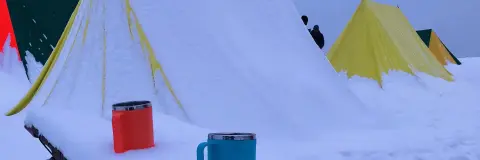
Batches take up to 20 trekkers, with one trek leader or guide for every 8, and families walk as part of the group. At camp, tents are shared by three trekkers and women share tents only with other women. On Kedarkantha and Chopta Chandrashila, couples and families get separate tents as needed; on Brahmatal, Dayara Bugyal and Kuari Pass a single tent is an optional add-on for an extra charge.
If you want the trek to yourselves, Trekkaro also runs private, customised Kedarkantha treks for a group of any size, at your own pace. The cost depends on the number of trekkers, the duration and the type of trek. A private trek suits a family with young children who need more rest stops than a mixed batch.
How do you prepare a child for a winter trek?
- Walk together for a few weeks before the trek, on stairs, hills or long walks, so the child's legs and shoes are ready.
- See a doctor for every family member's medical certificate early, so there is time for any extra check the doctor wants.
- Pack five warm layers for each person: a thermal top and bottom, two fleece or woollen layers and a padded jacket, plus a woollen cap, a balaclava and waterproof gloves. Keep one set of thermals dry for the night.
- Pack snacks the child likes, such as dry fruits and energy bars, plus ORS sachets and a reusable lunch box for the packed lunch. Our guide to trekking food covers the meals.
- Before you book, ask our team whether the Free Trekking Gear comes in your child's shoe and jacket size. On Kedarkantha the guide runs a gear check before the trek starts.
- Arrange travel insurance for every trekker; it is mandatory and not in the fee. Our guide to trekking insurance lists what it must cover.
Talk to your child about the rules before you go: walk with the group, stand on the mountain side of the trail when mules pass, and keep the cap on at the summit. Check the forecast for the trek's district on the India Meteorological Department's Dehradun centre in the days before you travel.
What does the trek team do to keep children safe?
Every trekker is checked, whatever their age. SpO2 and pulse are checked twice a day at every campsite, and on Kedarkantha and Brahmatal blood pressure is checked too. One portable oxygen cylinder, one stretcher and a first-aid kit travel with every batch. Trek leaders are trained in wilderness first aid and lead with local guides, and the trek leader can suggest another plan when the weather turns, ask a trekker who is not fit to go on to rest or descend, and on Kedarkantha turn the group back on summit day; the leader's decision on health and safety is final.
Altitude affects children as well as adults, so tell the trek leader if your child has a headache, will not eat or seems unusually tired. Our guide to altitude sickness on Himalayan treks lists the signs to watch for.
What should you check before you book a family trek?
With children along, the details of the batch matter even more. Compare these points; the last column shows Trekkaro's answers on its winter treks.
| What to check | Why it matters | With Trekkaro |
|---|---|---|
| What is the minimum age, and who must come with a child? | Without clear rules, a family can book a trek a child is not allowed to start. | From 7 on Brahmatal to 14 on Chadar; under 18 with a parent or guardian. |
| How are tents shared? | Without a plan, a family can end up split across tents. | Three per tent, women only with women; separate tents for families on Kedarkantha and Chopta Chandrashila. |
| Does the free gear fit your child? | A child in shoes that do not fit has a hard trek. | Free Trekking Gear on the Uttarakhand winter treks; ask our team about your child's shoe and jacket size before you book. |
| Can you trek as your own group? | Young children may need more rest stops than a mixed batch. | Private, customised Kedarkantha treks for a group of any size, at your own pace. |
| What does the fee cover? | Without a written list, extras add up for every family member. | Stays, tents, pure vegetarian meals, permits and the gear kit. On the Brahmatal trek, for example, the fee is ₹9,000 per person plus 5% GST (₹9,450 with GST). |
| What if a child falls ill before the trek? | Without clear terms, one sick child can cost the whole family's fee. | 70% back at 30 or more days, 50% at 15 to 29 days and no cash refund from 14 days; up to 8 days before, a 100% TrekCash voucher, a free reschedule or a transfer instead. |
| Can you pay in instalments? | Without EMI the fee for every family member is due at booking. | EMI starts at ₹463 a month. |
See Brahmatal Trek dates and book | Winter treks for beginners | Medical certificate for trekking
Frequently asked questions
What is the minimum age for a Himalayan trek with Trekkaro?
It depends on the trek: 7 on Brahmatal, 8 on Kedarkantha, Dayara Bugyal, Kuari Pass, Chopta Chandrashila and Gulabikantha, 9 on Nag Tibba, 10 on Aancha Top and 14 on Chadar. Trekkers under 18 come with a parent or guardian.
Which winter trek is easiest for a family with children?
Nag Tibba is the shortest, two days with one night in tents, for children from 9 who already walk regularly. Brahmatal takes children from 7 but runs six days.
Can a family share a tent on a trek?
On Kedarkantha and Chopta Chandrashila, couples and families get separate tents as needed. On Brahmatal, Dayara Bugyal and Kuari Pass, a single tent is an optional add-on for an extra charge.
Do children need a medical certificate for a trek?
Yes. Every trekker, at any age, brings a medical certificate signed by a doctor; the form is in My Bookings.
What should I look for when choosing a company for a winter trek?
Check the minimum age, how tents are shared, whether the free gear fits your child and whether you can trek as a private group. Then compare SpO2 checks, the fee, cancellation terms and EMI.