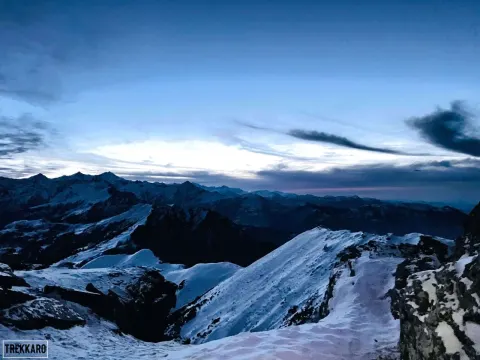
Quick answer: Altitude sickness can start above about 3,000 m, the height at which four of Trekkaro's winter treks put you to sleep for at least one night. Watch for a persistent headache, nausea, light-headedness, poor sleep or loss of appetite. Climb gradually, rest 5–10 minutes every hour, avoid alcohol and smoking, tell your trek leader early and go down if you feel unwell.
The altitude risk is not the same on every winter trek, and the early signs are easy to miss. This guide sets out both for Trekkaro's eight winter treks. It uses the health advisories of the Uttarakhand Health Department, Ladakh Tourism and the Shri Amarnathji Shrine Board, and the altitudes on our own trek pages.
What is altitude sickness, and at what height does it start?
Higher up, each breath carries less oxygen. If you climb faster than your body adjusts, you can develop acute mountain sickness (AMS). The Uttarakhand Health Department's high-altitude advisory applies its advice above 3,000 m (10,000 ft), where it also warns of cold, low humidity and strong UV. The Shri Amarnathji Shrine Board's advisory warns that high altitude sickness left untreated "may be lethal in a matter of hours", which is why the early signs matter.
What counts on a trek is not only the summit height but where you sleep. A summit is a few hours at the top; a camp is a whole night at that height.
How high do you sleep on each winter trek?
These figures come from Trekkaro's trek pages. "Highest night" is the highest place you sleep; "highest point" is where you stand at the top.
| Trek | Highest night | Highest point | Night above 3,000 m? |
|---|---|---|---|
| Kedarkantha | Base camp, 3,429 m | Summit, 3,810 m | Yes, one night |
| Kuari Pass | Khullara, 3,350 m | Pass, 3,815 m | Yes, two nights |
| Brahmatal | Base camp, 3,106 m | Brahmatal Top, 3,734 m | Yes, two nights |
| Chadar | Leh, 3,500 m; camps 3,150–3,400 m | Nerak, 3,400 m (Leh, where you sleep first, is 3,500 m) | Yes, every night |
| Dayara Bugyal | Gui, 2,936 m | Dayara Top, 3,749 m | No |
| Chopta Chandrashila | Baniyakund, 2,610 m | Chandrashila, 3,962 m | No |
| Gulabi Kantha | Kandola, 2,590 m | Summit, 3,658 m | No |
| Nag Tibba | Camp near the Nag Devta temple, about 2,300 m | Summit, 3,022 m | No |
The trek pages describe the risk in the same order. Kedarkantha sleeps no higher than base camp. Kuari Pass says the height gain is gradual. Gulabi Kantha calls the risk relatively low because no night is spent above Kandola, and Nag Tibba says altitude sickness is rarely a problem at 3,022 m. The Dayara page still says some risk exists, because summit day climbs about 813 m to 3,749 m.
What are the signs of altitude sickness?
The three official advisories between them list these signs. We group them by what you should do.
Mild signs: slow down and tell your trek leader
- A persistent headache
- Mild nausea or loss of appetite
- Difficulty sleeping
- Light-headedness or unusual tiredness
Serious signs: get help immediately
- Breathlessness even at rest, chest pain or a persistent cough
- Dizziness or disorientation, which the Uttarakhand advisory lists among signs needing immediate help
- Confusion or a gradual loss of consciousness
- Vomiting
- Bluish lips, nose or fingertips
- Weakness or numbness on one side of the body
Do not explain a headache away as tiredness after a long climb. The Shrine Board's first "don't" is "Don't ignore the symptoms of high altitude illness."
How do you prevent altitude sickness on a trek?
- Climb gradually. The Uttarakhand advisory sets no more than 800–1,000 m of elevation gain a day above 3,000 m. On Kedarkantha, the day you reach base camp climbs about 656 m; on Kuari Pass, the day to Khullara climbs about 450 m; on Brahmatal, the move to base camp gains about 308 m in sleeping height.
- Rest on the way. The same advisory asks for 5–10 minutes of rest for every hour of trekking. The Kuari Pass page recommends a short break every 15 minutes on the summit ridge, and warns that the common mistake is to start too fast.
- Walk slowly on steep sections. The Shrine Board advises walking slowly while ascending and pausing on steep inclines; the Chandrashila page asks for short steps, steady breathing and frequent pauses on summit day.
- Drink enough water and eat. The Shrine Board advises plenty of water against dehydration and headaches, and carbohydrates against fatigue.
- Skip alcohol and smoking. The Ladakh and Shrine Board advisories both say so; Ladakh Tourism asks for none at all in the first 48 hours after arriving in Leh.
- Talk to your doctor before the trek. The Kedarkantha trek page asks you to consult your doctor before the trek, including about Diamox, and the Shrine Board advises checking with your physician before taking any medication.
Why does Chadar need two days in Leh first?
Chadar is the one winter trek where you arrive high. You fly straight into Leh at 3,500 m, so there is no gradual climb at all. Ladakh Tourism's travel advisory asks visitors to allow at least 48 hours to acclimatise, rest completely on the first day and avoid gaining more than 300–500 m a day above 3,000 m, stricter than the 800–1,000 m in the Uttarakhand advisory. The Chadar itinerary follows this: Day 1 is rest, Day 2 is acclimatisation in Leh and Day 3 is the mandatory medical check at the Government Medical Camp, whose results decide whether you are fit to continue.
What should you do if symptoms start?
The Uttarakhand and Shrine Board advisories agree: do not go higher with symptoms. The Uttarakhand advisory says "Descend if feeling unwell; do not ascend further", and the Shrine Board says to descend immediately to an elevation where you can acclimatise.
- Tell your trek leader the moment you notice a headache, nausea or breathlessness. The Gulabi Kantha page asks for exactly this, and early is when it is easiest to manage.
- Answer health checks honestly. On Kedarkantha and Brahmatal, SpO2, pulse and blood pressure are checked twice a day at every campsite, and on Nag Tibba the team carries a pulse oximeter.
- Do not ascend further while signs persist, as both advisories say. Turning back from a summit is part of a safe trek, not a failure.
What safety cover does a Trekkaro winter trek carry?
The Kedarkantha, Brahmatal, Nag Tibba, Chopta Chandrashila and Gulabi Kantha pages say no doctor joins and that trek leaders are trained in Wilderness First Aid. Kedarkantha and Brahmatal carry a portable oxygen cylinder and an emergency stretcher on every batch; the Kuari Pass, Dayara Bugyal, Gulabi Kantha, Chopta Chandrashila and Chadar pages list portable oxygen cylinders with the group and stretchers at every campsite. Before you join:
- Every trekker brings a medical certificate signed by a doctor. Trekkers above 60 are recommended an ECG or TMT report.
- Travel insurance is mandatory and not included in the fee; on Kedarkantha it must cover high-altitude trekking and helicopter evacuation, and Chadar requires high-altitude risk insurance.
- If you have an existing medical condition, the Shrine Board advises checking with your physician before going to higher elevations.
If you are choosing your first winter trek and want the lowest sleeping heights, Nag Tibba, Gulabi Kantha, Chopta Chandrashila and Dayara Bugyal all keep every night below 3,000 m while still taking you above it on summit day.
See Trekkaro's winter treks and dates | How to prepare for your first Himalayan trek | Winter trek packing list
Frequently asked questions
At what altitude does altitude sickness start?
The Uttarakhand Health Department applies its high-altitude advice above 3,000 m (10,000 ft). Kedarkantha, Kuari Pass, Brahmatal and Chadar each put you to sleep above that height for at least one night.
What are the first signs of altitude sickness on a trek?
A persistent headache, mild nausea, poor sleep, loss of appetite, light-headedness or unusual tiredness. Tell your trek leader as soon as you notice any of them; dizziness or confusion needs help at once.
Should I take Diamox for a Himalayan trek?
Ask your doctor before the trek. The Kedarkantha trek page asks you to consult your doctor, including about Diamox, and the Shrine Board advises checking with your physician before taking any medication.
Which winter treks are lowest for altitude?
Nag Tibba, Gulabi Kantha, Chopta Chandrashila and Dayara Bugyal keep every night below 3,000 m. You still go above 3,000 m on their summit days.
What should I do if I feel unwell at high altitude?
Stop climbing, tell your trek leader and do not go higher. The Uttarakhand advisory says to descend if you feel unwell, and the Shrine Board says to descend immediately if symptoms appear.