This guide is about the Benog Tibba Trek — dates, price, day-by-day itinerary and booking are on the trek page.
Quick answer: Benog Tibba and Nag Tibba are both 2-day Easy treks from Dehradun. Benog Tibba is about 8 km to a 2,216 m (7,270 ft) top, 35 km from Dehradun, from age 6. Nag Tibba is about 16 km to 3,022 m (9,915 ft), 88 km away, from age 9, and has winter snow.
How do Benog Tibba and Nag Tibba compare?
Both the Benog Tibba Trek and the Nag Tibba Trek are reached from Dehradun through Mussoorie, both run from September to June with no batches in July and August, and both camp one night near a small temple. Beyond that they are different trips.
| Fact | Benog Tibba | Nag Tibba |
|---|---|---|
| Grade | Easy, no trekking experience needed | Easy, for fit beginners |
| Days | 2 days, 1 night in tents | 2 days, 1 night in tents |
| Distance on foot | About 8 km (4 km up, 4 km down) | About 16 km (5 km on Day 1, 11 km on Day 2) |
| Highest point | 2,216 m / 7,270 ft, at the Jwala Devi temple | 3,022 m / 9,915 ft, the Nag Tibba summit |
| Trailhead | Cloud End (about 2,074 m) | Pantwari village (1,400 m) |
| From Dehradun by road | About 35 km, about 2 hours, through Mussoorie | 88 km, about 4 hours |
| Camp | On the top, near the Jwala Devi temple | About 2,300 m (7,550 ft), near the Nag Devta temple |
| Minimum age | 6 | 9 |
| Winter camp nights (December to February) | -3°C to 4°C | -7°C to -2°C |
| Back in Dehradun on Day 2 | By early afternoon | By evening |
| Fee with GST | ₹4,016 | ₹4,016 |
Benog Tibba is a short forest walk to a hilltop camp. Nag Tibba is a real summit climb with a long descent.
Which trek is easier?
Benog Tibba is clearly easier. On Day 1 you walk about 4 km in 2 to 3 hours from Cloud End and gain only about 140 m to the camp on the top. On Day 2 you walk the same 4 km back down in 1.5 to 2 hours.
Nag Tibba asks for far more height. Day 1 is a 5 km climb of about 900 m in 3 to 4 hours, steady rather than steep. Day 2 starts well before dawn with headlamps on: about 720 m up to the summit, which groups reach between 9 and 10 AM and leave after 30 to 45 minutes. After breakfast at camp comes a descent of about 1,620 m to Pantwari, about 11 km on foot in 6 to 8 hours in all, and the descent is harder on the knees than the climb. Our Nag Tibba itinerary guide walks through both days.
Which is better for children and first-timers?
For young children, Benog Tibba. Its minimum age is 6, for children who already walk regularly, and it suits families, school groups and first-time campers. Nag Tibba's minimum age is 9, also for children who walk regularly, and it suits fit beginners, families with such children and working trekkers with two days. On both treks, trekkers under 18 come with a parent or guardian.
Nag Tibba may not suit you if a long descent is hard on your knees, if you are unsure about a tent night at -7°C to -2°C in winter, or if you need an ATM on the way. Benog Tibba's winter camp nights are milder, at -3°C to 4°C.
Which trek has snow in winter?
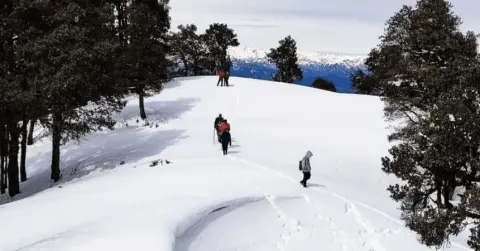
Nag Tibba. Snow lies on its upper forest and summit from late December; our Nag Tibba best-time guide compares the winter months.
Benog Tibba is not a snow trek. From December to February the trail is dry and frosty, with frost on the meadow on most mornings, and a light dusting of snow is possible after a cold spell. Winter days on Benog Tibba are 8°C to 15°C against 0°C to 9°C on Nag Tibba. Pick Benog for frost and clear views, and Nag Tibba if walking in snow is the point of the trip.
Which trek should you choose?
Match the trek to who is going and how much effort you want.
| Choose Benog Tibba if | Choose Nag Tibba if |
|---|---|
| A child of 6 to 8 is coming | Everyone in the group is 9 or older and walks regularly |
| You want to be back in Dehradun by early afternoon on Day 2 | You can get back by evening on Day 2 |
| A descent of about 140 m suits your knees | You can handle a descent of about 1,620 m |
| Winter frost and clear views are enough | You want snow underfoot in winter |
| You want the shortest walk, about 8 km in all | You want a summit climb of about 720 m before breakfast |
What will you see from each top?
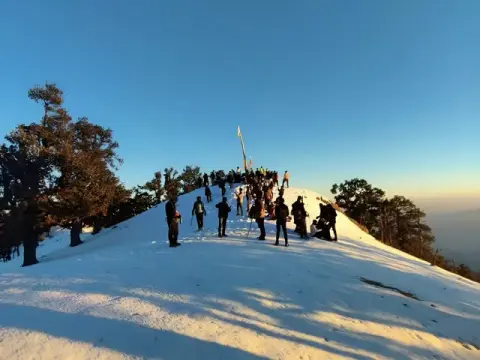
On clear days both tops show the same snow peaks to the north: Bandarpoonch, Swargarohini, Kala Nag and the Gangotri group. On very clear days Nag Tibba adds the Kedarnath peaks. Benog Tibba gives the Doon and Yamuna valleys on either side; the sun sets over the Yamuna valley before dinner, and on Day 2 you wake early for the sunrise, when the first light falls on the snow peaks.
The Benog trail also runs through the Benog Wildlife Sanctuary, where red-billed blue magpies, Himalayan woodpeckers and laughingthrushes live. Trekkaro arranges the sanctuary entry permit, which is checked at the forest check post, so keep a government photo ID handy. Our Benog Wildlife Sanctuary guide covers the forest and its birds.
How do the costs and logistics compare?
The Benog Tibba fee is ₹3,825 per person plus 5% GST (₹4,016 with GST), and the Nag Tibba fee is ₹3,825 per person plus 5% GST (₹4,016 with GST). Both include Free Trekking Gear (Decathlon trekking shoes, a jacket, trekking poles, gaiters and microspikes) against a ₹3,000 refundable deposit and a ₹200 washing charge, pure vegetarian meals, tents shared by three and forest permits. Meals run from Day 1 lunch to Day 2 breakfast on Benog Tibba and from Day 1 lunch to Day 2 lunch on Nag Tibba.
Transport is not included on either trek: we help the group book shared cabs, paid directly to the driver and split among trekkers, and your trek coordinator confirms the fare. On Nag Tibba you can leave bags you do not need free of charge in Trekkaro's store in Pantwari; valuables stay with you.
Cash and signal differ too. For Benog, Mussoorie and Dehradun have the last reliable ATMs, and Mussoorie has good mobile network while the sanctuary and camp are patchy. For Nag Tibba there is no ATM on the trail and Pantwari has only small bank branches, so carry cash from Dehradun or Mussoorie; Jio and Airtel work at Pantwari and patchily at camp, with little or no signal near the summit. On both treks every trekker brings a medical certificate signed by a doctor (the form is in My Bookings), and travel insurance covering high-altitude trekking and emergency evacuation is mandatory and not included. Before you go, check the forecast on the India Meteorological Department's Dehradun centre.
See Nag Tibba Trek dates and book | See Benog Tibba Trek dates and book | Where is Nag Tibba?
Frequently asked questions
Which is easier, Benog Tibba or Nag Tibba?
Benog Tibba is easier: about 8 km on foot with a gain of about 140 m. Nag Tibba is about 16 km, with about 900 m up on Day 1 and a long descent on Day 2.
Which trek is better for snow in winter?
Nag Tibba. Snow lies on its upper forest and summit from late December, with January and February the most reliable months, while Benog Tibba gets frost and only a light dusting after a cold spell.
Can a 6-year-old do the Nag Tibba trek?
No. The minimum age for Nag Tibba is 9. A 6-year-old who already walks regularly can join Benog Tibba with a parent or guardian.
Which is closer to Dehradun?
Benog Tibba. Cloud End is about 35 km and about 2 hours from Dehradun, while Pantwari, the Nag Tibba trailhead, is 88 km and about 4 hours away.
Can you see the same mountains from both treks?
Yes. Both show Bandarpoonch, Swargarohini, Kala Nag and the Gangotri group on clear days. Nag Tibba adds the Kedarnath peaks on very clear days.