This guide is about the Benog Tibba Trek — dates, price, day-by-day itinerary and booking are on the trek page.
Quick answer: Benog Wildlife Sanctuary, listed by the Environment Ministry as Mussoorie, covers 10.82 sq km of deodar, oak and rhododendron forest near Mussoorie in Dehradun district. Trekkaro's 2-day Benog Tibba trek climbs about 4 km through it from Cloud End (2,074 m) to the Jwala Devi temple top at 2,216 m, with the forest permit included.
Where is Benog Wildlife Sanctuary, and how big is it?
The sanctuary covers the forested ridge of Benog Tibba near Mussoorie, in Dehradun district of Uttarakhand. Two names point to the same forest. Locally it is called the Benog (Mussoorie) Wildlife Sanctuary, and the Ministry of Environment, Forest and Climate Change lists it simply as "Mussoorie" in its table of India's wildlife sanctuaries, with an area of 10.82 sq km.
That figure makes it the smallest of the seven Uttarakhand sanctuaries in the ministry's table. For scale, the same table gives Binsar 47.07 sq km, Govind Pashu Vihar 485.89 sq km and Kedarnath 975.2 sq km. The Govind forests around Kedarkantha are covered in our Govind National Park guide.
Trekkaro's batches enter the sanctuary at Cloud End, at about 2,074 m on its edge. Cloud End is 35 km from Dehradun, about 2 hours by road. The nearest airport is Jolly Grant (DED), about 25 km from Dehradun city, and Dehradun Railway Station is the cab pickup point. On Day 1 the group passes the forest check post, where the sanctuary entry permits are checked, and the walk begins there.
What is the forest like inside Benog sanctuary?
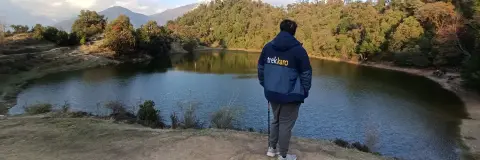
The path to Benog Tibba is a shaded forest trail through deodar, oak, pine and rhododendron, with old stone ruins and small clearings along the way. The height gain is small: the trail climbs from 2,074 m at Cloud End to 2,216 m at the top, a rise of about 142 m over roughly 4 km. Trekkaro grades the walk easy, and no previous trekking experience is needed.
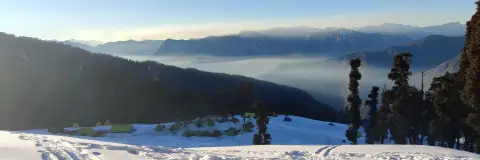
In winter the trail stays the same length but turns colder. Frost covers the meadow on most mornings, and a light dusting of snow is possible on the top in January. Microspikes and gaiters are part of the free gear for those cold mornings.
Which birds and animals live in Benog Wildlife Sanctuary?
Benog is a protected forest known for its birdlife. The Ministry of Tourism's Incredible India site counts over 200 species of resident and migratory birds there. The table lists the species each source names; a walk of a few hours cannot promise any single sighting.
| Bird or animal | What the source says | Source |
|---|---|---|
| Red-billed blue magpie | Likely to be spotted on the trail | Trekkaro trek leaders |
| Himalayan woodpeckers | Likely to be spotted on the trail | Trekkaro trek leaders |
| Laughingthrushes | Likely to be spotted on the trail | Trekkaro trek leaders |
| Himalayan quail | Once recorded in the Mussoorie hills; no confirmed sighting since the 1870s | Historical bird records |
| Himalayan monal, kalij pheasant, white-capped water redstart | Named among the sanctuary's birds | Incredible India |
| Himalayan goral, barking deer | Named among the sanctuary's animals | Incredible India |
Do you need a permit, and when is the sanctuary open?
Yes. The Benog Tibba trek lies inside the sanctuary and needs an entry permit. On Trekkaro's trek the forest permits and camping charges are part of the fee, and the permit is checked at the forest check post on Day 1. Carry a government photo ID for that check. Foreign nationals pay a flat forest fee of ₹1,000 per person at booking, with no GST, refunded in full if the booking is cancelled before the trek starts.
For day visitors, Incredible India lists the opening time as 7 AM and the closing time as 5 PM. A Trekkaro group stays the night at the camp beside the Jwala Devi temple, with the camping charges for that night paid as part of the trek.
What is the Jwala Devi temple on Benog Tibba?
The trail ends at the top of Benog Tibba, 2,216 m (7,270 ft), beside the small Jwala Devi temple. Trekkaro's camp is set up close to the temple, so the temple is both the summit and the night's stop.
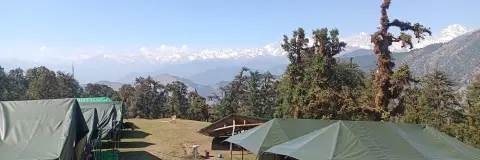
The group watches the sunset over the Yamuna valley from the camp. On a clear next morning you see Bandarpoonch, Swargarohini, Kala Nag (Black Peak) and the Gangotri group to the north, with the Doon valley and the Yamuna valley on either side of the ridge.
How does the Benog Tibba trek cross the sanctuary?
The Benog Tibba trek is a 2-day walk of about 8 km, up and back on the same forest trail.
| Stage | Distance | Time | Height |
|---|---|---|---|
| Day 1: Cloud End to Benog Tibba top and camp | About 4 km on foot | 2 to 3 hours | 2,074 m to 2,216 m |
| Day 2: Top back to Cloud End | About 4 km on foot | 1.5 to 2 hours | 2,216 m to 2,074 m |
Cloud End is the road head on both days, and the group is back in Dehradun by early afternoon on Day 2. Natural water sources inside the sanctuary are scarce, so each person carries at least 2 litres on Day 1. Mobile network is good in Mussoorie but patchy inside the sanctuary and at camp, and the last reliable ATMs are in Mussoorie and Dehradun.
When is the best time to visit Benog Wildlife Sanctuary?
Trekkaro runs Benog Tibba from September to June, with winter batches from December to February, and pauses the trek for the monsoon. The camp temperatures below are Trekkaro's figures for each season.
| Months | Day | Night | What it means on the trail |
|---|---|---|---|
| March to June | 15°C to 25°C | 7°C to 12°C | The mildest nights of the year at camp |
| September to November | 12°C to 20°C | 5°C to 10°C | Cool nights after the monsoon break |
| December to February | 8°C to 15°C | -3°C to 4°C | The coldest nights; pack the warmest layer |
Pick December to February for frost and the coldest night out, and March to June for the warmest one. Check the IMD Dehradun forecast for the district in the days before you travel.
What does the Benog Tibba trek cost and include?
The fee is ₹3,825 per person plus 5% GST (₹4,016 with GST). EMI starts at ₹197 a month. The fee covers:
- Free Trekking Gear (Decathlon trekking shoes, a -10°C jacket, trekking poles, gaiters and microspikes), against a ₹3,000 refundable deposit and a ₹200 washing charge
- One night in tents shared by 3, with men and women in separate tents, plus sleeping bags, mats, a dining tent and a toilet tent
- Pure vegetarian meals from Day 1 lunch to Day 2 breakfast, with tea and snacks
- Sanctuary permits and camping charges
- A trek leader, a local guide, a cook and support staff
Transport between Dehradun and Cloud End is not in the fee. Trekkaro helps the group book shared cabs from Dehradun Railway Station, paid directly to the driver, and your trek coordinator confirms the fare. Travel insurance that covers high-altitude trekking and evacuation is mandatory and not included, so buy your own. Every trekker brings a medical certificate signed by a doctor; the form is in My Bookings.
Children aged 6 and above who already walk regularly can join with a parent or guardian. Batches take up to 20 trekkers with one leader or guide for every 8, and online booking closes at 5 PM India time the day before the trek starts.
See Benog Tibba trek dates and book | Treks near Dehradun | Best winter treks for beginners
Frequently asked questions
Is Benog Wildlife Sanctuary the same as Mussoorie Wildlife Sanctuary?
Yes. The Environment Ministry lists the sanctuary as Mussoorie, with an area of 10.82 sq km, and locally it is called the Benog (Mussoorie) Wildlife Sanctuary. Both names refer to the forest around Benog Tibba in Dehradun district.
Do you need a permit to enter Benog Wildlife Sanctuary?
Yes. The Benog Tibba trek is inside the sanctuary, and the entry permit is checked at the forest check post where the walk begins. On Trekkaro's trek the permit and camping charges are included in the fee, and each trekker carries a government photo ID.
What are the timings of Benog Wildlife Sanctuary?
The Ministry of Tourism's Incredible India site lists the sanctuary as open from 7 AM to 5 PM for visitors. Trekkaro's group camps overnight beside the Jwala Devi temple, with the camping charges paid as part of the trek fee.
Which birds can you see in Benog Wildlife Sanctuary?
Red-billed blue magpies, Himalayan woodpeckers and laughingthrushes are the birds you are most likely to spot on the trail. Incredible India adds the Himalayan monal, the kalij pheasant and the white-capped water redstart among more than 200 species recorded there.
How far is the Jwala Devi temple from Cloud End?
About 4 km on a shaded forest trail, which takes 2 to 3 hours on the way up and 1.5 to 2 hours on the way down. The temple stands at the top of Benog Tibba at 2,216 m, about 142 m above Cloud End.