This guide is about the Aancha Top Trek — dates, price, day-by-day itinerary and booking are on the trek page.
Quick answer: The Aancha Top trek is graded Easy–Moderate and suits fit beginners from age 10, with no trekking experience needed. You walk about 22 km over four days and climb 1,684 m to the 3,818 m summit. The hard parts are a steep one-hour climb to Dinnala and an 8 km, 6–7 hour summit day on a rocky ridge.
How difficult is the Aancha Top trek?
The Aancha Top trek is graded Easy–Moderate: 6 days from Dehradun to Dehradun, with 4 trekking days from Ranachatti (2,134 m / 7,000 ft) to the summit at 3,818 m (12,525 ft) and back. Nothing on the route is technical, but the grade does not mean every day is easy. The first two trekking days are kept short so your body can adjust to the height, Day 3 holds an hour of steep forest climbing, and summit day is long, with narrow, rocky and exposed ridge sections and no water on the way. In winter, snow makes every day harder and colder.
How much walking and climbing does each day involve?
The table takes the distance, time and camp heights from the itinerary and works out the height gained and lost. Day 1 and Day 6 are drives of about 160 km and 6–7 hours between Dehradun and Ranachatti.
| Day | Route | Distance | Walking time | Height up | Height down |
|---|---|---|---|---|---|
| Day 2 | Ranachatti (2,134 m) to Bamsingh (2,804 m) | 4 km | 3–4 hours | 670 m | – |
| Day 3 | Bamsingh to Dinnala Bugyal (3,277 m) | 4 km | About 4 hours | 473 m net | A short drop to Daloti Gad |
| Day 4 | Dinnala to Aancha Top (3,818 m), then Aancha camp (3,475 m) | 8 km | 6–7 hours | 541 m | 343 m |
| Day 5 | Aancha camp to Ranachatti (2,134 m) | 6 km | About 5 hours | – | 1,341 m |
| Total | Ranachatti to Ranachatti | 22 km | 18–20 hours | 1,684 m | 1,684 m |
The daily distance is modest, 4–8 km, so the effort comes from the slope rather than the length. The trek also loses all 1,684 m of its height in two days, which is why the descents need as much respect as the climbs.
Which days are the hardest, and why?
Day 3: the steep climb to Dinnala
Day 3 is only 4 km, but the itinerary calls it the steepest climb of the trek so far. The trail drops to a stream crossing at Daloti Gad, then climbs steeply through the forest for about an hour before Dinnala Bugyal opens out at 3,277 m. Trekkaro’s trek leaders walk the group in a line, with a gap between trekkers and feet on solid ground rather than loose stones. Short, frequent pauses work far better here than long stops.
Day 4: the summit ridge
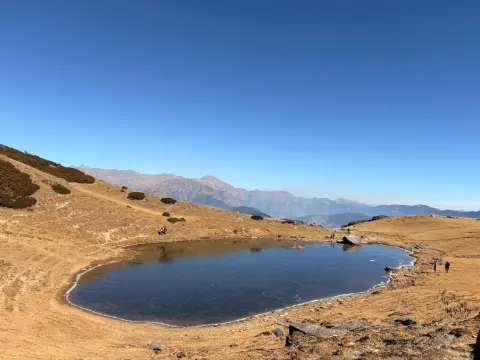
Summit day is the longest and hardest day of the trek. You leave Dinnala before sunrise with at least two litres of water, because there is none on the route. The first part, across the upper meadows and past three small glacial lakes, can be taken at an easy pace. Then the ridge begins: a few stretches are narrow, rocky and exposed, with loose stones underfoot. The trek leader guides each step; you keep your hands free and put your poles away on the rocky sections when asked. Groups reach Aancha Top between 9 and 10 AM and stay 30 to 45 minutes, and the same care applies on the way down to the Aancha campsite.
Day 5: the long descent
Day 5 runs almost entirely downhill, through open meadows and the clearing of Pokhari Thathar, then steeply through pine, silver birch and oak to Ranachatti. Downhill is where tired legs make mistakes, so shorten your step, keep your knees soft and keep the same careful pace on the last steep section into the village, where many slips happen.
Is the Aancha Top trek good for beginners, and who should think twice?
The trek suits fit beginners, and you do not need previous trekking experience. From April to June and from September to November, when the trail is snow-free, it suits first-timers; for a winter snow summit Trekkaro recommends one earlier Himalayan trek, though it is not compulsory.
The minimum age is 10, and trekkers under 18 come with a parent or guardian. There is no upper age limit; trekkers above 60 need good fitness, and Trekkaro recommends an ECG or TMT report. Every trekker brings a medical certificate signed by a doctor (the form is in My Bookings) and travel insurance that covers high-altitude trekking and emergency evacuation.
The trek page asks you to think twice if any of these is true for you:
- Narrow, exposed ridge sections with loose stones worry you.
- A 6–7 hour summit day with no water on the route is beyond your training.
- You need phone signal, and there is little or none after Ranachatti.
Shoes, a jacket rated to -10°C, poles, gaiters and microspikes come with Free Trekking Gear, and what the fee, cab and gear deposit add up to is set out in our Aancha Top trek cost guide.
How should you train for the Aancha Top trek?
You should be comfortable walking 5–7 hours a day on uneven ground. As a benchmark, aim to jog 5 km in under 40 minutes, and allow 4–6 weeks of training with running, cycling or swimming. The trek page also suggests brisk walks, stairs or uphill walking, with squats and lunges for the descents, which matter on a trek that drops 1,341 m on its last trekking day. Trekkaro’s free 2-minute fitness test, Am I Ready?, gives a quick read before you book.
How high does the trek go, and what does the health advisory say?
The highest point is 3,818 m, and the trek page rates the risk of altitude sickness as low to moderate. The itinerary sets daily distance and height gain so your body can adjust, which is why Day 2 ends with a free afternoon at Bamsingh.
Uttarakhand’s Char Dham Yatra health advisory, Swasth Satark Safal Yatra, advises “No more than 800 - 1000 meters of elevation gain per day” and rest of “5 - 10 mins for 1 hour of trek”. The biggest rise from one camp to the next on Aancha Top is the 670 m from Ranachatti to Bamsingh. The advisory lists warning signs including chest pain, shortness of breath, persistent coughing, dizziness or disorientation and vomiting, and asks people with a history of heart disease, hypertension, asthma or diabetes to get a health check-up first.
On the trek, report a headache, nausea, dizziness or breathlessness to the trek leader at once; rest and going lower are the best treatment. Our altitude sickness guide explains the signs in more detail.
What safety cover does a Trekkaro batch carry?
Batches take up to 20 trekkers, with one trek leader or guide for every 8. Trekkaro’s trek leaders are trained in wilderness first aid, have completed a basic mountaineering course and lead with local guides who know the route, its weather and its campsites.
- SpO2 and pulse are checked twice a day at every campsite, along with blood pressure, and a falling SpO2 reading is acted on early.
- One oxygen cylinder and one stretcher go with every batch, along with a first-aid kit.
- The team keeps in touch by radio, as mobile signal is not reliable on the trail.
- No doctor joins the trek; if you are not fit to continue, the trek leader will ask you to rest or descend, and that decision is final.
Keep your cap and gloves on at the top, even for photos, because taking them off in the morning wind on an open top is dangerous.
How is snow handled on the ridge?
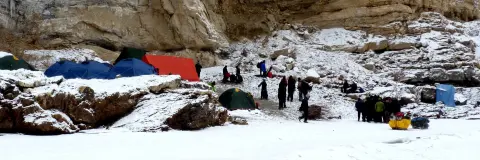
Ropes are not used on this trek. After fresh snowfall the trek team clears the trail, cuts steps where needed and helps you across slippery sections, and microspikes and gaiters from Free Trekking Gear go on. Which months bring snow is covered in our Aancha Top best time guide.
See Aancha Top trek dates and book | Altitude sickness on Himalayan treks | Highest treks in Uttarakhand
Frequently asked questions
Can a 10-year-old do the Aancha Top trek?
Yes, the minimum age is 10. Trekkers under 18 must come with a parent or guardian.
Do I need trekking experience for the Aancha Top trek?
No experience is needed from April to June and September to November. For a winter snow summit, one earlier Himalayan trek is recommended but not compulsory.
Is there a technical section on the Aancha Top trek?
Nothing is technical, and ropes are not used. The final climb follows a narrow, rocky ridge where the trek leader guides each step.
How much water should I carry on summit day?
Carry at least two litres, because there is no water on the route on Day 4. Fill your bottles at camp the evening before.
What happens if I feel unwell on the trek?
Report a headache, nausea, dizziness or breathlessness to the trek leader at once. The trek leader will ask you to rest or descend if you are not fit to continue, and that decision is final.