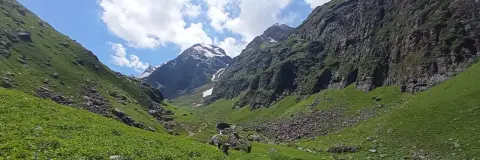
This guide is about the Kalpeshwar Rudranath Trek — dates, price, day-by-day itinerary and booking are on the trek page.
Quick answer: Rudranath temple is at 3,600 m (11,811 ft) in Chamoli district, Uttarakhand, and the Chamoli district page gives the trek from Sagar village as 20 km. On the 8-day Kalpeshwar Rudranath trek you walk about 66 km, reach the temple on Day 6 from the Panar Bugyal camp (3,400 m) and come down 12 km to Sagar on Day 7.
How far is Rudranath from Sagar?
Rudranath is a 20 km trek from Sagar, the village near Gopeshwar that the district page names as the entry point. That is the figure on the Chamoli district page for Rudranath temple. The same page puts Gopeshwar about 258 km from Jolly Grant airport, Dehradun, and about 241 km from the railhead at Rishikesh. On the trek, cabs drive the 5 km from Sagar down to Gopeshwar on Day 8 before the run to Rishikesh.
Trekkaro’s own figures for the same stretch come out close to that. On the trek, the walk between Panar Bugyal and Sagar is 12 km, and the temple day from Panar is a 14 km round trip, about 7 km each way. Together that is about 19 km between Sagar and the temple.
| Stretch | Distance on foot | Height at each end | On the Trekkaro trek |
|---|---|---|---|
| Sagar to Panar Bugyal, via Lyuti Bugyal | About 12 km | 2,000 m and 3,400 m | Walked downhill on Day 7, about 1,400 m of descent |
| Panar Bugyal to Rudranath, over the Pitradhar ridge | About 7 km | 3,400 m and 3,600 m | Walked there and back on Day 6, 14 km in all |
| Sagar to Rudranath, one way | About 19 km (the district page says 20 km) | 2,000 m and 3,600 m | Covered in pieces on Days 6 and 7 |
How high is Rudranath temple?
Rudranath temple is at 3,600 m (11,811 ft), the highest point of the trek. The other heights on the route:
| Place | Height | What it is on the trek |
|---|---|---|
| Devgram, Urgam valley | 2,020 m | Start of the walk; guesthouse on Days 1 and 2 |
| Kalpeshwar temple | 2,200 m | Visited on Day 2, a 4 km round trip |
| Bansi Narayan | 3,500 m | Camp on Day 3, by the temple |
| Dumak | 2,400 m | Roadless village; homestay on Day 4 |
| Panar Bugyal | 3,400 m | High meadow camp on Days 5 and 6 |
| Rudranath temple | 3,600 m (11,811 ft) | Visited on Day 6 |
| Sagar | 2,000 m | End of the walk on Day 7 |
The Chamoli district page prints a different altitude, 2290 metres, for the temple. That figure does not fit the route: Sagar, the entry point the same page names, is already at about 2,000 m, and Panar Bugyal, the camp below the temple, is at 3,400 m. Trekkaro uses 3,600 m, the height on its trek page, and that is the figure in this article.
The district page describes Rudranath as one of the Panch Kedar temples of Lord Shiva, where the face of Lord Shankar is worshipped.
How long is the whole Kalpeshwar Rudranath trek, day by day?
The trek is 8 days from Rishikesh to Rishikesh, with about 66 km on foot over Days 1 to 7. It goes in through the Urgam valley and comes out at Sagar.
| Day | Route | On foot | Time | Height change |
|---|---|---|---|---|
| 1 | Drive about 250 km from Rishikesh, then walk to Devgram | 2 km | 9 to 10 hrs drive | Ends at 2,020 m |
| 2 | Devgram to Kalpeshwar temple and back | 4 km | 2 to 3 hrs | Up to 2,200 m and back |
| 3 | Devgram to Bansi Narayan via Bansa | 12 km | 8 to 10 hrs | About 1,480 m up |
| 4 | Bansi Narayan to Dumak via Kalgoat | 10 km | 5 to 6 hrs | About 1,100 m down |
| 5 | Dumak to Panar Bugyal via Toli | 12 km | 6 to 8 hrs | About 1,000 m up |
| 6 | Panar to Rudranath and back | 14 km | 7 to 9 hrs | Up to 3,600 m and back to 3,400 m |
| 7 | Panar to Sagar via Lyuti Bugyal | 12 km | 4 to 5 hrs | About 1,400 m down |
| 8 | Drive about 230 km from Sagar to Rishikesh via Gopeshwar | None | 8 to 9 hrs drive | Back to Rishikesh |
| Total on foot | About 66 km | – | Highest point 3,600 m | |
Day 8 reaches Rishikesh in the evening, so plan onward travel for late that night or later.
Why does the trek take 66 km to reach a temple 20 km from Sagar?
Because the route is built for two temples and for the height. Day 2 is a gentle acclimatisation day with the walk to Kalpeshwar, a cave shrine beside the Kalp Ganga stream and the only one of the five Panch Kedar temples open all year. You then sleep at Bansi Narayan (3,500 m) and Panar (3,400 m), which the trek page calls two chances to adjust before the temple day, and you sleep at Panar, not at the temple. The trek page warns that the stone-paved descent to Sagar on Day 7 is steep and hard on the knees.
Which day is the hardest?
Day 3 is the hardest: about 12 km and 8 to 10 hours, climbing roughly 1,480 m through oak and rhododendron forest from Devgram to the camp by the Bansi Narayan temple.
Day 6, the temple day, is the longest day on foot. It is about 14 km and 7 to 9 hours at altitude, over the Pitradhar ridge to Rudranath and back to Panar. The trek page asks you to carry at least 2 litres of water from Panar for this day.
Day 7 is short in hours but steep: about 1,400 m down to Sagar, with long sections of stone steps. Trekking poles help on this descent; our guide on how to use trekking poles covers adjusting them for the way down.
The trek page grades the route moderate, at the harder end of the grade because of its length. Prepare for about eight weeks, building up to a 5 km jog in about 35 minutes and four- to five-hour walks with a loaded backpack. The minimum age is 12, and trekkers under 18 come with a parent or guardian.
When is Rudranath open, and how cold is it?
Rudranath temple opens in May and closes in October, after which the deity moves to the Gopinath temple in Gopeshwar for the winter. Trekkaro runs the trek from mid-May to June and from September to mid-October, inside those months.
| Months | Day temperature | Night temperature |
|---|---|---|
| Mid-May to June | 12°C to 22°C | -2°C to 10°C |
| September to mid-October | 10°C to 18°C | -5°C to 5°C |
Mobile signal is patchy in the Urgam valley and absent from Bansi Narayan to Rudranath; it returns at Sagar. The last ATM is in Chamoli, so carry small notes.
What should you check before you book a trek to Rudranath?
The last column gives Trekkaro’s answers.
| What to check | Why it matters | With Trekkaro |
|---|---|---|
| How many nights at height before the temple day? | Reaching 3,600 m with no nights above 3,000 m leaves your body no time to adjust. | Nights at Bansi Narayan (3,500 m) and two at Panar (3,400 m) before and after the temple. |
| Who handles the forest registration? | The route runs through forest land that needs registration and fees. | Forest registration with the Kedarnath Wildlife Division is arranged by Trekkaro, with the fees included. Our page on the Kedarnath Wildlife Sanctuary explains the protected area. |
| What happens to your extra luggage? | Luggage left at the start cannot be brought to the end of the trek. | No store on this route; one 50 to 60 litre backpack, extra bags left with your hotel or a friend in Rishikesh. Backpack offloading is an optional extra. |
| Is gear included? | Nights at Panar and Bansi Narayan drop below freezing. | Free Trekking Gear: Decathlon trekking shoes, a -10°C jacket, trekking poles, gaiters and microspikes, with a ₹3,000 refundable deposit and a ₹200 washing charge; the deposit comes back within 7 working days of the gear check. |
| What help travels with the group with no signal for days? | From Bansi Narayan to Rudranath there is no mobile network. | Pulse oximeter and BP checks twice a day at every campsite; one oxygen cylinder, one stretcher and a first-aid kit with every batch. |
| How many trekkers per trek leader or guide? | Day 3 runs 8 to 10 hours and Day 6 runs 7 to 9 hours. | Up to 20 trekkers per batch, one trek leader or guide for every 8. Leaders are trained in wilderness first aid and lead with local guides. |
What does the Kalpeshwar Rudranath trek cost?
The Kalpeshwar Rudranath trek fee is ₹22,000 per person plus 5% GST (₹23,100 with GST). EMI starts at ₹1,132 a month. It covers guesthouse nights, the homestay at Dumak and tents shared by three (men and women in separate tents), vegetarian meals from dinner on Day 1 to breakfast on Day 8, forest permits, camping equipment, the trek leader, a local guide, a cook and support staff, and the Free Trekking Gear. Transport is not included: shared cabs are arranged and paid directly to the driver, and your trek coordinator confirms the fare. Every trekker brings a medical certificate signed by a doctor (the form is in My Bookings) and an original government photo ID with a photocopy, and travel insurance that covers high-altitude trekking and evacuation is mandatory and not included. Live batch dates and fees are on the Kalpeshwar Rudranath trek page.
See Kalpeshwar Rudranath Trek dates and book | Altitude sickness on Himalayan treks | Medical certificate for trekking
Frequently asked questions
What is the distance of the Rudranath trek from Sagar?
The Chamoli district page gives the trek from Sagar to Rudranath as 20 km. Trekkaro’s stage distances, 12 km from Sagar to Panar Bugyal and about 7 km on to the temple, add up to about 19 km.
What is the height of Rudranath temple?
Rudranath temple is at 3,600 m (11,811 ft), the highest point of the Kalpeshwar Rudranath trek. The last camp below it, Panar Bugyal, is at 3,400 m.
How many km is the Kalpeshwar Rudranath trek?
It is about 66 km on foot over 8 days from Rishikesh to Rishikesh. The temple day is about 14 km there and back from Panar.
Which months is Rudranath temple open?
Rudranath opens in May and closes in October, and in winter the deity moves to the Gopinath temple in Gopeshwar. Trekkaro runs the trek from mid-May to June and from September to mid-October.
What should I look for when choosing a company for the Rudranath trek?
Check how many nights you spend above 3,000 m before the temple day, who arranges the forest registration and how luggage works on a route that ends in another valley. Then compare the health checks, the 1:8 ratio and what is in the fee.