This guide is about the Gaumukh Tapovan Trek — dates, price, day-by-day itinerary and booking are on the trek page.
Quick answer: Tapovan, the meadow at 4,463 m (14,640 ft) above the Gaumukh glacier snout, sits at about −5°C to 3°C from mid-May to June and −8°C to 2°C from mid-September to October. Gangotri, where the trek starts, stays at about 5°C to 18°C. The route closes in July and August for the monsoon, and it is open only between the Gangotri temple’s opening and closing. The Gaumukh Tapovan trek package runs in two windows: mid-May to June and mid-September to October.
This guide is about Tapovan above Gaumukh in Uttarkashi district, not the Tapovan area of Rishikesh.
What is the temperature at Gaumukh and Tapovan?
The trek page gives these ranges for the two trekking windows, from the start at Gangotri to the highest camp at Tapovan:
| Place | Height | Mid-May to June | Mid-September to October |
|---|---|---|---|
| Gangotri | 3,065 m (10,056 ft) | 5°C to 15°C | 5°C to 18°C |
| Bhojbasa camp | 3,775 m (12,385 ft) | −2°C to 5°C | −3°C to 8°C |
| Tapovan camp | 4,463 m (14,640 ft) | −5°C to 3°C | −8°C to 2°C |
Gaumukh, the glacier snout at 3,892 m (12,770 ft), lies between Bhojbasa and Tapovan. You pass it on the way up on Day 4 and do not sleep there. The trek page gives no separate temperature for it.
Where do you sleep, and how cold is each night?
The trek climbs in steps, and the coldest night is the one at Tapovan:
| Night | Camp | Height |
|---|---|---|
| Day 1 | Gangotri | 3,065 m (10,056 ft) |
| Day 2 | Chirbasa | 3,600 m (11,808 ft) |
| Day 3 | Bhojbasa | 3,775 m (12,385 ft) |
| Day 4 | Tapovan | 4,463 m (14,640 ft); the highest and coldest night |
| Day 5 | Bhojbasa | 3,775 m (12,385 ft) |
| Day 6 | Gangotri | 3,065 m (10,056 ft) |
Above Gangotri, every night from Day 2 to Day 5 is spent above 3,500 m, and the Tapovan night can fall to −8°C in October. Trekkaro uses double-wall, rain-rated tents and −20°C sleeping bags at every campsite. Our guide to altitude sickness on Himalayan treks lists the warning signs to watch for at these heights.
What is the weather like at Gaumukh month by month?
| Months | Status | What to expect |
|---|---|---|
| Late April to early May | Season opening | The Gangotri temple opens in late April or early May, on the Char Dham calendar; the trek window starts from mid-May |
| Mid-May to June | Open | Snow on the trail above Chirbasa, Tapovan partly under snow, the Bhagirathi at its fullest, wildflowers on the lower trail from late May |
| July and August | Closed | Monsoon: rockfall in the gorge, flash floods and a dangerous wet moraine |
| Early to mid-September | Drying out | The monsoon ends, and the trail takes about two weeks to dry |
| Late September to October | Open; the best weather | A dry trail, the most stable moraine and the clearest views of the year; very cold nights at Tapovan |
| Late October to early November onwards | Season over | The Gangotri temple closes for the winter, which ends the trek window |
The temple dates change every year, so check before you go.
What is Gaumukh and Tapovan like from mid-May to June?
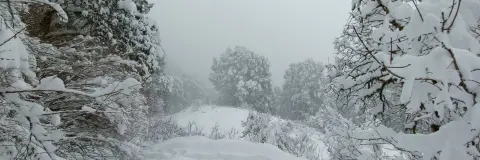
The trail still carries winter snow above Chirbasa, and the Tapovan meadow is partly snow-covered in May and early June. The snow makes Shivling (6,543 m) look dramatic from camp, but it also means you need microspikes and careful steps on the moraine between Gaumukh and Tapovan. Microspikes are part of the Free Trekking Gear.
The Bhagirathi runs at its strongest in late May and June, fed by snowmelt. The air is sharp and clear before the pre-monsoon haze builds, wildflowers start to appear on the lower trail from late May, and there are fewer trekkers than in autumn.
Is the Gaumukh Tapovan trek open in the monsoon?
No. The route is closed in July and August. The canyon walls above Chirbasa shed rocks onto the trail, flash floods hit the Bhagirathi gorge, and the glacier moraine above Gaumukh becomes very dangerous when wet. After the monsoon ends in early to mid-September, the trail takes about two weeks to dry out.
Why is late September to October the best weather for Tapovan?
By late September the upper route is clear, the moraine is at its most stable and the views are the sharpest of the year. At dawn and dusk the low sun turns the face of Shivling orange and rose. The days are crisp and clear, but the nights at Tapovan are very cold, at −8°C to 2°C, so the warmth of your sleeping bag matters. For the best mix of trail, weather and views, the trek page recommends a batch from late September to mid-October.
The window ends when the Gangotri temple closes for the winter, in late October or early November.
What should you wear for the cold at Tapovan?
| When | Wear or carry |
|---|---|
| Walking by day | A quick-dry base layer, a fleece, sunglasses and sunscreen; the sun is strong on snow and bare rock |
| Evenings and nights at Bhojbasa and Tapovan | Thermals, a fleece, a heavy jacket, gloves, a warm cap and woollen socks |
| On the moraine in May and June | Microspikes and gaiters, with poles for balance |
Free Trekking Gear covers Decathlon trekking shoes, a −10°C jacket, trekking poles, gaiters and microspikes, against a ₹3,000 refundable deposit plus ₹200 for washing. Bring your own clothing layers, backpack and sunglasses.
Can you check the Gaumukh weather on the trail?
Only up to Gangotri. Gangotri is the last place with a stable mobile signal, where BSNL, Jio and Airtel work; beyond it there is almost no signal. Check the forecast and make your calls at Gangotri on Day 1. The last reliable ATM before Gangotri is at Bhatwari.
What should you check before booking a Gaumukh Tapovan trek?
Ask any company these questions; the last column gives Trekkaro’s answers.
| What to check | Why it matters | With Trekkaro |
|---|---|---|
| Which months does the batch run? | The route is closed in the monsoon, and the season follows the Gangotri temple. | Mid-May to June, and mid-September to October. |
| What tents and sleeping bags are used? | Tapovan can fall to −8°C in October. | Double-wall, rain-rated tents and −20°C sleeping bags at every campsite. |
| Is there an acclimatisation night before Tapovan? | Tapovan is the highest camp, at 4,463 m. | Day 3 at Bhojbasa is a short day, designed for acclimatisation. |
| Who arranges the permits? | Gangotri National Park has permit quotas. | Trekkaro arranges the park permits and the Gaumukh entry fees. |
| What are the cancellation terms? | Weather can change your plans after you book. | 70% back at 30 or more days, 50% at 15 to 29 days, no cash refund at 8 to 14 days and nothing at 7 days or less. Up to 8 days before, you can take a 100% TrekCash voucher (valid 1 year), one free reschedule or a transfer instead. |
What does the Gaumukh Tapovan trek cost?
The Gaumukh Tapovan trek fee is ₹16,500 per person plus 5% GST (₹17,325 with GST). EMI starts at ₹849 a month. It starts and ends at Gangotri. Transport between Dehradun and Gangotri is not included: Trekkaro helps the group book shared cabs, about ₹8,000 one way per 5 to 6 seat vehicle, paid directly to the driver and split among the trekkers in it. Travel insurance is mandatory and not included. Live batch dates are on the Gaumukh Tapovan trek dates and cost page.
See Gaumukh Tapovan Trek dates and book | Altitude sickness on Himalayan treks
Frequently asked questions
What is the temperature at Tapovan?
The trek page gives −5°C to 3°C from mid-May to June and −8°C to 2°C from mid-September to October, at 4,463 m (14,640 ft).
How cold is Gaumukh?
The trek page gives no figure for the snout itself, at 3,892 m. The camp below it, Bhojbasa at 3,775 m, is −2°C to 5°C in May and June and −3°C to 8°C in September and October.
Is the Gaumukh Tapovan trek open in July?
No. The route is closed in July and August because of rockfall, flash floods and a dangerous wet moraine.
Is there snow at Tapovan in May?
Yes. In May and early June the Tapovan meadow is partly snow-covered and the trail carries snow above Chirbasa, so microspikes are needed on the moraine.
When is the best time for the Gaumukh Tapovan trek?
Late September to mid-October, for a dry trail, a stable moraine and the clearest views. Mid-May to early June is the alternative, with snow at Tapovan and the river at its fullest.