
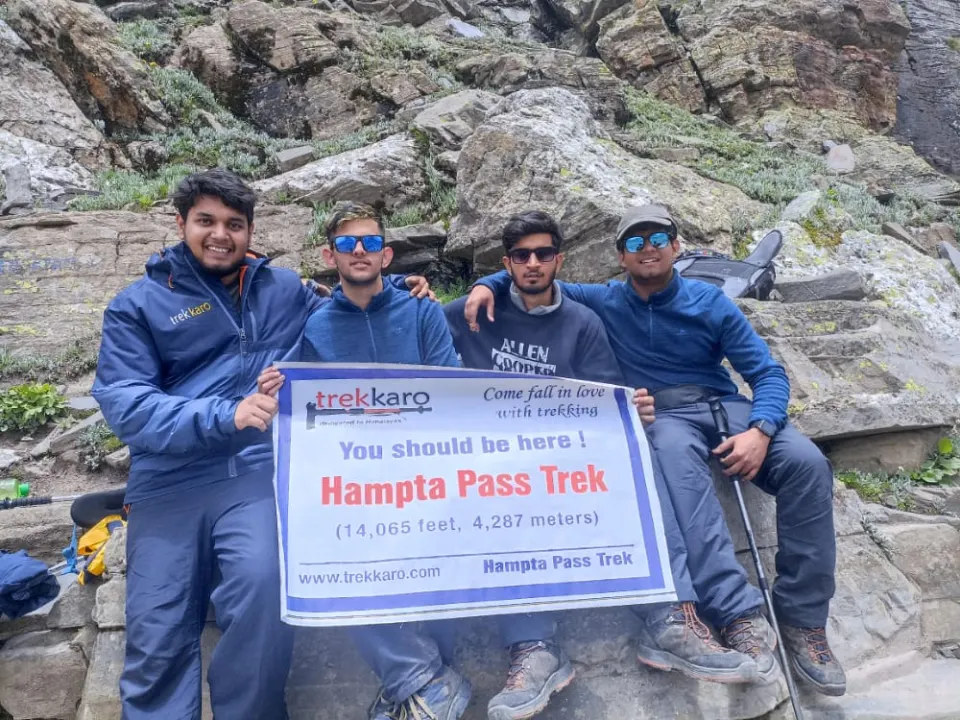
Hampta Pass Trek
Inclusion:
Meals on the Trek
All Permits
Expert Trek Leader & Guide
Hampta Pass Trek — Guide, Dates & Cost
Hampta Pass Trek is a 5-day moderate trek in Kullu, Himachal Pradesh, reaching 4,298 m (14,100 ft). It covers about 26.5 km on foot and starts and ends at Manali. Best time: June to September. Trekkaro price: ₹9,000 per person + 5% GST, with free microspikes & gaiters (no deposit, no charge); bring your own trekking shoes, jacket and poles. Next batch: 12 Jun 2027 (68 upcoming batches).
Updated
District: Kullu
Duration: 5 Days
Difficulty Level: Moderate
Highest Altitude: 4,298 m / 14,100 ft
Trekking Distance: 26.5 km
Temperature: Jun-mid Jul: Day 8°C to 18°C, Night -4°C to 0°C | Mid Jul-mid Aug: Day 12°C to 22°C, Night 2°C to 6°C | Mid Aug-Sep: Day 10°C to 20°C, Night 0°C to 4°C
One valley is carpeted in wildflowers and river mist. The other is a planet of silver rock and ancient silence. Between them, at 14,100 feet, sits a pass that delivers both in five extraordinary days and rewards you with a lake so beautiful it has no rival in the Himalayas.
The Hampta Pass trek is one of the most visually dramatic high-altitude crossings in the Indian Himalayas. In no other trek of comparable length and difficulty does the landscape transform so completely from one side of a mountain pass to the other. You begin in the lush, forested Kullu Valley above Manali, moving through meadows of rhododendron and streams fed by glacial meltwater. You cross a 14,100-foot pass in a single defining day – the air thin, the views absolute, the effort real. And then you descend into Spiti: treeless, raw, ancient, and unlike anything you have seen before. Hampta Pass is not just a trek. It is a journey between two worlds.
Hampta Pass (4,298 m / 14,100 ft) is a high-altitude mountain pass in the Kullu district of Himachal Pradesh, connecting the Kullu Valley on the western side with the Lahaul-Spiti Valley on the eastern side. The pass cuts through the Pir Panjal range of the western Himalayas and has been used as a trade and migration route between these contrasting ecological zones for centuries. Today it is one of the most celebrated moderate-grade treks in northern India, and for very good reason: the sheer variety of terrain, altitude, and landscape packed into five days makes it an experience that trekkers describe as disproportionately expansive for its length and difficulty rating.
The Two-World Phenomenon
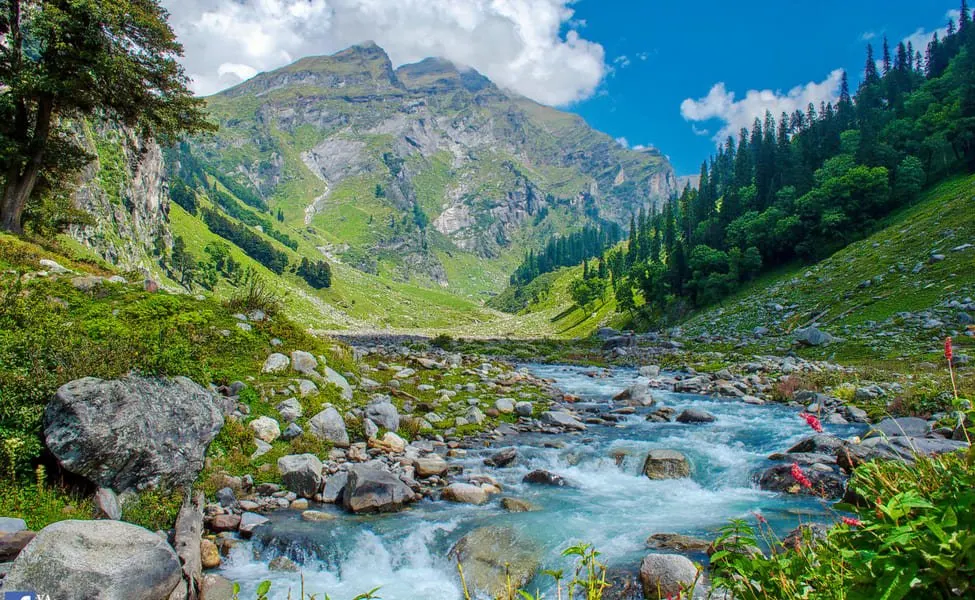
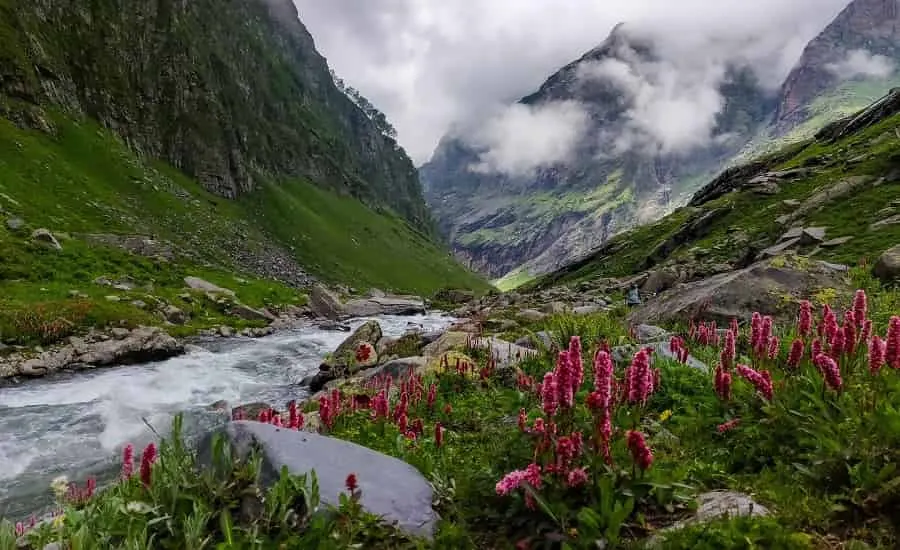
The defining characteristic of the Hampta Pass trek – the feature that sets it apart from virtually every other moderate-grade Himalayan route – is the landscape transformation that occurs at the pass itself. The Kullu side of the trail is green, wet, and verdant. Alpine meadows called buras stretch across wide glacial valleys. The Jobra stream runs cold and fast through dense forest. Wild bergenia, potentilla, and Himalayan blue poppy grow in profusion along the trail margins. The air feels alive with moisture and birdsong. Then you cross the pass, and the world ends. The Lahaul-Spiti side is a geological moonscape: silver-grey slopes stripped of vegetation by the rain shadow cast by the Pir Panjal range, sculpted river valleys of coloured scree and moraine, and the Chandra River cutting a turquoise line through the brown and ochre landscape below. No other accessible trek in India delivers this contrast so quickly and so absolutely.
Who Is This Trek For?
Hampta Pass is graded Moderate, making it suitable for trekkers with a baseline level of physical fitness and ideally some prior trekking experience, though confident first-timers who have prepared adequately have completed it successfully on Trekkaro batches. The trail involves sustained ascent on Day 3 and Day 4, with the pass crossing itself requiring 6 to 8 hours of continuous effort at altitude. The daily trekking hours range from 4 to 8 hours depending on the day. The minimum recommended age is 11 years. There is no upper age limit; trekkers above 60 need good fitness and a doctor’s medical certificate. If you can sustain a brisk uphill walk for 4 to 5 hours at sea level, Hampta Pass is achievable with proper preparation and the right pacing strategy.
The Chandratal – The Lake of the Moon
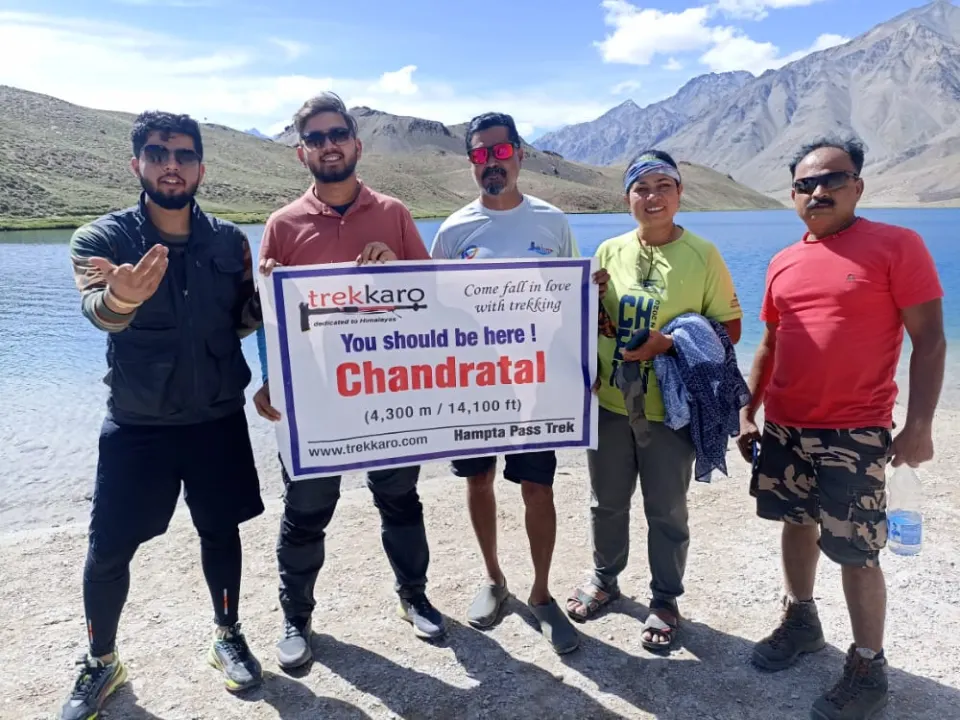
Chandratal Lake sits at 14,100 feet on the Spiti side of the Hampta Pass range, in a glacially carved bowl of absolute silence. Named for its crescent shape, with 'chandra' meaning 'moon', it is a UNESCO Ramsar Wetland of international importance and one of the most visually extraordinary places in the entire Himalayan range. In summer, the lake’s colour shifts throughout the day like a living thing: deep cobalt at dawn, brilliant turquoise by mid-morning, a jade-pale green where the shallows catch the afternoon light, and a dark pewter at dusk that mirrors the surrounding peaks with mirror-perfect clarity. There is no single photograph that captures it fully. You have to be there, standing at the edge, watching the water change colour in real time, to understand what makes trekkers describe Chandratal as the most beautiful place they have ever seen. On Day 4, the Trekkaro itinerary takes you there directly, not as an optional extra, but as a fully included, non-negotiable part of your Hampta Pass experience.
Key Highlights of the Hampta Pass Trek
- Cross the 14,100 ft Hampta Pass – 360-degree views of Kullu and Lahaul-Spiti simultaneously
- Chandratal Lake at 14,100 ft: crescent-shaped, colour-shifting between cobalt, turquoise and jade – included in the Trekkaro package
- Dense cedar and birch forest trail above Manali on Day 1 – the Himalayas at their most welcoming
- Wide-open alpine meadow trekking to Balu Ka Ghera with direct views of the pass ridge
- Fixed ropes on the steepest section below the pass – a safety step on Trekkaro batches
- Dramatic Spiti-side geology: rust, ochre, and silver rock with the Chandra River below
- Return through the Atal Tunnel – the world's longest highway tunnel above 10,000 ft
- NIM-certified Trekkaro trek leaders, daily health checks, and free microspikes and gaiters
Best Time to Visit Hampta Pass
The Hampta Pass trekking window is defined by snowmelt and snowfall. The pass remains buried under several metres of snow until late May or June, and it closes again under fresh snowfall by October. Within the open window, each month delivers a distinctly different experience.
June to Mid-July - Early Season (Snow on Pass)
June marks the opening of the Hampta Pass route. The pass itself retains significant snow cover well into June, knee-deep in places, and the upper trail is a river of meltwater and loose slush. For trekkers who want a snow-crossing experience, June delivers it in abundance. The Kullu Valley meadows are at peak bloom, carpeted in wildflowers immediately after the snowmelt, and the streams run at their most dramatic. The trade-off is a harder, wetter crossing and colder nights at camp. Our trek leaders assess pass conditions daily in June and adjust departure timings accordingly.
- Temperatures: Day: 8°C to 18°C | Night at camp: 0°C to -4°C
- Trail conditions: Snow on upper trail and pass. Wildflowers in meadows. Cold camp nights.
- Best for: Snow experience, wildflower photography, fewer crowds.
Mid-July to Mid-August - Peak Season (Recommended)
This is Trekkaro's most recommended window for Hampta Pass. The snow on the upper trail has consolidated or melted to manageable levels, the pass crossing is at its most stable, and the contrast between the green Kullu Valley and the bare Spiti landscape is at its most vivid. The weather is warm and clear in the mornings with occasional afternoon thunderstorms, a characteristic pattern of Himalayan summer that is entirely manageable with proper waterproof gear and good pacing. Streams are full and spectacular. Chandratal is at its deepest and most brilliantly coloured. This is when the trek looks exactly like the photographs that first made you want to do it.
- Temperatures: Day: 12°C to 22°C | Night at camp: 2°C to 6°C
- Trail conditions: Mostly clear. Some snow patches near the pass. Full streams.
- Best for: Best overall experience, vivid landscape contrast, Chandratal at full depth.
Mid-August to September - Late Monsoon / Post-Monsoon (Great Visibility)
Late August through September is an excellent and underappreciated window for Hampta Pass. The monsoon begins to weaken, bringing progressively clearer skies and some of the sharpest mountain visibility of the year. The meadows remain lush, Chandratal is still brilliantly coloured, and the post-monsoon atmosphere is crisp and cool without the frigid nights of October. Trail conditions are at their best by September. The main caveat is occasional residual monsoon rain bursts in late August – manageable with proper gear and flexible pacing.
- Temperatures: Day: 10°C to 20°C | Night at camp: 0°C to 4°C
- Trail conditions: Clear trails, crisp air, strong visibility. Occasional late-August rain.
- Best for: Clear summit views, crisp air, fewer crowds than peak July.
October Onwards – Closing Season (Advanced Trekkers Only)
October brings the first snows of winter back to the Hampta Pass area. The pass can receive fresh snowfall from mid-October onwards, making it technically challenging and increasingly dangerous for standard trek groups. Trekkaro runs Hampta Pass batches from June to September. The Spiti Valley below becomes rapidly inaccessible by road as winter closes in.
📅 Best months for the Hampta Pass Trek: June to September. Still choosing dates? Compare all treks in June, treks in July, treks in August and treks in September.
🏃 Am I ready for the Hampta Pass Trek? Take the free 2-minute fitness test and get your readiness score and a personal training plan.
Take the test →Trek Itinerary
Trekkers must book Volvo buses that reach Manali by 9:00 AM on Day 1. Reporting time is 10:00 AM at Manali Bus Stand. Missing it counts as a no-show (no refund, voucher, reschedule or transfer); if you are running late, tell the trek coordinator early. Always double-check bus timings with your transporter.
While booking return bus tickets, choose departures from Manali after 4:00 PM. This allows buffer time for traffic delays or roadblocks on the way.
Day 1: Manali to Jobra & Trek to Chika
Route Details:
Drive: Manali → Jobra (~23 km, ~45 min) | Trek: Jobra → Chika | Distance: ~2 km | Duration: 1-2 hours | Altitude: 9,800 ft → 10,400 ft
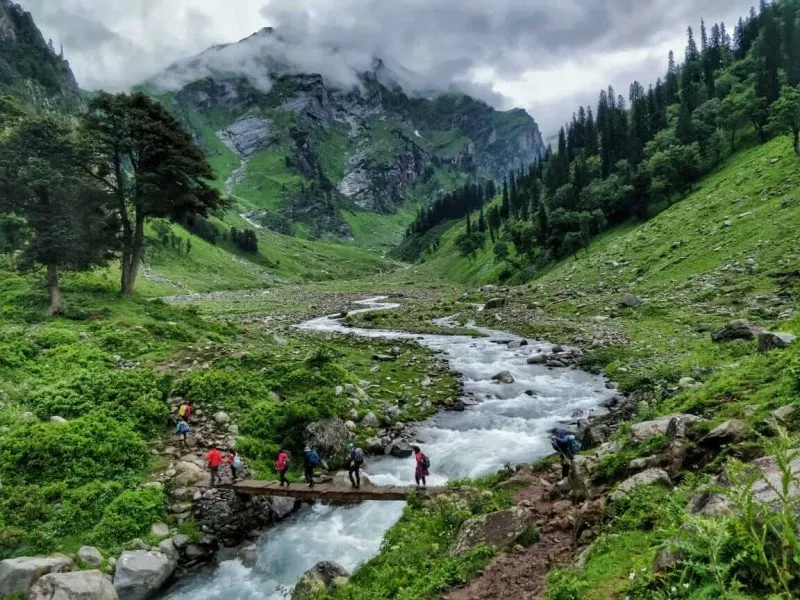
The Hampta Pass trek begins not with a dramatic vertical climb but with one of the gentlest, most beautiful introductions in Himalayan trekking. From Jobra, a quiet forest clearing near the Hampta village above Manali, the trail enters a dense cover of oak, birch, and conifer that filters the morning light into slanted gold columns. The Hampta stream runs alongside the path, visible through the trees and audible even when obscured, its glacial chill adding a particular quality of freshness to air that is already noticeably colder and cleaner than anything you breathed in Manali. This is the Himalayas at their most welcoming: physically unhurried, visually generous, and immediately removed from the noise of the world below.
The first day's trail is a confidence builder by design. The elevation gain is modest, roughly 600 feet over 2 kilometres, and the terrain is a well-defined forest path with some rocky sections near the stream crossings. First-time trekkers find their rhythm here, learning how their body responds to uphill movement at altitude and settling into the pace their guide sets. More experienced trekkers use the day to assess their kit: checking whether their boots are broken in enough, calibrating their layering to the ambient temperature, and adjusting their pack so that the weight sits correctly on their hips rather than their shoulders.
After approximately 1.5 hours of steady walking, the forest opens suddenly and dramatically into the wide, flat meadow at Chika. The transition from enclosed forest to open alpine meadow is one of the recurring visual rewards of the Hampta Pass trail, and it first delivers itself here in a way that stops most trekkers mid-step. Chika sits in a glacially carved valley bowl at 10,400 feet, ringed by green ridges and snow-patched peaks. The meadow is wide enough that tents spread across it feel small against the landscape. Streams from multiple directions converge nearby with an audible rushing that fills the campsite with a constant, peaceful sound. Dinner is served in the mess tent as the light on the surrounding ridges shifts from gold to pink to grey, and the temperature drops fast after sundown. Tonight, the mountains are showing you what is coming.
What to Expect:
- Drive from Manali to Jobra trailhead (~45 min) through the Kullu Valley
- Entry into dense oak and birch forest alongside the Hampta stream
- Gentle 600-foot altitude gain – ideal for acclimatisation and finding your rhythm
- Arrival at Chika Meadow Campsite (10,400 ft) with surrounding peak views
- First campsite dinner and overnight in Trekkaro tents
Day 2: Chika to Balu Ka Ghera
Route Details:
Altitude: 10,400 ft → 12,200 ft | Distance: ~8.5 km | Duration: 6 hours | Terrain: Alpine meadows, river crossings, moraine
Day 2 is when the Hampta Pass trail reveals itself in earnest. The gentle forest introduction of Day 1 gives way to a wide, open valley that climbs steadily toward the base of the pass in a series of terraced meadows separated by stream crossings and moraine fields. From the moment you leave Chika, the scale of the surrounding terrain becomes apparent in a way that the forest canopy had partially obscured. The ridgelines are higher. The peaks are closer. The valley ahead narrows visibly in the distance, converging on the snowy V-shaped notch of the pass itself, still two days away but already visible as a distinct feature on the horizon.
The trail to Balu Ka Ghera passes through some of the most spectacular open meadow terrain on the entire route. The Hampta River, which at this elevation is more accurately described as a collection of braided glacial streams flowing together across a wide, flat valley floor, provides a series of crossings that require careful foot placement and occasionally wet boots, depending on the time of season and the day's snowmelt rate. In June and early July, these crossings can be knee-deep and fast-moving; by August and September, they are ankle-deep and manageable with trekking poles for balance. Your guide will assess each crossing and assist trekkers individually if the water level is significant.
The upper section of the day's trail passes through a boulder field and low moraine before arriving at Balu Ka Ghera, literally 'home of sand' in the local dialect, named for the alluvial deposits that characterise the campsite's terrain. At 12,200 feet, Balu Ka Ghera is positioned directly at the foot of the pass approach, and the view from camp looking up the valley is one of the most memorable on the trek. The glacial headwall that forms the upper valley is fully visible, streaked with snow even in peak summer, and the pass, now clearly identifiable as the lowest point on the skyline ridge, feels suddenly close. Surrounding peaks include Deo Tibba (6,001 m) to the north and Indrasan (7,074 m) to the south, both visible in clear conditions from camp. Sleep early and sleep well. Tomorrow is the longest day.
What to Expect:
- Wide-open valley trekking through tiered alpine meadows with full peak views
- Multiple glacial stream crossings – difficulty varies by season and snowmelt rate
- Progressive altitude gain from 10,400 ft to 12,200 ft over 8.5 km
- First views of the Hampta Pass notch on the skyline ridge ahead
- Campsite at Balu Ka Ghera with Deo Tibba and Indrasan visible in clear conditions
Day 3: Balu Ka Ghera to Hampta Pass & Descent to Shea Goru
Route Details:
Altitude: 12,200 ft → 14,100 ft → 11,800 ft | Distance: ~10 km | Duration: 7-8 hours | Terrain: Snow, scree, steep ascent and descent
This is the day the entire trek has been building toward, and it earns its reputation completely. The Hampta Pass crossing is the defining experience of the trek – the physical, emotional, and visual centrepiece around which everything else organises itself. It is a demanding day: 10 kilometres of total distance, close to 2,000 feet of altitude gain in the morning followed by a steep 2,300-foot descent in the afternoon, all at elevations between 12,000 and 14,100 feet, where the available oxygen is roughly 40% less than at sea level. It is also the most scenic day of walking on this trek.
Departure from Balu Ka Ghera is early, 5:30 AM to 6:00 AM – to take advantage of the morning's firmer snow and to ensure the group crosses the pass and completes the descent before afternoon weather builds. The first two hours are a sustained ascent up the glacially carved valley above camp. The terrain is a mix of compacted snowfields, loose scree beneath the snow, and occasional exposed rock sections where the trail becomes a steep scramble. Your trek leader moves at a measured pace that prioritises consistent forward movement over speed. The altitude demands deliberate breathing; many trekkers adopt a rhythmic step-breath pattern that becomes almost meditative over the course of the ascent. Fixed ropes are installed by the Trekkaro technical team on the steepest section just below the pass, a safety measure that converts a potentially dangerous exposed slope into a confidently manageable climb.
The pass itself is a narrow, rocky ridge at 14,100 feet. When you step onto it, the world divides. Behind you: the green, water-rich Kullu Valley; the forested ridges of Manali visible in the far distance; and the braided streams of the Hampta River glittering two thousand feet below. In front of you: the Lahaul-Spiti Valley, grey and silver and brown and utterly barren, a high-desert terrain that looks like the surface of a planet where water has been absent for millennia. The Chandra River, a distant turquoise thread, cuts through the valley floor far below. Mountain ranges you have not seen before line the eastern horizon, the ridges of Ladakh and the Great Himalayan Range visible on clear days as a jagged white wall fifty miles away. Most trekkers stand on this ridge for longer than they intend to. The view in both directions simultaneously is genuinely difficult to fully absorb.
The descent to Shea Goru on the Spiti side is steep, loose, and technically demanding in places – arguably harder on the knees and concentration than the ascent. The trail drops quickly through a chute of loose scree and snow before levelling into the flat, rocky terrain of the Lahaul Valley floor. The landscape around you is completely transformed: no trees, no grass, no streams audible. Just rock and sky and the wind. Shea Goru campsite sits at the foot of the descent at 11,800 feet, and after the day's exertion, it feels like the most welcome place in the world. The silence here, in the absence of water sound and birdsong, is of a quality unlike anything on the Kullu side. You are in a different Himalaya now, and it will stay with you long after you have returned home.
What to Expect:
- Early 5:30 AM departure for firm snow and pre-afternoon weather window
- Sustained ~2,000 ft ascent on snow, scree, and exposed rock to the pass at 14,100 ft
- The pass: simultaneous 360-degree views of Kullu and Lahaul-Spiti – the defining moment of the trek
- Steep scree descent to Shea Goru (11,800 ft) on the Spiti side – trekking poles essential
- Overnight in the barren moonscape terrain of the Lahaul Valley floor
Day 4: Shea Goru to Chhatru and Drive to Chandratal Lake & back
Route Details:
Trek: Shea Goru → Chhatru | Distance: ~6 km | Duration: 3–4 hrs | Altitude: 11,800 ft → 10,900 ft Drive: Chhatru → Kunzum Pass → Chandratal Lake (≈ 60 km, ~2 hrs) | Walk to lake: ~2 km | Return to Chhatru overnight
After the enormous physical and emotional investment of Day 3, the morning of Day 4 begins gently and unhurriedly. The 6-kilometre trail from Shea Goru to Chhatru follows the Chandra River along the floor of the Lahaul Valley – mostly flat, occasionally undulating, with the river in constant sight and the dramatic bare ridgelines of the Spiti ranges flanking both sides of the path. This is the Himalayas with all softness removed: wide, open, and elemental, lit by a hard directional light that falls on bare rock with no canopy to diffuse it. Formations of deep rust, pale ochre, silver-grey, and dark volcanic brown rise above the path in layered geological exposures that read like pages of a very long book. You are walking across the floor of an ancient inland sea, and the landscape makes that legible in ways that no geology lesson could.
The Chandra River is one of the significant rivers of the western Himalayas, the headwater of the Chenab, and walking alongside it at this elevation carries a particular weight of significance. The river runs glacial-blue and fast, fed by snowfields above that are still visible on the ridgelines. Many trekkers use this morning to process what happened the previous day: the pass, the descent, the landscape change, the fixed rope, and the moment on the ridge looking both ways. The mountains have given you something significant, and the easy morning walk gives you time to sit with it before the afternoon’s second extraordinary experience begins. Chatru is reached in three to four hours, a remote settlement at the junction of the Manali-Kaza Highway and the Hampta Valley trail, sitting at the confluence of the Chandra River and the road into Spiti. After a hot lunch at camp, the Trekkaro vehicles load up, and the afternoon drive begins.
The road from Chhatru to Chandratal passes over the Kunzum Pass at 15,059 feet, itself one of the highest motorable passes in the world, marked with hundreds of prayer flags that snap and stream in the constant wind and a small Kunzum Devi temple where vehicles stop and travellers offer thanks before the descent. The drive over Kunzum is a high-altitude spectacle in its own right: glaciers close enough to reach from the road window, valleys of impossible scale opening below, and the Spiti landscape becoming progressively more dramatic and alien as you gain altitude again. From the pass, the road drops into the Spiti Valley and follows the Chandra River to the Chandratal turn-off. A gentle two-kilometre walk from the road, across flat open terrain with the lake bowl visible ahead, brings you to the shore of Chandratal.
Chandratal – the Lake of the Moon, at 14,100 feet – is a crescent of pure, living colour in a bowl of absolute silence. The lake’s colour is not fixed: it shifts throughout the day between deep cobalt, luminous turquoise, and a pale jade-green depending on depth, angle of light, and the position of clouds above. The surrounding peaks reflect in its surface on calm days with a mirror-clarity that makes the reflections feel more real than the mountains themselves. Named for its crescent shape, the lake is a UNESCO Ramsar Wetland of international importance and one of the most frequently photographed natural features in the Himalayas, and yet every trekker who arrives here reports the same thing: no photograph has ever done it justice. You have to stand at the edge and watch the water change colour in real time to understand what all the photographs are attempting to show. The Trekkaro group has approximately two hours at the lake – time to walk the shoreline, sit at the water’s edge, photograph from every angle, and simply be present with one of the most beautiful places on earth. The drive back to Chhatru takes the last of the light, and the Spiti Valley receives you for your final overnight in the high desert.
What to Expect:
- Easy morning trek along the Chandra River from Shea Goru to Chhatru (6 km, 3-4 hrs)
- Spiti-side geology: rust, ochre, and silver rock formations with zero vegetation on both sides
- Hot lunch at Chatru camp before the afternoon drive begins
- Drive over the Kunzum Pass (15,059 ft) – one of the highest motorable passes in the world
- 2 km walk from the road to Chandra Taal Lake shore across open Spiti terrain
- Chandratal Lake: crescent-shaped, colour-shifting, 14,100 ft – included in your Trekkaro package
- ~2 hours at the lakeshore: walk the perimeter, photograph, and watch the colour change
- Return drive to Chhatru for dinner and overnight camp under the Spiti stars
Day 5: Chhatru to Manali via Atal Tunnel
Route Details:
Drive: Chhatru → Atal Tunnel → Manali | Distance: ~65 km by road | Duration: ~3–4 hours | Altitude: 10,900 ft → 6,700 ft
The final morning at Chhatru arrives with the particular quality of light that belongs only to high-altitude Lahaul: flat, clean, and hard-edged, falling across the grey river gravel and bare ridgelines without any warmth of forest or meadow to soften it. You have slept two nights now on the Spiti side of the Hampta Pass, and the landscape has done its work on you. There is a specific kind of quiet that belongs to this terrain – wider and more absolute than the quiet of the forested Kullu Valley – and the final morning at Chhatru is when most trekkers sit with it most consciously, knowing it will not be available on the other side of the mountain. Breakfast is taken at camp as the team packs the last of the equipment and the vehicles are loaded. Then the drive begins.
The route from Chhatru to Manali follows the Chandra River westward before entering the Rohtang La area and descending through the Atal Tunnel – the 9.02-kilometre tunnel that bores straight through the Rohtang Pass mountain at 10,171 feet and emerges on the Kullu Valley side near Solang Valley. Inaugurated in 2020 and named after former Prime Minister Atal Bihari Vajpayee, the Atal Tunnel is an engineering landmark of considerable scale – it is the world’s longest highway tunnel above 10,000 feet – and it transforms a journey that once required crossing the dangerous Rohtang Pass road into a direct, year-round connection between Lahaul and Manali. The tunnel entrance on the Lahaul side sits in the bare, treeless terrain that has been your world for two days. The tunnel exit on the Manali side opens into a pine forest. The contrast – from grey rock and open sky to green, fragrant forest in the space of fifteen minutes – is so sudden and so complete that it feels almost theatrical. You step out of the mountain and back into the valley you started from.
The descent from the tunnel to Manali follows the Beas River valley, the same river that flows through Manali town and whose sound is the backdrop of every evening in the city. As altitude drops, the vegetation thickens rapidly: first scrubby pine, then proper forest, then the apple orchards and cedar groves that line the valley floor approaching Manali. The air noticeably warms and moistens. Traffic reappears. The road becomes busier. The Himalayas are releasing you back into the world gently and incrementally, giving you 65 kilometres of road to make the transition. Arrival in Manali is late morning to early afternoon – time for a hot shower that feels more luxurious than any shower you have ever taken, a proper sit-down restaurant meal, and the entirely particular pleasure of a comfortable chair and a cup of tea while you try to organise five days of extraordinary experience into something that can be explained to someone who was not there. You will find, as most Hampta Pass trekkers do, that it largely resists explanation. The two valleys, the pass, the moonscape, the lake – they are a complete experience, and they belong to you now entirely.
What to Expect:
- Final morning at Chhatru camp – last breakfast in the Lahaul landscape before departure
- Atal Tunnel crossing (9.02 km, world’s longest highway tunnel above 10,000 ft) – Lahaul to Kullu Valley in fifteen minutes
- Dramatic landscape reversal from bare Lahaul rock to pine forest and Beas Valley greenery on exit
- Arrival in Manali late morning to early afternoon – hot shower, meal, and five days of the Himalayas to reflect on
How To Reach
Nearest airport: Bhuntar Airport (Kullu-Manali, KUU), about 50 km and 1.5–2 hrs by taxi from Manali, with flights from Delhi. Flights are limited and weather-dependent, so fly in at least a day before the 10:00 AM reporting time. If Bhuntar flights are full, fly to Chandigarh (about 300 km from Manali) and take an overnight bus.
From Manali to Jobra: Report at Manali Bus Stand at 10:00 AM on Day 1; the 23 km (about 45 min) drive to Jobra is included in your trek fee and a 2 km walk to the Chika camp. Missing the 10:00 AM reporting time counts as a no-show: no refund, voucher, reschedule or transfer (see our cancellation policy). If you are running late, tell the trek coordinator early so the team can try to help you join. Be in Manali by 9:00 AM.
Return: On the last day the included drive brings you from Chhatru to Manali via Atal Tunnel (65 km, 3–4 hrs). Bhuntar flights are limited, so book your flight for the next day.
Nearest railway station: Manali has no railway. The nearest major station is Chandigarh (about 300 km), with Kalka and Ambala as alternatives; from there you continue by road. Check current timings.
- Chandigarh – trains from Delhi; then an overnight Volvo or HRTC bus from Chandigarh (ISBT Sector 43) to Manali, about 8–9 hrs.
- Kalka or Ambala – useful if Chandigarh trains are full; continue by road to Manali.
From Manali to Jobra: Report at Manali Bus Stand at 10:00 AM on Day 1; the 23 km (about 45 min) drive to Jobra is included in your trek fee and a 2 km walk to the Chika camp. Missing the 10:00 AM reporting time counts as a no-show: no refund, voucher, reschedule or transfer (see our cancellation policy). If you are running late, tell the trek coordinator early so the team can try to help you join. Be in Manali by 9:00 AM.
Return: On the last day the included drive brings you from Chhatru to Manali via Atal Tunnel (65 km, 3–4 hrs). Book a bus from Manali to Chandigarh leaving after 4:00 PM to allow for traffic or roadblocks, then your train from Chandigarh – check current timings.
Bus route: Overnight Volvo and HRTC buses run from Delhi ISBT Kashmere Gate to Manali in about 12–14 hrs; buses also run from Chandigarh (ISBT Sector 43, about 8–9 hrs). Book a Volvo that reaches Manali by 9:00 AM on Day 1 and double-check its timing with your transporter.
- Volvo – AC overnight coach; the option Trekkaro asks you to book for Day 1.
- HRTC – Himachal government buses from Delhi and Chandigarh; check current timings.
From Manali to Jobra: Report at Manali Bus Stand at 10:00 AM on Day 1; the 23 km (about 45 min) drive to Jobra is included in your trek fee and a 2 km walk to the Chika camp. Missing the 10:00 AM reporting time counts as a no-show: no refund, voucher, reschedule or transfer (see our cancellation policy). If you are running late, tell the trek coordinator early so the team can try to help you join. Be in Manali by 9:00 AM.
Return: On the last day the included drive brings you from Chhatru to Manali via Atal Tunnel (65 km, 3–4 hrs). Book a return bus leaving Manali after 4:00 PM to allow for traffic or roadblocks.
Things To Carry
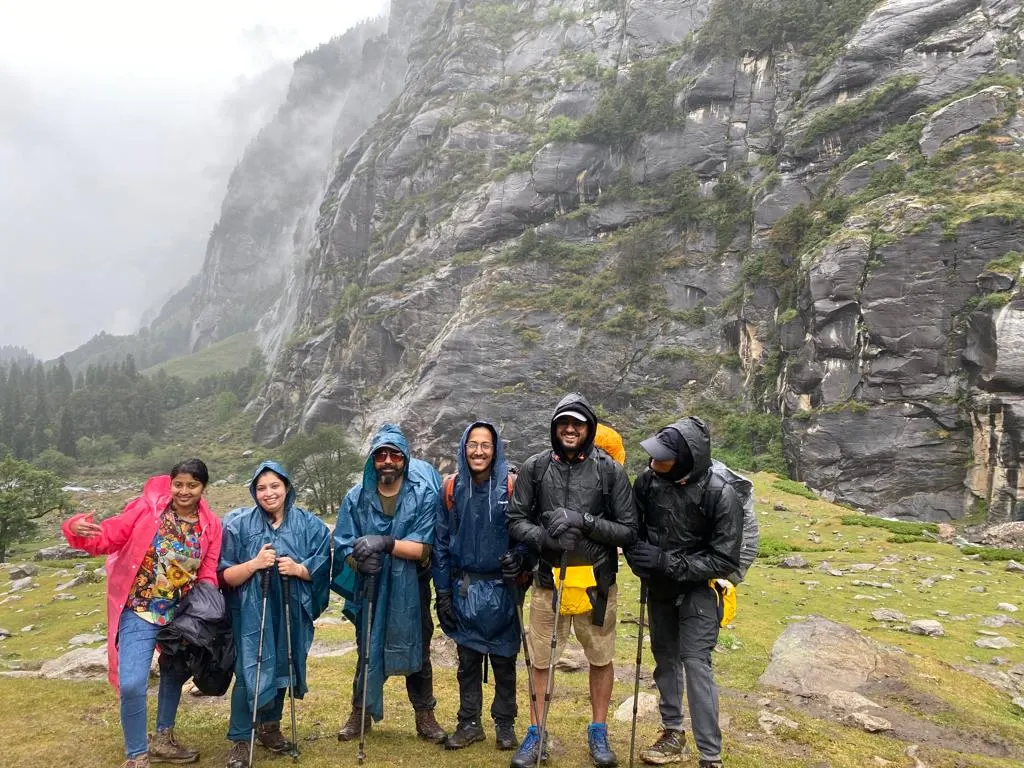
Hampta Pass (4,298 m) is crossed in the rainy months, with wet trails and stream crossings on the Kullu side and a steep scree descent from the pass, so bring sturdy gear of your own.
- Backpack – 50–60 L with a rain cover; line it with a large plastic bag to keep clothes dry.
- Day pack – 20–30 L for the pass crossing day; needed if you offload your main backpack.
- Trekking shoes – bring your own: waterproof, with ankle support and good grip, and broken in before the trek.
- Trekking poles – bring your own pair; they make the scree descent and stream crossings much safer.
- Microspikes and gaiters – provided free (no deposit, no charge); useful for snow patches on the pass approach and for muddy trails.
- Headlamp – with spare batteries, for early starts and camp.
- Water bottles – two 1 L bottles.
Days are mild but the pass is cold and rain is likely on the Kullu side, so carry 3 warm layers and full rain wear.
- Padded or down jacket – bring your own; for the pass crossing and camp evenings.
- Thermal innerwear – 1–2 sets, top and bottom, in a moisture-wicking fabric; avoid cotton.
- Fleece jacket – 1, medium weight, for rest stops and camp.
- Rain jacket and rain pants (or a poncho) – essential in these months, especially on the Kullu side.
- Trek pants – 2, quick-dry (one to wear, one spare); avoid jeans, which stay wet.
- Collared T-shirts – 3, quick-dry, full-sleeved to protect against the sun.
Glare on the pass at 4,298 m is strong and the ridge is windy, so protect your eyes, skin and hands.
- Sunglasses – UV-protected (category 3 or 4) for glare on pass day.
- Sun cap – wide-brimmed or with a neck flap.
- Woollen cap – covering the ears, needed for the pass crossing.
- Gloves – 1 fleece pair plus 1 waterproof pair for the pass and rain.
- Buff or neck gaiter – for wind on the open pass ridge.
- Socks – 4 pairs: cotton or sports socks for walking and 2 woollen pairs for nights; extras help because feet get wet at stream crossings.
- Sunscreen – SPF 50+; reapply through the day.
- Lip balm – with SPF, to prevent chapped lips.
There is no charging on the trail beyond Manali and ATMs are few in the hills, so bring a power bank and enough cash from Manali.
- Lunch box – reusable, for packed lunches on the trail.
- Toiletries – biodegradable only (required in the Hampta Pass forest zone): toothbrush, toothpaste, soap and toilet paper; no wet wipes.
- Quick-dry towel – small and light.
- Plastic or ziploc bags – to wrap clothes, phone and documents against rain, and to carry your waste back down; Trekkaro follows a zero-waste policy on the trail.
- Personal medical kit – your regular medicines, blister plasters and ORS; ask your doctor about altitude medicine before the trek.
- Snacks and electrolytes – nuts, energy bars, dates and electrolyte or ORS sachets, especially for pass day.
- Power bank – keeps your phone going through the trek.
- Camp slippers – light sandals for the tent and camp.
- Cash – withdraw enough in Manali, in small notes; cards are not accepted in the mountains.
- Original government photo ID – Aadhaar card, passport, voter ID or driving licence.
- Photocopy of the same ID – keep it with the original in a waterproof pouch.
- Passport – for international trekkers; needed for forest entry permits and in case of medical evacuation.
- Trekkaro booking confirmation – your e-ticket or tax invoice.
- Medical fitness certificate – signed by a doctor.
- Travel insurance policy – mandatory, with emergency evacuation cover.
- Disclaimer form – with your emergency contact details filled in.
Frequently Asked Questions
Hampta Pass Trek is a 5-day moderate trek in Kullu, Himachal Pradesh, reaching 4,298 m (14,100 ft). It covers about 26.5 km on foot and starts and ends at Manali. Best time: June to September. Trekkaro price: ₹9,000 per person + 5% GST, with free microspikes & gaiters (no deposit, no charge); bring your own trekking shoes, jacket and poles. Next batch: 12 Jun 2027 (68 upcoming batches).
The Hampta Pass trek is in Kullu district, Himachal Pradesh, and crosses from the green Kullu valley into the bare Lahaul valley. It starts at Jobra, a 23 km (about 45 minute) drive from Manali, and ends at Chhatru, from where you drive back to Manali through the Atal Tunnel.
The pass, at 4,298 m (14,100 ft), sits on the ridge between the two valleys, so from the top you see Kullu on one side and Lahaul-Spiti on the other.
The Hampta Pass trek takes 5 days from Manali to Manali, with 4 trekking days covering about 26.5 km.
- Day 1: drive from Manali to Jobra, then a short walk to the Chika camp
- Days 2–3: up to Balu Ka Ghera, then over the pass to Shea Goru
- Day 4: walk to Chhatru, then a drive to Chandratal Lake and back
- Day 5: drive from Chhatru to Manali via the Atal Tunnel (3–4 hours)
On the Hampta Pass trek you walk between 2 km and 10 km a day, taking 1–8 hours. Pass day is the longest, while the first and last trekking days are short.
- Day 1: Jobra to Chika, 2 km, 1–2 hours
- Day 2: Chika to Balu Ka Ghera, 8.5 km, about 6 hours
- Day 3: over Hampta Pass to Shea Goru, 10 km, 7–8 hours
- Day 4: Shea Goru to Chhatru, 6 km, 3–4 hours
The highest point of the Hampta Pass trek is the pass at 4,298 m (14,100 ft). The trek starts at Jobra (2,990 m / 9,800 ft), so you climb about 1,300 m in the first three days.
- Chika camp: 3,170 m (10,400 ft)
- Balu Ka Ghera camp: 3,720 m (12,200 ft), the highest campsite
- Shea Goru camp: 3,600 m (11,800 ft)
- Chhatru camp: 3,320 m (10,900 ft)
The Hampta Pass trek is graded Moderate. Most days are steady walking, but pass day is long and steep, and rain can make the trail slippery, so good fitness is needed.
- Pass day: 10 km in 7–8 hours, with a climb of about 2,000 ft on snow, scree and exposed rock
- Descent: a steep scree slope down to Shea Goru, where trekking poles are essential
- Stream crossings: several glacial streams on Day 2, harder when snowmelt is high
Yes, the Hampta Pass trek suits fit beginners who prepare well. It eases you in with a 2 km first day and only about 600 ft of height gain, which helps acclimatisation.
Pass day is the real test: 7–8 hours on snow and scree. Train for it in advance and bring your own broken-in shoes and trekking poles.
For the Hampta Pass trek you should be comfortable walking up to 8 hours in a day on uneven ground, including a sustained climb of about 2,000 ft to the pass at 14,100 ft.
- Build stamina: regular brisk walks, stair climbing or uphill hikes in the weeks before the trek
- Strength: strong legs help on the steep scree descent from the pass
- Fitness test: take the free 2-minute Am I Ready? test on the Trekkaro website
The Hampta Pass trek runs from June to September. From mid-October to May the route is under snow and closed.
- June to August: days of 10–20°C, with rain likely on the Kullu side
- Pass approach: patches of hard snow remain, so pass day starts at 5:30 AM while the snow is firm
- September: colder, with a real chance of snowfall
Yes, but mainly on pass day. The first two days of the Hampta Pass trek are free of snow; above Balu Ka Ghera you cross hard snow, scree and rock on the climb to 14,100 ft.
- Early start: pass day begins at 5:30 AM, while the snow is still firm
- Gaiters and microspikes: provided free for the snow patches on the pass approach
- September: fresh snowfall is possible
On the Hampta Pass trek, days are about 8°C to 22°C from June to September. Nights at camp are coldest in June and early July (0°C to -4°C), 2°C to 6°C from mid-July to mid-August, and 0°C to 4°C in late August and September, when early snowfall on the pass is possible.
- Layers: 3 warm layers: thermals, a fleece and a padded or down jacket
- Rain wear: a rain jacket and rain pants, as rain is likely on the Kullu side
- Pass day: a woollen cap, a buff and two pairs of gloves
From the Balu Ka Ghera camp on the Hampta Pass trek you can see Deo Tibba and Indrasan in clear weather, and from the pass you get 360-degree views over both the Kullu and Lahaul-Spiti valleys.
- Kullu side: oak and birch forest, then tiered alpine meadows along the Hampta stream
- Lahaul side: bare rock in rust, ochre and silver tones along the Chandra River
- Chandratal Lake: a crescent-shaped lake visited on Day 4
The terrain on the Hampta Pass trek changes every day, from forest and meadows on the Kullu side to snow, scree and bare rock on the Lahaul side.
- Day 1: dense oak and birch forest along the Hampta stream
- Day 2: alpine meadows, glacial stream crossings and moraine
- Day 3: snow, scree and exposed rock up to the pass, then a steep scree descent
- Day 4: an easy walk along the Chandra River with almost no vegetation
Yes, there is some risk of altitude sickness on the Hampta Pass trek, as you go from 9,800 ft to 14,100 ft in three days. Day 1 gains only about 600 ft, and the highest camp is at 12,200 ft, which helps your body adjust.
- Trek leaders: trained in Wilderness First Aid and aware of high-altitude issues
- First aid: a full first-aid kit and essential medicines are carried
- Before you go: ask your doctor about altitude medicine and bring your own regular medicines
The minimum age for the Hampta Pass trek is 11 years. Trekkers under 18 must come with a parent or guardian.
There is no upper age limit. Trekkers above 60 are welcome if they are fit and in good cardiovascular health; along with the medical certificate signed by a doctor that every trekker brings, we recommend an ECG or TMT report.
The Hampta Pass trek starts in Manali: report at Manali Bus Stand at 10:00 AM on Day 1, from where the group drives 23 km (about 45 minutes) to Jobra.
- By bus: overnight Volvo or HRTC buses from Delhi ISBT Kashmere Gate take 12–14 hours; book one that reaches Manali by 9:00 AM
- By air: Bhuntar Airport (KUU) is about 50 km from Manali; flights are limited, so fly in a day early
- By train: the nearest major station is Chandigarh (about 300 km), then an 8–9 hour bus to Manali
- Return: book buses leaving Manali after 4:00 PM on Day 5
Yes, transport during the Hampta Pass trek is included in the trek fee: the drive from Manali to Jobra on Day 1, the Chandratal Lake drive on Day 4 and the drive from Chhatru back to Manali on Day 5.
- Vehicles: Bolero, Max, Tempo Traveller or equivalent
- Your part: travel to Manali and back home
- Late arrival: missing the 10:00 AM reporting time counts as a no-show (no refund, voucher, reschedule or transfer); if you are running late, tell the trek coordinator early so the team can try to help you join
On the Hampta Pass trek you stay 4 nights in Trekkaro tents at Chika, Balu Ka Ghera, Shea Goru and Chhatru. Three trekkers share each four-person tent.
Women trekkers share tents only with other women, and men with men.
A Hampta Pass batch has a maximum of 20 trekkers, and a fixed departure needs at least 6. Each batch is led by a professional trek leader who has completed basic and advanced mountaineering courses and is trained in first aid.
- Support team: a local guide, chef, assistant, porters and other staff
- Private treks: group size does not matter for a private batch
Yes, the Hampta Pass trek is safe for women trekking alone, and the safety of women trekkers is of the utmost importance to Trekkaro. A woman trekking solo shares a tent only with other women trekkers, never with men.
- Staff: guides and support staff are carefully selected, trustworthy and reliable
- Valuables: keep your personal belongings secure, as on any group trip
The Hampta Pass trek serves simple, nutritious vegetarian food, with eggs available on request at the campsite.
- On the trail: packed lunches, so carry a reusable lunch box
- Day 4: a hot lunch at the Chhatru camp before the Chandratal drive
- Snacks: bring nuts, energy bars and electrolyte sachets, especially for pass day
Yes. On the Hampta Pass trek the water comes from Himalayan streams, and to be safe it is boiled or treated with chlorine tablets at the camps.
- Bottles: carry two 1 L bottles
- Refills: ask the trek leader or guide where to fill your bottles during the day
Yes. On the Hampta Pass trek you bring your own trekking shoes, jacket and poles; microspikes and gaiters are provided free, with no deposit and no charge.
Yes, backpack offloading on the Hampta Pass trek costs ₹2,500 + 5% GST, and a porter or mule carries your main bag.
- Notice: tell us at least 15 days in advance so a porter or mule can be arranged
- Day pack: carry a 20–30 L day pack with water, rain jacket and snacks
No, a doctor does not join the Hampta Pass trek. The trek leaders are trained in Wilderness First Aid and high-altitude issues, and the team carries a full first-aid kit and essential medicines.
- Your medicines: always bring your own regular medicines and a personal medical kit
- Before booking: check your health, or get expert advice if you are unsure about your fitness
For the Hampta Pass trek, carry an original government photo ID with a photocopy, a medical fitness certificate signed by a doctor, and travel insurance with emergency evacuation cover, which is mandatory.
- ID: Aadhaar card, passport, voter ID or driving licence
- International trekkers: passport, needed for forest entry permits and any medical evacuation
- Forms: the disclaimer form with emergency contact details, and your Trekkaro booking confirmation
No. There is no charging on the Hampta Pass trek beyond Manali, and ATMs are few in the hills, so carry a power bank and withdraw enough cash in Manali.
- Cash: keep small notes, as cards are not accepted in the mountains
- Phone: wrap it in a ziploc bag to protect it from rain
Yes, a visit to Chandratal Lake is included in the Hampta Pass trek. On Day 4, after a short walk to Chhatru, you drive about 60 km (2 hours) to the lake and return to Chhatru for the night.
- The lake: crescent-shaped and colour-shifting, at about 14,100 ft
- On the way: the drive goes over Kunzum Pass (15,059 ft)
- At the lake: a 2 km walk from the road and about 2 hours at the shore
Book your travel for the Hampta Pass trek as soon as your payment is complete: your booking is then confirmed and shows as Paid in My Bookings.
- Arrival: a bus that reaches Manali by 9:00 AM on Day 1, or a flight to Bhuntar the day before
- Departure: a bus leaving Manali after 4:00 PM on Day 5, or a flight the next day
Yes, the Hampta Pass itinerary can change if weather or other mountain conditions demand it, but the trek still ends on the planned date. In such cases the trek leader offers the closest alternative to the original plan.
Leave some buffer in your own travel plans, and book return buses after 4:00 PM to allow for traffic or roadblocks.
Yes, you can book the Hampta Pass trek as a private trek for your own group, with any number of people.
The price of a private trek depends on the group size, the trek, its duration and the type of trek, so contact Trekkaro for a quote.
Terms & Conditions
1. Accommodation
- Day 1 to Day 4: camping at Chika, Balu Ka Ghera, Shea Goru and Chhatru, on a triple-sharing basis
2. Meals
- All meals from Day 1 lunch to Day 5 breakfast: breakfast, lunch, snacks and dinner
3. Transport
- Manali to Jobra trailhead
- Chatru to Chandratal and back
- Return from Chatru to Manali
4. Permits & Camping Fees
- Forest department permits and Chandratal Lake entry fees
5. Camping & Safety Equipment
- Double-wall, rain-rated tents and -20°C sleeping bags at every campsite
- Trekking mattresses or sleeping pads at every campsite
- Free microspikes and gaiters (no deposit, no charge)
- Basic first-aid kit carried by the trek leader on the trail at all times
6. Trek Team
- Certified trek leader and guide throughout the trek
- Experienced mountain kitchen staff, helpers, and a mule and horse support team
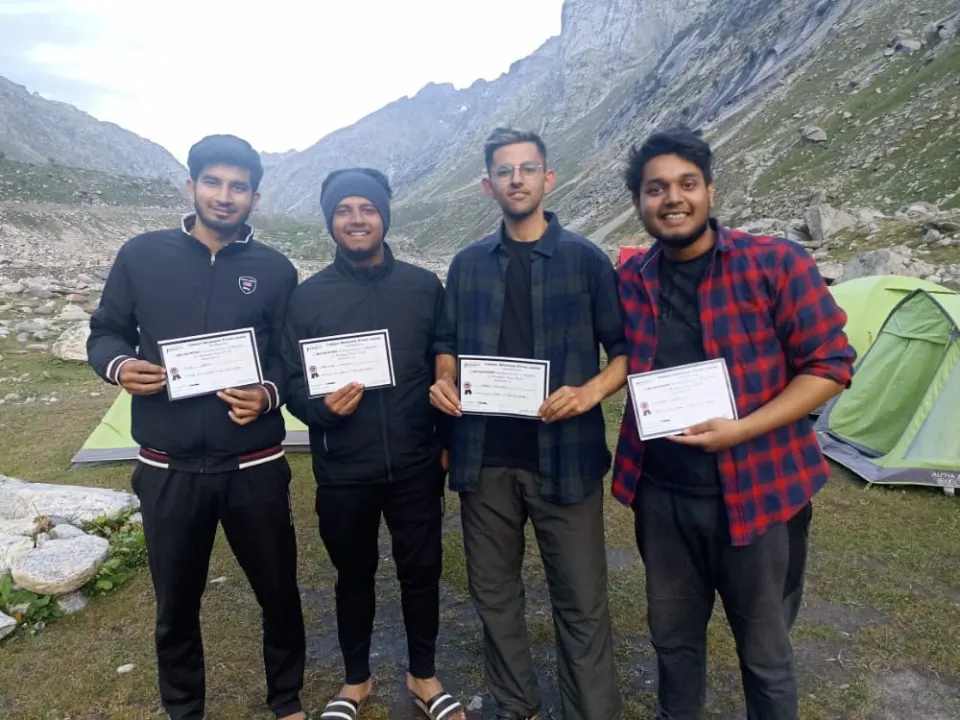
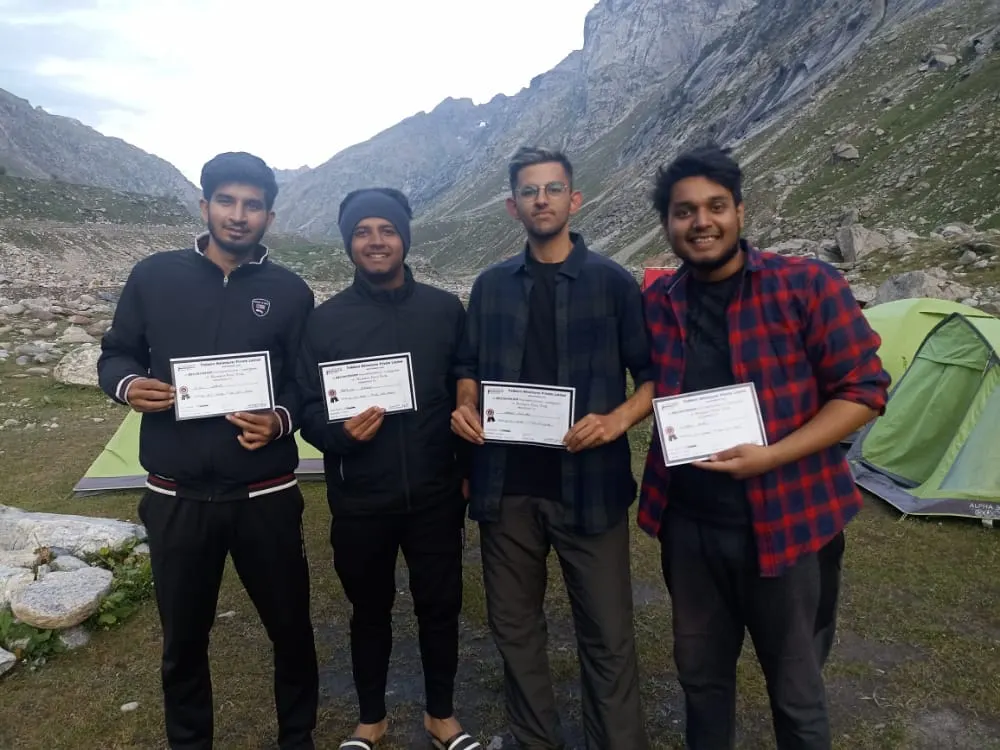
- Trekkaro trek completion certificate when you successfully cross the pass
1. Transport
- Travel to and from Manali (flights, trains or buses), arranged by you
2. Food During Transit
- Meals during travel to and from Manali
3. Backpack Offloading (optional)
- ₹2,500 + 5% GST for the entire trek
- Maximum weight: 9 kg; no suitcases, trolleys or duffel bags
- Charges may be higher for last-minute requests made at Manali
4. Single Tent Occupancy (optional)
- ₹2,000 + 5% GST per tent for the entire trek
5. Personal Equipment
- Your clothing, backpack and sunglasses
- Trekking shoes, jacket and trekking poles: bring your own (microspikes and gaiters are provided free)
6. Trek Insurance
- Travel insurance and emergency evacuation cover are not included
7. Anything Not Mentioned Under Inclusions
- Accommodation in Manali before or after the trek
- Personal expenses such as tips, calls, laundry and extra snacks
- Costs from an early exit, evacuation, or an itinerary change due to weather or medical reasons
We know that cancelling a trek can be genuinely disappointing. Plans change, life intervenes, and sometimes the mountains have to wait. That is why Trekkaro has designed one of the most trekker-friendly cancellation policies in the industry — to reduce the financial impact on you and give you real options when things do not go as planned.
Important: Bookings made on trekkaro.com are cancelled online from My Bookings. Bookings made offline with our team must be cancelled in writing by e-mail by the person who originally booked the trek. Requests over the phone, via WhatsApp, or through third parties are not accepted.
How to Cancel Your Trek
Booked online on trekkaro.com:
- Log in and open My Bookings.
- Choose Cancel Booking on the trek you want to cancel.
- Pick a refund (as per the charges below) or Get TrekCash Voucher instead — the voucher is issued instantly and appears under My TrekCash Vouchers.
Booked offline with our team:
- Compose an e-mail from the registered e-mail ID used at the time of booking.
- Attach a copy of your tax invoice to the e-mail.
- Send both to info@trekkaro.com.
- Your cancellation is effective from the date Trekkaro receives and acknowledges your e-mail.
How to Reschedule Your Trek (Free)
- Once per booking, to another batch of the same trek, free of charge. A request we decline doesn’t count.
- Up to 8 days before departure, also in the 8–14-day window when there is no cash refund. The new batch must start at least 7 days after the day you ask.
- Subject to seat availability for every trekker on the booking.
- Not available for bookings paid fully or partly with a TrekCash Voucher.
- No fee or price difference; add-ons and the number of trekkers stay as booked.
Booked online: My Bookings → Reschedule free → pick a batch. Our team confirms by e-mail and your booking moves once approved. Booked offline: e-mail info@trekkaro.com.
How to Transfer Your Booking
You can give your booking to another trekker up to 8 days before departure. E-mail info@trekkaro.com from your registered e-mail ID with your booking ID and the new trekker’s name, age, phone number and ID proof. The new trekker must meet the fitness, age and document rules of the trek. We confirm the transfer by e-mail.
Cancellation Charges
| When you cancel | Cash refund | Other options |
|---|---|---|
| 30 days or more before departure | 70% refund (30% cancellation charge) | Or instead: a 100% TrekCash Voucher (valid 1 year), a free reschedule or a transfer |
| 15 to 29 days before departure | 50% refund (50% cancellation charge) | Or instead: a 100% TrekCash Voucher (valid 1 year), a free reschedule or a transfer |
| 8 to 14 days before departure | No cash refund of the trek fee | You can take a 100% TrekCash Voucher (valid 1 year), a free reschedule (once per booking) or a transfer to another trekker |
| 7 days or less before departure, or no-show | No refund of the trek fee | None: no voucher, reschedule or transfer |
A 100% voucher instead of a refund. From the day you book until 8 days before departure, you can take a TrekCash Voucher worth 100% of the amount paid, valid for 1 year on any Trekkaro trek. This works in every slab above, including 8–14 days, when there is no cash refund. Online bookings take the voucher from My Bookings → Cancel Booking (issued instantly). Offline bookings ask for it by e-mail to info@trekkaro.com.
If you paid the FTG security deposit and the washing charge, both are refunded in full when you cancel before the trek starts, in every slab.
Cancellation of Voucher-Based Bookings
- The standard cancellation policy applies to voucher-based bookings in the same way it applies to direct bookings.
- Any remaining balance after the applicable cancellation charge has been deducted will be credited back to your Trekkaro account as a new voucher.
- If your voucher has already expired at the time of cancellation, no refund, credit, or extension will be issued under any circumstance.
- If a voucher is set to expire on a Sunday or public holiday, it must be redeemed before the expiry date.
Additional Terms
- Free Rescheduling: Switching to a different batch of the same trek is free of charge once per booking, up to 8 days before departure, subject to seat availability. Not available for bookings paid with a TrekCash Voucher. See “How to Reschedule Your Trek” above.
- Trek Transfers: You can transfer your booking to another person up to 8 days before departure, by e-mail. The new trekker must meet the fitness, age and document rules of that trek. See “How to Transfer Your Booking” above.
- No Refund Post-Commencement: Once the trek has commenced from Day 1 of your confirmed itinerary, no refunds or TrekCash Vouchers will be issued for any reason, including early exit, illness, or dissatisfaction with services.
- Policy Changes: Trekkaro reserves the right to amend or withdraw this cancellation policy at any time without prior notice. The version in effect at the time of your booking confirmation governs your booking.
Early Exit or Removal from Trek
A trekker may be required to leave the trek before completion for health concerns (AMS, hypertension, cardiac symptoms, or fitness that poses a safety risk), rule violations (alcohol or non-prescribed drugs on trail, smoking in prohibited zones, reckless behaviour, or misconduct), or by their own decision. In all cases of early exit or removal, no refund, partial refund, or TrekCash Voucher will be provided, and any additional transport or exit expenses are the trekker's responsibility. The trek leader's decision on health and safety grounds is final.
If Trekkaro Cancels Your Trek
In rare circumstances beyond our control — natural disasters (extreme snowfall, avalanche, floods, landslides, earthquakes) or unforeseen civil events (government curfews, lockdowns, political unrest) — Trekkaro will issue a TrekCash Voucher for the full trek fee paid, valid for 12 months on any trek listed on Trekkaro.com. If the new trek costs more, the difference is payable by the trekker. The voucher is sent to your registered e-mail within 10 working days and may be transferred to another person who meets Trekkaro's eligibility requirements.
Refund Processing
Refunds are processed within 10 working days of cancellation approval and credited to the original payment method only (credit card, debit card, net banking, UPI, or wallet). Your bank may take another 3–5 business days. Office hours: Monday to Saturday, 10:00 AM to 7:00 PM IST.
The full policy is part of our Terms & Conditions (Section 09).
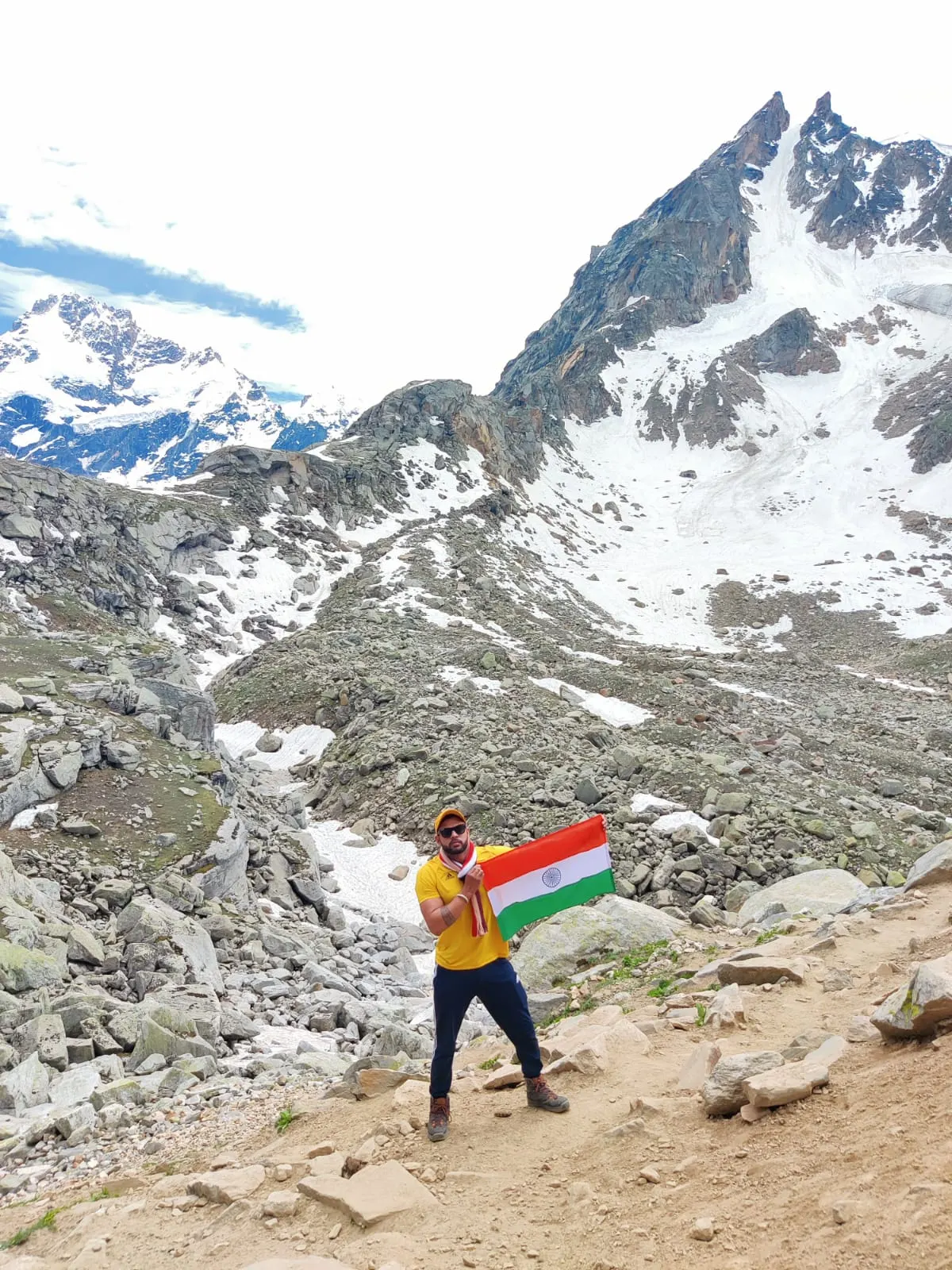
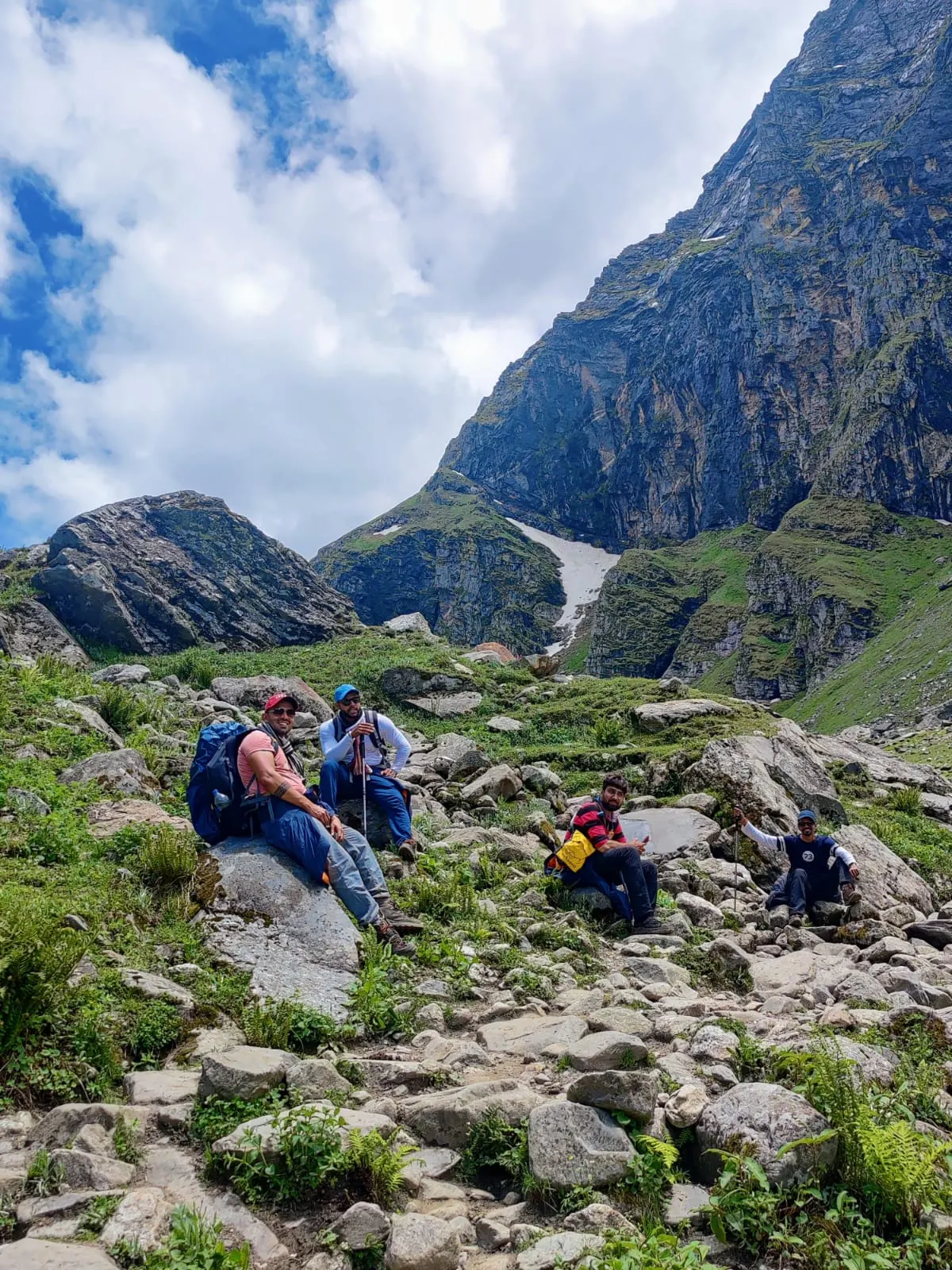
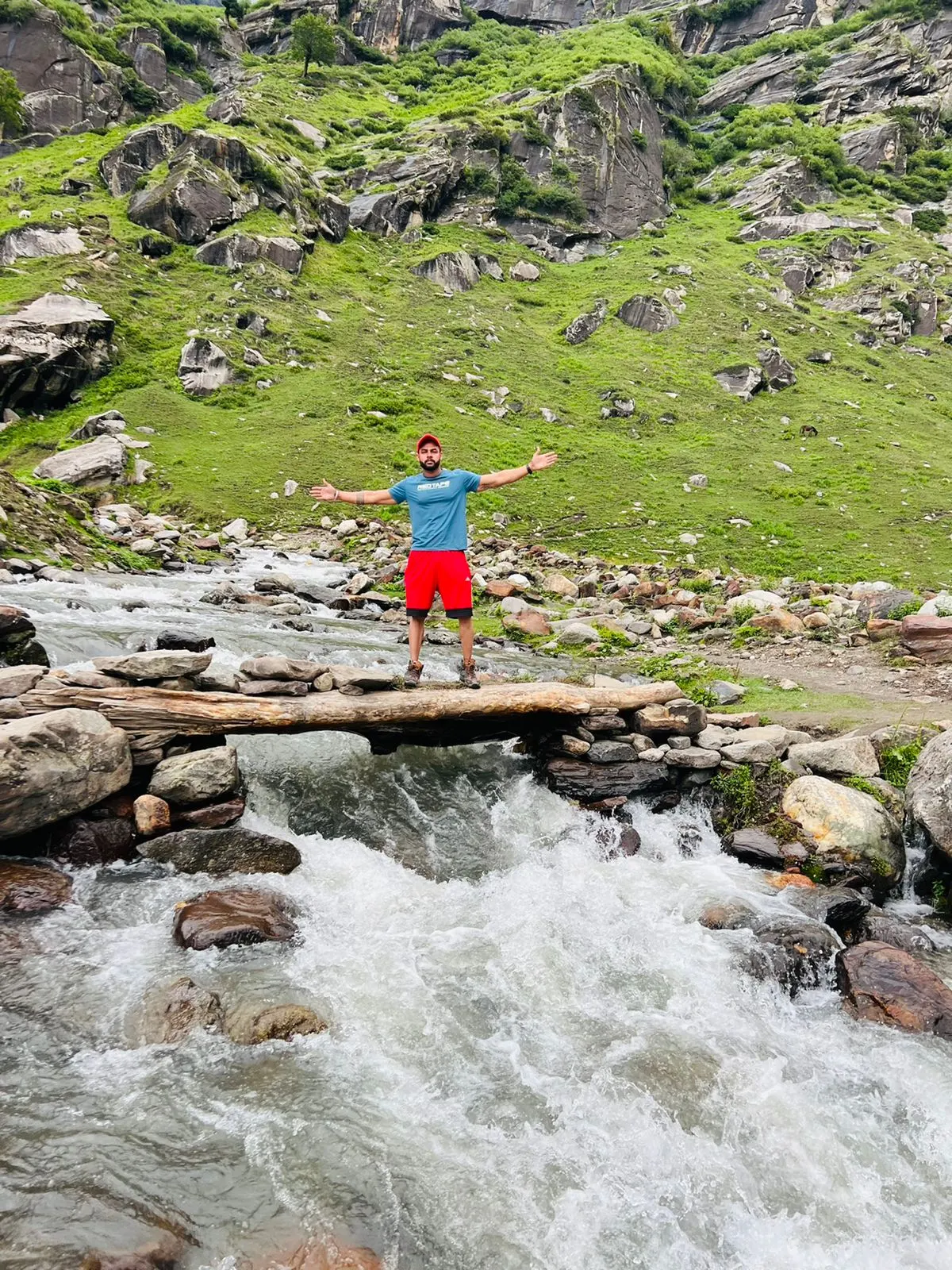
Gallery

Oxygen, first aid, daily SpO₂ checks, trained leaders — tap to read
1. Trained Trek Leaders
- Trek leaders hold NIM (Nehru Institute of Mountaineering) certification or an equivalent qualification
- Their training covers casualty assessment, high-altitude medical response, rope work and evacuation
2. Daily Health Checks
- Blood oxygen (SpO2) and pulse are checked for every trekker every day
- A falling SpO2 reading is acted on early, before it turns into Acute Mountain Sickness (AMS)
- If you are not fit to continue, the trek leader will ask you to rest or descend; the trek leader’s decision on health and safety is final
3. Emergency Equipment
- Portable oxygen cylinders carried with the group
- First-aid and medical kit with the trek team
- Stretchers at every campsite for emergency evacuation
- Radio communication across the trek team, as mobile signal is not reliable on the trail
4. Proper Trekking Gear
- Free microspikes and gaiters on this trek (no deposit, no charge). Bring your own broken-in trekking shoes with good grip, a warm jacket and trekking poles (see Things To Carry)
5. Tents and Sleeping Bags
- Sleeping bags rated to -20°C, and tents shared by three trekkers, with men and women in separate tents
6. Snow and Steep Sections
- On snow, ice or exposed ground, the trek team fixes ropes and cuts steps where needed and helps you across
7. Risks on the Hampta Pass Trek
- Highest point: 4,298 m (14,100 ft)
- Pass day: 10 km in 7–8 hours, with a climb of about 2,000 ft on snow, scree and exposed rock
- A steep scree descent to Shea Goru
- Glacial stream crossings on Day 2, harder when snowmelt is high
8. Your Part
- Build your fitness before the trek with running, cycling or swimming
- Tell the trek leader about any medical condition and the medicines you carry before Day 1
- Report a headache, nausea, dizziness or breathlessness to the trek leader at once
- Carry travel insurance that covers high-altitude trekking and emergency evacuation
What a day on the trek feels like — tap to read
1. What You Can Expect From Us
- Safety first on the Hampta Pass trek: daily SpO2 and pulse checks, oxygen cylinders and a stretcher with the group
- Personal attention: batches of up to 20 trekkers, so the trek leader knows each trekker’s health and pace
- NIM-certified trek leaders (Nehru Institute of Mountaineering, or an equivalent qualification), with local guides who know the Hampta Pass route, its weather and its campsites
- An itinerary planned for altitude, with daily distance and height gain set so your body can adjust
- Clear pricing: everything included and excluded is listed under Terms & Conditions, with the price of each optional add-on
2. What We Expect From You
- A willing attitude: cold nights, steep climbs and sudden weather changes are part of the mountains
- Physical preparation: you do not need to be an athlete, but train before the trek so the longest day feels comfortable
- Trust in your trek leader: follow their calls on route, pace, start times and turning back, as they are made for the group’s safety
Last ATM and phone network on the route — tap to read
1. Last ATM
- Manali is the last reliable place to withdraw cash
- Carry enough money before the trek starts
- Carry small notes: cards are not accepted on the trail
2. Mobile Network
- Manali is the last place with a stable mobile signal
- There is little or no signal from Chika, the first campsite, onwards
- Make your important calls and tell your family about the limited connectivity before you leave the base
Reviews
Route Map & Altitude Profile
Follow the Hampta Pass Trek route on the map: from Jobra (2,990 m) to Chandratal Lake (4,300 m), about 1,310 m of climbing. Press Walk the trail and follow the hiker camp to camp, or tap a day to jump to its camp.
Satellite imagery with a topographic map option. The trail is drawn from mapped footpaths and the Trekkaro route (269 points); it is for orientation, not a navigation map. Your trek leader walks the trail with you.
Camps and altitudes on the Hampta Pass Trek
- Day 1 Jobra · 2,990 m / 9,810 ft Base — Road head above Manali
- Day 1 Chika · 3,170 m / 10,400 ft Camp — Meadow camp by the river
- Day 2 Balu Ka Ghera · 3,720 m / 12,205 ft Camp — Open valley camp below the pass
- Day 3 Hampta Pass · 4,298 m / 14,101 ft Pass — The crossing into Lahaul
- Day 3 Shea Goru · 3,600 m / 11,811 ft Camp — Dry camp on the Spiti side
- Day 4 Chhatru · 3,320 m / 10,892 ft Camp — Road head; drive to Chandratal
- Day 4 Chandratal Lake · 4,300 m / 14,108 ft Lake by road — Day visit by road from Chhatru (not walked)
Related Treks You May Like
Hampta Pass Trek Guides

What Trekkers Say About the Hampta Pass Trek
Reviews left on trekkaro.com by trekkers who did this trek with us.
"It was very good experience. The food quality, safety measures, expertise of the guide, punctuality during overall trek, all was perfectly placed. Specially talking about food quality, we got such a delicious food that we couldn't even got in hotels of Manali."
"Trek was well organised, Food was good, guides were good. Overall a good experience."
"Beautiful experience with the team.The Hampta Pass Trek Team was amazing. Food was great, especially to prepare at this height. Didn't expect the team to be this professional and friendly. Special mention to Laxman Bhai and the cooking team. Would be wonderful to Trek with this amazing team again."
"I have completed couple of treks with Trekkaro and the experience has been exhilarating! You are allowed the freedom to experience the wild terrain on your own with a challenge or two if you are game for it. Team ensures safety while retaining the adventure!! Great work Trekkaro!"
"Trekkaro is environment friendly organisation which take care of safety of hikers and care for mountains. Making trekking self reliant and lifestyle is their goal. You feel like home and fall in love mountain when you trek with them. I trek to Hampta Pass with them, Keep it up guys thank you for amazing experience."
"Hampta Pass trek it was an amazing experience. The scenery was stunning and the route was well marked out and easy to follow, even for a novice like me. The views from the pass were absolutely breathtaking and I cannot wait to go back again."
Why Trekkaro?
Leaders in providing Free Trekking Gear for 8+ years — redefining the way everyone must trek.

Up to 8 days before departure, reschedule to another batch for free or take a TrekCash Voucher worth 100% of your amount — valid for 1 year on any future trek.

Rated 4.9/5 on Facebook & 4.7/5 on Google by trekkers who trekked with us.

We keep you safe from the moment you book to the moment you head home — certified leaders, first aid & emergency support.

Well-planned itineraries balanced with the freedom to make the experience your own — no matter the trek difficulty.

Every decision we make is guided by our commitment to making trekking a force for good — for people and the planet.
Welcome to Trekkaro
Login or create an account to manage your bookings and profile
Login Create AccountTalk to an Expert
Enter your number — we'll call you back shortly.
*Free to use on the trek, returned after · refundable deposit
AI can make mistakes · don’t share personal details · Talk to a person