This guide is about the Roopkund Trek — dates, price, day-by-day itinerary and booking are on the trek page.
Quick answer: Roopkund Lake is a small glacial lake at 4,800 m (15,750 ft) in the Uttarakhand Himalaya, called the skeleton lake because hundreds of ancient human skeletons were found at its bottom. You reach it on Day 5 of the 7-day Roopkund trek, a 12 km, nine-hour day that starts at Bhagwabasa (4,300 m).
Where is Roopkund Lake, and how high is it?
Roopkund lies above the meadows of Ali Bugyal and Bedni Bugyal, at the head of a route that starts in Lohajung (2,316 m), about 250 km and 8 to 10 hours by road from Rishikesh. From Lohajung you reach the water on your fourth day on foot, after three camps, each higher than the last.
| Point on the route | Height | When you reach it |
|---|---|---|
| Lohajung, the base village | 2,316 m | Day 1, by road from Rishikesh |
| Ghairoli Patal camp | 3,205 m | Day 2 |
| Bedni Bugyal meadow | 3,550 m | Day 3 |
| Pathar Nachauni camp | 3,870 m | Day 3 |
| Kalu Vinayak shrine | 4,200 m | Day 4 |
| Bhagwabasa, the last camp | 4,300 m | Day 4 |
| Roopkund Lake | 4,800 m (15,750 ft) | Day 5 |
| Junargali, an optional ridge above the lake | 4,880 m (16,000 ft) | Day 5 |
You will see a second height for the lake. A Ministry of Tourism webinar summary published by the Press Information Bureau gives Roopkund as 4,785 m (15,700 ft). Trekkaro uses 4,800 m (15,750 ft), the figure on the trek page, so that is the height in the table. The two differ by 15 m.
Why is Roopkund called the skeleton lake?
The Roopkund trek page puts it plainly: “Hundreds of ancient human skeletons were discovered at the bottom of this glacial lake.” That discovery gave the lake its other name.
The same PIB summary says the skeletons are of about 500 people who were caught in a lethal hailstorm while crossing Roopkund, and that scientists confirmed this by carbon dating the bones. It places that event more than a thousand years ago. The summary comes from a Ministry of Tourism webinar.
At the shore, take photographs and leave every bone where it lies.
What does the lake look like when you get there?
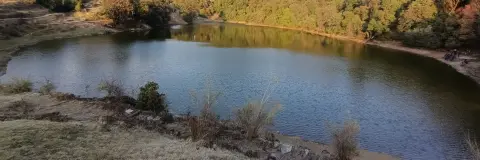
Do not expect a wide lake. The trek page describes Roopkund as small for most of the year; it grows during the monsoon as glacier melt feeds it. Early in the season Bhagwabasa is snow-covered, and in September and October there is more snow near the lake.
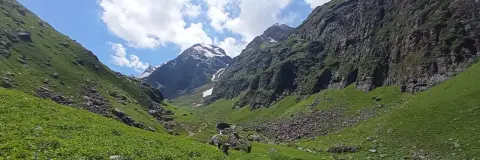
The peaks around you are the other half of the view. Trishul (7,120 m) and Nanda Ghunti fill the sky from the meadows, and both stay in sight from Kalu Vinayak and the lake area. Our guide to Trishul peak covers that mountain on its own.
| Season on the trek | Day temperature | Night temperature | What it means at the lake |
|---|---|---|---|
| May to June | 13°C to 18°C | 0°C to 7°C | Bhagwabasa is snow-covered early in the season |
| September to October | 3°C to 9°C | -3°C to -1°C | More snow near the lake; evenings at Bhagwabasa are cold and windy |
Trekkaro runs Roopkund from May to June and from September to October. See the trek page for live batch dates.
Which stops come before the lake?
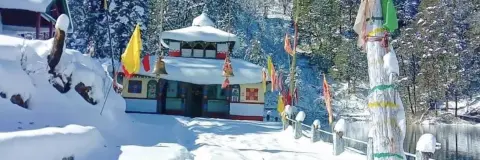
Kalu Vinayak, on Day 4, is a black stone shrine to Lord Ganesha on a rocky ridge at 4,200 m. Bedni Kund, at 3,600 m, is a small sacred lake used in rituals during the Nanda Devi Raj Jat, and it is a short detour on Day 3. Our Ali Bedni Bugyal guide describes the two meadows you cross to get there.
How hard is the day to the lake?
Day 5 is the hardest day of the trek. You leave Bhagwabasa well before dawn, because strong winds pick up in the afternoon, and after 2 to 3 hours of steady climbing you reach the lake at 4,800 m. After the lake, and Junargali if you choose it, you walk back down past Bhagwabasa to sleep at Pathar Nachauni, 930 m lower than the lake. The whole day is 12 km and about nine hours.
The trek is graded Moderate–Difficult because of the altitude, the steep rocky climbs and the long days. The trek page recommends prior trekking experience and at least eight weeks of preparation, and the minimum age is 12, with trekkers under 18 joining with a parent or guardian.
The height gain before the lake is gradual but large: camps at 3,205 m, 3,870 m and 4,300 m come before Day 5. Walk slowly, drink water, and tell your trek leader about a headache, nausea or dizziness at once. SpO2 and pulse are checked twice a day at every campsite, and one oxygen cylinder and one stretcher travel with every batch. Our guide to altitude sickness on Himalayan treks explains the warning signs.
Should you go on to Junargali?
Junargali is optional. It rises about 80 m above the lake, to 4,880 m, and gives a wider panorama of the surrounding peaks. It adds time to an already long day, so decide at the lake with your trek leader.
What should you check before you book a trek to Roopkund Lake?
Reaching the lake means a pre-dawn start at 4,300 m, snow near the lake and a long walk down. These are the questions to put to any company; the last column gives Trekkaro’s answers for the Roopkund trek.
| What to check | Why it matters | With Trekkaro |
|---|---|---|
| How many camps come before the lake, and how high are they? | A fast climb to 4,800 m leaves your body no time to adjust. | Three camps first: Ghairoli Patal (3,205 m), Pathar Nachauni (3,870 m) and Bhagwabasa (4,300 m). |
| Does the lake day end at a lower camp? | Sleeping lower after the lake helps you recover from the height. | Yes. Day 5 ends at Pathar Nachauni, 3,870 m. |
| Are microspikes, gaiters and a warm jacket in the fee? | Without grip, snow near the lake and at Bhagwabasa is slow and unsafe. | Yes, Free Trekking Gear: Decathlon trekking shoes, a jacket rated to -10°C, poles, gaiters and microspikes. A ₹3,000 refundable deposit and a ₹200 washing charge; buying the kit costs about ₹13,395. |
| What emergency kit goes up with the group? | At 4,300 m, help from the road is days away. | One oxygen cylinder and one stretcher with every batch, a first-aid kit, and SpO2 checks twice a day at every campsite. |
| How many trekkers per trek leader or guide? | On a nine-hour day, a slow walker needs someone beside them. | Up to 20 trekkers per batch, one trek leader or guide for every 8. Leaders are trained in wilderness first aid and lead with local guides. |
| What are the cancellation terms? | Without them, a change of plan can cost you the whole fee. | 70% back at 30 or more days, 50% at 15 to 29 days, no cash refund from 14 days; up to 8 days before, a 100% TrekCash voucher (valid 1 year), a free reschedule or a transfer instead. |
| Can you pay in EMI? | Without EMI the full fee is due when you book. | EMI starts at ₹849 a month. |
| Where do extra bags stay? | Without a store, your travel bag climbs to 4,300 m with you. | Free of charge in Trekkaro’s store in Lohajung; valuables stay with you. |
What does the Roopkund trek cost?
The Roopkund trek fee is ₹16,500 per person plus 5% GST (₹17,325 with GST). It covers a guesthouse or homestay in Lohajung, tents on the trail (shared by three, with men and women in separate tents), pure vegetarian meals, all trekking permits and forest camping fees, the trek leader and guide, and the Free Trekking Gear. The drive between Rishikesh and Lohajung, about 250 km and 8 to 10 hours each way, is not included; we help the group book shared cabs at ₹6,500 one way per 5 to 6 seat vehicle, paid directly to the driver and split among the trekkers in it. Each trekker brings a medical certificate signed by a doctor (the form is in My Bookings), and travel insurance that covers high-altitude trekking and evacuation is mandatory and not included. Live batch dates and fees are on the Roopkund trek page.
See Roopkund Trek dates and book | Highest treks in Uttarakhand | Ali Bedni Bugyal guide
Frequently asked questions
How high is Roopkund Lake?
Roopkund Lake is at 4,800 m (15,750 ft), the figure on the Roopkund trek page. The Junargali ridge above it is 4,880 m, about 80 m higher.
Why are there skeletons in Roopkund Lake?
Hundreds of ancient human skeletons were found at the bottom of the lake. A Ministry of Tourism summary published by PIB says they are of about 500 people caught in a lethal hailstorm while crossing Roopkund, an account it says carbon dating confirmed.
Can beginners trek to Roopkund Lake?
The trek is graded Moderate–Difficult, and prior trekking experience is recommended. Plan at least eight weeks of preparation, and note that the minimum age is 12.
When can you trek to Roopkund Lake?
Trekkaro runs the trek from May to June and from September to October. Early in the season Bhagwabasa is snow-covered, and in September and October there is more snow near the lake.
What should I look for when choosing a company for a Roopkund Lake trek?
Check that there are three camps before the lake, that the lake day ends at a lower camp and that microspikes and gaiters are in the fee. Then compare the oxygen cylinder and stretcher, the 1:8 ratio, refunds and the luggage store.