This guide is about the Kedarkantha Trek — dates, price, day-by-day itinerary and booking are on the trek page.
Quick answer: On our Kedarkantha trek you camp at Juda Ka Talab (2,773 m) and base camp (3,429 m). On cloudless nights at Juda Ka Talab the Milky Way spans the horizon; nights near the new moon (9 Nov, 9 Dec, 8 Jan, 6 Feb) are darkest. The summit climb starts at 2:00 AM. Winter camp nights fall to -10°C to -15°C.
This guide is for trekkers who want to know what the dark hours on Kedarkantha are like: how cold the camps get, how the night climb works, when the sun comes up and when the sky is darkest. The facts come from our trek page and batch calendar; the sunrise and moon times are our own calculation.
Where do you spend each night on the Kedarkantha trek?
| Night | Place | Altitude | Stay |
|---|---|---|---|
| Night 1 | Sankri | 1,950 m / 6,400 ft | Guesthouse, triple sharing |
| Night 2 | Juda Ka Talab | 2,773 m / 9,100 ft | Tents beside the lake, in a bowl-shaped meadow |
| Night 3 | Kedarkantha Base Camp | 3,429 m / 11,250 ft | Tents; early dinner and rest before the climb |
| Night 4 | Juda Ka Talab | 2,773 m / 9,100 ft | Tents, after the summit |
On Day 5 you walk about 4 km down to Sankri and drive about 200 km to Dehradun. The cab is expected at Dehradun Railway Station by 06:00 PM, so there is no fifth night on the trail.
How cold is Kedarkantha at night?
For the months on sale now, the trek page gives winter (December–February) camp nights of -10°C to -15°C and autumn (September–November) nights of -2°C to -8°C. Our weather article has every month.
The trek page gives no temperature for the summit climb at 2:00 AM and says only that it is well below freezing. Put on every layer you carry before you leave the tent.
The batches listed now run from late October 2026 to the end of February 2027, with a departure each day from 1 December to 28 February. Spring and summer 2027 dates are not on the trek page yet, so the warmer-night months cannot be booked today.
How do you stay warm in camp?
What we provide at each campsite: double-wall tents shared by 3 trekkers (men and women in separate tents), sleeping bags rated to -20°C and a trekking mattress or sleeping pad. The Free Trekking Gear jacket is rated to -10°C. If you want a tent to yourself, a single tent costs ₹2,000 + GST.
For the night hours, the trek page's list has the items that matter most: a balaclava and waterproof gloves for summit morning, a woollen cap, a headlamp, a power bank kept close to your body in the cold, and an insulated bottle so your water does not freeze. Drinking water at camp is boiled or treated with chlorine tablets.
The summit climb in the dark, step by step
- Day 3 evening at base camp. Your guides give the summit briefing: wake-up time, pace and the turnaround policy. Dinner is early and the night is for rest.
- 2:00 AM. The guide calls each tent, and you leave base camp at 3,429 m with headlamps on.
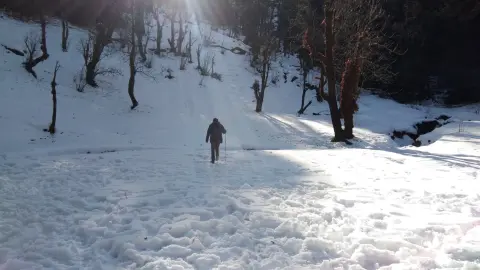
- The climb. In winter it is a steep climb in deep snow across switchbacks, and the summit trail is steep and unrelenting in places; microspikes are provided on summit day. About an hour in, the valley below is dark except for the faint lights of camp.
- First light. Near the final ridge, the eastern sky turns from black to deep purple.
- Sunrise on top, 3,810 m (12,500 ft), with first light on Swargarohini, Black Peak, Bandarpunch and Kalanag. Hot tea comes out of the guide's thermos.
- Down. Back at base camp by mid-morning and at Juda Ka Talab by late morning; summit day is about 9 km and 8–9 hours in all.
The climb is about 3 km and 381 m.
What time is sunrise on Kedarkantha summit?
The trek page times the summit for sunrise but gives no clock time. We worked out the times below with a standard astronomy calculation for the summit point on our route map (31.0225° N, 78.1719° E), for a level horizon. The height of the summit can bring the sun up about 10 minutes earlier, and ridges to the east can hold it back. Treat these as times to within about 10 minutes.
| Date | Sunrise (IST) | Sky visibly light (nautical dawn, about) |
|---|---|---|
| 25 October 2026 | 6:26 AM | 5:33 AM |
| 15 November 2026 | 6:43 AM | 5:49 AM |
| 15 December 2026 | 7:07 AM | 6:10 AM |
| 15 January 2027 | 7:16 AM | 6:20 AM |
| 15 February 2027 | 6:58 AM | 6:05 AM |
So a December or January summit morning means about four hours in full dark after the 2:00 AM start, and about five before the sun is up.
Kedarkantha night sky: when are the stars best?
Our trek page describes Juda Ka Talab as a camp under a star-filled sky, where on cloudless nights the Milky Way spans the full horizon. Two things decide what you see: cloud and the moon.
Cloud you cannot plan months ahead. Check the district forecast for Uttarkashi on the IMD Meteorological Centre, Dehradun in the days before you leave; the same page carries district-wise warnings and nowcasts.
The moon you can plan. Within a few days of the new moon, the moon is out of the sky for most of the night. These dates come from the same astronomy calculation (IST):
| Month | New moon (darkest nights) | Full moon (brightest nights) | Batches whose base camp night falls near the new moon |
|---|---|---|---|
| October–November 2026 | 9 November | 26 October, 24 November | 7 and 8 November starts (the Diwali batches) |
| December 2026 | 9 December | 24 December | Starts from 5 to 9 December |
| January 2027 | 8 January | 22 January | Starts from 4 to 8 January |
| February 2027 | 6 February | 21 February | Starts from 2 to 6 February |
Base camp is Night 3, so a batch that starts on the 7th sleeps at base camp on the 9th.
The 24 and 25 October starts sleep at base camp on 26 and 27 October, at full moon, and the 21 and 22 November starts on 23 and 24 November, also near full moon. Those nights are bright and show fewer stars.
The trade-off: a full-moon week hides the fainter stars; a new-moon week gives the darkest sky. The summit climb is done by headlamp either way.
Safety in the cold and the dark
The trek leader checks SpO2, pulse and blood pressure twice a day at each campsite. Each batch carries a portable oxygen cylinder and an emergency stretcher, and the trek team talks on HF radio. The Uttarakhand Health Department advisory for travellers above 3,000 m lists chest pain, breathlessness, persistent cough, dizziness and vomiting as warning signs and says to descend if you feel unwell. Speak up at night too; do not wait for morning.
There is no mobile network after Sankri, where only Jio works. The last reliable ATM is at Purola, and cards are not accepted on the trail. Bring an original photo ID with a photocopy, a medical certificate signed by a doctor, and travel insurance that covers high-altitude trekking and helicopter evacuation (mandatory, not included). Ask your doctor about Diamox before the trek.
Who should think twice about a winter batch: anyone who sleeps badly in the cold or does not want a 2:00 AM start in sub-zero air. The minimum age is 8, and children under 18 come with a parent or guardian.
What it costs
| Item | Amount |
|---|---|
| Trek fee (5 days, Sankri to Sankri) | ₹9,000 + 5% GST = ₹9,450 |
| EMI | The trek page shows EMI from ₹463 a month |
| Free Trekking Gear (shoes, -10°C jacket, poles, gaiters, microspikes) | ₹3,000 refundable deposit + ₹200 washing charge (+ GST) |
| Shared cab Dehradun–Sankri | ₹1,000 per person one way (₹2,000 return), paid to the driver |
| Single tent (optional) | ₹2,000 + GST |
| Backpack offloading (optional) | ₹1,500 + GST |
Transport is not included in the trek fee: we help the group book shared cabs, paid directly to the driver and split among trekkers. Pickup is at Dehradun Railway Station at 06:30 AM on Day 1. A batch has at most 20 trekkers, with 1 trek leader or guide for every 8, and booking closes at 5 PM (India time) the day before the trek.
If you cancel 30 or more days before departure, you get a 70% refund; at 15–29 days, 50%; at 8–14 days, no cash refund; at 7 days or less, or for a no-show, nothing (no voucher, reschedule or transfer). At any point up to 8 days before departure you can take a 100% TrekCash voucher (valid 1 year), a free reschedule (once per booking) or a transfer to another trekker instead of the cash refund.
See Kedarkantha dates and book | Kedarkantha weather by month | Kedarkantha distance and height | Kedarkantha in December
Frequently asked questions
Can you see the Milky Way on the Kedarkantha trek?
Yes, on cloudless nights, and the Juda Ka Talab camp is where the trek page describes it. Your best chance is a batch whose camp nights fall close to a new moon, such as starts from 5 to 9 December.
Why does the Kedarkantha summit climb start at 2 AM?
The aim is to stand on top at sunrise, which is around 7:00 AM in mid-winter. The 3 km climb is slow in snow, and the trek page has you back at Juda Ka Talab by late morning.
When is the full moon on Kedarkantha in October 2026?
Our calculation puts it at 9:41 AM IST on 26 October. The 24 and 25 October batches sleep at base camp on 26 and 27 October, so their summit nights are moonlit.
Can I charge my phone or camera at Kedarkantha base camp?
No. There is no charging on the trail after Sankri, so carry a power bank and keep it close to your body in the cold.
Is the Kedarkantha night trek done in a group?
Yes. Summit day is the only day the trek page gives a night start (2:00 AM), and the group climbs in single file behind the guide, with 1 trek leader or guide for every 8 trekkers.