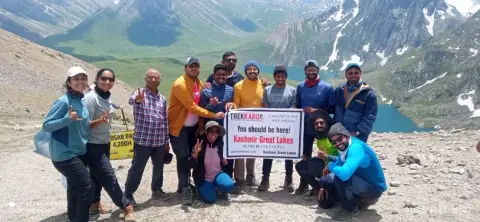
This guide is about the Kashmir Great Lakes Trek — dates, price, day-by-day itinerary and booking are on the trek page.
Quick answer: Kashmir Great Lakes is a 7-day, Moderate to Difficult trek from Shitkadi near Sonamarg to Naranag, crossing three passes up to Gadsar Pass at 4,206 m (13,800 ft) and passing alpine lakes including Vishansar, Gadsar, Satsar and Gangabal. It covers 67 km and runs from July to mid-September. Trekkaro's price is ₹19,500 + 5% GST (₹20,475).
On Kashmir Great Lakes almost every day ends beside a different turquoise lake, with meadows of wildflowers and snow-streaked ridges around you. It is also a serious trek, with long days and three high passes. This guide covers the route, the best month, the day-by-day plan, difficulty, cost, permits, gear and how to reach Srinagar, with links to detailed articles.
Kashmir Great Lakes trek at a glance
| Detail | Kashmir Great Lakes trek |
|---|---|
| Highest point | Gadsar Pass, 4,206 m / 13,800 ft |
| Duration | 7 days, plus Day 8 as a buffer |
| Trekking distance | 67 km over 6 trekking days |
| Grade | Moderate to Difficult |
| Start and end | Shitkadi (near Sonamarg) to Naranag, Ganderbal district |
| Season | July to mid-September |
| Minimum age | 14 years (under 18 with a parent or guardian) |
| Trekkaro price | ₹19,500 + 5% GST = ₹20,475 |
| Group size | Maximum 20 trekkers, 1 leader or guide for every 8 |
What makes Kashmir Great Lakes special?
- A lake almost every day. Vishansar and Krishansar, Gadsar, the chain of Satsar lakes, and the twin lakes of Gangabal and Nundkol below Mount Harmukh.
- Three passes. Nichnai Pass, Gadsar Pass (the highest point) and Zaj Pass each open a new valley.
- Wildflower meadows. July and August turn the valleys between the passes into carpets of flowers.
- Shepherd country. You share the meadows with Gujjar and Bakarwal herders and their flocks.
- A complete journey. You start near Sonamarg and finish at Naranag, so every day shows new country.
When is the best time for the Kashmir Great Lakes trek?
The trek opens in early July, once the passes are clear enough to cross, and Trekkaro runs batches until mid-September. Temperatures below are from Trekkaro's Kashmir Great Lakes trek page.
| Period | Day | Night at camp | What to expect |
|---|---|---|---|
| Early July | 8°C to 18°C | -2°C to -5°C | Snow on the passes, lakes at their fullest, cold nights |
| Mid-July to August | 14°C to 22°C | 2°C to 8°C | Peak wildflowers, greenest meadows, busiest weeks |
| Late August to mid-September | 10°C to 18°C | -1°C to 4°C | Clearest skies, autumn colours starting, fewer people |
For flowers, go from mid-July to mid-August. For snow on the passes, go in early July. For clear skies and quieter camps, choose late August or early September. Before you leave, check the forecast from the India Meteorological Department's Srinagar centre.
Kashmir Great Lakes trek itinerary (7 days + buffer)
Day 1: Srinagar to Shitkadi (about 2,600 m / 8,530 ft)
Pickup at the Tourist Reception Centre (TRC), Srinagar, at 12:00 PM. About 85 km and 3 hours by road past Ganderbal to the base camp at Shitkadi near Sonamarg. Sonamarg has the last ATM.
Day 2: Shitkadi to Nichnai (about 3,510 m / 11,500 ft)
10 km, 4 to 5 hours. A steep climb through maple and birch forest opens onto meadows, then follows a stream up the Nichnai valley to camp.
Day 3: Nichnai to Vishansar Lake via Nichnai Pass
12 km, 6 to 7 hours. You cross Nichnai Pass (about 3,990 m / 13,100 ft) and descend into a wide meadow to camp near Vishansar Lake (about 4,080 m / 13,386 ft), with Krishansar just above it.
Day 4: Vishansar to Gadsar Lake via Gadsar Pass (4,206 m / 13,800 ft)
14 km, 7 to 8 hours, the hardest day. An early 5:30 AM start, a steep climb to Gadsar Pass with views of Vishansar and Krishansar below, and a long descent of about 600 m to Gadsar Lake (about 3,600 m / 11,800 ft). Fixed ropes are used on steep snow if needed.
Day 5: Gadsar to Satsar (about 3,780 m / 12,400 ft)
10 km, 5 to 6 hours, through meadows to the Satsar chain of small lakes. There is an army checkpoint on the way, so keep your ID handy.
Day 6: Satsar to Gangabal (3,501 m / 11,486 ft) via Zaj Pass
10 km, 5 to 6 hours, over boulder fields and Zaj Pass to the twin lakes of Gangabal and Nundkol below Mount Harmukh, the most dramatic campsite of the trek.
Day 7: Gangabal to Naranag (about 2,190 m / 7,200 ft), drive to Srinagar
11 km, 5 to 6 hours, a long, steep descent through pine forest to Naranag and its old temple ruins, then about 55 km and 2 hours to Srinagar.
Day 8: Buffer day
Kept free in case weather stops a pass crossing. If it is used, it costs ₹2,500 per person per day; if not, there is no charge. Book a fixed ticket home for Day 9, or a flexible or refundable one for Day 8.
How difficult is the Kashmir Great Lakes trek?
Kashmir Great Lakes is graded Moderate to Difficult. Days are 4 to 8 hours long, all three passes are above 13,000 ft, and the descents from Gadsar Pass and to Naranag are steep and hard on knees. It is not suited to a first Himalayan trek: Trekkaro recommends one earlier Himalayan trek at a similar altitude, or a strong fitness base and 8 to 10 weeks of serious training with jogging, stair climbs and long walks with a loaded backpack.
You sleep near 4,000 m at Vishansar, so altitude is the main risk. The team checks oxygen saturation and pulse daily and carries oxygen and a stretcher. Read the Shri Amarnathji Shrine Board's health advisory before you go, and tell your trek leader about any symptom early.
What does the Kashmir Great Lakes trek cost?
Trekkaro's Kashmir Great Lakes trek costs ₹19,500 per person + 5% GST = ₹20,475. The trek page shows EMI from ₹1,003 a month.
| Item | Cost |
|---|---|
| Trek fee (camping, meals, permits, trek team) | ₹19,500 + 5% GST = ₹20,475 |
| Cab, Srinagar to Shitkadi and Naranag to Srinagar | About ₹8,500 per 5 to 6 seat vehicle for the round trip, split among trekkers |
| Backpack offloading (optional, up to 9 kg) | ₹3,000 + GST = ₹3,150 |
| Single tent (optional) | ₹2,000 + GST = ₹2,100 |
| Buffer day, only if used | ₹2,500 per person per day |
The fee includes six nights of camping (three trekkers to a tent), meals from Day 1 dinner to Day 7 breakfast, forest permits and entry fees, sleeping bags rated to -20°C and mats, and a certified trek leader with guides, cooks and mules. Transport is not included in the trek fee: we arrange shared cabs at an additional cost, paid directly to the driver and split among trekkers. Cancellation: 70% refund 30 days or more before departure and 50% between 15 and 29 days; at 8 to 14 days there is no cash refund, but you can take a 100% TrekCash voucher valid for one year, a free reschedule or a transfer to another trekker. Any of these can also replace a cash refund at any point up to 8 days before departure. At 7 days or less, or a no-show, there is no refund. See the Kashmir Great Lakes trek cost breakdown.
Permits, ID and gear
Forest permits and route entry fees are included. Carry an original government photo ID with a photocopy (Aadhaar, passport, voter ID or driving licence); international trekkers need a passport. Travel insurance with high-altitude and helicopter evacuation cover is mandatory, and every trekker brings a medical certificate signed by a doctor.
Kashmir Great Lakes comes with free microspikes and gaiters, useful on the snow of the passes in July. You bring your own trekking shoes, warm jacket, trekking poles, a rain jacket and pack cover, thermal inners, fleece, warm cap and gloves, sunglasses, sunscreen, a headlamp and a power bank, because there are no charging points on the trail.
How do you reach Srinagar?
Fly to Srinagar (Sheikh ul-Alam International Airport), about 1 hour 20 minutes from Delhi, and reach the TRC by 12:00 PM on Day 1; arriving the day before is safer. By train, go to Katra or Jammu Tawi, then take the Vande Bharat from Katra to Srinagar (about 3 hours). Sonamarg has the last ATM, and only postpaid SIMs work, and only up to Shitkadi.
Five things to know before you go
- Book a fixed ticket home for Day 9, or a flexible one for Day 8. The buffer day exists because weather can close a pass.
- Carry a postpaid SIM and cash. Prepaid SIMs from other states do not work in Kashmir, and there are no ATMs after Sonamarg.
- Train for the descents. Gadsar and Naranag punish weak knees; practise downhill walking with poles.
- Pack for rain. Afternoon showers are common in July and August.
- Keep ID with you every day. There is an army checkpoint near Satsar.
See Kashmir Great Lakes dates and book | Kashmir Great Lakes trek cost | Hampta Pass guide | First Himalayan trek guide
Frequently asked questions
How many days does the Kashmir Great Lakes trek take?
The Kashmir Great Lakes trek takes 7 days from Srinagar to Srinagar, with 67 km of trekking over six days, plus Day 8 kept as a buffer for bad weather.
What is the best time for the Kashmir Great Lakes trek?
July to mid-September. Mid-July to mid-August has the best wildflowers, early July has snow on the passes, and late August to early September has the clearest skies.
Is Kashmir Great Lakes suitable for beginners?
It is not suited to a first Himalayan trek. Trekkaro recommends one earlier Himalayan trek at a similar altitude, or a strong fitness base and 8 to 10 weeks of serious training. It is graded Moderate to Difficult, with long days, three high passes and steep descents, and the minimum age is 14.
What is the highest point on the Kashmir Great Lakes trek?
Gadsar Pass at 4,206 m (13,800 ft), crossed on Day 4. Nichnai Pass is about 3,990 m (13,100 ft), and the Vishansar campsite is about 4,080 m.
Which lakes do you see on the Kashmir Great Lakes trek?
Vishansar and Krishansar, Gadsar, the Satsar chain of small lakes, and the twin lakes of Gangabal and Nundkol, along with several smaller lakes on the way.
Do I need my own trekking shoes for Kashmir Great Lakes?
Yes. On this trek you bring your own trekking shoes, jacket and poles; Trekkaro provides free microspikes and gaiters, plus tents, sleeping bags and mats.
How much does the Kashmir Great Lakes trek cost with Trekkaro?
₹19,500 + 5% GST, which is ₹20,475 per person. The cab between Srinagar and the trailheads is about ₹8,500 per vehicle for the round trip, paid separately.