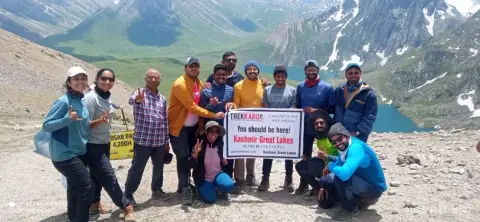
This guide is about the Kashmir Great Lakes Trek — dates, price, day-by-day itinerary and booking are on the trek page.
Quick answer: The best time for the Kashmir Great Lakes (KGL) trek is mid-July to August, when the Nichnai and Gadsar passes are clear of snow and camp nights stay at 2 to 8°C. Our season runs early July to mid-September, and there are no batches from mid-September to June. See the trek page for live batch dates.
This guide is for trekkers choosing a month for Kashmir Great Lakes, the 7-day crossing from Shitkadi near Sonamarg to Naranag. It also answers the question people ask every autumn: is KGL open now? Every season fact and temperature below comes from our Kashmir Great Lakes trek page.
When does the Kashmir Great Lakes trek open?
Our KGL season opens in early July. Before July, snow blocks Nichnai Pass at about 13,100 ft and Gadsar Pass at 13,800 ft (4,206 m). From mid-October, fresh snow can close them again, and we run no standard batches after mid-September.
- First batches: early July, once the passes are clear enough to cross.
- Last batches: mid-September; each trek ends six days after it starts.
- We run no KGL batches from mid-September to June; from mid-October, fresh snow closes the passes.
See the trek page for live batch dates. Booking for each batch closes at 5 PM (India time) the day before it starts.
KGL trek conditions through the season
The trek page splits the season into three windows. Temperatures are day and night at camp.
| Window | Day | Night at camp | Snow and trail |
|---|---|---|---|
| Early July | 8°C to 18°C | -5 to -2°C | Snow on both passes; microspikes needed |
| Mid-July to August | 14°C to 22°C | 2 to 8°C | Passes fully clear |
| Late August to mid-September | 10°C to 18°C | -1 to 4°C | Clear trails; nights get colder from early September |
| Mid-September to June | No batches | No batches | From mid-October fresh snow closes the passes |
Our batches follow the same pattern:
- July: batches through the month, starting with the snowy opening weeks.
- August: batches through the month, in the peak window.
- September: batches in the first half of the month only.
See the trek page for live batch dates.
Which month should you pick?
Mid-July to August: the easiest window
This is the window our trek page calls the best. The passes are fully clear of snow for the climbs to Nichnai Pass on Day 3 and Gadsar Pass on Day 4, and the nights at camp stay above freezing. For the mildest conditions on the trek, pick a date here.
Early July: snow on the passes
The first batches meet snow on both passes, and nights at camp fall to -5°C. You walk the snow sections on microspikes, which we hand out free. Pick early July only if you are comfortable walking on snow and sleeping in sub-zero cold.
September: colder nights, last chance
The trails are clear, but nights fall to -1°C from early September. The last batches start in mid-September. If your leave falls after mid-September, KGL is closed until the next July.
Trekkaro tip: if you can only travel in late September or October, choose another trek. Fresh snow can close the KGL passes from mid-October, and we do not run batches after mid-September.
What the season changes on the hardest day
Day 4 crosses Gadsar Pass, the highest point of the trek: about 14 km in 7 to 8 hours, from Vishansar Lake (about 13,386 ft) up to 13,800 ft and down about 2,000 ft of scree and boulders to Gadsar Lake. The group leaves Vishansar camp by 5:30 AM, while the snow is firm, to clear the pass before afternoon cloud and wind build on the upper ridge. In early July this climb is on snow; from mid-July the pass is clear.
How many days of leave do you need?
Pickup is at the Tourist Reception Centre (TRC), Srinagar, at 12:00 PM on Day 1, and the shared cab reaches Srinagar by evening on Day 7. Day 8 is a buffer day, used only if weather or trail conditions delay the group; it costs ₹2,500 per person only if it is used. Our trek page asks you to arrive in Srinagar a day early. So plan about 10 days from home: a travel day, 7 trek days, the buffer day, and the journey home.
Srinagar airport has direct flights from Delhi of about 1 hour 20 minutes. By rail, the Vande Bharat from Katra reaches Srinagar in about 3 hours.
Gear and safety in each window
- We lend only microspikes and gaiters on KGL, free, with no deposit. Bring your own trekking shoes, warm jacket and trekking poles. For early July, pack for -5°C nights.
- The minimum age is 14, and trekkers under 18 come with a parent or guardian. The trek page recommends one earlier Himalayan trek at a similar altitude, or strong fitness and 8 to 10 weeks of preparation. It is not suited to a first Himalayan trek.
- A medical fitness certificate signed by a doctor is mandatory, with an original government photo ID and a photocopy. Travel insurance that covers high-altitude trekking and helicopter evacuation is mandatory and not included.
- Sonamarg has the last ATM, so carry cash in small notes. Shitkadi is the last point with a stable signal, on postpaid SIMs only.
- Water comes from glacial streams and is boiled or treated with chlorine at camp.
Before you climb, read the Ladakh Tourism advisory for high-altitude travellers: it lists early signs of altitude sickness, such as a persistent headache and mild nausea, and says to stop ascending immediately if they appear. In the week before you leave, check the IMD Meteorological Centre, Srinagar for current weather in the Kashmir valley.
What a KGL batch costs in any month
The fee is the same through the season: ₹19,500 per person + 5% GST = ₹20,475. The trek page shows EMI from ₹1,003 a month. Transport is not included in the trek fee: we help the group book shared cabs, paid directly to the driver and split among trekkers, at ₹8,500 per 5–6 seat vehicle for the round trip from Srinagar. Meals on the drives are not included. Backpack offloading is ₹3,000 + GST (up to 9 kg), and a single tent ₹2,000 + GST. Each batch takes at most 20 trekkers, with one trek leader or guide for each 8.
If your dates change: 70% refund 30 days or more before departure, 50% at 15 to 29 days, no cash refund at 8 to 14 days, and nothing at 7 days or less or for a no-show. At any point up to 8 days before departure you can take a 100% TrekCash voucher (valid one year), one free reschedule or a transfer to another trekker instead of the cash refund.
See Kashmir Great Lakes dates and book | KGL distance and height | Kashmir Great Lakes cost | Kashmir Great Lakes complete guide
Frequently asked questions
Is the KGL trek open in October?
No. Our Kashmir Great Lakes batches run from early July to mid-September, and fresh snow can close the passes from mid-October. See the trek page for live batch dates.
Can I do the Kashmir Great Lakes trek in June?
Not with us. The passes are snowbound before July, so our season starts in early July. See the trek page for live batch dates.
Which month has snow on the KGL passes?
Snow lies on both passes in early July, and microspikes are needed. From mid-July the passes are clear, and fresh snow can close them again from mid-October.
How cold does it get at night on the Kashmir Great Lakes trek?
Between -5 and -2°C in early July, 2 to 8°C from mid-July to August, and -1 to 4°C from late August to mid-September.
Is the Kashmir Great Lakes trek possible in winter?
No. We run no batches from mid-September to June. From mid-October, fresh snow closes the passes.