This guide is about the Gulabi Kantha Trek — dates, price, day-by-day itinerary and booking are on the trek page.
Quick answer: The Gulabi Kantha trek is graded Easy–Moderate and suits beginners with basic fitness. Its one hard day is summit day: 14 km in 7 to 8 hours from Kandola (2,590 m) to the 3,658 m (12,000 ft) top and back, with about 1,068 m of climbing that turns steeper above Seema Thatch. The minimum age is 8.
How difficult is the Gulabi Kantha trek?
Trekkaro grades the Gulabi Kantha Trek Easy–Moderate. Two of its five days are drives, and the walks to and from Kandola are 5 km each. What lifts it above Easy is a single long, steep day, and in winter, snow on the upper trail and cold camp nights.
| Day | What it asks of you | Hardest stretch |
|---|---|---|
| Day 1 | A 7 to 8 hour drive from Dehradun to Hanuman Chatti | None on foot |
| Day 2 | A short, gradual climb to Kandola camp in 3 to 4 hours | None; the ascent is gradual |
| Day 3 | The long summit day: 14 km in 7 to 8 hours, up and back | The steep climb above Seema Thatch to the top, then the same height down |
| Day 4 | A short walk down to Hanuman Chatti in 2 to 3 hours | The steep descending patches |
| Day 5 | A 7 to 8 hour drive back to Dehradun | None on foot |
The leg-by-leg distances and height gains are in our Gulabi Kantha distance guide; this page is about the effort they ask of you.
Why is summit day the hard part?
You leave Kandola early, with a packed lunch in your bag. The trail climbs through forest and opens onto the alpine meadows of Seema Thatch at 3,200 m (10,500 ft). Above Seema Thatch the trail turns steeper, and this hard section stays with you until the top. The full ascent takes about 4 to 5 hours, and groups reach the summit between 9 and 10 AM, stay 30 to 45 minutes, and then retrace their steps through Seema Thatch to Kandola.
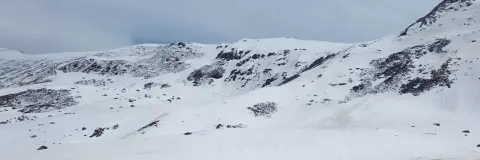
The way down is the other half of the day. You lose the same 1,068 m on tired legs, so a slow, controlled descent with poles matters as much as the climb. From December to February snow on the upper trail makes the day slower and more tiring; after fresh snow the team clears the trail, cuts steps where needed and helps trekkers across slippery sections. Walk in the line your guide sets.
Who should think twice about Gulabi Kantha?
Trekkaro asks you to think twice if a 14 km day with a steep final climb worries you, or, in December to February, if you cannot take camp nights of -10°C to -5°C. A few other points decide who should join:
- The minimum age is 8, and trekkers under 18 come with a parent or guardian.
- Trekkers above 60 need good fitness and cardiovascular health, and an ECG or TMT report is recommended.
- Day 4 has steep descending patches, so trekkers with weak knees should train for descents and use trekking poles.
- Every trekker brings a medical certificate signed by a doctor, using the form in My Bookings.
If you are new to trekking, the month matters too; our Gulabi Kantha best-time guide shows how the trek changes from October to April.
How fit do you need to be, and how should you train?
You need basic fitness and enough stamina for a 14 km summit day of 7 to 8 hours. Trekkaro's advice is to build that before the trek with running, cycling or swimming, and to practise walking with a small loaded backpack. Brisk walks, jogging, stair climbing, squats and lunges all help.
| What to train | How | Where it helps on the trek |
|---|---|---|
| Stamina for a long day | Running, cycling, swimming or brisk walks | The 7 to 8 hours of summit day |
| Climbing strength | Stair climbing and jogging | The steep stretch above Seema Thatch |
| Leg control on descents | Squats and lunges | The 1,068 m down on Day 3 and the steep patches on Day 4 |
| Carrying a load | Walks with a small loaded backpack | Every walking day, with your daypack on summit day |
On the trail, take short, regular rests. The Uttarakhand health department's high-altitude health advisory suggests a rest of 5 to 10 minutes for each hour of trekking.
Is altitude sickness a risk on Gulabi Kantha?
The risk is relatively low, because the highest camp is Kandola at 2,590 m and you sleep there again after the summit. The summit itself is above 3,000 m, so tell your trek leader early about a headache, nausea or breathlessness. The same Uttarakhand advisory lists chest pain, shortness of breath, persistent coughing, dizziness or disorientation and vomiting as signs to seek help at once, and its rule is to descend if you feel unwell and not to go higher.
What safety cover does a Trekkaro batch carry?
Trek leaders are trained in wilderness first aid and lead with local guides, with one trek leader or guide for every 8 trekkers. Your SpO2 and pulse are checked twice a day at every campsite. Each batch carries a portable oxygen cylinder, a first-aid and medical kit and a stretcher, and ice axes, microspikes and gaiters travel with the group; ropes are not used on this trek. No doctor joins the trek, which is one more reason the medical certificate and travel insurance matter. Insurance is mandatory and not included, and it must cover high-altitude trekking and emergency evacuation.
Free Trekking Gear takes some of the load off your own kit: Decathlon trekking shoes, a -10°C jacket, trekking poles, gaiters and microspikes, against a ₹3,000 refundable deposit and a ₹200 washing charge. Sleeping bags are rated to -20°C, and tents are shared by three, with men and women in separate tents.
The fee is ₹8,500 per person plus 5% GST (₹8,925 with GST). EMI starts at ₹437 a month. Transport between Dehradun and Hanuman Chatti is not included; we help the group book shared cabs, paid directly to the driver and split among trekkers. Our Gulabi Kantha cost guide has the full budget.
See Gulabi Kantha Trek dates and book | Gulabi Kantha trek distance | Gulabi Kantha best time and weather
Frequently asked questions
Is the Gulabi Kantha trek difficult?
It is graded Easy–Moderate. Most days are short, but summit day is 14 km in 7 to 8 hours with a steep climb above Seema Thatch.
Can a first-time trekker do the Gulabi Kantha trek?
Yes, if you have basic fitness. The trek is short, and the preparation that counts is for one long day with a sustained climb and an equally long descent.
Which is the hardest part of the Gulabi Kantha trek?
The stretch above Seema Thatch at 3,200 m, where the trail turns steeper and stays steep to the 3,658 m top. Take the same stretch slowly on the way down, with your poles out.
What is the minimum age for the Gulabi Kantha trek?
The minimum age is 8, and anyone under 18 comes with a parent or guardian. Trekkers above 60 are advised to bring an ECG or TMT report.
Do I need to carry my own trekking poles?
No. Trekking poles come with the Free Trekking Gear, along with Decathlon trekking shoes, a -10°C jacket, gaiters and microspikes. Use them on the steep stretch above Seema Thatch and on the Day 4 descent.