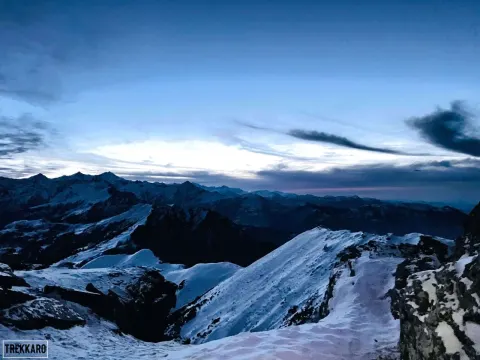
This guide is about the Gulabi Kantha Trek — dates, price, day-by-day itinerary and booking are on the trek page.
Quick answer: The Gulabi Kantha trek best time is October to April, and Trekkaro recommends December to April. Pick December to February for snow on the upper trail and summit (days 7°C to 16°C, nights -10°C to -5°C), March to April for milder nights and blooming meadows, or October to November for clear trails.
When is the best time for the Gulabi Kantha trek?
The trek runs from October to April. The Gulabikantha trek page gives its season as "January to April and October to December", which covers the same seven months. The trek does not run from May to September. Its own recommendation is narrower: "Trekkaro recommends December to April for Gulabikantha."
Inside that window, the right month depends on what you want from the 3,658 m (12,000 ft) summit day. The trek page splits the season into three parts and says plainly what each one is for:
- December to February if you want snow. In the trek page's words, "For a full snow trek and the summit meadow under winter cover, book December to February."
- March to April if this is your first trek or you are coming with children aged 8 and above. The trek page names March to April as its pick for blooming meadows, milder nights and the most comfortable conditions for first-time trekkers.
- October to November if you prefer quiet walking. "For a quiet trek on clear trails before the snow arrives, October to November works well."
So there is no single best month for everyone. Snow, comfort and clear trails peak at different times, and the choice is between them.
What is the weather like in each month from October to April?
The trek page gives temperatures for three seasonal blocks, not for single months. The table applies each block to the months it covers and keeps the trail notes to the trek page's own wording. The figures are for the trek as a whole; the trek page does not give separate readings for Hanuman Chatti, Kandola or the summit.
| Month | Trek page season | Day | Night | Trail conditions (trek page) |
|---|---|---|---|---|
| October | Autumn (Clear Trails) | 9°C to 20°C | 0°C to 5°C | Clear trails and pleasant walking weather |
| November | Autumn (Clear Trails) | 9°C to 20°C | 0°C to 5°C | Clear trails and pleasant walking weather |
| December | Winter (Snow Season) | 7°C to 16°C | -10°C to -5°C | Snow on the upper trail and summit; slower climbing; very cold nights |
| January | Winter (Snow Season) | 7°C to 16°C | -10°C to -5°C | Snow on the upper trail and summit; slower climbing; very cold nights |
| February | Winter (Snow Season) | 7°C to 16°C | -10°C to -5°C | Snow on the upper trail and summit; slower climbing; very cold nights |
| March | Spring (Meadows in Bloom) | 10°C to 24°C | -4°C to 6°C | Pleasant walking; meadows starting to bloom; snow possible higher up early in the season |
| April | Spring (Meadows in Bloom) | 10°C to 24°C | -4°C to 6°C | Pleasant walking; meadows starting to bloom; snow possible higher up early in the season |
Two things stand out. The coldest nights, down to -10°C, fall in December to February, while the warmest days, up to 24°C, come in March and April. And the gap between day and night is widest in spring: spring days can reach 24°C while spring nights can drop to -4°C, so a warm afternoon on the meadow says little about the night at camp.
Which months have snow, and where on the trail does it lie?
The trek page is consistent on the core snow window: snow lies on the upper trail and at the summit from December to February, and "snow can still lie on the higher slopes in March and April". It describes December to February as the time when "In winter the meadow transforms", with snow "turning the summit into a wide white slope".
The upper trail is the summit-day climb. On Day 3 you walk from Kandola camp at 2,590 m (8,500 ft) up through the meadows of Seema Thatch at 3,200 m (10,500 ft) to the top at 3,658 m (12,000 ft), then return to Kandola the same day. That climb of about 1,068 m is where snow changes the day. The trek page says "Snow on the upper trail and the summit makes the climb slower and more tiring, and the nights at Kandola are properly cold."
The trek page does not say how deep the snow gets or name a date when it arrives or melts, so neither is given here. For the full day-by-day distances and heights, see the Gulabikantha distance and height guide.
In autumn the trek page describes cold nights on mostly clear trails. It calls October and November the time when "the summit view can be enjoyed before the winter snow arrives." The peaks the trek page names on the skyline from the summit include Bandarpoonch, Black Peak, Swargarohini, Kalindi Srikala and Chaukhamba.
How should you dress and pack for each window?
Warm clothing scales with the month. The trek page's packing list asks for 5 warm layers from December to April and 3 to 4 in October and November. Inside that count, it lists 2 fleece or woollen layers from December to April and 1 to 2 in October and November.
From December to April, the packing list also adds:
- a balaclava
- a waterproof pair of gloves on top of one fleece pair
- one insulated bottle out of your two 1 L bottles, so the water does not freeze
Some of the cold-weather kit is already covered. Gulabikantha is one of the treks with Free Trekking Gear: Decathlon trekking shoes, a -10°C jacket, trekking poles, gaiters and microspikes, against a ₹3,000 refundable deposit and a ₹200 washing charge. At camp, the trek page lists sleeping bags rated to -20°C, in tents shared by three trekkers, with men and women in separate tents. Microspikes and gaiters are for snow on the trail, so in December to February they matter most on the climb above Kandola. Our note on using microspikes on a winter trek covers how to wear them.
Two more items matter in the snow months: UV-protected sunglasses, which the trek page calls "essential on snow to prevent snow blindness", and a rain jacket or poncho "for unexpected showers or snowfall".
Does the season change how hard the trek is?
Yes. Trekkaro grades Gulabikantha Easy–Moderate and states: "Without snow it is a gentle trek that beginners with basic fitness can manage; snow in the winter months adds some challenge." Its safety advice for the cold months is short: "In winter, snow adds to the effort, so use your poles and walk in the line your guide sets."
The trek page does not link altitude risk to the season. It rates the risk of altitude sickness on Gulabikantha as relatively low because you sleep no higher than Kandola at 2,590 m and go up to the summit and back in one day. What winter adds is cold and slower footing, not height.
If you are choosing between a snow trek and an easier first outing, this is the real trade. December to February gives you the white summit meadow with the coldest nights and the slowest summit day. March and April give you milder conditions, with snow possible higher up early in that period. October and November give you clear trails and nights of 0°C to 5°C.
How do you check the forecast before you go?
The trek page's temperatures describe each season, not a forecast for your days on the trail. Before you leave for the drive from Dehradun to Hanuman Chatti, check the India Meteorological Department's IMD Dehradun page, which has Warnings and Nowcast sections alongside current weather.
Check it before the drive, because the trek page names Barkot, about 1 hour 30 minutes before Hanuman Chatti, as the last reliable mobile network. On the trail itself, the trek page leaves weather decisions to the team: "If weather or other unexpected events force a change, the trek leader suggests the best alternate plan."
All trekkers bring a doctor-signed medical certificate, using the form in My Bookings, whichever month you pick. See the trek page for live batch dates.
See Gulabikantha Trek dates and book | Gulabikantha distance and height | Gulabikantha trek cost
Frequently asked questions
Do I need microspikes on the Gulabi Kantha trek in March or April?
Snow is possible on the higher slopes early in the spring period, so they can still be useful on the summit climb then. Microspikes and gaiters come with the Free Trekking Gear, so you do not need to buy them.
Is the free -10°C jacket enough for winter nights at Kandola?
The jacket is one piece of warm clothing, not the whole set. Winter nights drop to -10°C to -5°C, so the trek page asks for 5 warm layers from December to April, and the sleeping bags are rated to -20°C.
Can children do the Gulabi Kantha trek in winter?
The minimum age is 8, with adults accompanying the child. For families, the trek page names March to April as its pick because the nights are milder and the conditions are the most comfortable for first-time trekkers.
Does water freeze on the trek in the snow months?
It can, which is why the trek page asks you to make one of your two 1 L bottles insulated in the snow months. The packing list asks for two 1 L bottles in total, and only one of them needs to be insulated.
Can I do the Gulabi Kantha trek in May or the monsoon months?
No. The trek page gives its season as January to April and October to December, so there are no departures from May to September.