This guide is about the Brahmatal Trek — dates, price, day-by-day itinerary and booking are on the trek page.
Quick answer: March is the last month of the Brahmatal season (October to March). The trek page lists 2 feet or more of snow above Bekaltal, softer snow on the lower trail, Lohajung at 2°C to 14°C and base camp at -8°C to 0°C. The fee is ₹9,000 + 5% GST = ₹9,450 for 6 days.
The Brahmatal trek page calls March "Late Winter (Snow Softening, Extended Season)". The cold eases at night, the upper trail keeps its snow, and the lower forest turns softer underfoot. This page covers only what changes in March: which stretches still hold snow, how the nights compare with mid-winter, and why the first half of the month and the last days of the month are not the same trek.
Is there still snow on Brahmatal in March?
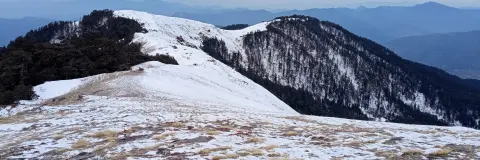
Yes, on the upper half. In the trek page's own words, "the higher sections of the trail, Jhandi Top, and the Base Camp area remain snow-covered through most of the month." Below Bekaltal it is a different picture: the snow "begins to soften and compact", and the page puts the depth at "2 feet-plus above Bekaltal, softening on the lower trail."
The table below follows the route stretch by stretch, using the itinerary distances and the March lines from the trek page.
| Stretch | Walked on | Distance and time | March condition on the trek page |
|---|---|---|---|
| Lohajung (2,316 m / 7,600 ft) to Bekaltal camp (2,798 m / 9,180 ft) | Day 2 | 6 km, 4–5 hrs | Snow softening and compacting below Bekaltal |
| Bekaltal over Jhandi Top (about 3,600 m / 11,810 ft) to base camp (3,106 m / 10,190 ft) | Day 3 | 7 km, 6–7 hrs | 2 feet or more of snow above Bekaltal; Jhandi Top snow-covered through most of the month |
| Base camp to Brahmatal Top (3,734 m / 12,250 ft) and back | Day 4 | 6 km round trip, 5–6 hrs | Base camp area snow-covered through most of the month |
| Base camp back to Lohajung | Day 5 | 10 km, 7–8 hrs | Snow above Bekaltal, softer snow on the lower forest trail |
What changes on each trekking day in March?
The route itself stays the same all season. What March changes is the snow underfoot and the cold at camp, so here is each walking day read against the March lines on the trek page.
Day 2: Lohajung to Bekaltal
The trail enters oak and rhododendron forest almost from Lohajung and climbs about 480 m (2,316 m to 2,798 m) over 6 km. In March this is the part of the route where the page says the snow softens and compacts.
Day 3: Bekaltal over Jhandi Top to base camp
The trek page calls this ascent "the steepest section of the entire Brahmatal route, requiring microspikes from the Bekaltal camp upward". The trail climbs steeply through the upper forest and breaks above the treeline to Jhandi Top at about 3,600 m, then drops across open snow on the far side of the ridge to camp at 3,106 m. In March this whole stretch sits in the zone the page lists at 2 feet or more of snow.
Day 4: Brahmatal Top and back
Departure is at 5:30 AM, and microspikes are worn "from Base Camp throughout the ascent and descent". In March the page lists the base camp area as snow-covered through most of the month, and early in the month the summit views keep their "winter clarity".
Day 5: base camp back to Lohajung
The longest day re-crosses Jhandi Top, then descends through the Bekaltal basin and the forest, about 790 m down from base camp to Lohajung (3,106 m to 2,316 m). The upper part is on the March snow above Bekaltal; the last kilometres are on the softening lower trail, at the end of a 7–8 hour day.
What should you wear for -8°C to 0°C at base camp?
March nights at 3,106 m are milder than the peak months but still below freezing, and summit day leaves base camp at 5:30 AM, before first light. The trek page's clothing list does not change for March: two sets of thermals, two fleece or woollen layers, a waterproof shell, warm trousers and 3–4 pairs of socks, worn under the -10°C padded jacket from the Free Trekking Gear kit. For the head and hands it lists a woollen cap, a balaclava, a buff and two pairs of gloves, and for the pre-dawn climb it names the balaclava and buff in particular.
Gaiters and microspikes come free with the kit. The page also asks for category 3 or 4 UV sunglasses and SPF 50+ sunscreen; in March the snow above Bekaltal is still on the ground through most of the month.
How much milder are March nights than February nights?
The trek page gives one band for December to February and a separate one for November and March. At base camp, March nights sit at -8°C to 0°C against -15°C to -5°C in the peak months, so the coldest March figure is 7 degrees above the coldest mid-winter figure. Lohajung moves from -2°C to 8°C up to 2°C to 14°C. The page publishes no separate March figure for Bekaltal, so none is given here.
That is the case the trek page makes for this month: "March is an excellent option for trekkers who want the snow experience with less severe overnight cold." Elsewhere it calls March "the gentler winter option", next to January as "the most dramatic winter month."
Early March or late March: which part of the month should you pick?
The two ends of the month read differently on the trek page.
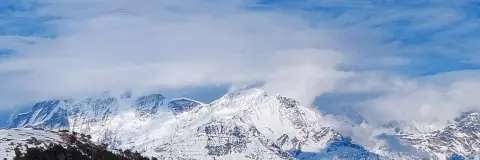
- Early March keeps the mid-winter sky. The page says "the summit views retain their winter clarity in early March, and daytime temperatures become more comfortable." From Jhandi Top and Brahmatal Top it names Trishul (7,120 m) and Nanda Ghunti (6,309 m), with Mt Kamet (7,756 m) from the summit on clear days.
- Late March is where the season stops. The page is direct about why: "The season ends in late March as snow becomes slushy and trail conditions deteriorate below the treeline."
The frozen lakes are a mid-winter promise, not a March one. The trek page says Bekaltal is frozen from December through February and gives no frozen-lake line for March, so plan for snow on the high trail rather than a frozen lake. See the trek page for live batch dates.
Who is a March batch right for?
The trek page sums up March as best for a "winter snow experience with less extreme overnight cold." That suits a trekker who wants to walk on snow and stand on a 3,734 m summit but does not want the -15°C base camp nights of January and February. Brahmatal is graded Easy–Moderate, and the trek page adds that how hard it feels "depends on the snow". The minimum age is 7.
What does a March Brahmatal trip cost?
The trek fee is ₹9,000 per person plus 5% GST, which comes to ₹9,450. Free Trekking Gear covers Decathlon trekking shoes, a -10°C jacket, trekking poles, gaiters and microspikes against a ₹3,000 refundable deposit and a ₹200 washing charge.
The drive is extra. Rishikesh to Lohajung is about 250 km and 8–10 hours each way. The cab leaves from Jumping Heights, Tapovan at 6:30 AM, and Trekkaro helps the group book shared cabs at about ₹6,500 one way per 5–6 seat vehicle, paid directly to the driver and split among the trekkers in it. The Lohajung travel guide covers the route in detail.
Each trekker brings a medical certificate signed by a doctor, using the form in My Bookings.
How do you check the forecast before a March start?
The trek page's March figures are a season band, not a forecast for your week. In the days before you leave, look at the Warnings and Nowcast sections of the India Meteorological Department's Dehradun page, and read the full month-by-month picture in the Brahmatal weather guide. Mobile signal on the trail is limited, so do the checking at Lohajung, the last place with a stable signal.
See Brahmatal dates and book | Brahmatal in February | Brahmatal distance and height
Frequently asked questions
Is the Brahmatal trek open in March?
Yes. The trek page gives the season as October to March, which makes March the final month of the season. The page marks late March as the end, once the lower trail goes slushy and the walking below the treeline gets worse.
How cold is Brahmatal base camp in March?
The trek page lists -8°C to 0°C for base camp at 3,106 m and 2°C to 14°C for Lohajung. Pack for sub-zero nights even though they are milder than the peak months.
Are Bekaltal and Brahmatal lakes frozen in March?
The trek page does not say. It describes Bekaltal as frozen from December through February, so a frozen lake is not something to count on in March.
Do I need microspikes for Brahmatal in March?
Yes. Snow stays on the trail above Bekaltal, and the trek page asks for microspikes from Bekaltal camp upward. They come in the Free Trekking Gear kit along with gaiters.
Is March a good month for a first Brahmatal trek?
It suits someone who wants snow on the trail but milder nights than January or February. The grade is Easy–Moderate, and the longest walking day is 10 km.