Brahmatal Trek
Inclusion:
Accommodation
Meals
All Permits
Expert Trek Leader & Guide
Brahmatal Trek — Guide, Dates & Cost
Brahmatal Trek is a 6-day easy–moderate trek in Chamoli, Uttarakhand, reaching 3,734 m (12,250 ft). It covers about 29 km on foot and starts and ends at Lohajung. Best time: October to March. Trekkaro price: ₹9,000 per person + 5% GST, with Free Trekking Gear (Decathlon shoes, -10°C jacket, poles, gaiters and microspikes; ₹3,000 refundable deposit + ₹200 washing). Next batch: 17 Oct 2026 (104 upcoming batches).
Updated
District: Chamoli
Duration: 6 Days
Difficulty Level: Easy–Moderate
Highest Altitude: 3,734 m / 12,250 ft
Trekking Distance: 29 km
Temperature: Dec-Feb: Lohajung -2°C to 8°C, Base Camp -15°C to -5°C | Nov and Mar: Lohajung 2°C to 14°C, Base Camp -8°C to 0°C
There is a version of the Himalayas that most trekkers never see, the winter version. The one where the trails are buried under two feet of snow, the oaks stand bare and frost-covered against a sky of absolute blue, the lakes are frozen solid, and the mountains above stand in a clarity that the summer haze entirely obscures. Brahmatal is the route into that version of the Himalayas. And it is extraordinary.
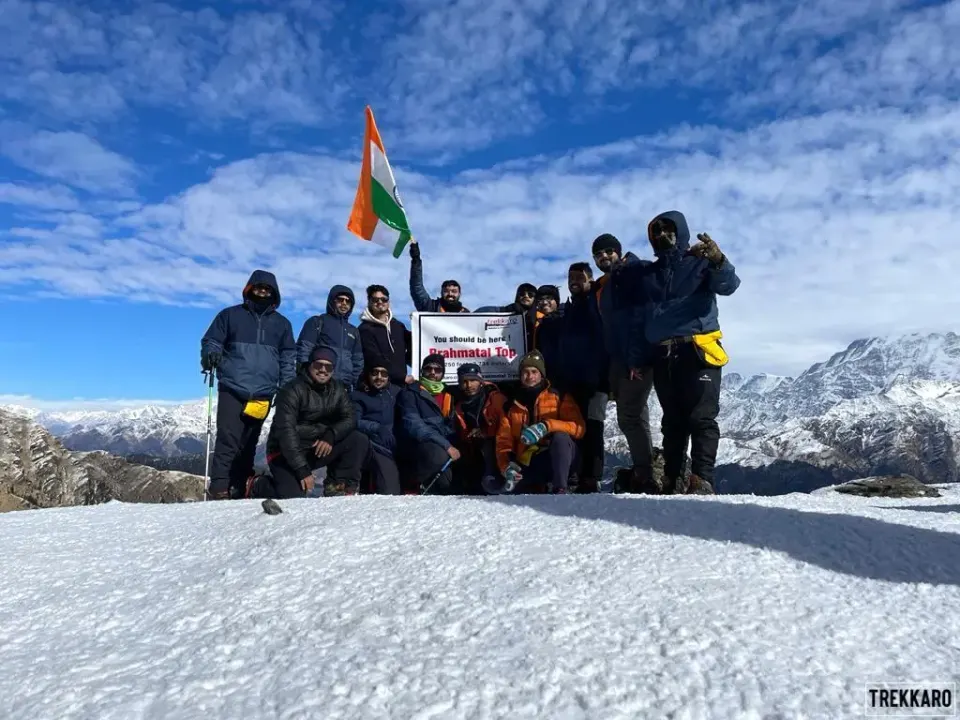
The Brahmatal trek is one of the finest winter treks in India, not because it is the hardest, but because the combination of what it offers at an easy-moderate grade is genuinely unmatched. A frozen lake near the 3,106 m base camp. A ridge viewpoint at Jhandi Top on Day 3. A summit at Brahmatal Top (3,734 m / 12,250 ft) on Day 4 with a panorama of the Garhwal Himalayan peaks: Trishul, Nanda Ghunti, Mt Kamet, and Hathi Ghoda Parvat filling the horizon simultaneously. Oak and rhododendron forests are buried shoulder-deep in snow. In six days from Rishikesh, Trekkaro takes you into this world and brings you back an experience that redefines what a winter Himalayan trek can be.
Trek Overview
The Brahmatal trek begins and ends at Lohajung (2,316 m), a village in the Chamoli district of Uttarakhand, about 250 km (8–10 hours by road) from Rishikesh. The route climbs from Lohajung through dense oak and rhododendron forest, reaching the frozen Bekaltal Lake on Day 2. Day 3 crosses Jhandi Top, a ridge viewpoint that provides the first commanding views of Trishul and the surrounding Garhwal peaks before descending to the Brahmatal Base Camp near Brahmatal Lake. Day 4 is the dedicated summit push: Brahmatal Base Camp to Brahmatal Top (3,734 m / 12,250 ft) and back. Day 5 descends the full route to Lohajung, and Day 6 is the drive back to Rishikesh. The trek is graded easy-moderate and is one of the best winter options in India for first-time snow trekkers and experienced Himalayan trekkers alike.
Why Winter – The Brahmatal Difference
Brahmatal is a winter trek in the truest sense: the experience it exists to provide requires snow. The Bekaltal Lake is frozen from December through February. Snow-covered banks and bare winter forests surround the Brahmatal Lake camp. Jhandi Top, the ridge crossing on Day 3, offers a 270-degree view of the Trishul group, Nanda Ghunti, and the Garhwal range, which the summer haze obscures, but the winter air holds a hard-edged clarity. The summit at Brahmatal Top in winter conditions delivers a Himalayan panorama that is among the finest accessible on an easy-moderate route in India. The forest sections of the trail between Lohajung and Bekaltal are under two to four feet of snow in January, producing the specific quality of snowbound forest silence that no summer mountain trail can replicate. This is the Himalayan winter. Brahmatal is the accessible entry point into it.
The Route – Three Stages, One Summit
The Brahmatal route is structured in three clear stages. The first stage, Days 2 and 3, is the approach through the snow forest to the Brahmatal Base Camp, with Bekaltal as the midpoint camp and Jhandi Top as the key ridge crossing that opens the landscape. The second stage, Day 4, is the summit push from Base Camp to Brahmatal Top and back, a round trip that delivers the defining visual experience of the entire trek. The third stage, Day 5, is the return descent from Base Camp to Lohajung, covering the full approach distance in a single long day. This structure gives the route a clarity of purpose that experienced trekkers find satisfying: every day has a defined objective, and the summit day is exactly that, a dedicated, unhurried push to the top and back.
Who Is This Trek For?
Brahmatal is graded Easy–Moderate and is one of the best winter trek options for first-time snow trekkers. The maximum altitude of 3,734 m is manageable for well-prepared beginners, and the daily distances of 6 to 10 km are achievable with a reasonable fitness base. The primary demands are the cold overnight temperatures at the higher camps, which reach -10°C to -15°C in January and February, and the significantly higher energy cost of walking in deep snow compared to bare trail. Minimum age: 7 years. There is no upper age limit; trekkers above 60 need good fitness and a medical certificate signed by a doctor. Daily trekking hours: 4 to 7 hours. Season: October to March.
Key Highlights of the Brahmatal Trek
- Brahmatal Top (3,734 m / 12,250 ft) – dedicated summit day with 270-degree Himalayan panorama
- Trishul (7,120 m) and Nanda Ghunti (6,309 m) – the signature peak views from both Jhandi Top and Brahmatal Top
- Jhandi Top ridge viewpoint – the Day 3 crossing that opens the full Garhwal Himalayan landscape for the first time
- Bekaltal Lake – frozen in winter, surrounded by the snow-buried oak forest
- Brahmatal Lake – the base camp lake beneath the summit approach
- Mt Kamet (7,756 m) – the second-highest peak in Uttarakhand, visible from the summit on clear days
- Snow-buried oak and rhododendron forest – the defining trail character of the Brahmatal approach from Lohajung
- Certified Trekkaro trek leader & guides, twice-daily health monitoring, and FTG gear with no rental fee
Best Time for the Brahmatal Trek
Brahmatal is a dedicated winter trek. The experience is known for frozen lakes, deep snow forests, clear winter summit views, and the Jhandi Top ridge panorama, which is at its fullest from December to March. Unlike most Himalayan treks that have a monsoon-to-autumn preference, Brahmatal actively improves as winter deepens.
November - Early Winter (First Snow, Pre-Peak)
The Brahmatal season opens in October, and November brings the first snow. The higher elevations above Bekaltal receive their first significant snowfall, and the forest sections below accumulate snow in the second half of the month. The full frozen lake experience at Bekaltal is less consistent in early November, and Jhandi Top may carry lighter snow than in December or January. Late November, after the first significant snowfall, is when the route comes properly into its own. Overnight temperatures drop sharply, and the Himalayan winter clarity begins.
- Temperatures: Lohajung: 2°C to 14°C | Base Camp: -8°C to 0°C
- Snow depth: Moderate at higher elevations, light to moderate on the forest trail.
- Best for: First winter experience, fewer trekkers, lakes beginning to freeze.
December to February - Peak Winter (Most Recommended)
This is the definitive Brahmatal window. December through February delivers the full winter experience: deep snow on the trail from Lohajung upward, completely frozen lakes at both Bekaltal and Brahmatal, the forest buried to the shoulder, and the crystal-clear winter air that brings Trishul and Nanda Ghunti into the kind of visual proximity that photographs consistently fail to represent. Jhandi Top on Day 3 is at its most spectacular in this window, a snow-covered ridge with an unobstructed 270-degree view of the Garhwal range. January delivers the most extreme cold (-15°C at Base Camp) and the clearest views. February combines full snow depth with slightly less severe temperatures. This is what Brahmatal is for.
- Temperatures: Lohajung: -2°C to 8°C | Bekaltal: -10°C to -3°C | Base Camp: -15°C to -5°C
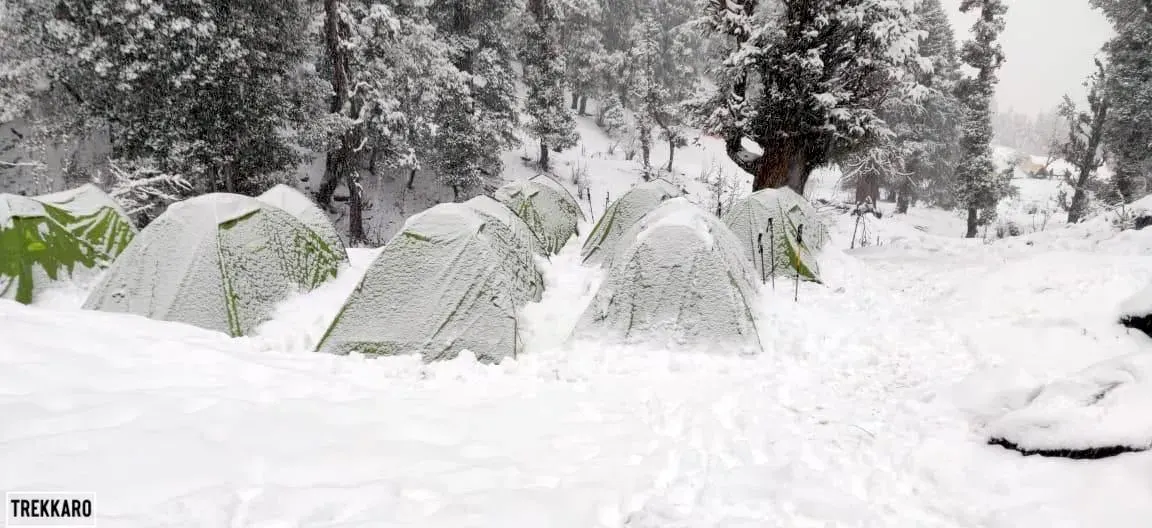
- Snow depth: 2 to 4 feet on the trail. Both lakes are fully frozen. The forest is completely snowbound.
- Best for: Full winter experience. Frozen lakes. Jhandi Top panorama. Sharpest summit views.
March - Late Winter (Snow Softening, Extended Season)
March sees the gradual return of warmth to the lower elevations. The snow begins to soften and compact below Bekaltal, but the higher sections of the trail, Jhandi Top, and the Base Camp area remain snow-covered through most of the month. The summit views retain their winter clarity in early March, and daytime temperatures become more comfortable. March is an excellent option for trekkers who want the snow experience with less severe overnight cold. The season ends in late March as snow becomes slushy and trail conditions deteriorate below the treeline.
- Temperatures: Lohajung: 2°C to 14°C | Base Camp: -8°C to 0°C
- Snow depth: 2 feet-plus above Bekaltal, softening on the lower trail.
- Best for: Winter snow experience with less extreme overnight cold.
Trekkaro Recommendation
For the complete Brahmatal experience, frozen lakes, deep snow trail, the full Jhandi Top panorama, and the sharpest Brahmatal Top summit views, book a December to February batch. January is the most dramatic winter month. February combines full snow with slightly less severe cold. March is the gentler winter option. All three windows are extraordinary.
📅 Best months for the Brahmatal Trek: October to March. Still choosing dates? Compare all treks in October, treks in November, treks in December and treks in January.
🏃 Am I ready for the Brahmatal Trek? Take the free 2-minute fitness test and get your readiness score and a personal training plan.
Take the test →Trek Itinerary
Transport is not included in the trek fee: we help the group book shared cabs (about ₹6,500 one way per 5–6 seat vehicle), paid directly to the driver and split among trekkers. The cab leaves Rishikesh (Jumping Heights, Tapovan) for Lohajung at 06:30 AM.
Transport is not included in the trek fee: we help the group book shared cabs (about ₹6,500 one way per 5–6 seat vehicle), paid directly to the driver and split among trekkers. The cab leaves Lohajung at 06:30 AM for Rishikesh (Jumping Heights, Tapovan), with an expected arrival by 06:00 PM.
Day 1: Rishikesh to Lohajung
Route Details:
Drive: Rishikesh → Lohajung | Distance: ~250 km | Duration: 8–10 hrs | Altitude: 356 m (Rishikesh) → 2,316 m (Lohajung)
Day 1 is an approach day, a long but scenically rewarding drive from the pilgrimage city of Rishikesh into the Garhwal interior, ending at Lohajung (2,316 m), the gateway village for the Brahmatal trek. The route follows NH7 and the state highways through the Alaknanda Valley, passing the Devprayag Sangam, where the Bhagirathi and Alaknanda rivers meet to form the Ganga proper, a confluence of sacred geography that is worth the brief roadside stop. Above Rudraprayag, the valley narrows and the river runs faster below the road. Above Karnaprayag, the final hour of the drive climbs through progressively denser forest to Lohajung.
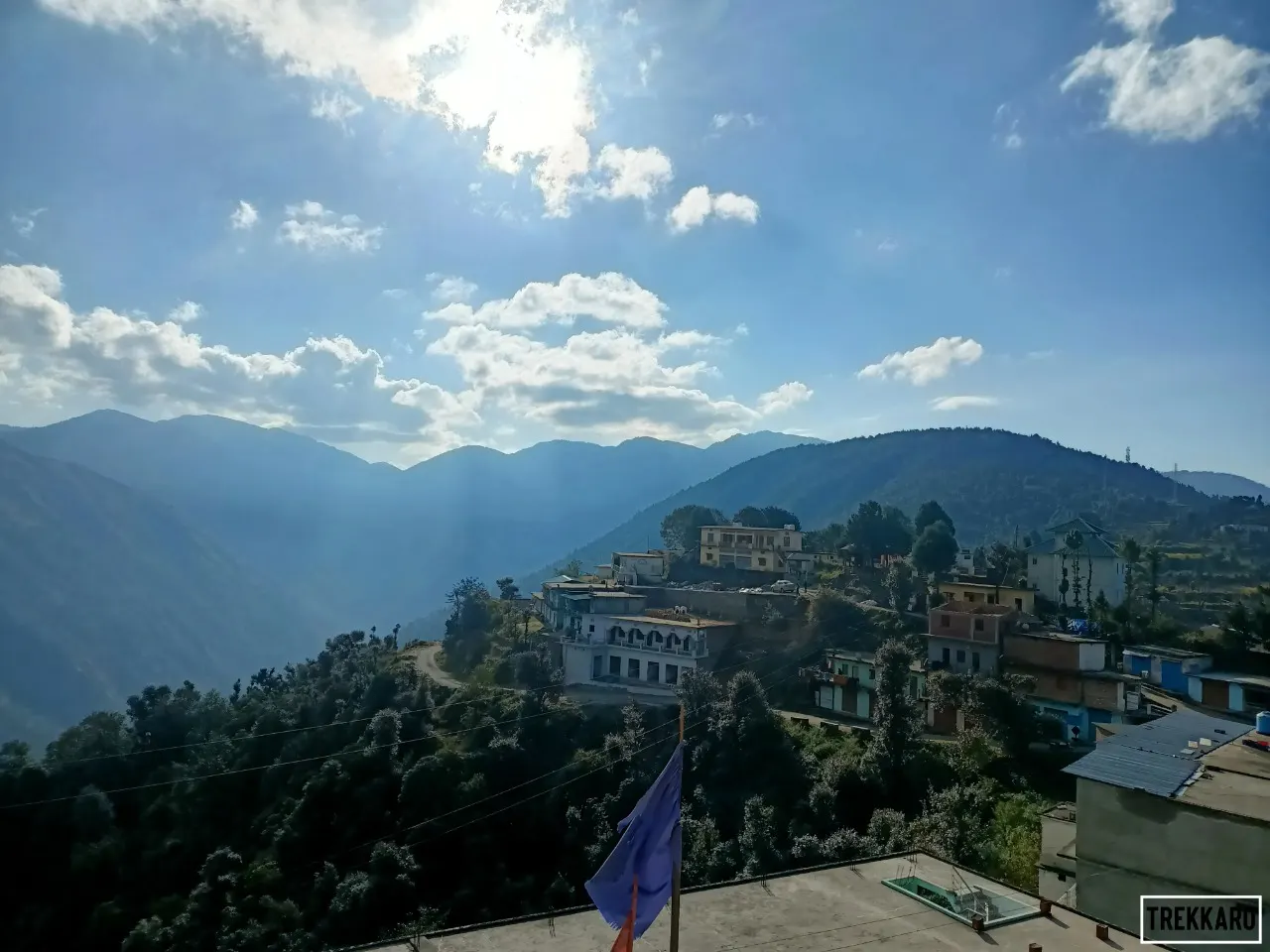
Lohajung in winter is a different village from its summer self. The surrounding forest carries the first snow on its upper edges in December, and by January the hillsides above the village are white. On clear mornings, Trishul (7,120 m) is visible above the forest ridgeline to the northeast, a distant white summit that is the first visual confirmation of where the next five days are taking you. The village is small, quiet, and genuinely connected to the mountain life of the Garhwal Chamoli district rather than to the trekking economy in any commodified way.
The evening in Lohajung is for rest, gear check, and the trek briefing. Trekkaro's health baseline SpO₂, pulse, and blood pressure for every trekker is recorded here at 2,316 m as the individual reference point for all subsequent daily readings on the route. The trek briefing covers the full six-day itinerary, the specific preparation required for winter snow trekking, the layering protocol for the temperature range ahead, and the AMS awareness relevant to the altitudes of Days 3 and 4. Sleep early and well.
What to Expect:
- Drive Rishikesh to Lohajung – ~250 km, 8–10 hrs via Devprayag, Rudraprayag, and Karnaprayag
- Devprayag Sangam: confluence of Bhagirathi and Alaknanda – the birth point of the Ganga proper
- Alaknanda Valley: river gorge, terraced farms, and progressively wilder Garhwal interior
- Lohajung (2,316 m): winter village with Trishul visible on clear mornings above the forest
- Free Trekking Gear: Decathlon trekking shoes, jacket, trekking poles, gaiters and microspikes
- Health baseline: SpO₂, pulse, and BP recorded at Lohajung for all trekkers
- Trek briefing: route, winter preparation, layering protocol, AMS awareness
- Overnight: Lohajung (2,316 m) – the last road town before the trek begins
Day 2: Lohajung to Bekaltal
Route Details:
Altitude: 2,316 m (Lohajung) → 2,798 m / 9,180 ft (Bekaltal) | Distance: ~6 km | Duration: 4–5 hrs | Terrain: Snow-covered forest trail, gradual climb through oak and rhododendron
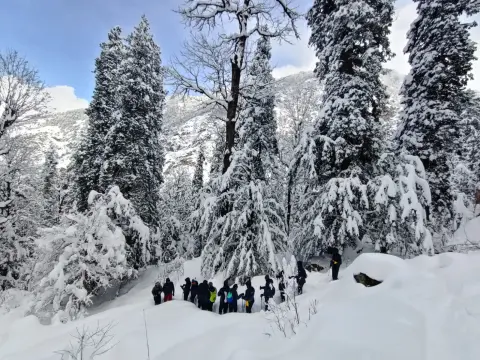
Day 2 is when Brahmatal begins to show you what it is. The trail from Lohajung enters the oak and rhododendron forest almost immediately and climbs steadily through a landscape that is, in winter, completely unlike anything on the summer trekking circuit. The trees are leafless and bare, their black branches coated in white frost, reaching upward against a sky that in the Garhwal winter is a blue of improbable intensity. The snow on the forest floor deepens progressively with altitude: at Lohajung, a few inches; by the time the trail reaches 2,800 m, knee-deep in places; by 3,000 m, the forest is buried to the waist in compressed snowpack that the oaks are growing through as though reclaiming the landscape from below.
The silence in the snow forest is a quality that most trekkers have not previously encountered. The snowpack absorbs sound in a way that the bare summer trail does not. Footsteps are muffled. The wind, which in summer rustles the oak canopy audibly, is reduced to a distant whisper above the snow-laden branches. The occasional crack of a snow-laden branch releasing its load, the distant sound of a bird, and the rhythmic crunch of boots on packed snow are the complete acoustic world of the Brahmatal forest in January. Many trekkers describe this section of the route as the most affecting they have encountered, not because of its visual scale, but because of its quality of deep, absolute quiet.
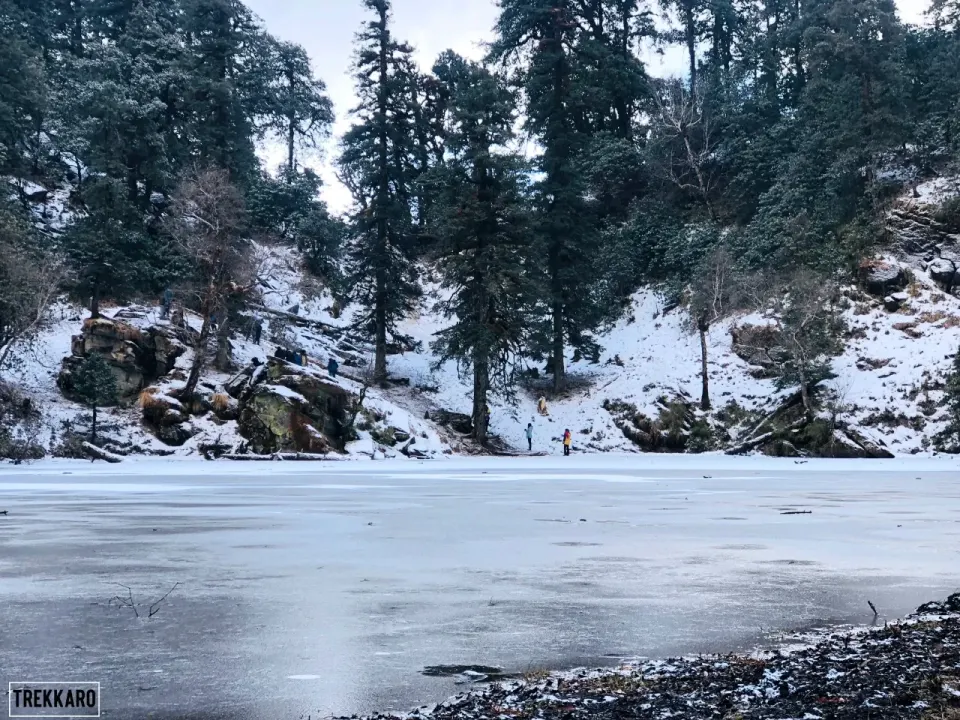
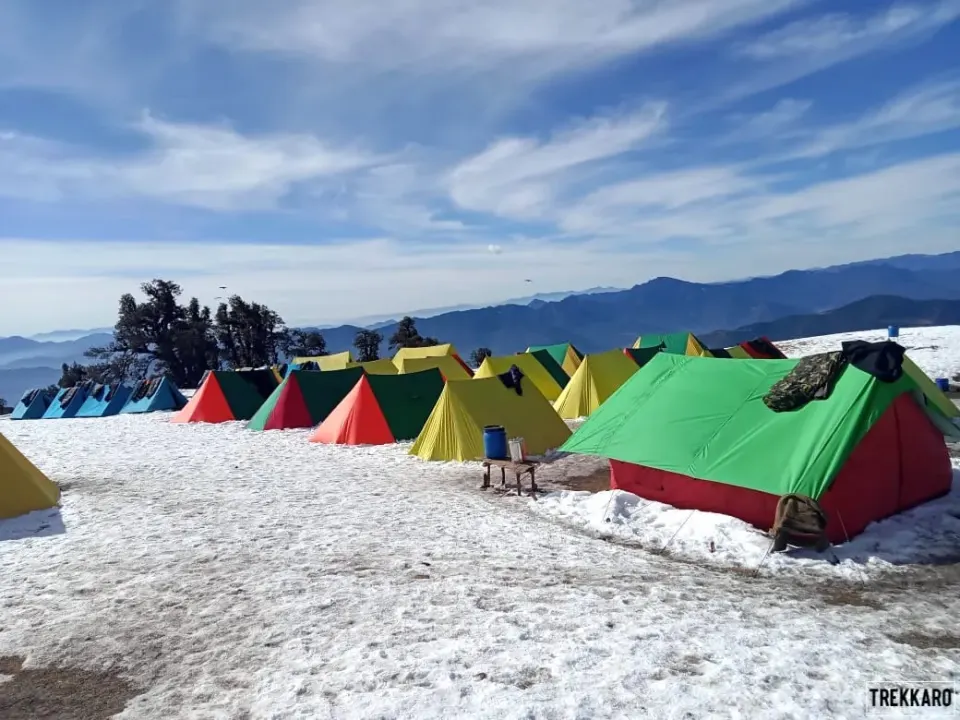
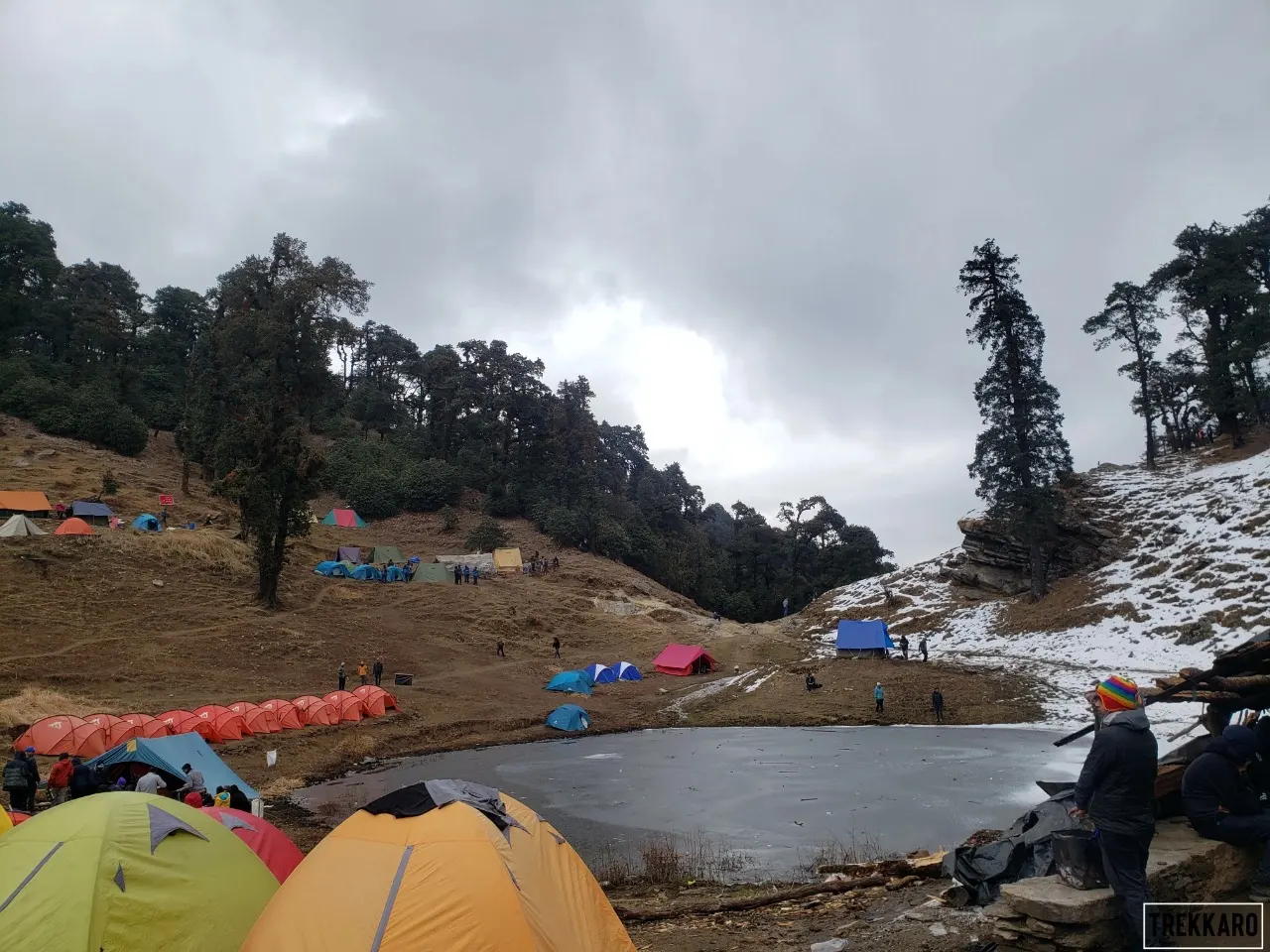
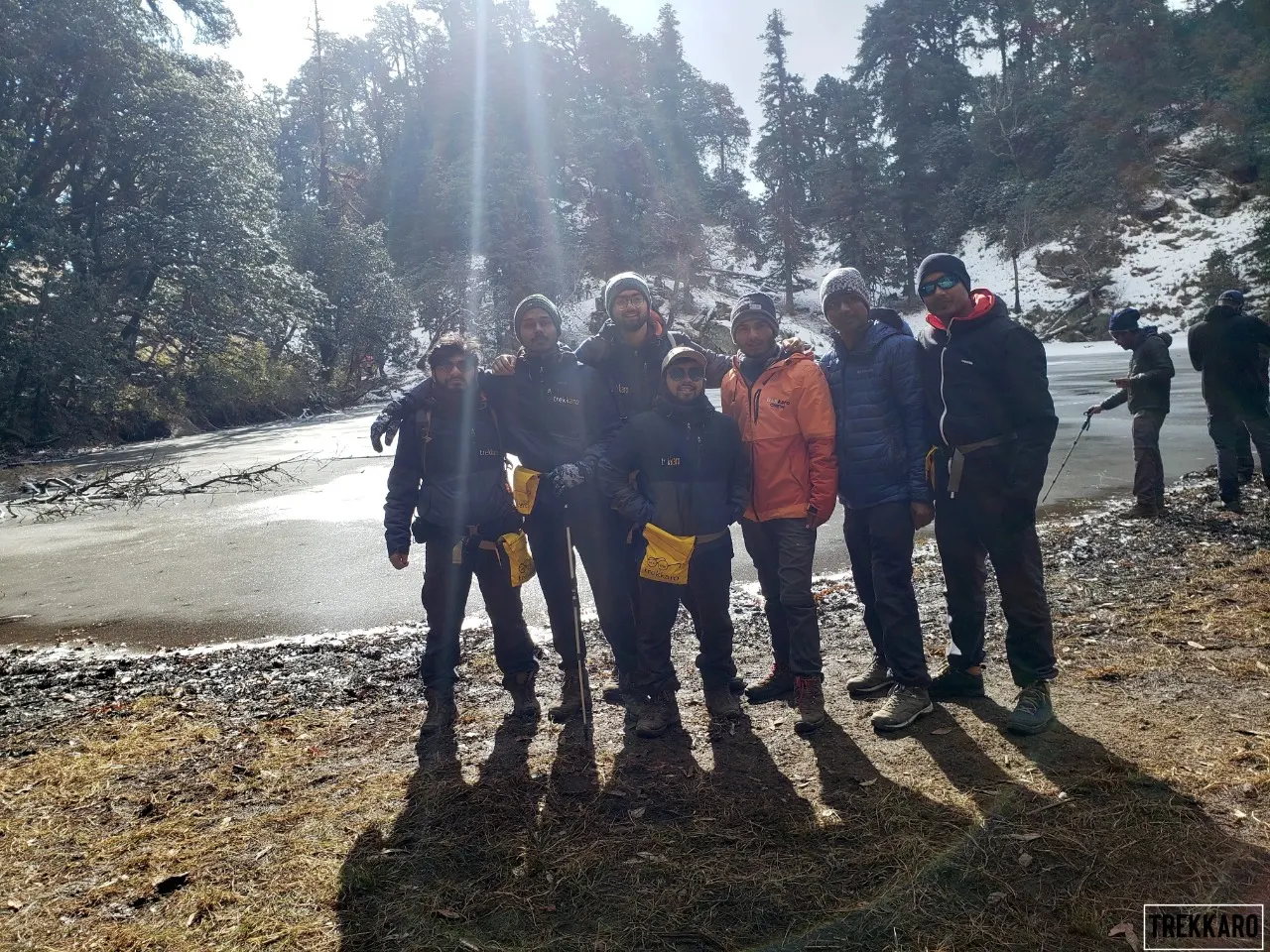
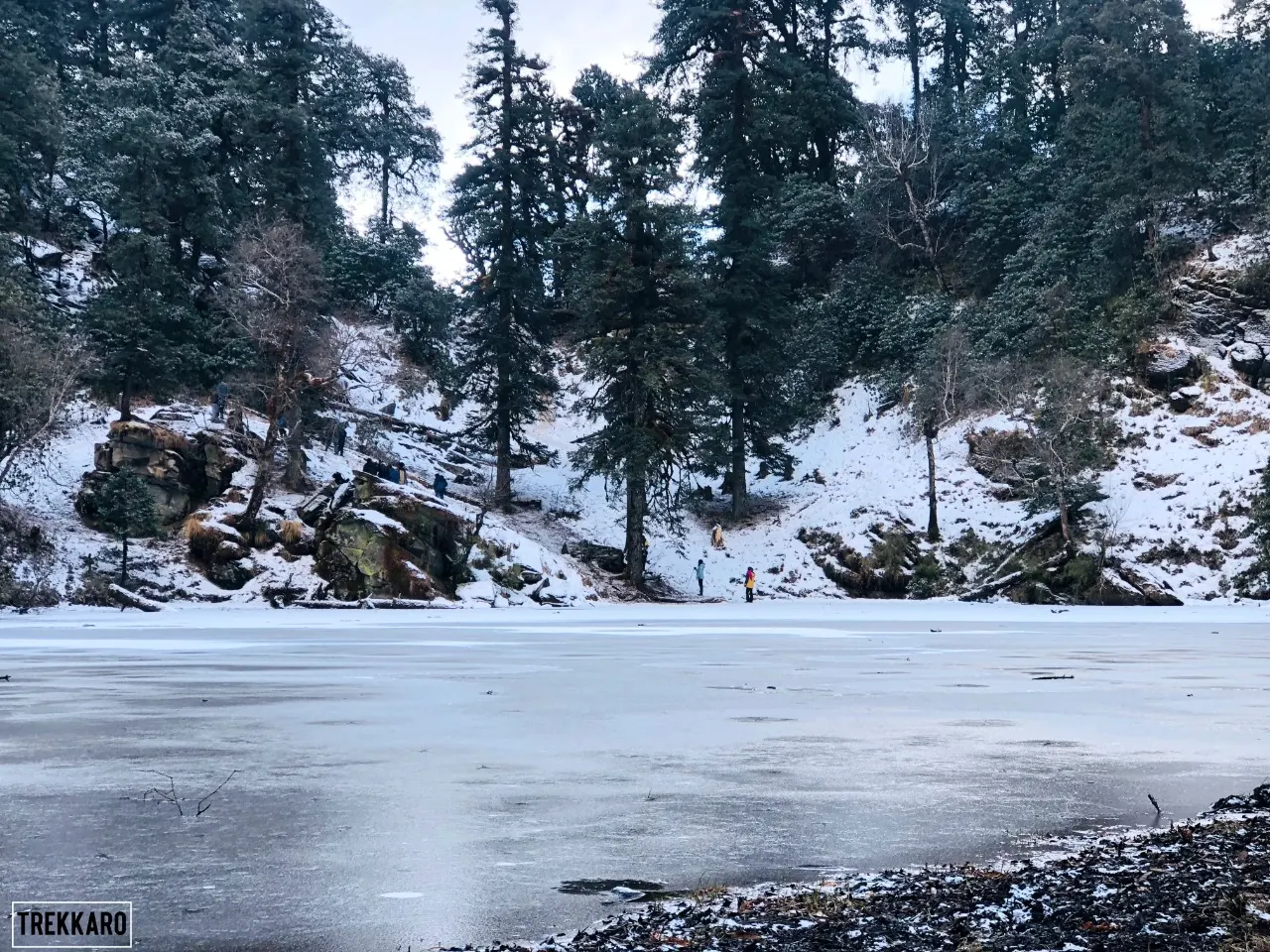
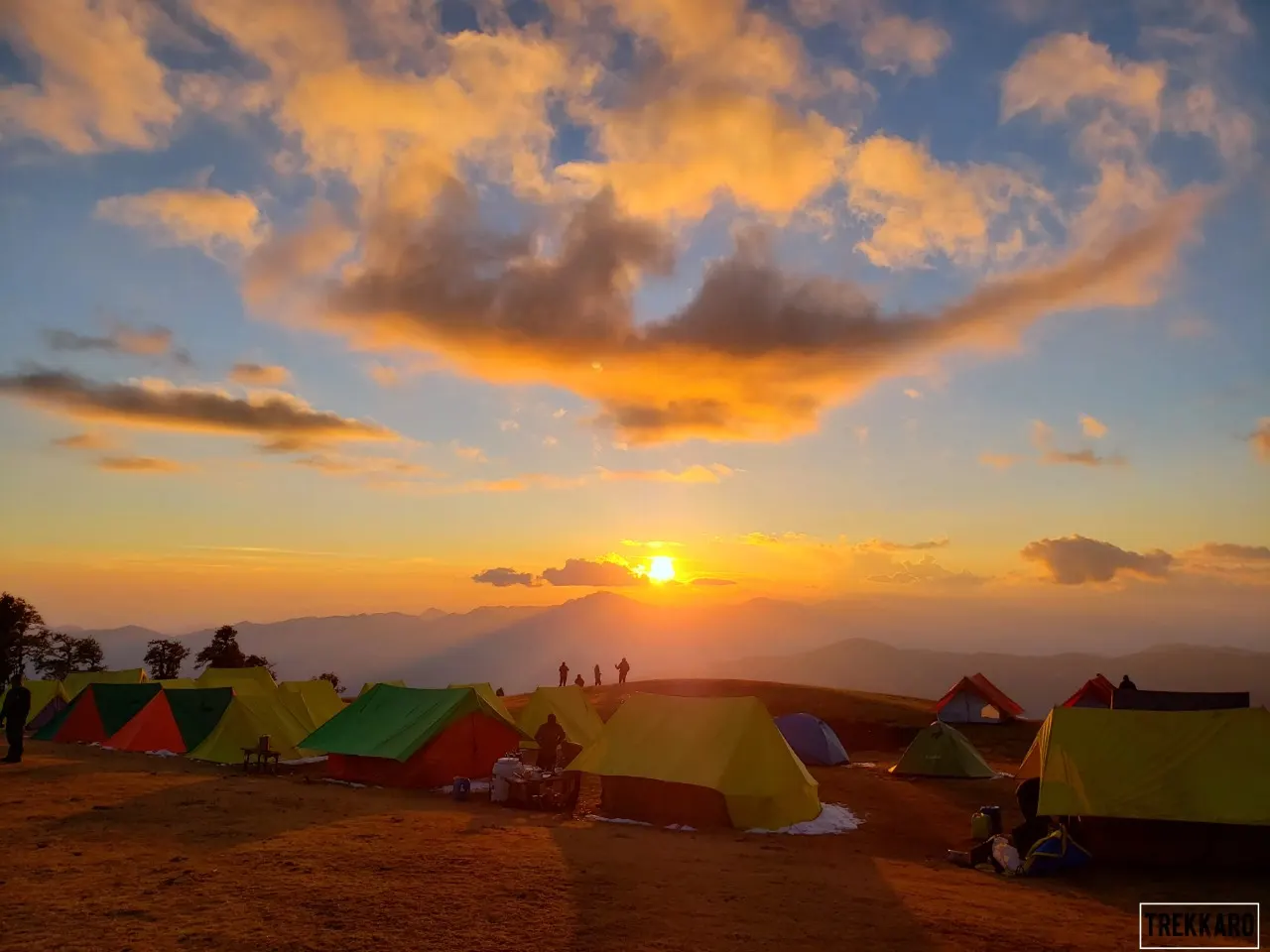
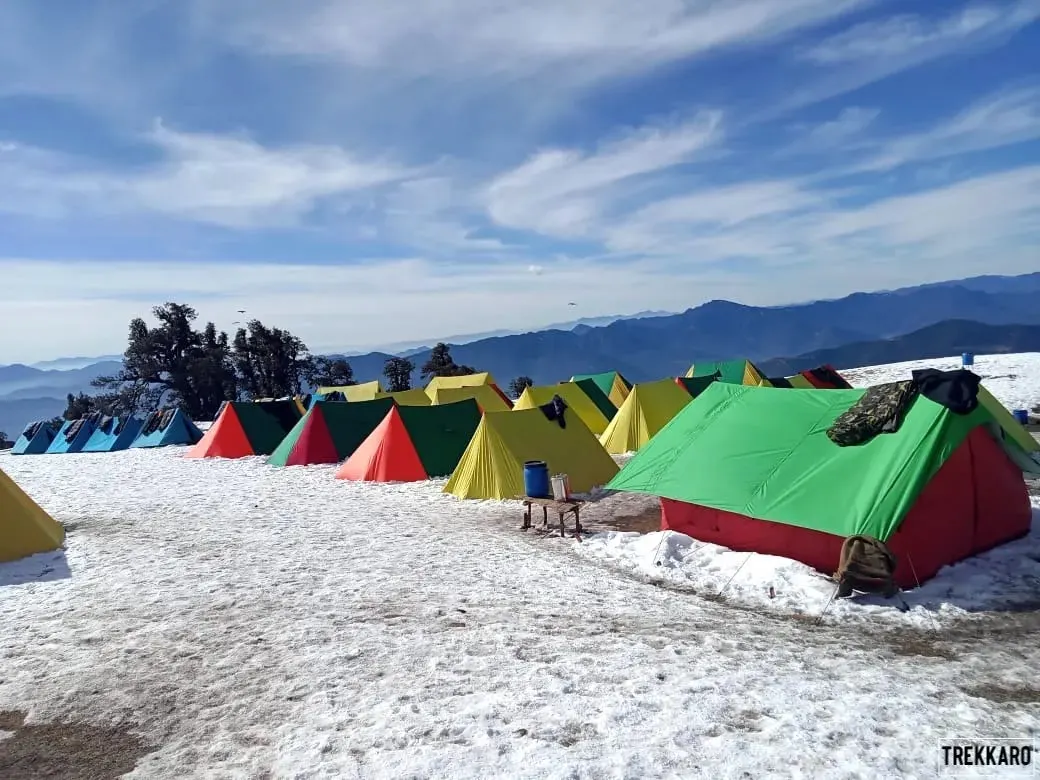
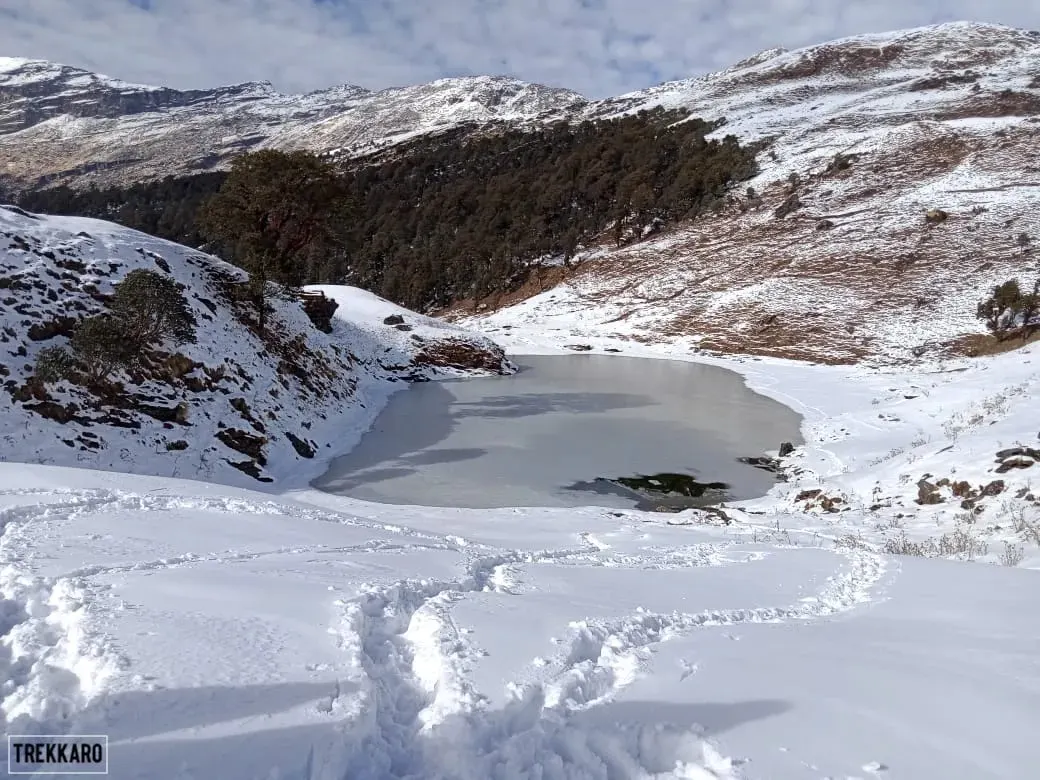
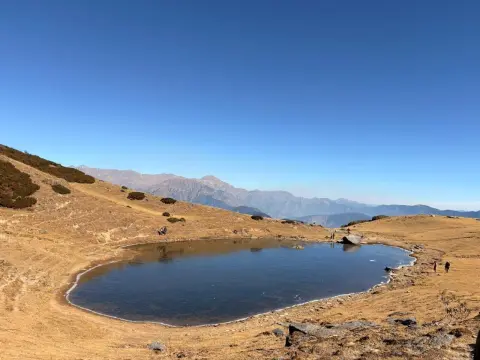
Bekaltal Lake, close to the camp at about 2,798 m (9,180 ft), is the first of the two lakes that give the Brahmatal route its character. In winter, the lake surface is frozen solid, a flat, white plane surrounded by snow-covered banks and the bare winter forest, with the sky and the occasional glimpse of a distant peak reflected in the ice at the margins where the surface catches the low winter sun. The camp at Bekaltal is in a clearing beside the lake, sheltered by the surrounding forest. This is a cold camp; temperatures at the lake will drop to -10°C or below overnight in January, and tonight is the first genuine test of your sleeping bag and layering system. The -20°C rated sleeping bags that Trekkaro provides are not precautionary overkill at Bekaltal in deep winter. They are exactly necessary.
What to Expect:
- The trail begins at Lohajung – an oak and rhododendron forest in full winter snow from the first steps
- Snow depth increases steadily with altitude – from inches at Lohajung to waist-deep at the higher forest
- Snow forest silence: the defining acoustic experience of the lower Brahmatal trail
- Distance: ~6 km | Duration: 4–5 hrs | Altitude gain: ~480 m
- Bekaltal Lake (camp at about 2,798 m / 9,180 ft): frozen solid in winter – flat white ice surrounded by snowbound forest
- Critical: sleeping bag – Trekkaro -20°C sleeping bag essential tonight.
- Overnight: Bekaltal camp (2,798 m / 9,180 ft) – first high-altitude winter camp of the route
Day 3: Bekaltal to Brahmatal Lake
Route Details:
Altitude: 2,798 m / 9,180 ft (Bekaltal) → Jhandi Top (~3,600 m) → Brahmatal Base Camp (3,106 m / 10,190 ft) | Distance: ~7 km | Duration: 6–7 hrs | Terrain: Steep snow ascent to Jhandi Top ridge, open ridge walk, descent to Brahmatal Lake basin
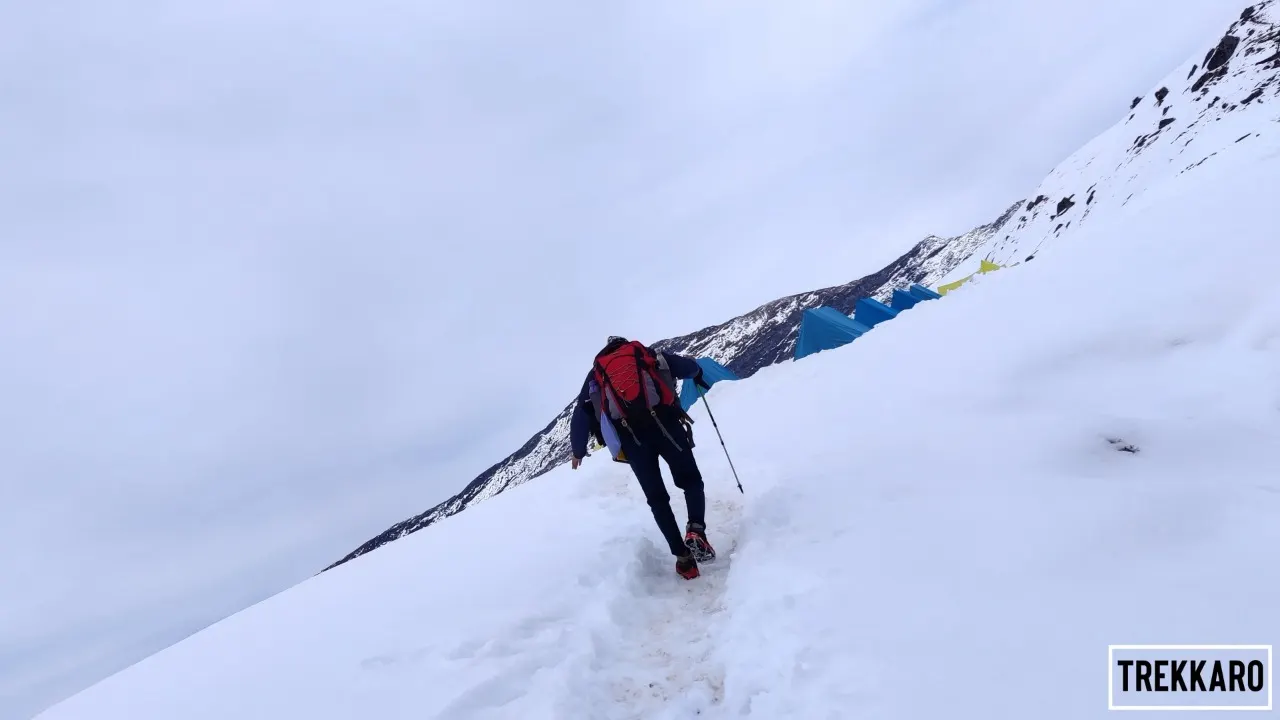
Day 3 is the route's most visually dramatic day before the summit push and the day that earns its place at the centre of the itinerary through a combination of effort, exposure, and reward that the approach days cannot yet provide. The trail from Bekaltal climbs steeply through the upper forest before breaking above the treeline onto the Jhandi Top ridge at approximately 3,600 m. This ascent is the steepest section of the entire Brahmatal route, requiring microspikes from the Bekaltal camp upward and deliberate, measured movement on the compacted snow slope that leads to the ridge.
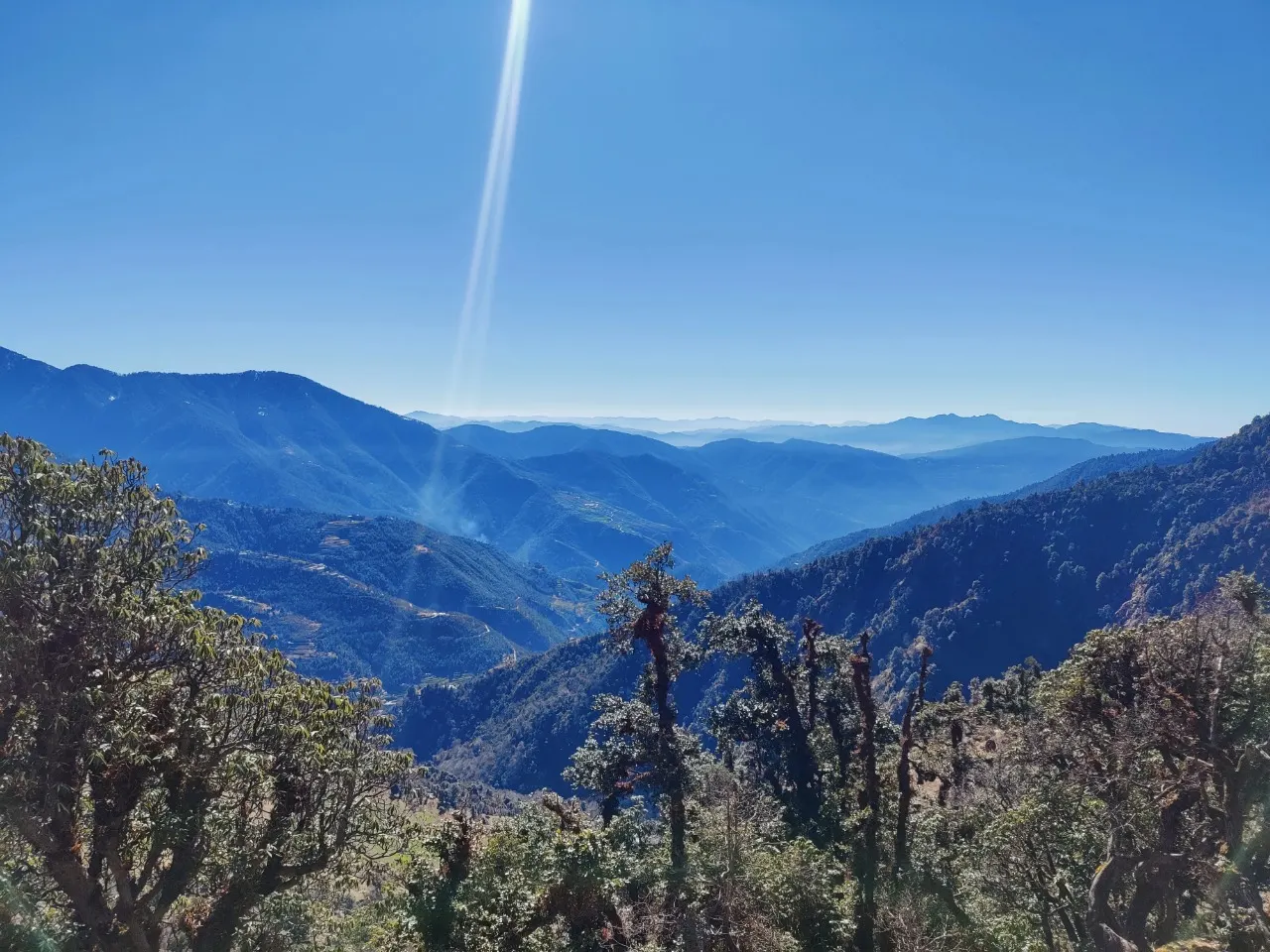
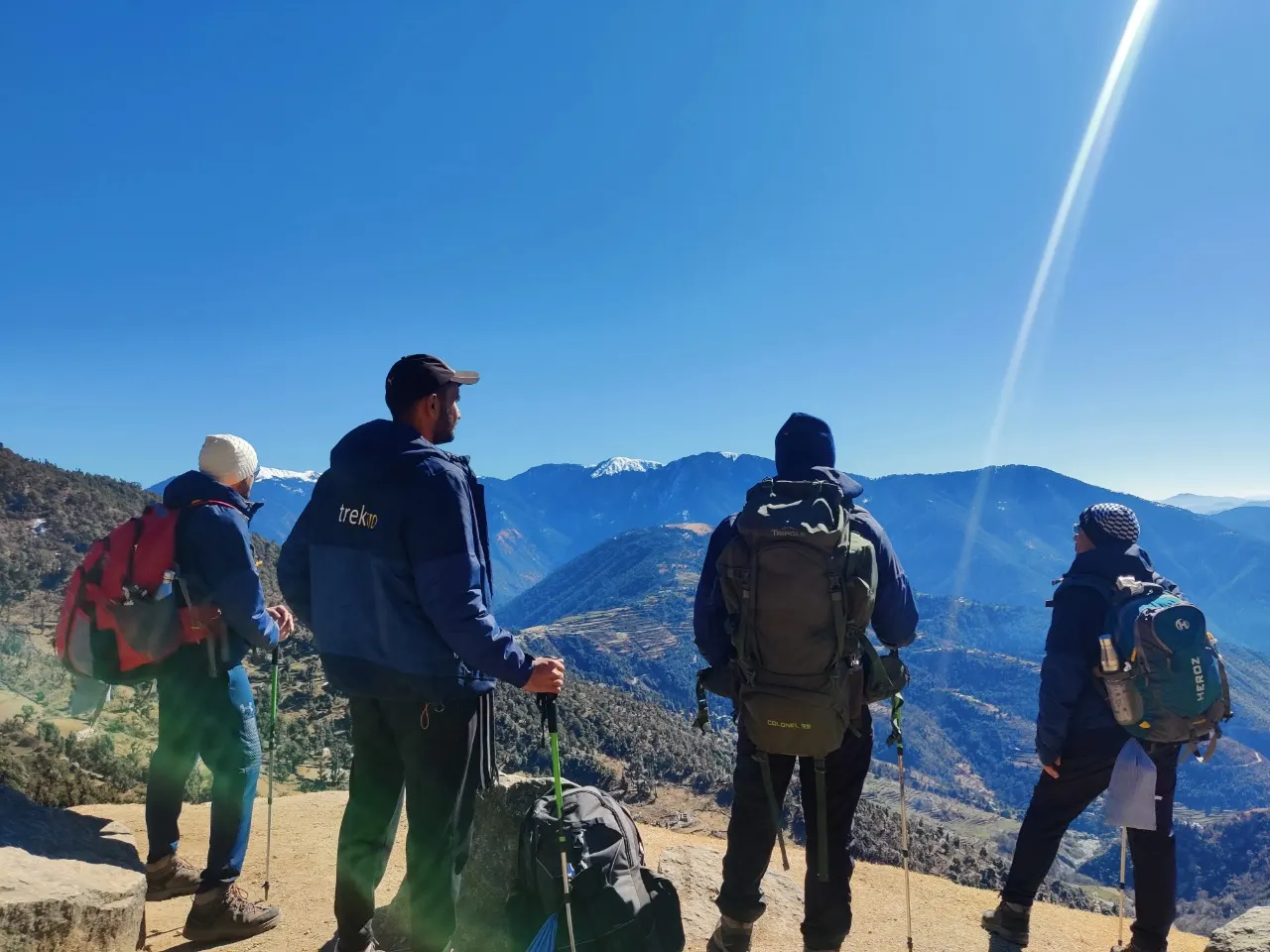
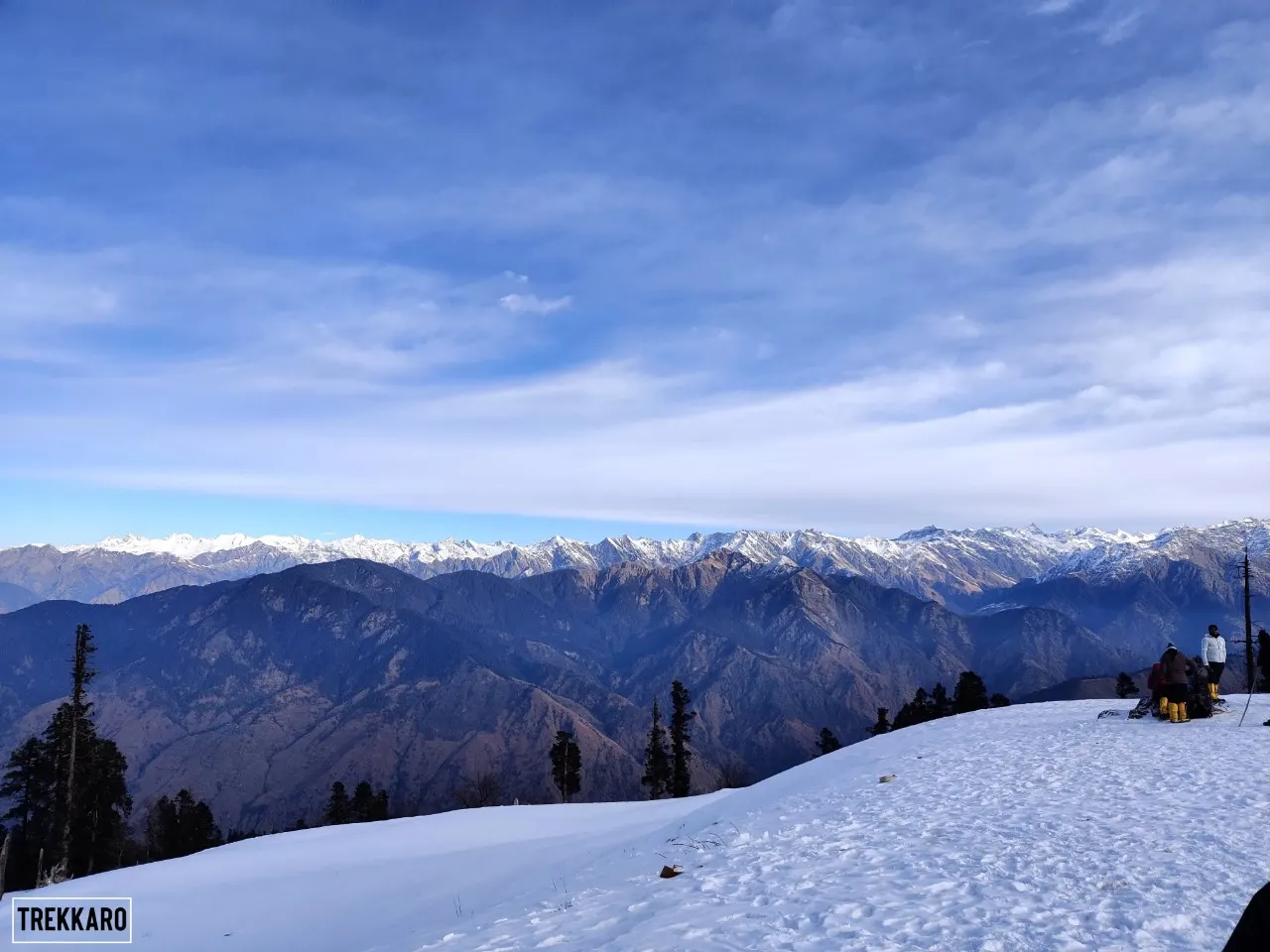
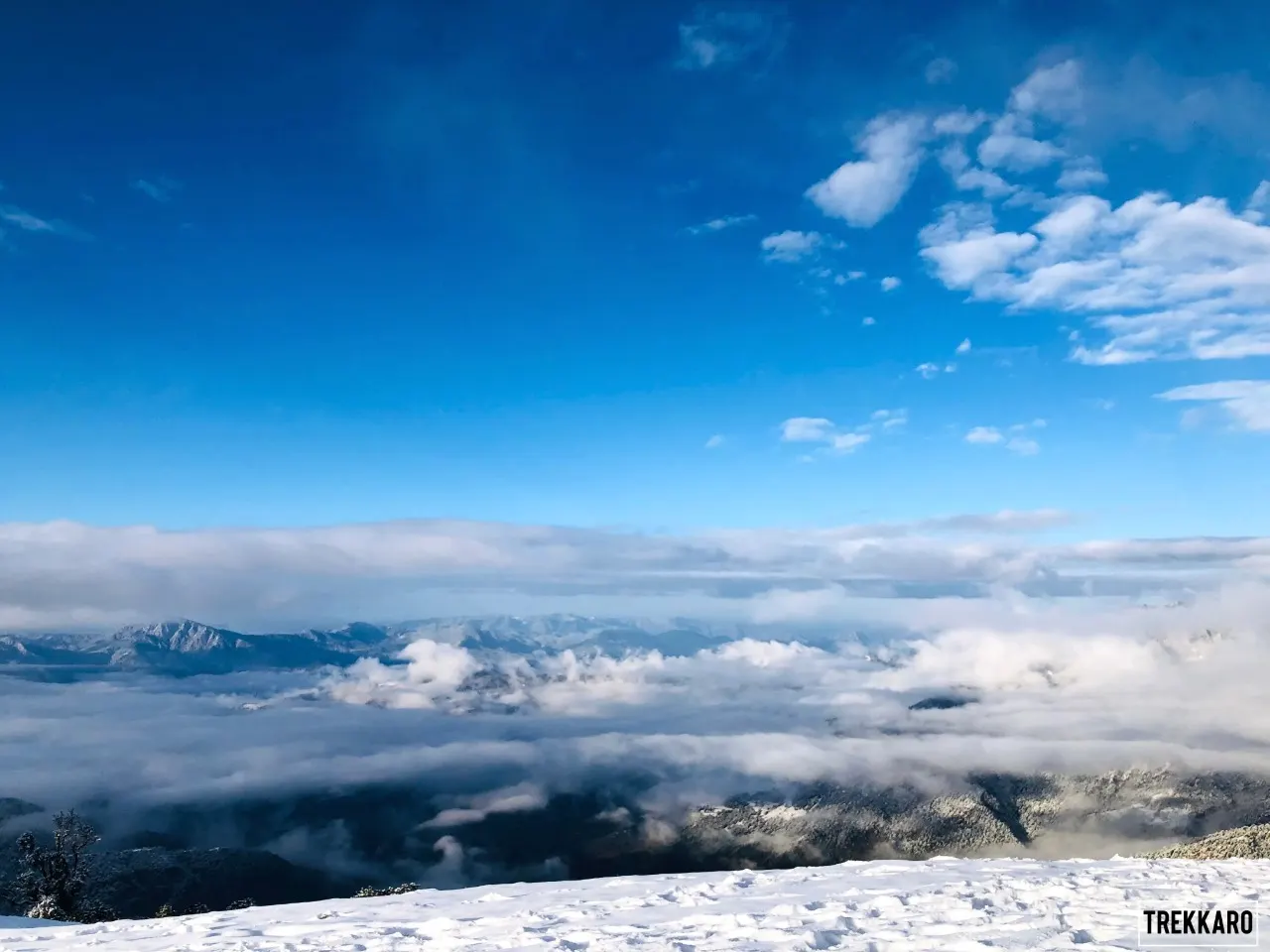
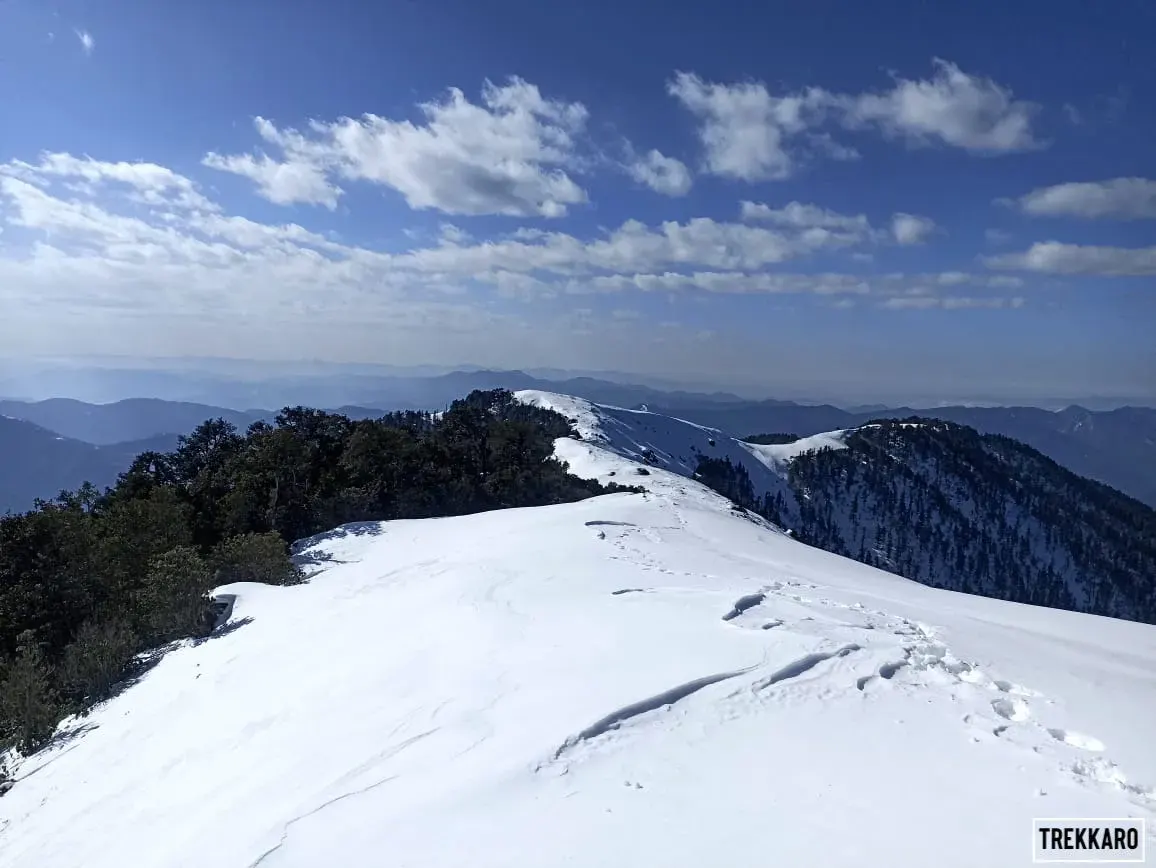
Jhandi Top is a snow ridge at approximately 3,600 m that serves as the viewpoint threshold between the enclosed forest terrain of the approach and the high mountain landscape ahead. When the ridge opens, it opens completely. To the north and northeast: Trishul (7,120 m) and Trishul East in full profile, the triple-peaked massif that dominates the western rim of the Nanda Devi Sanctuary, its upper snowfields brilliant white against the winter sky. Nanda Ghunti (6,309 m) sits immediately to its right, a sharper and more compact peak whose south face catches the morning sun in a composition that photographers consistently find impossible to adequately capture. To the north: Mt Kamet (7,756 m) on clear days, the second highest peak in Uttarakhand, as a massive white wall at the back of the range. Hathi Ghoda Parvat and the broader Garhwal Himalayan ridge extend across the entire northern horizon.
Most trekkers spend longer on Jhandi Top than the schedule strictly allows. The view from this ridge is the first unobstructed, high-altitude panorama of the trek, and it arrives after two days of forest walking in which the mountains were glimpsed rather than seen. Here, they are fully revealed. The Trekkaro guide will call the group onwards before the cold of the exposed ridge becomes a concern, but the time at Jhandi Top is a time that the route has been building toward and that deserves to be received without hurry.
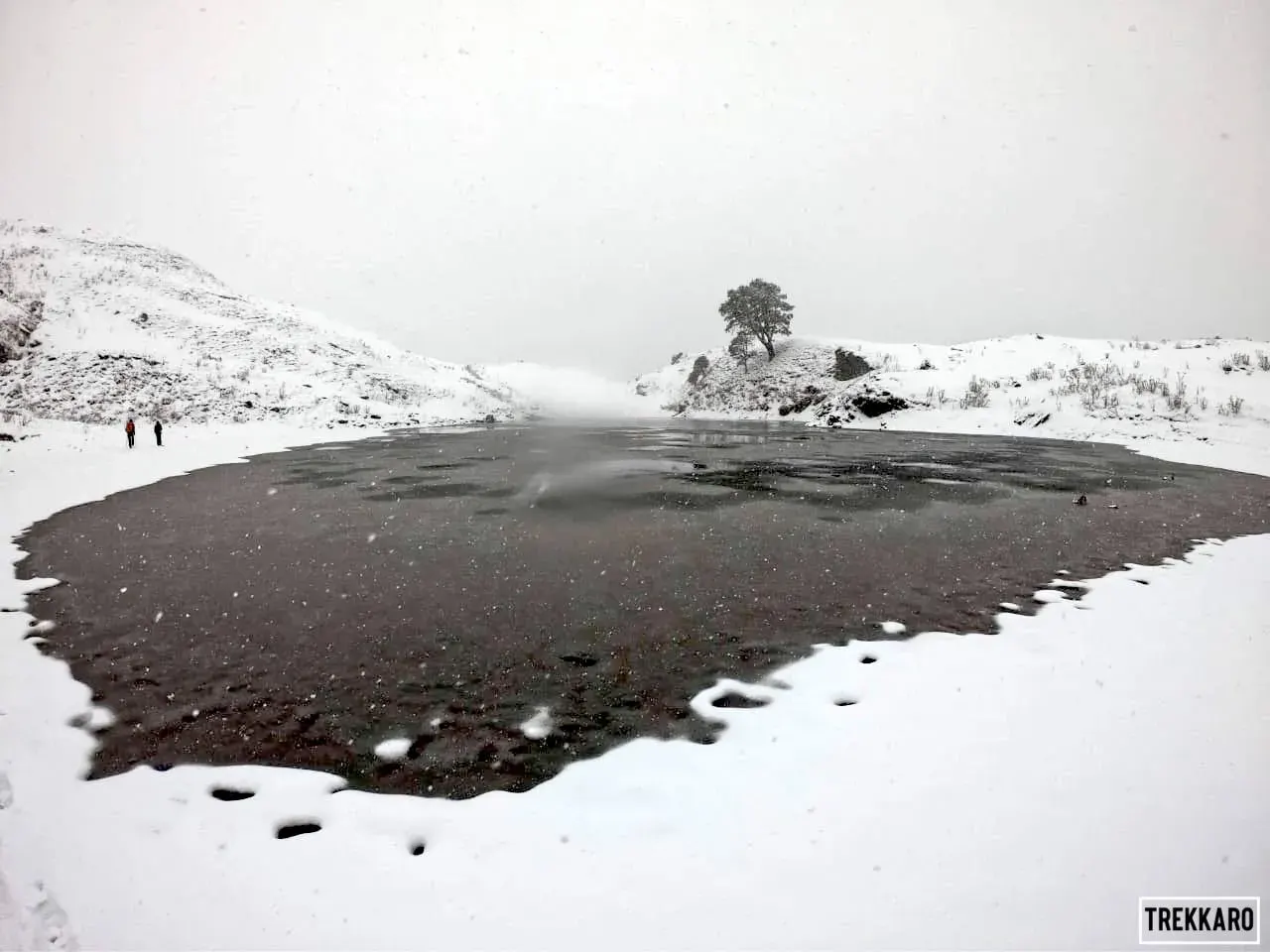
From Jhandi Top, the trail descends through the open snow terrain on the far side of the ridge into the Brahmatal Lake basin. The Brahmatal Lake, about 500 m from the base camp, frozen in winter, slightly larger than Bekaltal, positioned in a more open bowl, comes into view on the descent. The base camp is established beside the lake, with the summit approach to Brahmatal Top visible as a snow slope rising above the camp to the north. This is where Day 4 begins before dawn. Study the approach from camp this evening. Know the terrain before you climb it in the dark.
What to Expect:
- Steep ascent from Bekaltal to Jhandi Top ridge (~3,600 m) – microspikes mandatory from camp
- Jhandi Top ridge view: Trishul (7,120 m), Nanda Ghunti (6,309 m), Kamet (7,756 m), Hathi Ghoda Parvat
- First unobstructed high-altitude Garhwal panorama of the trek – the visual reward for two days of forest
- Descent to Brahmatal Lake basin – open snow terrain with the base camp and summit approach visible
- Brahmatal Lake (near the 3,106 m base camp): frozen, open basin, summit slope visible above camp to the north
- Critical evening health check: SpO₂, pulse, and BP before the summit push. Go/no-go for Day 4.
- Early sleep: Summit Day departs at 5:30 AM. Be in your sleeping bag by 8:00 PM.
- Overnight: Brahmatal Base Camp (3,106 m / 10,190 ft) – base camp for Brahmatal Top
Day 4: Brahmatal Base Camp to Brahmatal Top & Return
Route Details:
Altitude: 3,106 m / 10,190 ft (Base Camp) → 3,734 m / 12,250 ft (Brahmatal Top) → return to Base Camp | Distance: ~6 km round trip | Duration: 5–6 hrs | Terrain: Steep snow ascent to the summit ridge, open ridge walk, return by the same route
Day 4 is the summit day, a dedicated, focused push from the Brahmatal Base Camp to the top and back, with no other objective competing for the day's time or energy. Departure is at 5:30 AM, in the dark and in the cold that at this hour in January can be -15°C. Headlamps cut through the pre-dawn air as the group moves upward from the camp. The early departure is not ceremonial: the snow on the summit approach is at its firmest and most stable in the cold morning hours, and the Garhwal winter sky is at its clearest before the day's temperature inversion sometimes introduces a thin haze above the lower valleys.
The ascent from Base Camp to Brahmatal Top gains approximately 630 m across the upper snowfield and the final summit ridge. Microspikes are worn from the first step out of camp. The snow slope above the lake is steep but consistent, a sustained uphill push on compacted winter snow that requires deliberate, rhythmic movement and steady breathing. The trek leader sets the pace at a level that keeps every trekker moving continuously, because stopping in -15°C air without the thermal generation of movement means a rapid loss of core warmth that is difficult to reverse without physical activity. The group moves together, at a measured pace, in the pre-dawn quiet of the Garhwal winter.
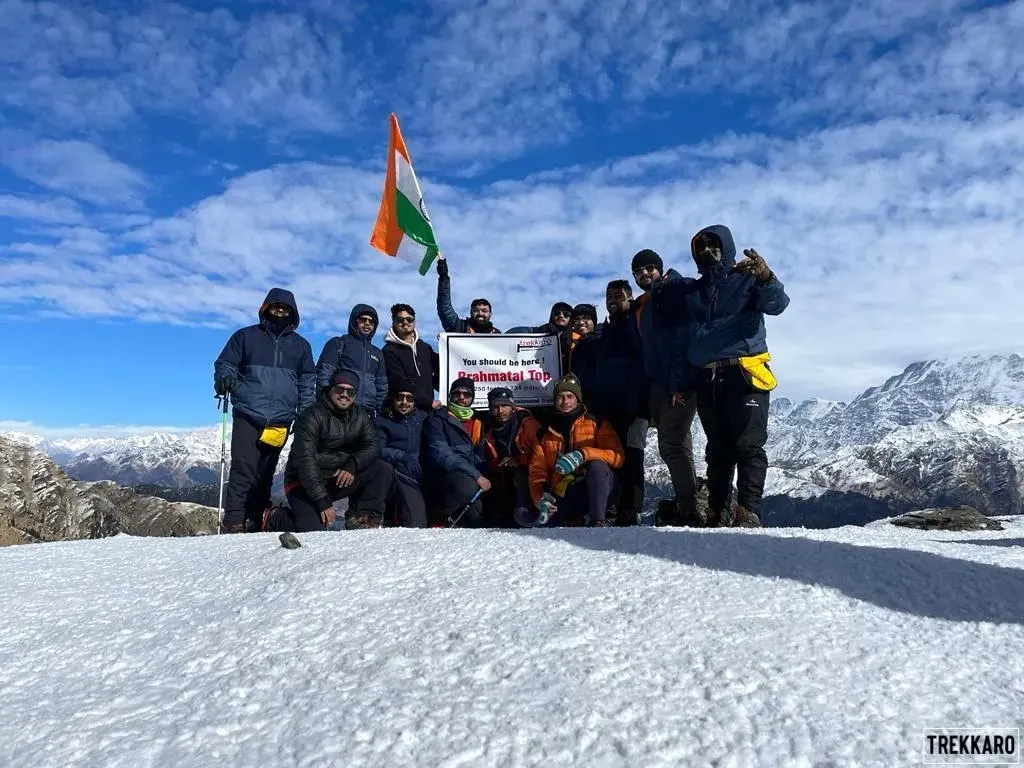
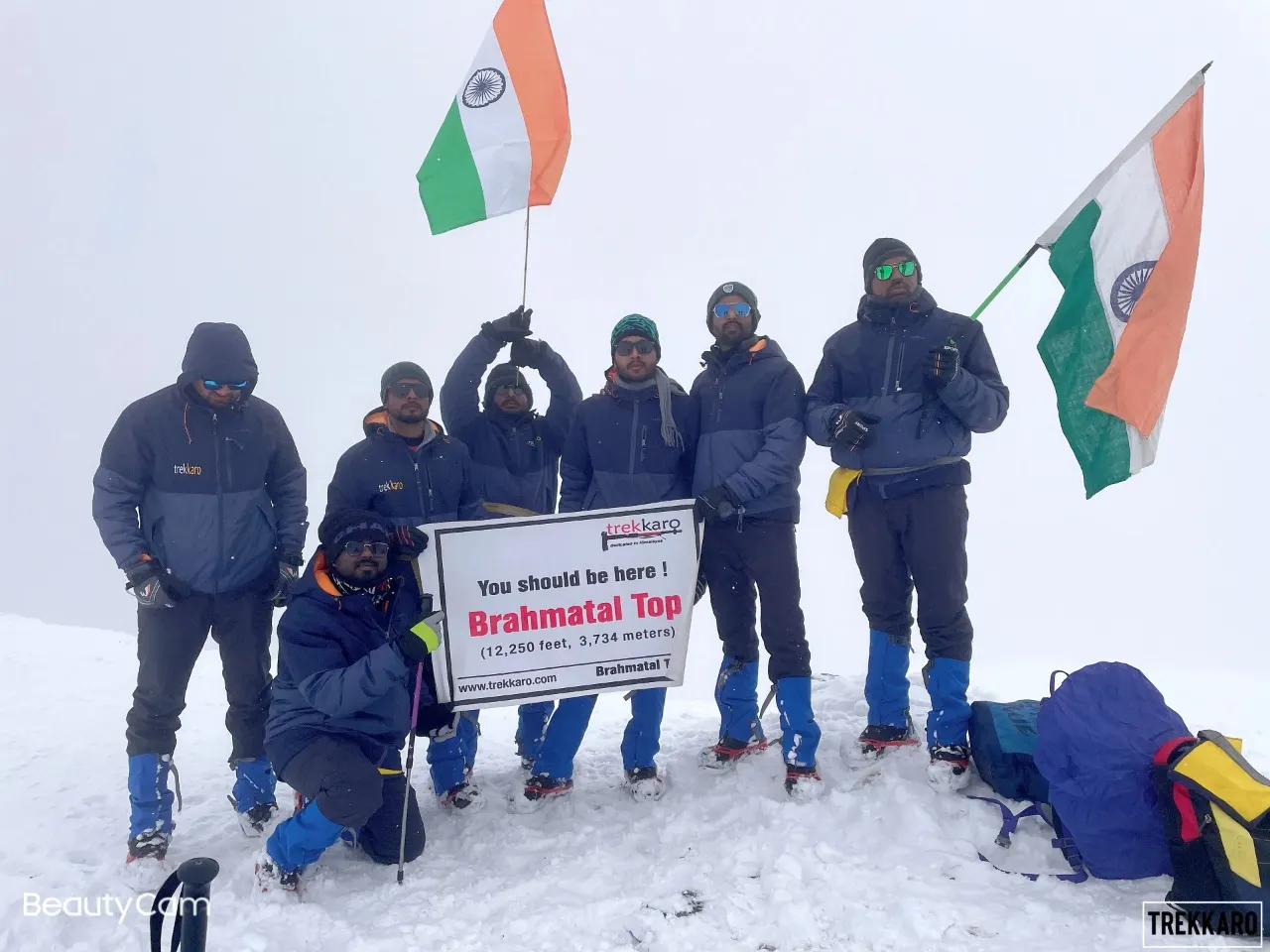
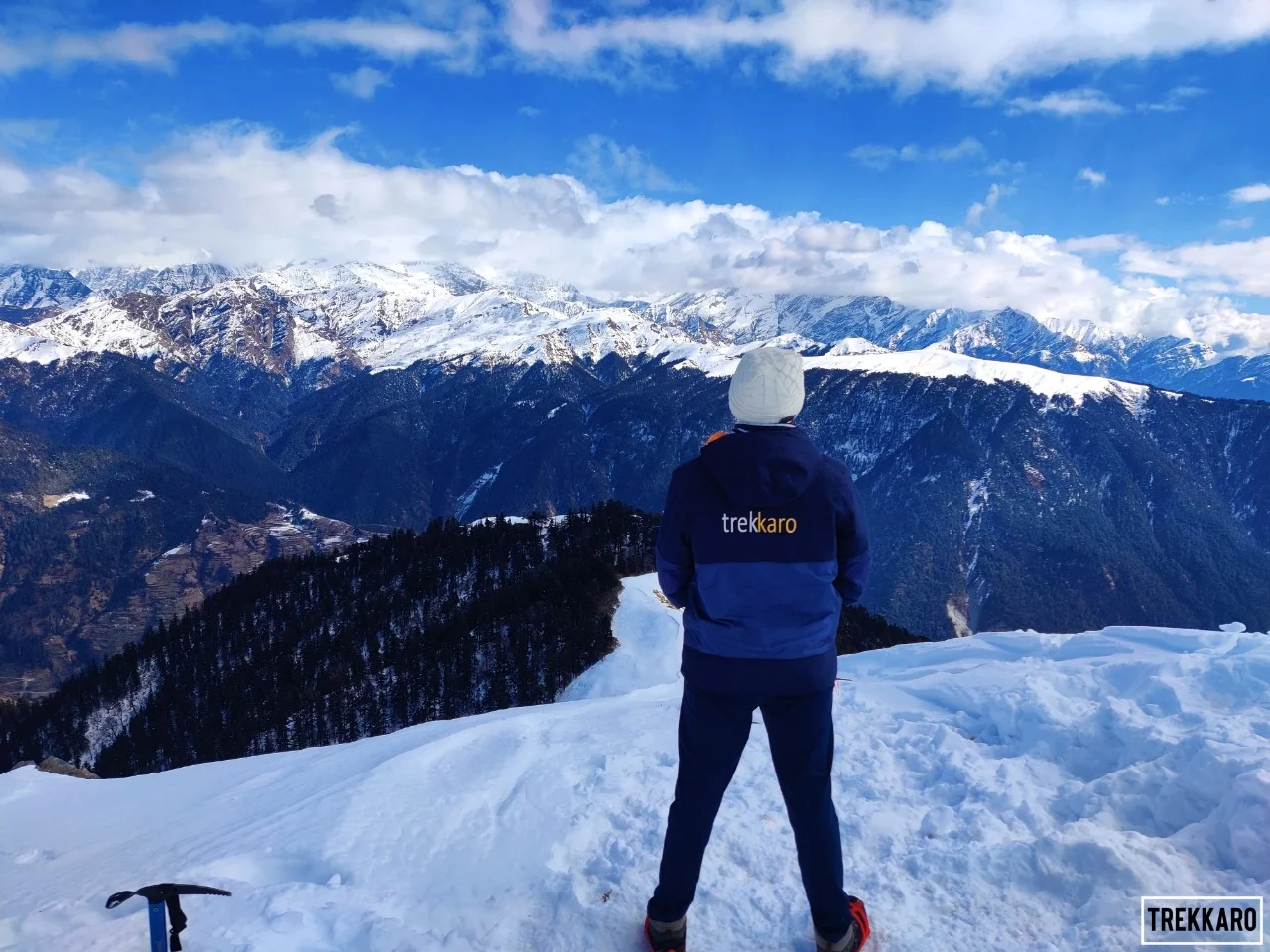
As the summit ridge approaches and the terrain levels, the view begins to open. The forest and the lake are left below. The ridgeline ahead carries nothing but snow and sky. And then Brahmatal Top at 3,734 m (12,250 ft) delivers its complete panorama simultaneously, a 270-degree sweep of the Garhwal Himalayan range in winter clarity that is, for most trekkers, the finest summit view they have encountered at moderate grade anywhere in India. Trishul (7,120 m) to the north, its triple summit in full profile and the upper snowfields carrying a light that shifts from blue-white to gold as the sun rises. Nanda Ghunti (6,309 m) immediately to its right, sharper and more severe. The Hathi Ghoda Parvat ridge extending across the eastern horizon. Mt Kamet (7,756 m) on clear days as a massive white presence above the back of the range. The complete Garhwal winter landscape, at a visual proximity that photographs consistently fail to convey.
Summit time at Brahmatal Top is 45 to 60 minutes, time for photographs from every angle, for the group ritual that the Trekkaro guide conducts at the top, and for simply being present on a 12,250-foot summit in the Garhwal winter with the Himalayan range on the horizon and the silence of a winter mountain above the treeline. The descent returns by the same route, reaching Base Camp in mid-morning. The rest of Day 4 is genuinely at rest: sleep, eat, hydrate, and let the body recover from the summit push. Tomorrow is a long descent day, and it requires legs that have been looked after today.
What to Expect:
- 5:30 AM departure – pre-dawn, -15°C. Full winter layering from the first step. Headlamps required.
- Summit ascent: ~630 m gain on compacted snow slope to Brahmatal Top (3,734 m / 12,250 ft)
- Microspikes worn from Base Camp throughout the ascent and descent
- Brahmatal Top panorama: Trishul (7,120 m), Nanda Ghunti (6,309 m), Kamet (7,756 m), Hathi Ghoda Parvat
- Summit time: 45–60 minutes – photographs, group summit ritual, panorama absorption
- Return to Base Camp: by the same route – mid-morning arrival back at the lake camp
- Rest afternoon: sleep, eat, hydrate. Day 5 is a long descent day. The body needs today's recovery.
- Overnight: Brahmatal Base Camp (3,106 m / 10,190 ft) – second and final night at the high camp
Day 5: Brahmatal Base Camp to Lohajung
Route Details:
Altitude: 3,106 m / 10,190 ft (Base Camp) → Jhandi Top (~3,600 m) → Bekaltal (2,798 m) → Lohajung (2,316 m) | Distance: ~10 km | Duration: 7–8 hrs | Terrain: Ascent to Jhandi Top, descent through Bekaltal and snow forest to Lohajung
Day 5 is the longest trekking day of the route: a full descent from the Brahmatal Base Camp back to Lohajung, covering approximately 10 km across 7 to 8 hours. The route re-crosses Jhandi Top before descending through the Bekaltal basin and the snow forest to Lohajung. It is a demanding day, not in the sense of altitude gain, but in the sustained effort required to descend 790 m of mountain terrain in winter snow conditions while the body is carrying the accumulated fatigue of four consecutive high-altitude days.
The morning departure from Base Camp is early, with the Brahmatal Lake visible one final time in the dawn light before the group moves upward toward Jhandi Top for the return crossing. Jhandi Top on the return has a different character from Day 3. Then, the ridge opening was a revelation, the first unobstructed view of the Garhwal range arriving after two days of enclosed forest. Now, the same view is received as a farewell: Trishul and Nanda Ghunti in the morning light, with the knowledge that the summit above them has been reached and that the Brahmatal Base Camp where you slept two nights will not be seen again on this journey. Most trekkers spend a few minutes on the ridge on the return that the forward movement of Day 3 did not allow.
The descent from Jhandi Top through Bekaltal and down through the snow forest to Lohajung covers the same terrain as the approach in reverse. The snow forest, which on Day 2 was an arrival into an unfamiliar world, is received on Day 5 as familiar terrain being departed. The lake at Bekaltal, frozen then, is still frozen now. The silence of the forest is the same silence. But the body walking through it carries a summit, a panorama, and two nights at 3,106 m that the body ascending three days ago had not yet earned. Lohajung by the late afternoon is warmth, walls, food, signal, and the particular relief of arrival that only exists after a genuinely demanding descent.
What to Expect:
- Longest trekking day: ~10 km, 7–8 hrs from Base Camp to Lohajung
- Re-crossing Jhandi Top – the summit panorama as a farewell view on the return
- Bekaltal Lake on descent: the same frozen lake, seen again from the opposite direction
- Full snow forest descent – the same forest as Day 2, carrying four days of summit behind you
- Altitude drops ~790 m from Base Camp to Lohajung – warmth increases noticeably with every hour
- Lohajung: warmth, walls, signal, device charging, first hot meal in a proper building
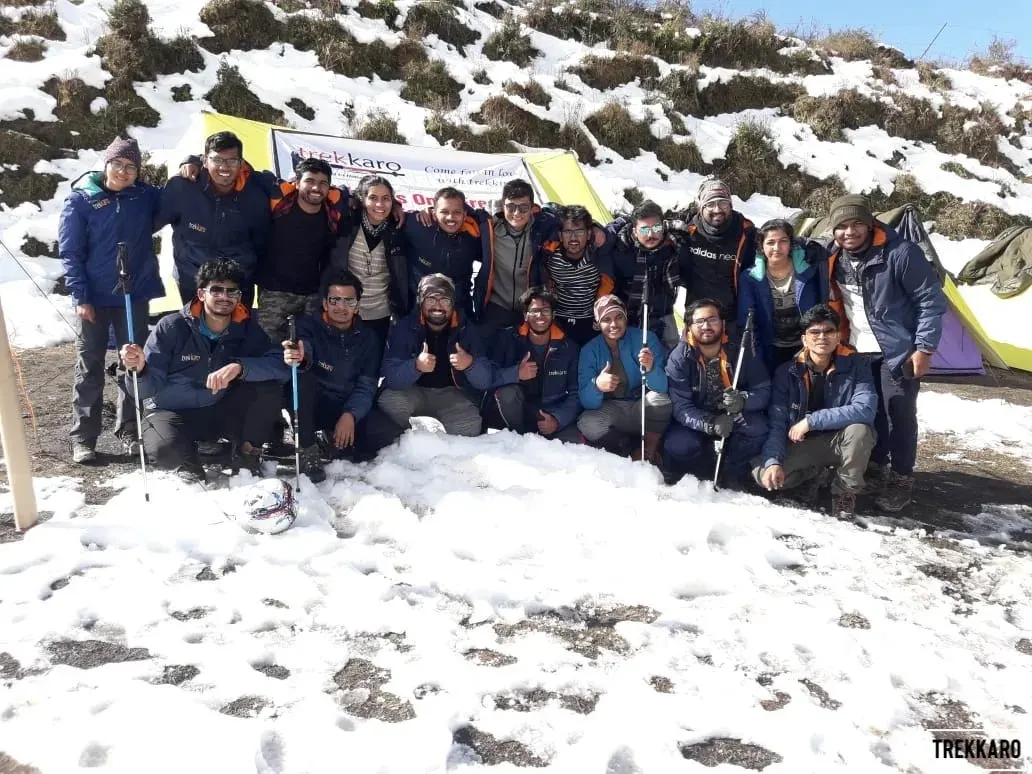
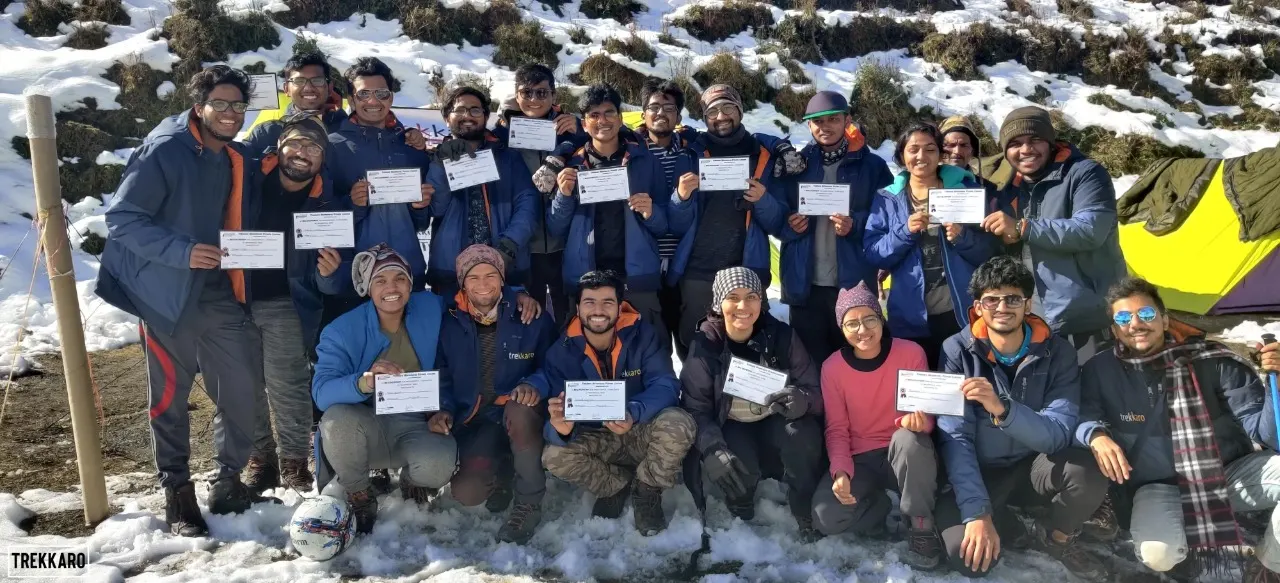
- Trek concludes at Lohajung. Completion certificates issued.
- Overnight: Lohajung (2,316 m) - final night before the Rishikesh return drive
Day 6: Drive from Lohajung to Rishikesh
Route Details:
Drive: Lohajung (2,316 m) → Karnaprayag → Rudraprayag → Devprayag → Rishikesh | Distance: ~250 km | Duration: 8–10 hrs
The final morning in Lohajung has a particular quality. The Trishul summit visible above the forest ridgeline on clear mornings, the same peak whose distant white profile was the first visual confirmation of the trek's destination on Day 1, is now a peak you have seen in full, from a high viewpoint, in the winter Himalayan clarity that only exists between December and February. What was a distant aspiration on the approach is now a peak, you know.
The drive from Lohajung to Rishikesh retraces the approach road in reverse: back down through the Garhwal interior, through Karnaprayag, past the Rudraprayag confluence, past the Devprayag sangam where the Bhagirathi and Alaknanda meet in their most visually dramatic form, and then back to the broader, warmer, louder landscape of the Rishikesh valley. The 8- to 10-hour drive is long but covers scenery that is, in its own way, as significant as the trek itself: the river gorges of the Alaknanda, the terraced Garhwal hillsides, and the progressively widening valley as altitude decreases and the plains begin to reassert themselves at the lower end of the Himalayan range.
For trekkers with same-day onwards connections from Haridwar or Dehradun, the early morning Lohajung departure allows evening train or flight connections. For those with more time, a night in Rishikesh at the ghats, in the ashrams, or simply at a restaurant that serves hot food is a transition from the Brahmatal winter world to the normal world that the experience deserves.
What to Expect:
- Drive Lohajung to Rishikesh – ~250 km, 8–10 hrs via Karnaprayag, Rudraprayag, and Devprayag
- Devprayag Sangam: the Bhagirathi and Alaknanda confluence – the birth of the Ganga proper
- Alaknanda Valley: the same gorge road in reverse, seen now with five days of winter above it
- Same-day connections: evening trains from Haridwar and flights from Dehradun are achievable with early departure
- Recommended: one night in Rishikesh if the schedule allows – the transition from winter altitude to warmth
How To Reach
Nearest airport: Jolly Grant Airport (DED), Dehradun – about 20–25 km / around 45 min from Rishikesh, with direct flights from Delhi (about 1 hr) and other metros. The cab to Lohajung leaves Rishikesh at 6:30 AM, so fly in the day before and stay the night in Rishikesh.
From Rishikesh to Lohajung: about 250 km along the Alaknanda via Devprayag, Rudraprayag and Karnaprayag, 8–10 hrs by road. Transport is not included in the trek fee: we help the group book shared cabs (about ₹6,500 one way per 5–6 seat vehicle), paid directly to the driver and split among trekkers. The cab leaves Jumping Heights, Tapovan (Rishikesh) at 6:30 AM.
Return: On Day 6 the shared cab (not included in the trek fee; about ₹6,500 per vehicle, paid directly to the driver and split among trekkers) leaves Lohajung at 6:30 AM and is expected to reach Jumping Heights, Tapovan by 6:00 PM. Book your flight home for the next day.
Nearest railway station: Haridwar Junction, about 25–30 km (~1 hr) from Rishikesh, is one of the best-connected stations in Uttarakhand, with trains from Delhi including the Shatabdi, Jan Shatabdi and overnight trains; Yog Nagari Rishikesh (YNRK) has only a few trains. From Haridwar, shared cabs and local buses run to Rishikesh – reach Tapovan the evening before the 6:30 AM departure.
From Rishikesh to Lohajung: about 250 km along the Alaknanda via Devprayag, Rudraprayag and Karnaprayag, 8–10 hrs by road. Transport is not included in the trek fee: we help the group book shared cabs (about ₹6,500 one way per 5–6 seat vehicle), paid directly to the driver and split among trekkers. The cab leaves Jumping Heights, Tapovan (Rishikesh) at 6:30 AM.
Return: On Day 6 the shared cab (not included in the trek fee; about ₹6,500 per vehicle, paid directly to the driver and split among trekkers) leaves Lohajung at 6:30 AM and is expected to reach Jumping Heights, Tapovan by 6:00 PM. Book a late-night train from Haridwar or travel the next day.
Bus route: Delhi ISBT Kashmere Gate to Rishikesh, about 6–7 hrs, by overnight Volvo and Uttarakhand Roadways buses; choose government buses from inside ISBT. An overnight bus arriving early in the morning can work, but the cab leaves at 6:30 AM, so reaching Rishikesh the evening before is safer.
From Rishikesh to Lohajung: about 250 km along the Alaknanda via Devprayag, Rudraprayag and Karnaprayag, 8–10 hrs by road. Transport is not included in the trek fee: we help the group book shared cabs (about ₹6,500 one way per 5–6 seat vehicle), paid directly to the driver and split among trekkers. The cab leaves Jumping Heights, Tapovan (Rishikesh) at 6:30 AM.
Return: On Day 6 the shared cab (not included in the trek fee; about ₹6,500 per vehicle, paid directly to the driver and split among trekkers) leaves Lohajung at 6:30 AM and is expected to reach Jumping Heights, Tapovan by 6:00 PM. Book an overnight bus to Delhi for that night or the next day.
Things To Carry
Brahmatal is a winter trek (October–March) with snowfields on the higher sections and freezing nights, so pack for snow and sub-zero cold.
- Trekking shoes – Provided free with Trekkaro’s Free Trekking Gear (one refundable deposit of ₹3,000 + ₹200 washing charge covers the whole kit); waterproof, with ankle support
- Trekking poles – Provided free with Trekkaro’s Free Trekking Gear; highly recommended for the descents
- Microspikes and gaiters – Provided free with Trekkaro’s Free Trekking Gear
- Backpack – 50–60 L with a rain cover
- Day pack – 20–30 L, for water, snacks and layers on summit day; needed if you offload your main backpack
- Water bottles – 2 x 1 L, at least one insulated so the water does not freeze
- Headlamp – with spare batteries for early-morning starts and camp; keep spares close to your body, as cold drains batteries fast
Winter nights on Brahmatal are below freezing, so carry 5 warm layers – thermals, 2 fleece or woollen layers and the padded jacket – plus a waterproof outer shell for summit day.
- -10°C padded jacket – Provided free with Trekkaro’s Free Trekking Gear
- Thermal inners – 2 sets, top and bottom, merino or synthetic
- Fleece or woollen layers – 2 (a 200–300 g fleece jacket and a woollen sweater)
- Waterproof, windproof shell jacket – your outer layer on summit day and in snowfall
- Trek pants – 2, quick-dry; ideally one waterproof pair for the snow sections
- Fleece or woollen trousers – for camp
- Collared T-shirts – 3, quick-dry
- Socks – 3–4 pairs of trekking socks, plus 2 woollen pairs
- Caps – a woollen cap that covers your ears, and a sun cap
- Balaclava and buff – critical for the pre-dawn summit climb
- Gloves – 1 fleece or woollen liner pair plus 1 waterproof outer pair
- Spare warm set – one set of warm clothes sealed in a dry bag, kept dry for emergencies
Snow glare above 9,000 ft is intense in winter, so protect your eyes and skin and keep your electronics dry and warm.
- UV sunglasses – category 3 or 4, to prevent snow blindness
- Sunscreen – SPF 50+
- Lip balm – with SPF
- Quick-dry towel – microfibre
- Toiletries – toothbrush, toothpaste, biodegradable soap and hand sanitiser; no wet wipes, as they are not biodegradable
- Dry bags or ziploc bags – to keep electronics, documents and clothes dry inside your pack
- Personal medical kit – your regular medicines, blister plasters and ORS; consult your doctor about altitude medicines before the trek
- Offline map and camera batteries – download a map before you go (signal is limited) and carry spare batteries
Cards are not accepted in the mountains and ATMs are few in the hills, so carry enough cash from Rishikesh.
- Cash – withdraw enough in Rishikesh, in small notes, for your share of the cab and personal expenses
- Waste bag – reusable; Trekkaro follows a zero-waste policy, so carry out all your packaging
- Lunch box – reusable, for packed lunches on the trail
- Snacks and electrolytes – trail mix, energy bars, dates, chocolate and ORS or electrolyte sachets
- Power bank – there is no charging on the trail
- Camp slippers or sandals – light, for use in the tent and at camp
- Earplugs – optional, useful in shared accommodation
- Government photo ID – original plus a photocopy (Aadhaar card, passport, voter ID or driving licence)
- Trekkaro booking confirmation – e-ticket / tax invoice
- Medical fitness certificate
- Travel insurance policy – mandatory, with emergency evacuation cover
- Disclaimer form – with your emergency contact details written on it
- Passport – for international trekkers; required for forest entry permits and in case of medical evacuation
Frequently Asked Questions
Brahmatal Trek is a 6-day easy–moderate trek in Chamoli, Uttarakhand, reaching 3,734 m (12,250 ft). It covers about 29 km on foot and starts and ends at Lohajung. Best time: October to March. Trekkaro price: ₹9,000 per person + 5% GST, with Free Trekking Gear (Decathlon shoes, -10°C jacket, poles, gaiters and microspikes; ₹3,000 refundable deposit + ₹200 washing). Next batch: 17 Oct 2026 (104 upcoming batches).
The Brahmatal trek is in Chamoli district, Uttarakhand. It starts from Lohajung, a village about 250 km (8–10 hours) by road from Rishikesh via Devprayag, Rudraprayag and Karnaprayag.
From Lohajung the trail climbs through oak and rhododendron forest to Bekaltal, crosses the Jhandi Top ridge to the Brahmatal lake basin and goes up to Brahmatal Top at 3,734 m.
The Brahmatal trek takes 6 days from Rishikesh to Rishikesh, with 4 trekking days covering about 29 km.
- Day 1 and Day 6: drive between Rishikesh and Lohajung (about 250 km, 8–10 hours)
- Days 2–3: Lohajung to Bekaltal (6 km), then over Jhandi Top to the base camp (7 km)
- Day 4: summit day to Brahmatal Top and back, 6 km in 5–6 hours
- Day 5: the longest day, about 10 km in 7–8 hours back to Lohajung
The highest point of the Brahmatal trek is Brahmatal Top at 3,734 m (12,250 ft). The trek starts at Lohajung (2,316 m / 7,600 ft), so you gain about 1,420 m.
- Bekaltal camp: 2,798 m / 9,180 ft
- Jhandi Top: about 3,600 m / 11,810 ft
- Brahmatal Base Camp: 3,106 m / 10,190 ft
The Brahmatal trek is graded Easy–Moderate, and how hard it feels depends on the snow. In winter the steep climbs to Jhandi Top and Brahmatal Top are on snow, with microspikes worn throughout.
- Day 2: 6 km and about 480 m of gradual climb through snow forest
- Day 3: a steep snow ascent to the Jhandi Top ridge (about 3,600 m)
- Summit day: a 5:30 AM start on a compacted snow slope
- Day 5: the longest day, about 10 km in 7–8 hours
Yes, the Brahmatal trek is graded Easy–Moderate, and in normal weather it is a straightforward walk suitable for most trekkers, including fit beginners.
In winter, snow on the higher sections and freezing nights make it more demanding, so come well prepared.
A moderate level of fitness is recommended for the Brahmatal trek: you should be comfortable walking 6–10 km a day for 4–8 hours, on snow in winter.
- Longest day: about 10 km in 7–8 hours on Day 5, including a climb back over Jhandi Top
- Steepest climb: from Bekaltal to the Jhandi Top ridge on Day 3
- Health check: SpO2, pulse and blood pressure are recorded for every trekker at Lohajung
The Brahmatal trek is a winter trek, run from October to March. December to March brings abundant snow and the most adventurous conditions.
- December to March: deep snow in the forest and frozen lakes
- October to November: the start of the season, with freezing nights
The Brahmatal trek has abundant snow from December to March, and in winter the forest is under snow from the first steps at Lohajung.
- Snow depth: from inches at Lohajung to waist-deep in the higher forest
- Lakes: Bekaltal and Brahmatal are frozen in winter
- Gear: microspikes are worn from Bekaltal onward, and gaiters are provided free
On the Brahmatal trek, from December to February Lohajung ranges from about -2°C to 8°C, Bekaltal from -10°C to -3°C and Brahmatal base camp from -15°C to -5°C; the 5:30 AM summit start is the coldest part of the trek.
- Layers: 5 warm layers – thermals, 2 fleece or woollen layers and the padded jacket – plus a waterproof shell
- Summit morning: a balaclava and buff for the pre-dawn climb
- November and March: Lohajung about 2°C to 14°C and base camp -8°C to 0°C
From Jhandi Top and Brahmatal Top on the Brahmatal trek you see Trishul (7,120 m), Nanda Ghunti (6,309 m), Kamet (7,756 m) and Hathi Ghoda Parvat.
- Lohajung: Trishul is visible above the forest on clear mornings
- Jhandi Top: the first open high-altitude Garhwal panorama of the trek
- Drive: Devprayag Sangam, where the Bhagirathi and Alaknanda meet to form the Ganga
The Brahmatal trek passes two high lakes, Bekaltal and Brahmatal, both frozen solid in winter.
- Bekaltal: at the Day 2 camp (about 2,798 m), flat white ice surrounded by snowbound forest
- Brahmatal: near the base camp (3,106 m), in an open basin with the summit slope visible above
- Return: you pass Bekaltal again on Day 5, seen from the other direction
The Brahmatal trek climbs through oak and rhododendron forest, crosses the open Jhandi Top ridge and finishes on snow slopes to Brahmatal Top.
- Day 2: snow-covered forest trail with a gradual climb
- Day 3: steep snow ascent to Jhandi Top, an open ridge walk, then a descent to the lake basin
- Day 4: steep snow ascent to the summit ridge and back by the same route
- Day 5: back over Jhandi Top and down through the snow forest
The Brahmatal trek reaches 3,734 m, so some risk of altitude sickness exists, but the highest camp is at 3,106 m and every trekker’s health is checked along the way.
- Baseline: SpO2, pulse and blood pressure recorded at Lohajung
- Base camp: an evening health check before summit day
- Before you go: consult your doctor about altitude medicines and carry your own
The minimum age for the Brahmatal trek is 7 years. Trekkers under 18 must come with a parent or guardian.
There is no upper age limit. Trekkers above 60 are welcome if they are fit and in good cardiovascular health; along with the medical certificate signed by a doctor that every trekker brings, we recommend an ECG or TMT report.
The Brahmatal trek starts from Lohajung, about 250 km (8–10 hours) by road from Rishikesh. Transport is not included in the trek fee: we help the group book shared cabs, paid directly to the driver and split among trekkers. The cab leaves Jumping Heights, Tapovan (Rishikesh) at 6:30 AM on Day 1.
- By air: Jolly Grant Airport (DED), Dehradun, about 45 minutes from Rishikesh; fly in the day before
- By train: Haridwar Junction, about 1 hour from Rishikesh; reach Tapovan the evening before
- By bus: overnight buses from Delhi ISBT Kashmere Gate to Rishikesh take 6–7 hours
No, transport is not included in the Brahmatal trek fee. Trekkaro helps the group book shared cabs between Rishikesh and Lohajung, paid directly to the driver and split among trekkers.
- Cost: about ₹6,500 one way per 5–6 seat vehicle, shared
- Day 1: leaves Jumping Heights, Tapovan at 6:30 AM
- Day 6: leaves Lohajung at 6:30 AM and reaches Tapovan by about 6:00 PM
On the Brahmatal trek you camp at Bekaltal and at Brahmatal Base Camp, with Lohajung as the base at the start and end of the trek.
- Tents: four-person tents shared by only three trekkers
- Women: female trekkers share tents only with other women
- Sleeping bag: a Trekkaro -20°C sleeping bag for the cold nights
Brahmatal trek batches take up to 20 trekkers, men and women, with a minimum of 6 for a fixed departure, led by a professional trek leader.
- Trek leader: certified in mountaineering, with NIM (Nehru Institute of Mountaineering) certification or equivalent and trained in first aid
- Support team: a local guide, chef, assistant, porters and other staff
- Private treks: group size can be set to suit you
Yes, the safety of female trekkers is a top priority on the Brahmatal trek, and the guides and support staff are carefully selected and trustworthy.
- Tents: women share tents only with other female trekkers
- Belongings: keep your personal valuables secure
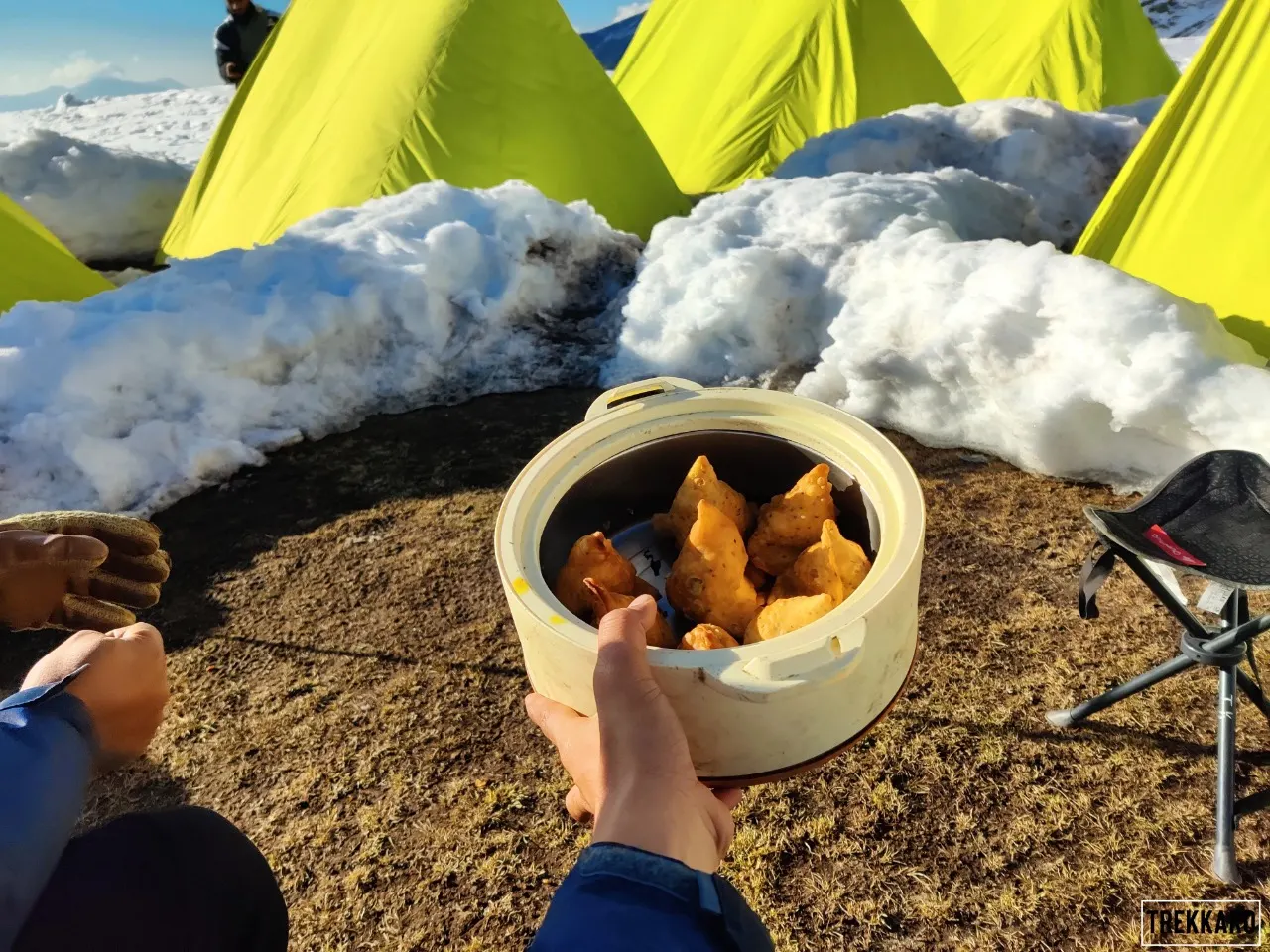
The Brahmatal trek serves simple, nutritious vegetarian meals, with eggs available on request at the campsite.
- On the trail: packed lunches, so carry a reusable lunch box
- Snacks: carry trail mix, energy bars, dates and electrolytes for the walk
On the Brahmatal trek, water at camp is boiled or treated with chlorine tablets, and you should refill only at sources approved by the trek leader.
- Bottles: two 1 L bottles, at least one insulated so the water does not freeze
- Electrolytes: carry ORS or electrolyte sachets
Yes, the Brahmatal trek includes Trekkaro’s Free Trekking Gear, so you do not need to buy or rent shoes, a jacket or poles.
- Included: waterproof trekking shoes with ankle support, a -10°C padded jacket and trekking poles
- Also free: microspikes and gaiters for snow and ice
- Deposit: one refundable deposit of ₹3,000 + ₹200 washing charge covers the whole kit
- Handover: at Lohajung on Day 1
Yes, backpack offloading on the Brahmatal trek costs ₹1,500 + 5% GST, with a porter or mule carrying your backpack.
- Book ahead: request it at least 15 days in advance
- Day pack: carry a 20–30 L day pack for water, snacks and personal items
No doctor joins the Brahmatal trek, but all trek leaders are trained in Wilderness First Aid and carry a full first-aid kit.
- Health checks: SpO2, pulse and blood pressure at Lohajung and again before summit day
- Your medicines: carry prescriptions, remedies for common ailments and any altitude medicine your doctor advises
- Fitness: make sure you are physically and medically fit before joining
For the Brahmatal trek you need a government photo ID, a medical fitness certificate, travel insurance and a disclaimer form.
- Photo ID: original plus a photocopy (Aadhaar card, passport, voter ID or driving licence)
- International trekkers: passport, required for forest entry permits and in case of medical evacuation
- Travel insurance: mandatory, with emergency evacuation cover
- Also carry: your Trekkaro booking confirmation and the disclaimer form with emergency contact details
Mobile signal on the Brahmatal trek is limited, there is no charging on the trail and cards are not accepted in the mountains, so carry enough cash from Rishikesh.
- Cash: small notes, for your share of the cab and personal expenses; ATMs are few in the hills
- Lohajung: signal and device charging are available back at the base
- Power: carry a power bank and spare camera batteries, and download an offline map
For the Brahmatal trek, pack for snow and sub-zero nights; Trekkaro also emails a full checklist after booking.
- Free Trekking Gear: shoes, padded jacket, poles, microspikes and gaiters are provided
- Clothes: 2 sets of thermals, 2 fleece or woollen layers, a waterproof shell, warm trousers and 3–4 pairs of socks
- Accessories: woollen cap, balaclava, buff, two pairs of gloves, UV sunglasses (category 3 or 4) and SPF 50+ sunscreen
- Essentials: headlamp, power bank, personal medicines and cash in small notes
To book the Brahmatal trek, select your date, fill in the booking form and pay online; your booking is confirmed instantly.
- Confirmation: booking details, the itinerary and the gear checklist are emailed to you
- Travel: book your travel as soon as the booking shows as Paid in My Bookings
Minor changes to the Brahmatal trek itinerary are possible, but the completion date must stay as scheduled.
If something unforeseen happens on the trail, your trek leader suggests a suitable alternative plan.
Yes, Trekkaro offers fully customisable private Brahmatal treks for a group of any size, at your own pace.
The price depends on group size, duration and the type of trek.
Terms & Conditions
1. Free Trekking Gear (FTG)
- Decathlon trekking shoes
- Decathlon jacket rated to -10°C
- Trekking poles, gaiters and microspikes
- No rental fee: ₹3,000 refundable deposit + ₹200 washing charge
2. Accommodation
- Day 1 and Day 5: guesthouse in Lohajung, on a triple-sharing basis
- Day 2 to Day 4: camping at Bekaltal and Brahmatal Base Camp, on a triple-sharing basis
3. Meals
- All meals from Day 1 dinner to Day 5 dinner: breakfast, lunch, evening snacks and dinner
4. Permits & Camping Fees
- Forest entry permits and all checkpost fees for the Brahmatal route, arranged by Trekkaro
5. Camping & Safety Equipment
- Double-wall, rain-rated tents and -20°C sleeping bags at every campsite
- Trekking mattresses or sleeping pads at every campsite
- SpO2, pulse and blood-pressure checks twice a day at every campsite
- Portable oxygen cylinder and emergency stretcher on every batch
- HF radio communication across the trek team
6. Trek Team
- Certified trek leader and guide for all 6 days
- Mountain kitchen staff, camp helpers, and mules or porters for the group equipment
- Trek completion certificate when you reach Brahmatal Top and return to Lohajung
1. Transport
- Not included: Rishikesh to Lohajung and back. A shared cab costs approximately ₹6,500 one way per 5–6 seat vehicle, split among the trekkers in it.
- Travel to and from Rishikesh (flights, trains or buses), arranged by you
2. Food During Transit
- Meals on the drive between Rishikesh and Lohajung
3. Backpack Offloading (optional)
- ₹1,500 + 5% GST for the entire trek
- Maximum weight: 9 kg; no suitcases, trolleys or duffel bags
- Charges may be higher for last-minute requests made at Lohajung
4. Single Tent Occupancy (optional)
- ₹2,000 + 5% GST per tent for the entire trek
5. Personal Equipment
- Your clothing, backpack, sunglasses and other personal gear (shoes, jacket, poles, gaiters and microspikes come with Free Trekking Gear)
6. Trek Insurance
- Travel insurance is mandatory and not included. It must cover high-altitude trekking and helicopter evacuation.
7. Anything Not Mentioned Under Inclusions
- Accommodation in Rishikesh before or after the trek
- Personal expenses such as tips, calls, laundry and extra snacks
- Costs from an early exit, evacuation, or an itinerary change due to weather or medical reasons
We know that cancelling a trek can be genuinely disappointing. Plans change, life intervenes, and sometimes the mountains have to wait. That is why Trekkaro has designed one of the most trekker-friendly cancellation policies in the industry — to reduce the financial impact on you and give you real options when things do not go as planned.
Important: Bookings made on trekkaro.com are cancelled online from My Bookings. Bookings made offline with our team must be cancelled in writing by e-mail by the person who originally booked the trek. Requests over the phone, via WhatsApp, or through third parties are not accepted.
How to Cancel Your Trek
Booked online on trekkaro.com:
- Log in and open My Bookings.
- Choose Cancel Booking on the trek you want to cancel.
- Pick a refund (as per the charges below) or Get TrekCash Voucher instead — the voucher is issued instantly and appears under My TrekCash Vouchers.
Booked offline with our team:
- Compose an e-mail from the registered e-mail ID used at the time of booking.
- Attach a copy of your tax invoice to the e-mail.
- Send both to info@trekkaro.com.
- Your cancellation is effective from the date Trekkaro receives and acknowledges your e-mail.
How to Reschedule Your Trek (Free)
- Once per booking, to another batch of the same trek, free of charge. A request we decline doesn’t count.
- Up to 8 days before departure, also in the 8–14-day window when there is no cash refund. The new batch must start at least 7 days after the day you ask.
- Subject to seat availability for every trekker on the booking.
- Not available for bookings paid fully or partly with a TrekCash Voucher.
- No fee or price difference; add-ons and the number of trekkers stay as booked.
Booked online: My Bookings → Reschedule free → pick a batch. Our team confirms by e-mail and your booking moves once approved. Booked offline: e-mail info@trekkaro.com.
How to Transfer Your Booking
You can give your booking to another trekker up to 8 days before departure. E-mail info@trekkaro.com from your registered e-mail ID with your booking ID and the new trekker’s name, age, phone number and ID proof. The new trekker must meet the fitness, age and document rules of the trek. We confirm the transfer by e-mail.
Cancellation Charges
| When you cancel | Cash refund | Other options |
|---|---|---|
| 30 days or more before departure | 70% refund (30% cancellation charge) | Or instead: a 100% TrekCash Voucher (valid 1 year), a free reschedule or a transfer |
| 15 to 29 days before departure | 50% refund (50% cancellation charge) | Or instead: a 100% TrekCash Voucher (valid 1 year), a free reschedule or a transfer |
| 8 to 14 days before departure | No cash refund of the trek fee | You can take a 100% TrekCash Voucher (valid 1 year), a free reschedule (once per booking) or a transfer to another trekker |
| 7 days or less before departure, or no-show | No refund of the trek fee | None: no voucher, reschedule or transfer |
A 100% voucher instead of a refund. From the day you book until 8 days before departure, you can take a TrekCash Voucher worth 100% of the amount paid, valid for 1 year on any Trekkaro trek. This works in every slab above, including 8–14 days, when there is no cash refund. Online bookings take the voucher from My Bookings → Cancel Booking (issued instantly). Offline bookings ask for it by e-mail to info@trekkaro.com.
If you paid the FTG security deposit and the washing charge, both are refunded in full when you cancel before the trek starts, in every slab.
Cancellation of Voucher-Based Bookings
- The standard cancellation policy applies to voucher-based bookings in the same way it applies to direct bookings.
- Any remaining balance after the applicable cancellation charge has been deducted will be credited back to your Trekkaro account as a new voucher.
- If your voucher has already expired at the time of cancellation, no refund, credit, or extension will be issued under any circumstance.
- If a voucher is set to expire on a Sunday or public holiday, it must be redeemed before the expiry date.
Additional Terms
- Free Rescheduling: Switching to a different batch of the same trek is free of charge once per booking, up to 8 days before departure, subject to seat availability. Not available for bookings paid with a TrekCash Voucher. See “How to Reschedule Your Trek” above.
- Trek Transfers: You can transfer your booking to another person up to 8 days before departure, by e-mail. The new trekker must meet the fitness, age and document rules of that trek. See “How to Transfer Your Booking” above.
- No Refund Post-Commencement: Once the trek has commenced from Day 1 of your confirmed itinerary, no refunds or TrekCash Vouchers will be issued for any reason, including early exit, illness, or dissatisfaction with services.
- Policy Changes: Trekkaro reserves the right to amend or withdraw this cancellation policy at any time without prior notice. The version in effect at the time of your booking confirmation governs your booking.
Early Exit or Removal from Trek
A trekker may be required to leave the trek before completion for health concerns (AMS, hypertension, cardiac symptoms, or fitness that poses a safety risk), rule violations (alcohol or non-prescribed drugs on trail, smoking in prohibited zones, reckless behaviour, or misconduct), or by their own decision. In all cases of early exit or removal, no refund, partial refund, or TrekCash Voucher will be provided, and any additional transport or exit expenses are the trekker's responsibility. The trek leader's decision on health and safety grounds is final.
If Trekkaro Cancels Your Trek
In rare circumstances beyond our control — natural disasters (extreme snowfall, avalanche, floods, landslides, earthquakes) or unforeseen civil events (government curfews, lockdowns, political unrest) — Trekkaro will issue a TrekCash Voucher for the full trek fee paid, valid for 12 months on any trek listed on Trekkaro.com. If the new trek costs more, the difference is payable by the trekker. The voucher is sent to your registered e-mail within 10 working days and may be transferred to another person who meets Trekkaro's eligibility requirements.
Refund Processing
Refunds are processed within 10 working days of cancellation approval and credited to the original payment method only (credit card, debit card, net banking, UPI, or wallet). Your bank may take another 3–5 business days. Office hours: Monday to Saturday, 10:00 AM to 7:00 PM IST.
The full policy is part of our Terms & Conditions (Section 09).
Gallery
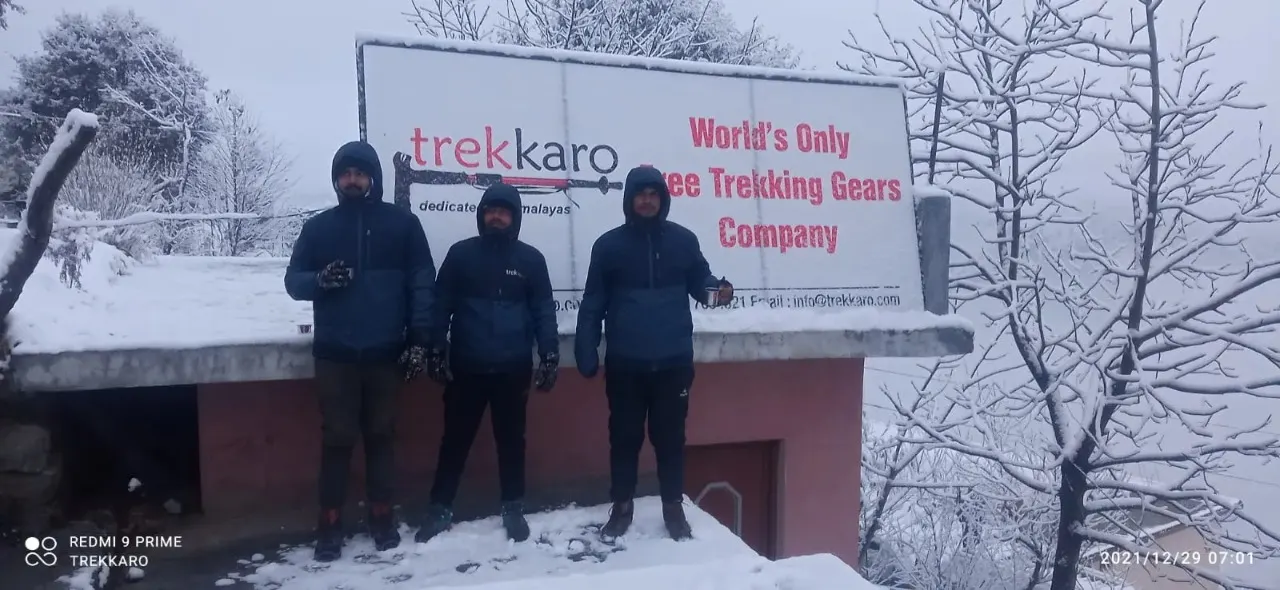
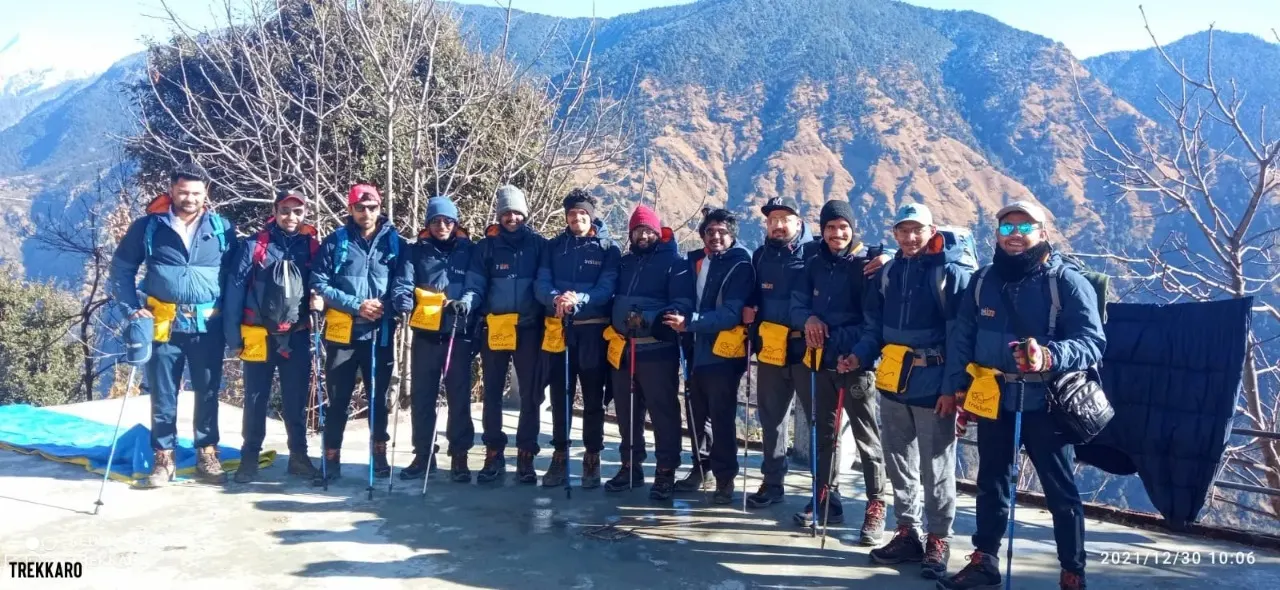
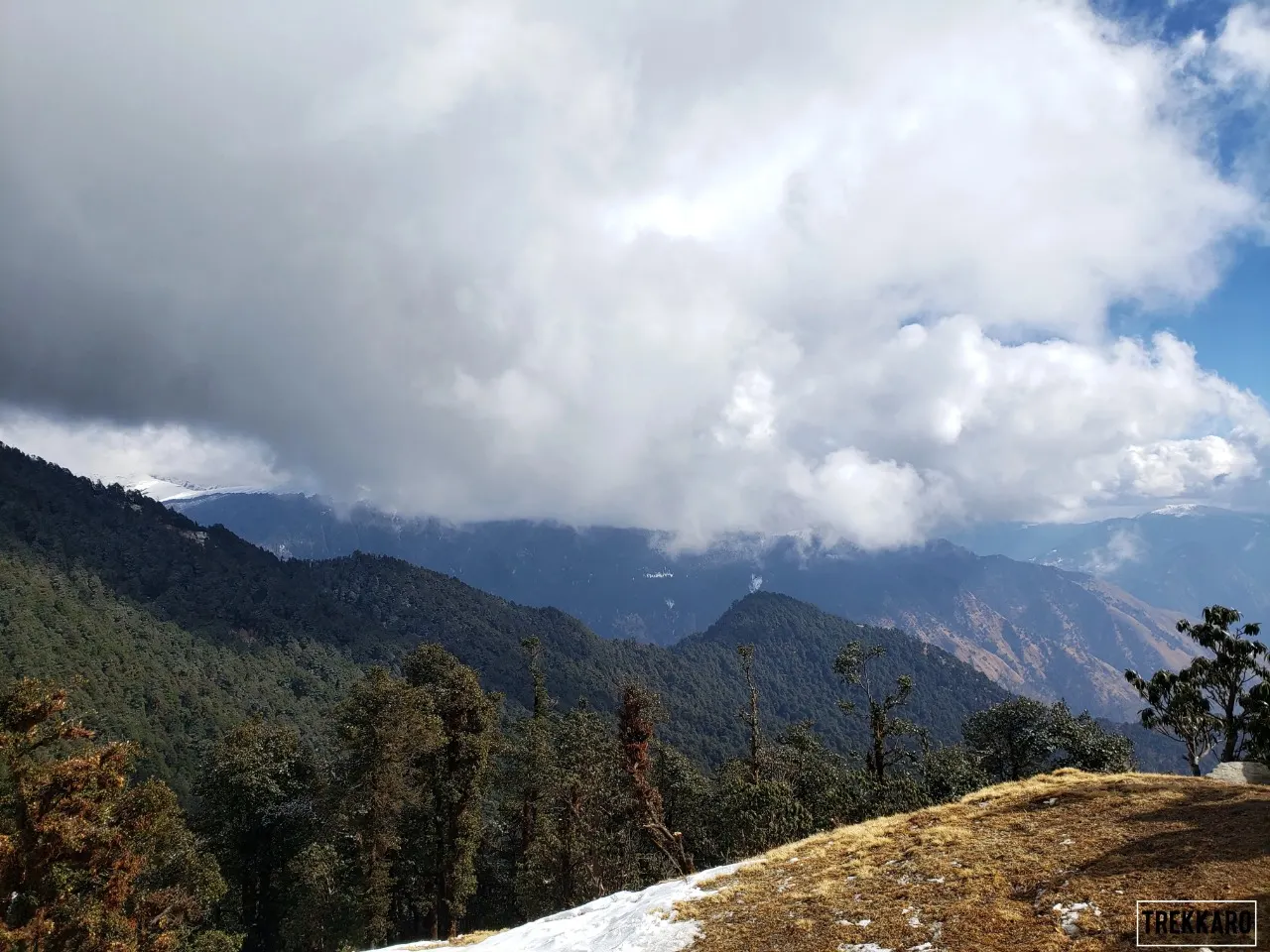
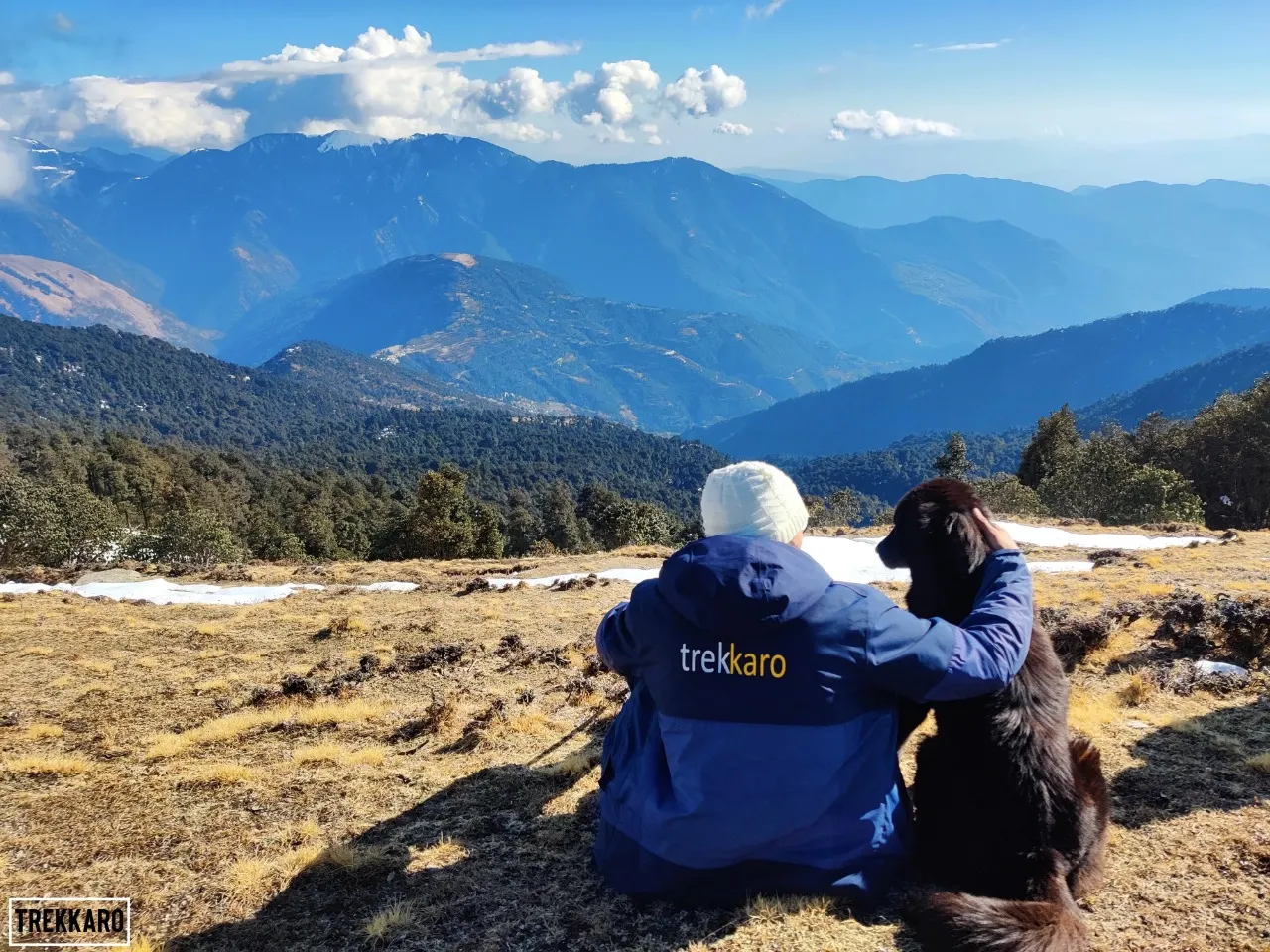




Oxygen, first aid, daily SpO₂ checks, trained leaders — tap to read
1. Trained Trek Leaders
- Trek leaders hold NIM (Nehru Institute of Mountaineering) certification or an equivalent qualification
- Their training covers casualty assessment, high-altitude medical response, rope work and evacuation
2. Daily Health Checks
- Blood oxygen (SpO2) and pulse are checked for every trekker every day
- A falling SpO2 reading is acted on early, before it turns into Acute Mountain Sickness (AMS)
- If you are not fit to continue, the trek leader will ask you to rest or descend; the trek leader’s decision on health and safety is final
3. Emergency Equipment
- Portable oxygen cylinders carried with the group
- First-aid and medical kit with the trek team
- Stretchers at every campsite for emergency evacuation
- Radio communication across the trek team, as mobile signal is not reliable on the trail
4. Proper Trekking Gear
- Free Trekking Gear, with no rental fee: Decathlon trekking shoes with good grip, a jacket rated to -10°C, trekking poles, gaiters and microspikes
- No one walks in worn-out or wrong gear, the cause of many slips and cold injuries
5. Tents and Sleeping Bags
- Sleeping bags rated to -20°C, and tents shared by three trekkers, with men and women in separate tents
6. Snow and Steep Sections
- On snow, ice or exposed ground, the trek team fixes ropes and cuts steps where needed and helps you across
7. Risks on the Brahmatal Trek
- Highest point: 3,734 m (12,250 ft)
- A steep snow ascent to the Jhandi Top ridge (about 3,600 m) in winter
- Summit day starts at 5:30 AM on a compacted snow slope
- Day 5 is the longest day, about 10 km in 7–8 hours
8. Your Part
- Build your fitness before the trek with running, cycling or swimming
- Tell the trek leader about any medical condition and the medicines you carry before Day 1
- Report a headache, nausea, dizziness or breathlessness to the trek leader at once
- Carry travel insurance that covers high-altitude trekking and emergency evacuation
What a day on the trek feels like — tap to read
1. What You Can Expect From Us
- Safety first on the Brahmatal trek: daily SpO2 and pulse checks, oxygen cylinders and a stretcher with the group
- Personal attention: batches of up to 20 trekkers, so the trek leader knows each trekker’s health and pace
- NIM-certified trek leaders (Nehru Institute of Mountaineering, or an equivalent qualification), with local guides who know the Brahmatal route, its weather and its campsites
- An itinerary planned for altitude, with daily distance and height gain set so your body can adjust
- Clear pricing: everything included and excluded is listed under Terms & Conditions, with the price of each optional add-on
2. What We Expect From You
- A willing attitude: cold nights, steep climbs and sudden weather changes are part of the mountains
- Physical preparation: you do not need to be an athlete, but train before the trek so the longest day feels comfortable
- Trust in your trek leader: follow their calls on route, pace, start times and turning back, as they are made for the group’s safety
Last ATM and phone network on the route — tap to read
1. Last ATM
- Dewal has the last reliable ATM before Lohajung
- Carry enough cash from Rishikesh
- Carry small notes: cards are not accepted on the trail
2. Mobile Network
- Lohajung is the last place with a stable mobile signal
- Beyond Lohajung the network is patchy to non-existent
- Make your important calls and tell your family about the limited connectivity before you leave the base
Route Map & Altitude Profile
Follow the Brahmatal Trek route on the map: from Lohajung (2,316 m) to Brahmatal Top (3,734 m), about 1,418 m of climbing. Press Walk the trail and follow the hiker camp to camp, or tap a day to jump to its camp.
Satellite imagery with a topographic map option. The trail is drawn from mapped footpaths and the Trekkaro route (199 points); it is for orientation, not a navigation map. Your trek leader walks the trail with you.
Camps and altitudes on the Brahmatal Trek
- Day 1 Lohajung · 2,316 m / 7,598 ft Base — Base village; guesthouse night
- Day 2 Bekaltal · 2,798 m / 9,180 ft Camp — Forest camp by the small lake
- Day 3 Brahmatal Lake (base camp) · 3,106 m / 10,190 ft Lake — Camp near the frozen lake
- Day 4 Brahmatal Top · 3,734 m / 12,251 ft Summit — Summit; views of Trishul and Nanda Ghunti
- Day 4 Brahmatal Base Camp (return) · 3,106 m / 10,190 ft Camp — Back to camp
- Day 5 Lohajung (trek end) · 2,316 m / 7,598 ft Base — Descent and drive to Rishikesh
Related Treks You May Like
Brahmatal Trek Guides

What Trekkers Say About Trekkaro
Reviews left on trekkaro.com by trekkers across our treks.
"Winter Kuari Pass trek with the team of Trekkaro. Food was amazing for breakfast, lunch and diner. Views on top and during the track are amazing. Trek in total was completely amazing. Big thanks to all of hard work from trek leader, superhuman cooks, the mule team, our driver."
"I have trek with Trekkaro for kuari pass and it was an amazing experience ,food was excellent and experience trek trainer."
"Trekkaro was simply amazing from the guidance to food to stay everything was very good!!! Local guides and trek leaders where always motivating, fun and made sure entire group had always been together and interacted with each other!!!"
"Had an amazing experience! Thanks for making this an amazing experience - Trekkaro Team"
"Trekkaro has a amazing team capable of leading anyone over a trek. Had an amazing experience!"
"Very amazing experience with Kedartal trek. Awesome views, Trek leaders and coordinators were very helpful."
Why Trekkaro?
Leaders in providing Free Trekking Gear for 8+ years — redefining the way everyone must trek.

World's first free trekking gear company — Decathlon trekking shoes, -10°C jacket, trekking poles, gaiters & microspikes. ₹3,000 refundable deposit + ₹200 washing charge.

Up to 8 days before departure, reschedule to another batch for free or take a TrekCash Voucher worth 100% of your amount — valid for 1 year on any future trek.

Rated 4.9/5 on Facebook & 4.7/5 on Google by trekkers who trekked with us.

We keep you safe from the moment you book to the moment you head home — certified leaders, first aid & emergency support.

Well-planned itineraries balanced with the freedom to make the experience your own — no matter the trek difficulty.

Every decision we make is guided by our commitment to making trekking a force for good — for people and the planet.
Welcome to Trekkaro
Login or create an account to manage your bookings and profile
Login Create AccountTalk to an Expert
Enter your number — we'll call you back shortly.
*Free to use on the trek, returned after · refundable deposit
AI can make mistakes · don’t share personal details · Talk to a person