This guide is about the Brahmatal Trek — dates, price, day-by-day itinerary and booking are on the trek page.
Quick answer: Yes. The Brahmatal trek is safe for a fit trekker who follows the trek leader. The real risks are altitude (the top is 3,734 m), steep snow on Jhandi Top and base camp nights down to -15°C. Every batch has SpO2 checks twice a day, an oxygen cylinder, a stretcher and radios.
What are the real risks on the Brahmatal trek?
The Brahmatal Trek is a 6-day, Easy to Moderate trek from Lohajung in Chamoli, about 29 km on foot, with no technical climbing. Trekkaro runs it from October to March, and December to February is the snow season. Trekkaro recommends these three months above the others, and they are also when each risk below is at its highest.
| Risk | Where and when | What Trekkaro does about it |
|---|---|---|
| Altitude | Base camp at 3,106 m (two nights) and the top at 3,734 m | A health baseline in Lohajung, checks twice a day at every campsite, a go/no-go check before summit day |
| Steep snow | The Day 3 climb to Jhandi Top, the Day 4 summit slope, the Day 5 return over Jhandi Top | Microspikes and gaiters free with the trek, worn from Bekaltal upward |
| Cold | Base camp nights of -15°C to -5°C from December to February | -20°C sleeping bags, a -10°C jacket in the Free Trekking Gear, hot water at every camp |
| Distance from help | Lohajung, the road head, is 8 to 10 hours by road from Rishikesh | Oxygen, a stretcher and HF radios with every batch; insurance with helicopter evacuation is mandatory |
Is altitude sickness a risk on Brahmatal?
Yes, because the trek climbs to 3,734 m (12,250 ft). The highest place you sleep is base camp at 3,106 m (10,190 ft). This is how the height builds up.
| Day | Where you go | Height gain | Where you sleep |
|---|---|---|---|
| 1 | Rishikesh to Lohajung by road | Drive | Lohajung, 2,316 m |
| 2 | Lohajung to Bekaltal, 6 km | About 480 m up | Bekaltal, 2,798 m |
| 3 | Bekaltal over Jhandi Top (about 3,600 m) to base camp, 7 km | About 800 m up, then about 490 m down | Base camp, 3,106 m |
| 4 | Base camp to Brahmatal Top and back, 6 km | About 630 m up and down | Base camp, 3,106 m |
| 5 | Base camp over Jhandi Top to Lohajung, 10 km | About 490 m up, then about 1,280 m down | Lohajung, 2,316 m |
| 6 | Lohajung to Rishikesh by road | Drive | Home |
Day 3 is the day to watch. It has the steepest climb of the route, about 800 m up to Jhandi Top. That is the 800 to 1,000 m that the Uttarakhand health department's yatra health advisory sets as the most height to gain in a day, though you then drop about 490 m, so you sleep only about 310 m higher than the night before. The same advisory asks you to rest 5 to 10 minutes in every hour of walking, to seek help at once for chest pain, shortness of breath, a persistent cough, dizziness or vomiting, and to descend if you feel unwell rather than go higher.
The Day 1 briefing in Lohajung covers altitude sickness for the heights of Days 3 and 4. Tell your trek leader about any headache, nausea or poor sleep early, and ask your doctor about altitude medicine before you go and carry your own. Our altitude sickness guide explains the symptoms in detail.
Who checks your health on Brahmatal, and what kit goes with the batch?
The checks start before you walk. On Day 1 the team records your SpO2, pulse and blood pressure in Lohajung as a baseline, and then checks them twice a day at every campsite. The evening check at base camp on Day 3 is the critical one: it decides who goes up on Day 4.
Trek leaders are trained in wilderness first aid and lead with local guides who know the route and the campsites. A batch takes up to 20 trekkers, with one trek leader or guide for every 8. Each batch carries a portable oxygen cylinder, a first-aid kit and an emergency stretcher, and the team talks by HF radio across the trek. No doctor joins the trek, which is why your own medical certificate and insurance matter.
Which three stretches on Brahmatal need the most care?
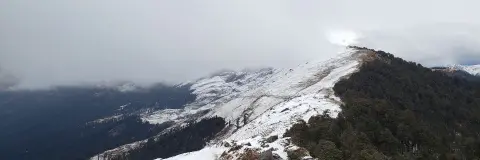
From December to February the snow on the trail is 2 to 4 feet deep, and it is deepest at Tilandi, above Bekaltal, in late January. Both lakes on the route, Bekaltal and Brahmatal, are fully frozen in these months. Three stretches need the most care.
- The Day 3 climb from Bekaltal to Jhandi Top, the steepest on the route, is a snow climb in winter. Microspikes go on at Bekaltal camp.
- The Day 4 summit climb starts before dawn, on a steep, compacted snow slope. Microspikes go on from the first step out of base camp. Groups stay 30 to 45 minutes at the top before walking back down.
- On Day 5 you cross Jhandi Top again, then descend about 1,280 m to Lohajung, a long day of 7 to 8 hours.
Microspikes and gaiters are free with the trek, as part of the Free Trekking Gear. Our Brahmatal difficulty guide covers how to train for these days.
How cold are Lohajung, Bekaltal and base camp?
From December to February, Lohajung runs from -2°C to 8°C, Bekaltal camp nights from -10°C to -3°C and base camp from -15°C to -5°C; the coldest base camp night the team has recorded is -15°C. In November and March base camp is milder, at -8°C to 0°C.
Tents are shared by three trekkers, with men and women in separate tents, and the sleeping bags are rated to -20°C. The Free Trekking Gear adds Decathlon trekking shoes, a -10°C jacket, trekking poles, gaiters and microspikes, against a ₹3,000 refundable deposit and a ₹200 washing charge plus GST. Bring your own thermals and warm layers. Hot water is available at every camp, so carry a reusable bottle. Our guide to hypothermia on winter treks lists the warning signs.
If you fall ill on Brahmatal, how do you get down, and to which hospital?
If a trekker cannot walk, the staff carry them on the stretcher down to Lohajung and on to the nearest hospital. The nearest public medical facility is the primary health centre at Dewal, on the drive to Lohajung. Beyond it are the community health centre at Tharali, the sub-district hospital at Karnaprayag and the district hospital at Gopeshwar.
Lohajung is the last place with a stable mobile signal, so on the trail the team relies on its radios. Rishikesh is 8 to 10 hours away by road, which is why travel insurance that covers high-altitude trekking and helicopter evacuation is mandatory. It is not included in the fee. Costs from an early exit, an evacuation, or a change of plan for weather or medical reasons are also not included, and helicopter and hospital bills fall to your insurer.
Is Brahmatal safe for women, children and older trekkers?
For women trekking alone, female trekkers share tents only with other women, and the guides and support staff are carefully selected. The minimum age is 7, and trekkers under 18 come with a parent or guardian. There is no upper age limit, but trekkers above 60 need good fitness, and Trekkaro recommends an ECG or TMT report for them.
Every trekker brings a medical certificate signed by a doctor (the form is in My Bookings). If you have any medical history, such as a heart condition, high blood pressure, asthma or diabetes, the state advisory asks you to get a health check-up before the trip and to carry your prescribed medicines.
Which four mistakes do Trekkaro's trek leaders see on Brahmatal?
Avoid these four.
- When mules pass, step to the mountain side, never to the valley side.
- Keep your cap and gloves on at Jhandi Top and Brahmatal Top, even for photos.
- Leave plastic bottles at home; fill a reusable bottle with hot water at camp and keep drinking.
- Do not smoke on the trek.
Above all, report any symptom at the health check instead of hiding it to reach the top.
The trail is busiest in the last part of December, the Christmas and New Year weeks, so expect more groups on the trail then. Before you leave home, check the forecast and district warnings for Chamoli on the India Meteorological Department's Dehradun centre, because hill weather changes from week to week.
What does the trek cost?
The fee for the Brahmatal Trek is ₹9,000 per person plus 5% GST (₹9,450 with GST). EMI starts at ₹463 a month. It covers stay, pure vegetarian meals, permits, the safety kit above and the Free Trekking Gear. Transport is not included: we help the group book shared cabs from Rishikesh to Lohajung, about 250 km, at ₹6,500 one way per 5 to 6 seat vehicle, paid directly to the driver and split among trekkers, which is ₹1,083 each, one way, when six share. Bags you do not need stay free of charge in Trekkaro's store in Lohajung; valuables stay with you. Dewal has the last reliable ATM, and cards are not accepted on the trail.
See Brahmatal Trek dates and book | Brahmatal difficulty | Brahmatal weather
Frequently asked questions
Is the Brahmatal trek safe for beginners?
Yes, for a fit beginner. It is graded Easy to Moderate with no technical climbing, and the trek leaders check your health twice a day. Train before you go, because Days 3 and 4 are steep snow climbs.
Is the Brahmatal trek safe in winter?
Yes, with the right kit. From December to February the trail has deep snow and base camp nights reach -15°C, so microspikes, gaiters, -20°C sleeping bags and warm layers are essential.
Is there a doctor on the Brahmatal trek?
No, a doctor does not join the trek. Trek leaders are trained in wilderness first aid, and every batch carries an oxygen cylinder, a first-aid kit and a stretcher.
Where is the nearest hospital to the Brahmatal trek?
The nearest public medical facility is the primary health centre at Dewal, below Lohajung. Larger facilities are the community health centre at Tharali, the sub-district hospital at Karnaprayag and the district hospital at Gopeshwar.
Is the Brahmatal trek safe for solo women?
Yes. Female trekkers share tents only with other women, and the guides and support staff are carefully selected. Batches take up to 20 trekkers with one leader or guide for every 8.